SODG Story Edits Finished

Click to see edits

Wahooooooo!

I just turned in my final story edits to Stacy and David. The due date was November 1. The 3rd actually. The book clocks in around 177,000 words.

Wow. This last set of story edits led to some great changes. Not huge ones, but nice touches. I had to rewrite part of this battle scene, and man, oh, man I’m totally geeking out about it. We’ll see how it plays with readers.

What’s been interesting is seeing the types of things Stacy and David have commented on in the text. It’s as if they went through asking simple logic questions. Did they have enough time actually to do this? It makes no sense that person y wasn’t there. This thing isn’t fully explained.

And sure enough, the logic gaps were there.

So it wasn’t the interest level of the story they seemed to be editing for as much as the details that lead to clarity and belief. Of course, that those two things must be present for the interest to come. And this is not to say they didn’t focus on parts where interest flagged. There was one comment that forced me to cut my favorite dawg scene, a whole chapter’s worth. But the bulk of the comments were focused on the “logic” of the story.

Anyway, as of next Monday I think I’m officially into production. And back to book 2, which I’m 25,000 words into.

Share

Similar Posts

  • NEWS: The Man is going all indie for the next little while

    After discussions with my agent and a few others, I’ve decided NOT to shop BAD PENNY to New York publishers. In fact, I’ve decided I’m not going to be shopping anything to NY for the next 12 – 18 months.

    My agent was certainly willing to take the property out, but given the average expected advance for thrillers ($15-20k per book; maybe up to $100k for three books) and the terms that NY currently wants, I thought that it might be worth it to try to build something on my own.

    I do not hold the illusions some do about indie publishing (I probably hold others). For example, I know quite a few authors who have published indie and are selling very low numbers each month–single digits and teens. Of course, I know others, a smaller portion, who are selling just fine.

    But then what’s the bar? How many copies do I have to sell on my own over a three to five year period to match what NY can do for me via brick and mortar?

    Let’s look at that from a revenue and a unit perspective.

    The average advance for a fantasy, according to Tobias Buckell’s survey, is about $7,000 for a new author. $12,000 for an established author. We saw the numbers I gathered for thrillers above.

    So lets see how many copies I’d have to sell indie style to earn as much as I’d get in an advance from New York.  Why not select a higher number? Well, my understanding is that most books don’t earn out their advance. That doesn’t mean the publisher doesn’t make money; just that a publisher’s profit isn’t dependent on an author earning out.

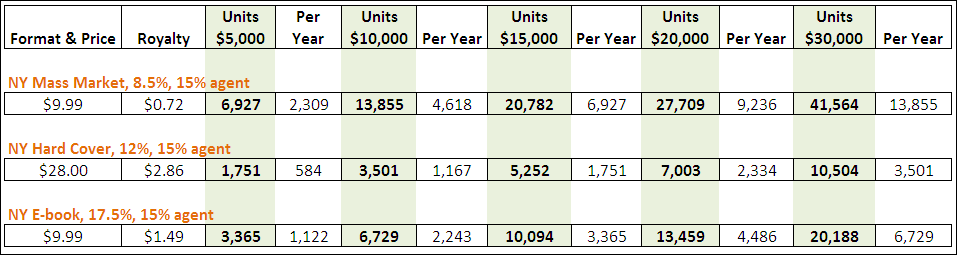
    So what are the numbers? Well, here are the numbers for NY. Down the first column you’ll see the different formats. Across the rows you’ll see how many units I’d have to sell to make the advance specified at the top. And how many units I’d have to sell if I wanted to spread the total over three years.
    IndieNYComparisonNYNumbers

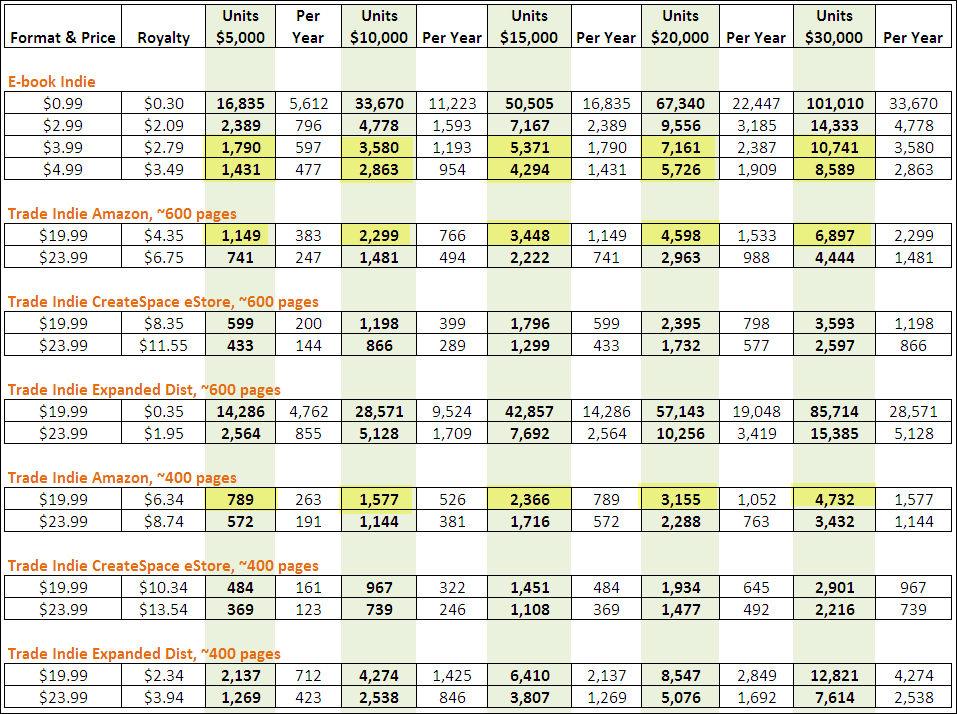
    Okay, and here’s what I’d have to sell if I went indie to make the same numbers. I put in the trade paperback format for both 600 and 400 pages because that’s about how big SERVANT and BAD PENNY are going to be.
    IndieNYComparisonIndieNumbers


    What does this tell me?

    It tells me I have to sell a heck of a lot more units with NY at a much higher price than I do indie.  It tells me that a $5,000 advance is not even close to being worth the control I lose with NY.  And if it’s true that most books don’t earn out, then it tells me the units that are being sold by NY on the average book.

    Back in 2009 I shared this: How Many Copies Do Average Authors Sell? This was from an editor at Tor Books. Seems like my numbers are in the ball park.

    It’s true that NY could get me into brick and mortar stores. But if the book gets shelved spine out in the back, how many people will discover it?

    It’s true that NY produces some spectacular hits. I looked at the USA Today bestseller list yesterday and it appears only about 10% of the books there this week are indies. But I can’t bank on becoming a NY wonder. The vast majority of NY published books DON’T make the bestseller lists.

    Finally, even if I sold BAD PENNY today, it still wouldn’t hit shelves for probably 12-18 months from now. And then it would only stay on the shelves for 12-18 weeks. Going indie, I will have it up by September. And it will stay. For years and years and years.

    There’s no guarantee of success either way. But the indie numbers look good to me. We’ll see how it goes.

    Share
  • New business cards

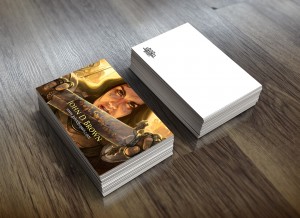
    Devon Dorrity, who helped me put together my covers, just helped me put together some business cards. I’m pretty excited about them. I’m biased, but I think they look awesome.

    Servant

    John-Brown-Servant-Business-Card

    Curse

    John-Brown-Curse-Business-Card

    Raveler

    John-Brown-Raveler-Business-Card-Front

    You can see here a mockup of how they’ll look. That bit on the back is the Blacksword Books logo.

    John-Brown-Raveler-Business-Card-Mockup

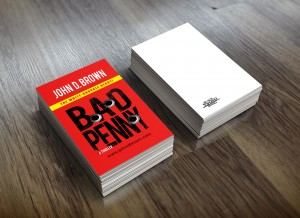
    I’m not sure about the one for Bad Penny. Devon liked it. Any opinions?

    John-Brown-Bad-Penny-Business-Card-Mockup

    Share
  • Servant of a Dark God: Coming October 13, 2009

    Tor Books’ production department has moved my book’s release date out one month. I’m getting so antsy to have it hit the stores, but October’s actually a better month, it being closer to the holiday season.

    You still might be able to get it earlier if you pre-order. The books actually start shipping in the second half of September. But it takes a few weeks to get them out to all the stores.

    Share
  • Vote for Servant of a Dark God, American Idol Style

    The Legend Award

    I was informed today that Servant of a Dark God is on the Longlist for the David Gemmell Legend Award for Fantasy and the Morningstar Award for best fantasy debut. I believe this means the Rapture is close at hand, folks. Or maybe it just means Cthulhu has taken over the North Pole. In either event, Hunger, Sugar, Talen, Hogan, Nettle, Legs, River, the Mother (and the kick butt Hag’s Teeth) can win an award for general awesomeness. They can because voting is open to the public.

    Kind of Like American Idol

    You may ask: Is this like getting the Nobel peace prize? No. You have to have actually done something like take out a group of speedy Somali pirates or write a fantasy novel. These awards are not given out as scratch away prizes at McDonalds (you can get them at Wendy’s). This is an award given to:

    • A full length novel published for the first time in the English language during the year of nomination (2009)
    • Traditional, Heroic, Epic, or High Fantasy and/or in the spirit of David Gemmell’s own work

    The nominees were submitted by editors working within a commercial genre fiction publisher (kind of like Hollywood week at American Idol). All the nominations are then put on the award’s Longlist.  The public then votes for their favorite on the list. The poll opened December 26, 2009. Voting on the Longlist will close March 31, 2010. You’ll notice it is indeed a looong list. But you don’t have to have read all the novels. You just vote.

    The top 5 novels with the most votes will be put on the award “Shortlist.” Then in April the public voting for the winner out of those five will begin, open to all.  See, American Idol, except you can’t vote two gajillion times for the same girl/guy just because of the her/his drool inducing factor. 

    How to Vote

    1. View the list of Legend nominees here: http://gemmellaward.ning.com/page/legend-1
    2. Cast your vote by hovering over the Legend menu item as shown below; you’ll see a red Vote link; click it and select the book you want to vote forGemmellLegendAwardVoting
    3. View the list of Morningstar nominees here: http://gemmellaward.com/page/morningstar-1
    4. Cast your vote by hovering over the Morningstar menu item and clicking the red Vote link.

    Who is David Gemmell?

    David Gemmell was a British writer of heroic fantasy. I’ve pasted two of his covers below. You can read more about him here.


    For those of you interested in LDS authors, nominate SERVANT for the Whitney

    Now that you’ve done your part to restore world order in the fantasy genre, if you’re interested in LDS authors/fiction, you can also nominate the Sugar, Talen, Hunger and the gang for The Whitney Award.

    This is an award for novels by LDS authors. It works in the opposite way of the Legend award. In this one, the public nominates novels by LDS authors they like. Then a “panel of industry professionals, including authors, publishers, bookstore owners, distributors, critics, and others” vote on the nominations. Of course, because I’m one of those Carrier Monkeys of Evil Mormons (a future post, folks), Servant of a Dark God is eligible.

    To nominate Servant of a Dark God go here: http://www.whitneyawards.com/nominations.php 

    Whew.  Be happy. I’ll keep you updated to let you know if SERVANT makes the short list for either of these.

    Share
  • Awful Intent: sheep block busted

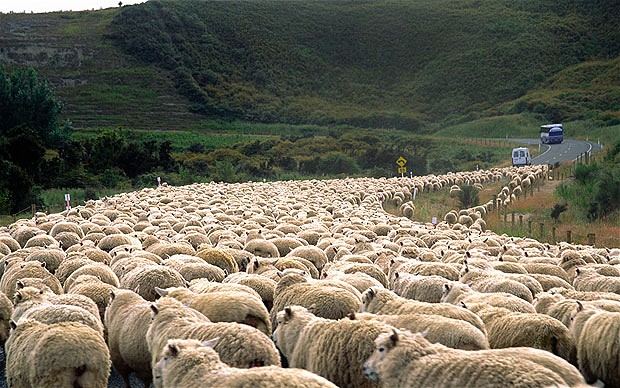
    SheepOnTheRoadSometimes the writing flows. And sometimes you get to the chapter you’ve sketched and realize you’re stuck until you get the sheep off the road.

    You had no idea they were going to be there, but there they are, bringing you to a halt.

    For me, this means I have got to do a lot more thinking to make the scene work realistically. Or work at all.

    That was chapter 13.

    It stopped me dead in my tracks. Some folks say to write on, get the first draft done, but that isn’t how my brain works.

    Besides, I tried that strategy with my first draft of Curse. I ignored the little Spideysense warnings I had about a fundamental situation and wrote on. I ended up with a big old honking manuscript that had to be rewritten from almost the beginning because everything from about 1/3rd the way through had taken the wrong trajectory. So instead of taking 10 hours to figure it out and fix it, I spent 300-400 rewriting.

    That’s called stupid writing.

    So for the last ten writing sessions I was researching and thinking and researching. And when I finally had a sketch based on how things actually work, I went back into flow and wrote the chapter without much trouble at all.

    Huzzah.

    Chapter 14 looks like it will be quick and easy. Some sneaking, some fighting, and a big discovery of a plot turn.

    Share
  • New series on writing coming next week

    I believe that there are three things you need to know to write stories. The better you know them, the better and more stories you’ll be able to write. Those three things are:

    1. What stories do, i.e. what you’re trying to do as an author.

    2. The principles of how character, setting, problem, plot, and text work to do those things.

    3. The principles of coming up with and developing stories.

    About this time last year I wrote my series on the key conditions for creating reader suspense, which went into depth on things 1 and 2. And I’ve written a bunch of other blogs on those topics. This year I’m going to be doing one on the key principles of getting and developing killer story ideas. I’ll be presenting it in a shortened form at this year’s League of Utah Writer’s roundup on Saturday (see my calendar for more details). One neat thing about this series is that I will have a number of other authors illustrate the principles with their own work. When learning this type of stuff, I don’t think we can’t get enough concrete examples. Keep your eyes open. I think it’s going to be a good one.

    Share