Similar Posts
Is Product Popularity Random?
In Why Publishing is Making You Crazy—and What You Can Do About It: The Tao of Publishing, Steven Axelrod and Julie Anne Long write an interesting post that takes some findings made by Duncan Watts and attempts to explain why writers should only focus on the quality of their work because they cannot reliably affect popularity in any other way.
I agree with them that social-influence seems like a good explanation for the sometimes unexplicable successes we see in publishing and the difficulty publishers have in both predicting and producing a steady stream of hits. However, I do not find support for their main conclusion that writers can do nothing but write. In fact, I suggest that Watts’ findings show quite the opposite.
Axelrod and Long base much of their argument on an experiment conducted by Duncan Watts that tested the power of social-influence on music selection in some controlled music websites. Watts summarizes his findings in the excellent Is Justin Timberlake a Product of Cumulative Advantage?.
In his part of the post, Axelrod points out that the Watts findings indicate “50% of the factors affecting your career could be totally outside of your control—totally random” and that “unless we can separate out those random factors which contributed to an author’s past success [and we can’t, Axelrod suggests], anything we can say or predict about why she succeeded will invariably be way off-the-mark.” And therefore “what’s interesting—and chilling, as well—is that there’s evidence that the harder a person works to make sense of a random event, the farther they’ll end up from the truth.”
In other words, the only thing an author can reliably do to improve the popularity of his stories is focus on their instrinsic quality. And get more stories out so he has more shots in the fickle social-influence game.
I agree that having more product in the market increases your odds. I also agree that focusing on the intrinsic quality of the writing can do the same. I even agree that this is where authors should spend most of their time. However, Watts’ studies do not indicate other efforts are wasted. In fact, they suggest the opposite.
Watts does not controvert anything we now know about marketing. What he does is clarify the power of social-influence in our decision making and the dynamics of ONE type of endorsement system. What Watts shows is:
- A perceived non-bias endorsement of your product can have a huge effect in the product’s popularity.
- The intrinsic quality of the product has an effect on popularity, but social-influence plays as large or larger role.
- Popularity in the system set up in the test websites depended on the decisions of a few early-arriving potential endorsers, i.e. good early reviews (downloads in this case) are amplified and lead to an effect he calls “the richer getting richer.”
- In this one endorsement system, neither a future endorsement nor the identity of the early endorser can be predicted.
These findings, however, need to be put in context. From cars, to camcorders, to recipes, the popularity of a product depends on three main factors. These aren’t new ideas and publishing is no different than any other industry. The factors come from long-standing marketing practice:
- Visibility (people know about it)
- Endorsement (recommendation from an attractive person, trusted authority or friend, or trusted system like the perceived unbiased reviews on Amazon or “most downloads” stats)
- Attractiveness (intrinsic to the product, the perceived value offered the target market, and the social effect as pointed out by Watts)
Each of these three affects the other two. Visibility makes endorsements and initial attractiveness possible. Endorsements make a product more attractive and more likely to be visible. Attractiveness makes something more visible and more likely to be endorsed. And round and round we go.
It’s true that Watts shows 50% of the effect is due to endorsement. But nowhere does Watts suggest an author cannot increase the probability of visibility and endorsement.
In the study, the endorsement method used was a counter showing the number of times the song had been downloaded. It was random, anonymous, and perceived as unbiased. That was a controlled environment. However, what if a singer had been able to ask all those he knew who loved his song to download it from the site? Or what if someone organized such a campaign independent of the singer? Both actions would immediately affect the probability of the song increasing in visiblity and endorsement and, hence, popularity.
It’s too bad Watts didn’t test this in one of his sites to see if he could make a winner. As it was, all Watts was doing was seeing if he could predict a success by quality alone. He was passively observing, not actively taking measures to increase visibility and endorsement.
Furthermore, the counter is just one type of endorsement system. There are a number of others. We’ve all seen how an Oprah endorsement can move the market. The identity of that endorser is NOT random and has great predictive value. Her decision to endorse is still random. But what if you have a way to make your book visible to her? Would it be a waste of time to do so?
Robert Sawyer loves to tell of one action he took with someone with much less endorsement power than Oprah and the effect it had on his sales. Was Sawyer guaranteed visibility and endorsement from that action? No. However, he DID increase the probability, and it resulted in sales. Here’s his account.
Watts confirms that endorsements have a mighty effect on popularity. Even something as simple as a “most downloads” counter can easily overwhelm a listener’s own reactions. But the logical conclusion is not to do nothing. The logical conclusion is that if authors want to increase their popularity, they must not rely only on the intrinsic value of their product, but they must also search for ways to increase visibility and endorsement.
Axelrod is correct that it’s sometimes difficult to see the effect of any given marketing campaign or tactic. This is because marketing efforts are probabilistic, not deterministic. However, probabilistic does not mean random. Furthermore, it does not indicate you cannot increase the probability of success. While publishers may not be able to produce best sellers every time, I’m confident if they decided to stop marketing altogether, sales would drop.
Will all efforts succeed? No. Any marketing progam needs to consider the effect of diminishing returns. The effectiveness of some actions may be difficult to test. Furthermore, authors may not have the budget to run a campaign large enough to increase their probabilities, although there are strategies to become a big fish in a small pond (see Geoffery Moore’s Crossing the Chasm).
Despite all these issues, we know, in general, getting endorsements helps. In general, the right placement in book stores increases visibility. Author visits to schools, if done right for middle age readers, can also increase visibility. Radio interviews, if done right, do the same. There are many things that DO improve an author’s odds. We can increase the probability of visibility and endorsement by taking intelligence, consistent action.
And that’s good news. We might not be able to guarantee a hit, but one thing IS certain—we’ll have no direct influence on visibility and endorsement if we do nothing.
(BTW, for those interested, here’s a great presentation on a related idea:Six Degrees: The Science of the Connected Age a presentation by Duncan J. Watts.)
What Comes Next?
At the UAA conference in Springville, Utah this Saturday, I’m going to be sharing two tools I use that help me figure out where to start my stories and what comes next.
The first is simply a quick and dirty method for figuring out a ballpark estimate of how long my story will be. But the length is not stated in words or pages for the simple reason that stories aren’t made up of words or pages.
The second is what I call The Story Cycle.
Everyone always wants a copy of the presentation. So here’s the PDF of “What Comes Next?”: WhatComesNextbyJohnDBrown_Print
Enjoy!
Awful Intent Update: The power of having the electric ladies read to you
Everyone says you cannot copyedit your own work.
You’re an idiot if you try.
Because you’re mind auto-corrects eorrs, and fills in missing punctuation or words like “of” “the” and “a”. And often doesn’t care or know the house rules for capitalization. Etc.
(Did you catch all the errors in that paragraph?)
Except the brains of copy editors play this trick as well. That’s why some read the manuscript backward and others use arcane WordText code to suss out issues. And some change the font face. And some make multiple passes over a section, looking for dialogue issues the first time through, capitalization the next, and something else the third time. And despite all their work, you still find errors in the text.
I’m not saying editors aren’t any good. I’m just saying that our brains, for the most part, don’t care about the details. They just care about the communication, and they’re very good at ignoring the rubbish. And when it’s just the brain and the eye working together, the brain makes sense of the text, even when something’s wrong or missing.
So one trick to force the brain to see what’s actually on the page is to read your text out loud to yourself. It’s an excellent practice, except a human brain is still involved, and it sometimes still plays tricks. And sometimes we get lazy and start to read too quickly, and the next thing you know we’re subvocalizing and whipping along, missing all sorts of stuff.
So what can you do?
Well, a few book releases ago, I stumbled onto something. I invited an electric lady to help. And she was dynamite. (You can invite a man if you prefer the sound of those voices.)
I’m talking about inviting your computer to read aloud every word of your manuscript to you. And highlight the words as it goes.
I can tell you I’m never going back. These ladies have simply helped me see too many errors that were invisible to me and my beta readers who had editorial chops.
I use WordTalk, a free plugin for Microsoft Word for this kind of reading. The University of Edinburgh created it to help kids learn how to read. It allows you to select from the text-to-speech voices you have on your computer, set the reading rate, and it highlights the word it’s reading so you immediately see where the error is.
I set it at a slightly faster reading speed so my mind cannot wander during the reading and use the quick keys so I can start and stop and make my edits easily. And I always, always, always have my electric friend re-read any fixes I make because I can’t tell you how many times I’ve adjusted a sentence or paragraph and introduced more errors that I didn’t see, even though they were staring me in the face.
I must admit that the electric ladies can’t do everything. Having them read to you cannot help you spot errors you don’t know are errors in the first place. If you don’t know, for example, the conventions for capitalization of personal titles or the conventions for numbers (is it a “.44mm” gun or “forty-four millimeter”?) If you don’t have your own house rules for the many areas where you have a choice like in an epic fantasy (do you use “Dreadman” or “dreadman”?) If you don’t know any of that, you’ll blithely skip over a host of errors and only see the issues you know like the misuses of “rise” and “raise” or “lie” and “lay.”
So you have to learn the conventions or find someone who does (an editor). Or both.
Also, doing this type of reading will not help you see if what you’ve written is actually translating the scene in your head clearly and vividly to the page for someone new to your story. Only a fresh set of eyes can tell you where your story isn’t clear, believable, or interesting (at least to that one reader).
But for helping you spot the issues you do know, I haven’t found anything better. Give it a try.
Oh, and the update on Awful Intent–Zira and I are almost finished with the copy edit! Which means the release is only days away.
What does an author earn per book?
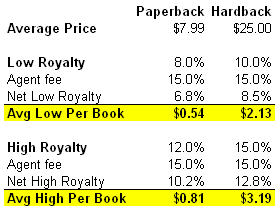
People are always curious about this, so I thought I’d post it and refer to my previous post about what kind of sales numbers it takes to make a living as a fiction author in the US. Of course, the royalty rates depend on what’s in your contract. Many contracts have sales volume break points. For example, an 8% royalty on the first 50,000 paperbacks sold, 10% on anything above that. But this should give you a good feel.
Do you want to meet authors and learn how to develop and write stories?
Then you want to be in Provo, Utah this Thursday, Friday, and Saturday, February 11-13th, and attend Life, The Universe & Everything, the annual science fiction and fantasy writing conference. (I think students get in free.)
If you live within a reasonable driving distance (I’m 2.5 hours away and consider that reasonable), then you should do everything you can to get down there. It’s going to be a blast. It and LDStorymakers are THE best conferences for writing that I know of in Utah, Nevada, Idaho, Wyoming, Colorado, and Arizona. And if you’re into SFF, then it’s the one. I mean, just check out the list of guests.
I’ll be on the Role of Magic in Your Story and Distributing Your Novel panels. Look at the schedule and check out the guests who will be on those panels with me. Yeah. Awesome.
And then I’ll be presenting Vivid and Clear by myself and Succeeding as a Writer with L.L. Muir, which is going to reveal some things that will surprise a lot of people.
BTW, L.L. Muir is the best kept secret success story in Utah at the moment. She’s selling thousands of books, pleasing thousands of readers, and making, well, you’ll have to come to that presentation find out how much money she’s making. And what the secrets to her success are.
How libraries select books
Back in May I wrote about a Gallup survey that shed some light on how US adults select books to read. That poll revealed that book reviews only play a role 7% of the time with readers. The most important things to readers are prior experience with an author and recommendations from someone they know.
But there’s another important block of buyers that don’t buy the same way. In fact, for them reviews are KING.
Who are these buyers?
Public libraries.
And the library market isn’t small. According to a fascinating Library Journal article, “there are more than 9,000 in the US, and that’s not counting branches.” Furthermore, “library purchases account for over ten percent of the $27 billion industry (excluding print textbooks for K–12 and higher ed). In contrast to consumer buying, which relies on discretionary dollars, the library market remains a consistent sales channel for publishers.”
When looking at how many books average authors sell and what it takes to make a living writing, it becomes very apparent that libraries can have a huge effect on a midlist writer’s career.
Of course, we all know there’s more to it than sales. The article points out:
Libraries are far more than a market, however. Libraries create readers. They are the test bed, the petri dish for books, a place where people can discover a passion for reading as children and indulge it as adults and where passionate readers can sample new authors. Librarians are the ultimate handsellers of books (though they call it readers’ advisory), and increasingly they put their considerable technical skills into making library web sites rich interactive social networks for book lovers.
I love libraries for this very reason. And because there’s no way I could purchase all the books I read. No way in heck. So how do they find the books for their collections? I mentioned above that they used reviews. But I didn’t know how much until I saw the data. Holy schnitzel (click on the graphic to see it full size).
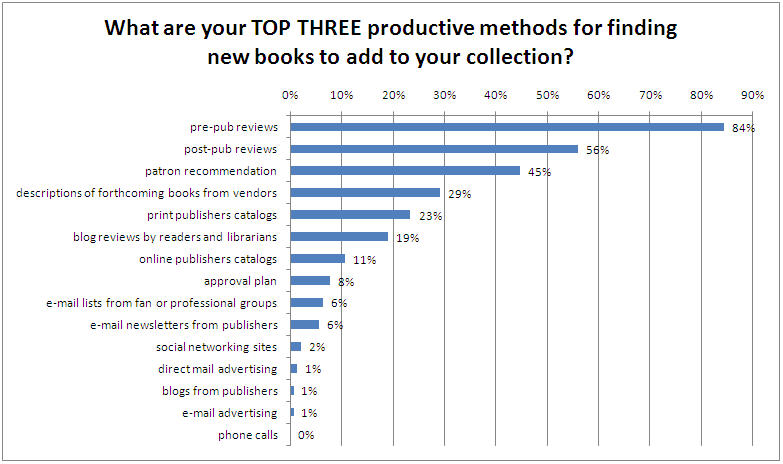 .
.This only makes sense. Study after study has shown that buyers don’t want unlimited choice. Readers use prior experience and recommendations from people they know to manage the chaos. Libraries use reviews and then patron recommendations. Of course, this use of reviews has other implications as shown below.
I get a lot of requests from self-published authors asking me to buy their books, and I have to explain that with limited resources and only so much space on the shelves, we have to go with books that are reviewed, that have been professionally edited. With nearly half a million books published each year—maybe half of them self-published, and most of those pretty awful—I just don’t have time to go beyond trusted sources. This usually doesn’t go over well.
About 9 months ago I wrote about how cumulative advantage can drive product popularity–products that get early positive notice tend to get more notice. It appears that cumulative advantage is at work again. It’s just that with libraries the method isn’t a download counter. The article’s author concludes, “the best way to reach the library market is indirectly: by publishing books that people want to read and having them assessed objectively in reviews.”
So what are the major sources for pre-publication book reviews? The article lists five big ones:
- Booklist
- Kirkus Reviews
- Library Journal
- Publishers Weekly
- School Library Journal
But what can an author do with this information? Authors can’t control reviews. Heck, according to the article the Library Journal itself only reviews about 10% of the books they receive.
We all know the answer. Authors can control one thing: they can strive to write the best holy freaking heck book in their power. After all, what’s a review but a recommendation? Besides, patron recommendations were #3 on the librians’ list anyway. Nevertheless, it DOES help to have a publisher who sends your book out to the reviewers and their catalogs out to libraries. It helps to have a team that’s connected with librarians.
The article ends by saying publishers and libraries are actually working together. I liked how the author summed it up.
What publishers offer:
- Discovery of talent
- Shaping and refining books
- Design, distribution, marketing, and promotion
What librarians offer:
- Discovery of books
- Nurturing of diverse reading communities
- Selection, distribution, marketing, and promotion
Here’s to libraries! (And good reviews. And grandmas. And the little house trolls that give writers fabulous ideas.)