Bad Penny – working title

I’ve decided to tentatively call the first book in my Frank Shaw series “Bad Penny.”  This is the thriller I’ve been talking about. It’s a working title, so it may change.

As for progress, I’m close to 14,000 words. Huzzah! And I’m having a blast writing it. Every day I look forward to my writing time.

For those curious, the book takes place in Rock Springs, Wyoming. The plot will move it across eastern part of the state and then down into Colorado.

Frank Moses Shaw, ex-con . . .

Ah, folks. I’m just loving it.

I’m also generating options for a pen name.  Althought I know there’s overlap between readers of epic fantasy and thrillers (hey, look at me!), I still think the genres are too different to try to spread a brand name across both.  I read about Tess Gerritsen, who started in romance, using the same name for her thrillers, which is all I think she writes now. She reports that she had a number of the thriller readers pick up her romances and vice versa, and then get frustrated because her brand meant one thing to them, but they got another.

If I was writing thrillerish SF, like Card’s Ender’s Game, or thrillerish fantasy, like Correia’s Monster Hunter, then maybe the stretch wouldn’t be so far.  For those of you who are thriller readers, I’ll be posting some possible names in the near future. I’d like your reactions on the options, so keep a look out.

As for CURSE OF A DARK GOD, no word yet from ye Editors. I’m expecting a reply March or April. Yeah, I turned it into my agent end of November. She submitted it to Tor in December. No, I don’t like these lead times any better than you do. But it is what it is. My job is to produce. My target this year is two novels–DARK GOD’S GLORY (book 3 in the series) and BAD PENNY. My stretch goal is to finish the working outline for the second Frank Shaw book (already have the premise) and actually start on it before the end of the year. We’ll see what happens.

Share

Similar Posts

  • Your Chance to Win a Signed Copy of Gun Runner

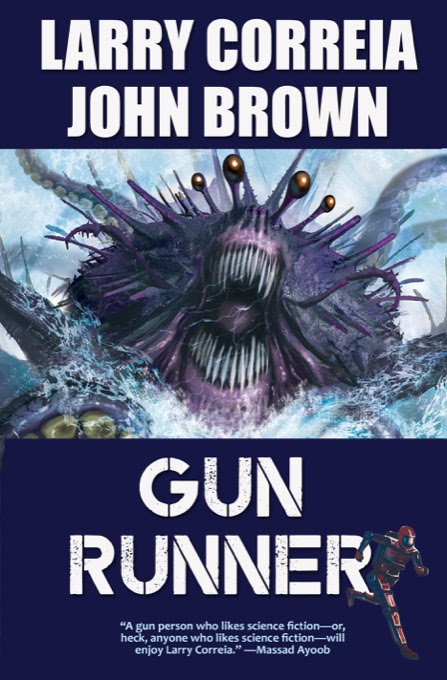
    Gun Runner, the action-packed sci-fi novel I wrote with Larry Correia, comes out in February. But we already have copies.

    And I’m happy to announce that this week you have a chance to WIN A STACK OF FIVE SIGNED SCI-FI AND FANTASY NOVELS that includes Gun Runner.

    Even if you don’t win, you can still get copies at Uncle Hugo’s that were signed by both Larry and I! You can pre-order one now, and get it shipped to you as soon as they’re available in February.

    Uncle Hugo’s is one of those rare indie bookshops that specializes and knows their customers. They’re the oldest independent science fiction bookstore in America.

    Share
  • Near Death Experiences With A Great Bunch of Young Men

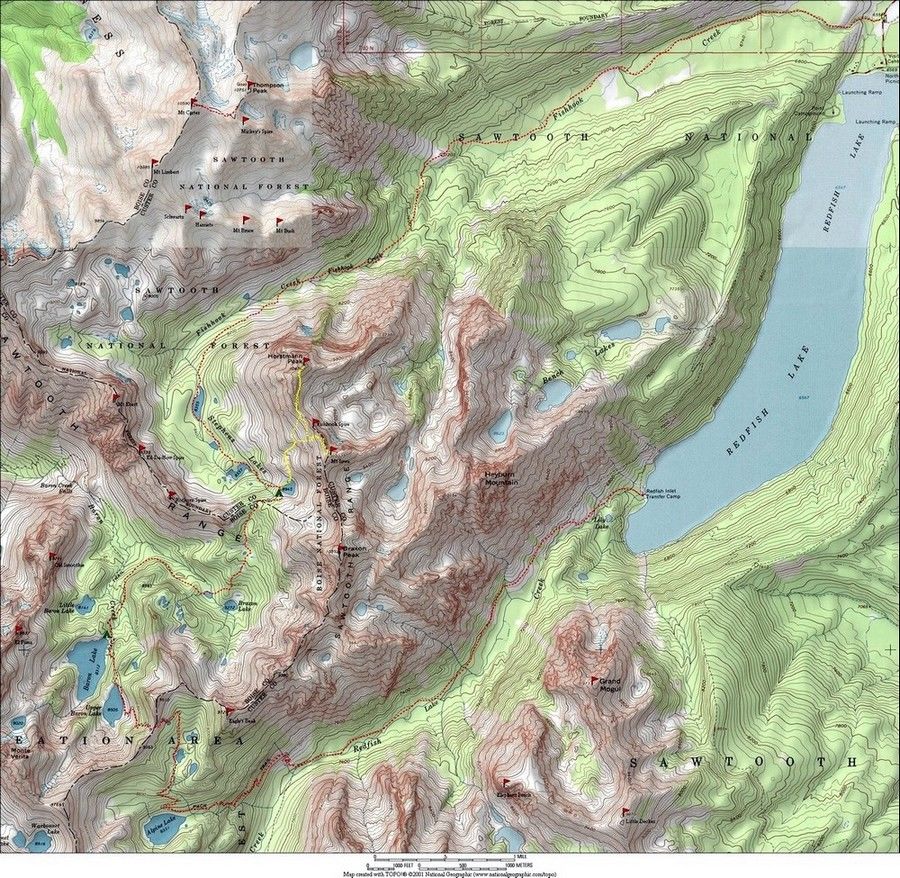
    TopoMapSawtoothAlpineBaronRedFishJust got back from taking a small troop of 12 and 13 year old young men on a scouting hiking and camping trip in the Sawtooth Mountains in Idaho with two other leaders.

    Here’s the checklist.

    Watch a boy think it’s a good idea to stand with his back three feet from the edge of an 80-foot drop and begin pulling on a two-hundred pound hunk of granite while three other boys on the other side push on it with their feet in an attempt to send said large object over the edge.

    Check.

    (Eventually their frontal cortexes will develop; until then it’s up to leaders to say, “Hey, um, make sure you pull really hard.”)

    Sleep under stars in sleeping bag I don’t quite fit in with my serial killer ski mask on backwards because my eyeballs are freezing and wake up at 5 am to 27 degrees.

    Check.

    See spectacular views, including one stark place (Baron Lakes) that looks like a habitation for dragons or trolls.

    Check.

    Watch in rear view mirror in the middle of nowhere Idaho as the other scout leader in the pickup with the four boys tries to pass two rabbit farmer pickups at a T intersection (yeah, passing at an intersection is against the law even if the trucks have hazards on and are waving people around), each with a single ton round bale in the bed; see the first rabbit farmer truck start to turn, and then the scout transportation vehicle swerve, miss a traffic sign by 14 inches, go flying off the road at 60 mph, bounce a number of times in the field and come to a halt. Upon flying off the road, spiritual and hippy scout leader shouts, “Oh, s**t!” When the truck comes to rest, the one scout whose father lent us the truck exclaims, “THAT WAS AWESOME!”

    Check.

    (Yes, they had their seat belts on.)

    So, all in all, a great trip.

    5.5 miles and 2,000+ feet in elevation on the way in and again on the way out, wearing a $6 pair of camo jeans purchased at the Deseret Industries (the local thrift shop) and a $17 pair of WalMart special shoes with soles that were mostly made out of foam, which meant that while they were comfy much of the time, I did get to make friends with a number of pointy granite rocks, proving that “be prepared” for some of us is more of a guideline than an actual rule.

    Share
  • New Release Sale for Curse!

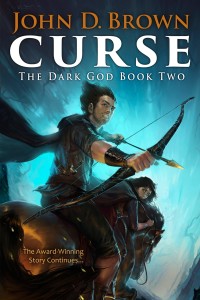
    CurseCoverEbook1600x2400Curse’s long and crooked path to publication is now over!

    And there was much rejoicing. To celebrate, we’re putting the book on a huge discount today and Saturday.

    Big trade paperback, plus free ebook: $9.99!
    (normally $18.98 if purchased separately)
    Amazon

    Ebook: $.99 cents!
    (normally $3.99)
    Amazon
    Nook
    iTunes
    Kobo
    Smashwords

    I want to thank all of you who emailed and posted comments on the website expressing your anticipation for this book. I really hope you enjoy the story as much as I have.

    Happy reading!

    John

    PS To get the free ebook with your purchase of the big paperback, purchase the paperback, then go to the Kindle store and click on “Kindle MatchBook” in the left sidebar. That will take you to your personal list of books you can get with the MatchBook program. Curse will appear there AFTER  you make the purchase.

    PPS Look for a similar sale for Raveler soon!

    Share
  • |

    The Pareto Principle, Form Follows Function, and Story

    There are a thousand things to “remember” when writing story. New writers who make lists of these things soon begin to drown in them. But I’ve come to realize that many of these “rules” don’t matter.

    They don’t matter because many ignore the function of story. And so you can’t know how and when to apply them, or if they’re even something you should apply in the first place. Furthermore, a good number that do tie back to function often have little impact.

    The more I develop and write, the more I begin to see that the key is to focus on a liminted number of fundamentals. To focus on the things that matter most.

    So what really matters when you’re writing a story?

    I’m going to be speaking for an hour at the Book Academy tomorrow. It’s at Utah Valley University. The week after I’ll be presenting all day at the American Fork Arts Council’s autumn writer’s conference. I will probably write up all my thoughts and post them to my site at some time.  But for right now this is where you can hear them.  

    I truly believe the Pareto Principle applies to writing. But you can’t go searching for those vital few factors until you know the effects they’re supposed to produce. Form follows function. And the function is something that happens in the reader.

    Here’s a nibble. This quote from David Howard is an example of what I’m talking about.

    “As we’ve seen, what the audience hopes for and what the characters hope for need not be the same thing. The same is true of our fears versus their fears. But how do hope and fear fit into the scheme of storytelling? Hope and fear are about the future. They derive from uncertaintly about future events in the story, future decisions the characters might make, future discoveries or revelations that might be unearthed, future outside forces and how they will influence the journey of the characters. When we discuss hope verusus fear in dramaturgical terms, this uncertainty is a function solely of the audience and its experience [my emphasis]. This is dramatic tension. We hope the man with the cobra in the shoe box won’t open the box; we fear he might and get himself or someone else bitten. We don’t know what will happen, but we know what might happen and therefore feel tension about those possibilities” (How to Build a Great Screenplay, 52).

    Readers buy novels because novels provide a service. They provide something to the reader. They DO something to the reader.  That’s why readers pay good money for them, and stay up late at night (well past smart bedtimes) with them, and spend hours of their lives reading them.  

    What do stories do? What are the key factors that have to be present in the stories for them to be able to do these things? How do you help readers hope and fear for what might happen?

    I’m no story guru, but I do hope to share some of the vital few factors I see in the presentations I’ll be giving this week and next.

    Share
  • David Morrell Workshop, June 6, 2008, Boise

    One of the things I love about writing is that there’s always something new to learn. There’s always new content and, therefore, lots of cool research, but there’s also a lot to learn about the craft. I have no illusion that because I now have a contract I’ve suddenly arrived as a master craftsman. This art is just too big.

    So you can imagine my delight when I saw that David Morrell is going to be giving a day-long workshop in my own backyard (out West, 5-8 hours is still in your backyard). I’ve signed up for Morrell’s workshop on June 6, 2008.

    He’s the guy who wrote Rambo and started Thrillers Inc. He was also a professor for many years.
    More on the Conference
    http://www.murderinthegrove.com/index.htm

    More on Morrell.
    http://www.shotsmag.co.uk/shots21/intvus_21/dmorrell1.html
    http://www.davidmorrell.net/
    http://www.writerswrite.com/journal/oct02/morrell.htm

    This was interesting.

    Ali: As a Professor of Literature at Iowa, what were your experiences in academia like? Did you tutor any students who became prominent in the fiction field?


    David : I have a Ph.D. in American literature and taught academic courses: the American Novel of the 19th Century, the American Novel of the 20th Century, American Realism, Hemingway and Faulkner, Hawthorne and Melville, that sort of thing. The University of Iowa has the famous Writers Workshop, but I had nothing to do with it. In fact, they hated the sort of books I wrote and hated even more that I earned money as a novelist. That was the official line. But in secret, students snuck to my office and asked me technical questions about craft or asked me to read contracts they’d been offered (to see if the contracts were reasonable). Sometimes they showed me their manuscripts. The most productive association of that sort was with Jon Jackson who later published a series of police novels about Detroit. My most gifted student was T. C. Boyle. He writes humorous literary novels and short stories that critics love. His latest is DROP CITY. I taught him nothing about writing – he was a genius. But he did ask me to direct an individual reading course that he needed in order to graduate. We had a lot of interesting discussions, and I’m thrilled by his distinguished career.

    Interestingly enough, T.C. Boyle was one of the writers that made life bearable for me while I was getting my BA in English. His novels, well, I never finished one of them. But his short work sings. Heck, his long work sings, but there’s not enough plot for my tastes.

    Share
  • LTUE presentation materials

    On Friday night I’m going to be part of a panel on RULES FOR WRITING MAGIC, and then I’ll be presenting VIVID & CLEAR to a bunch of SFF romancers. On Saturday I’ll be following that up with a presentation on STORY TURNS. Every time I present folks ask for the presentations. So instead of making them wait until I get home, I’ll just post them now.

    Enjoy!

    Some thoughts on inventing magic to go along with Friday’s panel.

    Presentation slides: Vivid and Clear v2

    Presentation slides: Story Turns v2

    And here is the fine car chase clip from the Story Turns presentation.

    Share

5 Comments

  1. I like the idea of using a pen name. I have probably spent more time thinking up pen names for when I am published than actually writing. (Maybe not, but my priorities are obviously not what they should be.)

    One of the best helps I have found for this is wordsmith.org ‘s anagram site. Use the advanced feature, it really helps tailor your options.

    Did you know that the only anagram for John Brown is Brown John. Not enough vowels I guess. So I used the title of Servant of a Dark God. My favorites are below and sound to me like gritty novel writer names.

    Tanager Vodkas Ford
    Farragos Vodka Dent
    Kaftan Graved Roods
    Kaftan Sa’vor Dodge

    I did run across a phrase that might fit somewhere in your novel, Fragrant Vodka Dose.

    Good Luck!

  2. Nah, go with color coding. Mysteries could be John Turquoise, or maybe John Fuchsia. And then there’s John Pink… what genre would that fit? 🙂 Get a color paint sampler at the House Despot near you and you’ll find all the shades of John you could ever want. John Royal Blue! Sure, why not?

  3. I like pennames for different genres. It’s all about branding. You don’t have to keep them secret from each other: it’s just to let buyers know what they’re getting. Coke is not Diet Coke is not Coke Zero is not Fanta is not Sprite, so when I buy one over another, I know exactly what I’m getting.

    John Brown…Jack Brawn. Now there’s a manly thriller name! 😉

  4. I agree, Sam. BTW, I will be posting my top 10 names here in the next few weeks. Stay tuned to see which one wins.

Comments are closed.