Similar Posts

  • What Robinson Wells Learned Last Year

    Look, this is just an excellent post by Robinson Wells: Five Things I’ve Learned In The Last Year About Writing.

    I kept finding myself saying yes, yes, yes!

    Yes! I hate “networking” too. Icky, icky, icky. Like squishy underwear. Like buddying up to someone to get them into your network marketing downline. Like flies in soup. I love how Robinson replaces that with the real deal. I think I’m going to summarize him every time anyone asks me about networking. 

    One point. I do think he might be overstating the you-need-to-know someone deal. It’s easier, sure. But Larry Correia didn’t know anybody. He just wrote a book a lot of people in a certain demographic loved. I didn’t know my agent from Adam. Didn’t know my editor, but did have an endorsement from one of his authors. But that didn’t get me any deal. It probably got me, at most, a fair consideration. I can name others who didn’t know a soul. In fact, go to the facts and figures page in the On Writing section. Look at the author polls there. A lot of authors didn’t know a soul. Of course, knowing someone can help.

    Yes! Be cheerfully flexible. Oh, my gosh. This is such a good approach. And I’m living it right now, although there have been a few moments when I’ve had to regroup for a moment to capture the cheerful.

    Yes! Sometimes the thing you love doesn’t work for the project. Sometimes it does. I would advocate making sure you get to the root of the issue. But we’re artists. If the thing we don’t love doesn’t work, we can create a new thing to love. That’s what it means to be creative.

    Work! Yes! It’s amazing what happens when you work.

    Good stuff.  

    I’m so bullish on this, I say Robinson for President.

    Of what, I don’t know. But he should be President, of something.

    Share
  • Writing a tie-in

    I read this article today, laughed, and then thought a while. Don’t know if tie-ins will ever be in my future. I would hope to do it just once for a series or film I love. In the meantime, it’s great fun reading about someone else’s experience.

    ‘Burn Notice’: The Novel
    Does a real writer accept a gig doing books spun off from films or TV shows? A real writer found the answer to his own question.
    By Tod Goldberg, Special to The Times
    August 24, 2008

    http://www.latimes.com/features/books/la-ca-tie-ins24-2008aug24,0,1463672.story 

    Share
  • Generating Story 2: No Clue, No Solution

    I want you to think about Ed Smylie, who helped save the Apollo 13 astronauts with his duct tape contraption. What if the authorities had come to Ed, but instead of saying, “Look, we need to fit the round CO2 scrubbers into the holes for the square ones,” they’d said, “We want you to do something; it involves thinking.”

    Ed would have blinked. Waited.  “Yeah?”

    “That’s it. Something. A lot is riding on this.” And then maybe they urged him on with a significant wave of their hands.

    Can you see Ed at this point?

    “Sure.” He’d say. “I’ll get right on that.” Then he’d wonder who put these guys up to this practical joke.

    Do you see how impossible it is when you frame things that way?

    To come up with solutions, you have to have a clue about what it is you’re trying to do. Even if it’s just a rough idea. It doesn’t matter if you’re trying to fix a space ship, roast hotdogs, or write a story.

    Once we have a rough idea of what we want to accomplish, the mind automatically kicks into gear to perform its wonders. Until we do that, we’re going to be like Ed in the example above—staring at a blank wall, wondering if our superiors aren’t a bit cuckoo.

    So what are we trying to do?

    Think about your reader. Is it a woman? A teen? A crazy dude? Do you remember my book tour with Larry Correia in 2009 and the guy who, during a booksigning / doughnut party at a Phoenix Barnes & Noble, proclaimed my book to be true?  Aliens really were eating our souls and enslaving humanity. They were lizards living in the hollow portion of the earth.

    The point is: what are your readers hoping your story provides them? In fact, since you’re the first audience, what do YOU want from your stories? Why do you read?

    I want you to write down five stories you really like. Movies, TV shows, novels, short stories, plays—I don’t care the genre or type. Just write down five. Do it now. Here are five random stories I like.

    • The Incredibles
    • The Good Guy by Dean Koontz
    • Hunger Games by Suzanne Collins
    • The Sound of Music
    • Runelords by David Farland

    This is going to be a powerful exercise for you. It was for me the first time I did it in a class on interior design.

    A few years ago, Lovely Wife and I were building a house. We wanted to make our living space sing. We wanted our surroundings to make us happy, but we didn’t quite know how to go about doing that. So we took a class on interior design, hoping to learn the principles involved.

    Except when we showed up in the first session and saw the many different design styles, it overwhelmed us. Some styles were ethnic (Southwestern, Asian, French, Gothic, Pygmy), some philosophical or religious (Zen, Feng Shui), many were artistic (Modern, Arts & Craft, Minimalist, Art Deco, College Room Mate ), a lot were mixtures. Some were about making statements and creating moods, some about practicality (here’s a taste of those styles).  How in the world were we going to learn this?

    Luckily, we had a very perceptive teacher. She knew that most of us were there, not to learn all the styles, but to decorate our own houses. So in our second session, she brought dozens of home magazines. She spread them out on the tables we were sitting at and told us we would go through the magazines. When we found a picture or image we liked, we were to rip that page out and put it in our personal stack. So for about 45 minutes we looked and ripped and looked and ripped. Lovely Wife and I each ended up with a pile of a few dozen pictures.

    Then the teacher told us to spread our pictures out in front of us and look for things that the images had in common. Colors, features, design elements.

    I spread my pictures out. Lovely Wife spread out hers. And it was like magic. Boom! Right there in front of us. I loved arches and eyebrow windows. Loved dark blues and purples mixed with creams and whites. Loved the color of blond wheat and a navy blue sky. I loved wood. Loved Arts & Craft with a few tweaks.
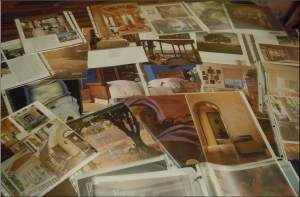
    Lovely Wife’s pile was equally revealing.

    The teacher then said, “This is your personal style. This is what’s going to make you happy.” She told us that when designing the rooms in our house, that we should think about their function and merge them with these elements. And if any of us were to work with clients, we’d do something similar with them and find out their wants and likes.

    With our styles now beginning to be fleshed out, Lovely Wife and I went to work. Some of her elements and colors overlapped mine. Some didn’t, like her idea of sleeping bliss: a bed with sheer red drapes hanging from some lamp shade contraption in the middle.

    I told her I didn’t know if I could keep my man card and sleep in that bed. She decided I should keep my man card, but said she couldn’t sleep in a plain-walled zen room. We compromised. She got textured red on the walls. I got a bed without too many frills. We came up with designs for our spaces that did what we wanted them to do.

    But we couldn’t have done this if we hadn’t identified what we were after.

    So I’ve adapted that visual art technique used in the design class for our purposes. It’s just as powerful with literary arts. Which is why I want you to write down five stories.

    I want you to take a moment and identify what you’re after, in a big picture general way.

    I can’t do this for you.

    You and I are different. Just like Lovely Wife and I are different. While our tastes may overlap in some places, they’re going to diverge. You don’t want to write my stories. You want to write YOURS.

    So write down five stories. Then write down what you really enjoyed, over all, about each of those five stories. You might do this on five pieces of paper. What did you enjoy with each of the main story elements—character, setting, problem, plot, and text? What kind of an experience did they give you? What drew you to them in the first place?

    You don’t need to go all crazy detailed on me with this and do a twenty page report. Just hit the highlights. The stuff that will fit on one page without writing in four point font.

    When you finish that, step back and look at all five pieces of paper side by side. What common elements do you see? Circle them.

    This is your style. This is what, in general, you’re going for.

    If you found the exercise insightful, do five more stories. Ten is such a nice number.

    I’m going to predict that 99% of the things you identify have to do with what the story did to you. The stories made you laugh, smile, scream, want to fall in love again. They made you curious or jealous or feel some type of desire (be a Ninja king, strong, beautiful). Maybe they gave you insight. Maybe they affected you so profoundly that it changed, if even in a small way, how you decided to live your life.

    Stories–the ones people pay money for; the ones people stay up until four a.m. reading with a flashlight; the ones people tell their friends about–make people feel things.

    A while back I wrote about this in three parts. I believe the things you’ll read in those short posts, if you don’t know them already, will change how you think about stories. They did for me. And it all begins with lipstick.

    1. Lipstick
    2. Getting specific
    3. My big draws

    Okay, I hope at this point you are getting a general idea of why readers pay money to read the stories we create. Why YOU pay money and spend countless hours reading what others write.

    This is the first step in being able to produce on purpose, not on accident. This is the first step to becoming the Ed Smylie of fiction—understanding what you, as a writer, are trying to do.

    This week, keep your eyes open. Notice what stories do to you. Notice how you feel about different characters and plots. If you feel like taking it farther, notice the effect of different beginnings and ends of novels, chapters, or scenes. Notice the effect of different ways authors describe characters, places, and actions.

    Of course, while knowing these general objectives is critical, it’s not enough. You need to know what you’re reaching for with the current story, the current characters, the current plot. How do you translate all this general stuff to the specifics of the story in front of you? Do you have to define everything up front? And what if you don’t know what you want in the current project anyway? What if you are clueless and have nothing but a handful of random ideas that for some reason are generating electrical sparks? What do you do then?

    In the next post, I’ll talk more about those questions and where the how-to’s fit into all of this, and then we’ll get into the principles of invention.

    For more in this series, see How to Get and Develop Story Ideas

    Share
  • The eBook Tsunami of Crap is Crap

    Some folks say ebooks will foist a terrible problem upon readers–they’ll soon have to wade through mountains of crap to find a book to read. It will be a terrible chore. J.A. Konrath gives his answer to this lament. Kris Rusch gives hers.

    Here’s mine: there will NEVER be a tsunami of crap facing a reader looking to buy ebooks or any other kind of book. Ever.

    Why?

    REASON 1

    Buyers REFUSE to look at seas of choices–crap or otherwise. Shoppers always seek to limit choices (too costly to look at everything) and use a number of methods to immediately narrow those choices down: recommendations, reviews, what’s on the shelf, etc. (For a fascinating look into a few facets of how we make choices, listen to this Radio Lab espisode.)

    For example, when shopping for vanilla you don’t go searching through the 500 brands available online and in various stores–Mexican, Vodka, American, Rum, organic, generic, brand, etc. It’s just not worth the time. Something on the shelf is usually GOOD ENOUGH.

    Likewise, nobody cares to look at 150,000 titles to find the best. They don’t have the time. In fact, they don’t need to. They can usually find a number of books that are intriguing enough in the “smaller” selection any given vendor sets before them.

    In the case of Amazon ebooks, that selection is the best-sellers, the ads, and the this person bought that.

    Nobody ever sees the 4 gazillion books. Ever. They don’t want to.

    REASON 2

    Vendors can’t display a gazillion choices, even if they wanted to, which they don’t (studies have actually shown that providing shoppers too big a selection leads to FEWER sales).

    And no, just because Amazon says it have 2 quintillion titles for sale that does not mean they’ve been displayed. You only see a handful of titles at a time.

    Even if you scroll through the various lists, you are rarely looking at more than a dozen choices at a time. You’ll probably see less than 200 titles total any given time you go shopping.

    Vendors NEVER display a tsunami. EVER.

    REASON 3

    Readers have MORE THAN ENOUGH leads to fill their capacity for reading.  Even if they wanted a sea of options, they wouldn’t wade through them because they don’t have to–it’s too easy to find something to read.

    Leads are everywhere. There are recommendations from friends, family, reviewers, celebrites, and Amazon’s this person bought that.  There are leads from best-seller lists (another type of tacit recommendation). Leads from browsing.

    Readers have leads coming out their ears.

    This is important because the number of leads any given reader has far excees that reader’s capacity for reading.

    How long does it take you to find one book that looks interesting? From browsing or recommendations or whatever?

    Minutes.

    Maybe if you’re having a really bad day, it takes an hour. But it takes so much longer to read one story than it does to find one you want to read.  That’s why we all have two year’s worth of books to read in our queues.

    So. There is no sea of crap. There NEVER was or ever will be one for any given reader.

    Buyers avoid selection seas like the plague. Vendors don’t provide such seas anyway. And readers don’t need them–they have more than enough leads which turn out to be exciting enough to fill up all their reading slots and more.

    Share
  • LTUE presentation materials

    On Friday night I’m going to be part of a panel on RULES FOR WRITING MAGIC, and then I’ll be presenting VIVID & CLEAR to a bunch of SFF romancers. On Saturday I’ll be following that up with a presentation on STORY TURNS. Every time I present folks ask for the presentations. So instead of making them wait until I get home, I’ll just post them now.

    Enjoy!

    Some thoughts on inventing magic to go along with Friday’s panel.

    Presentation slides: Vivid and Clear v2

    Presentation slides: Story Turns v2

    And here is the fine car chase clip from the Story Turns presentation.

    Share
  • |

    Indie Thoughts: Publishers know profit, but haven’t tapped best seller lists

    In The Business Rusch: Generational Divide Kris Rusch points out that the new on-demand and long-tail market for books has changed the duration of the opportunity a book has to be successful, but that it seems the industry still isn’t recognizing this in how they measure success.

    The problems come from the fact that those of us who run things—people in our forties, fifties, and sixties—use metrics that were developed by our parents for their world, that tightly controlled Mad Men world where everyone was expected to be the same, not just in what they wore or bought but in what they listened to or watched or read as well.

    The bestseller list?

    It measures velocity. (A good essay on this topic, “The Meaningless Metrics of Fame,”  came from Mike Briggs, husband of Patricia Briggs, earlier this week. I’ve also dealt with it.)

    Reviews?

    They only want new books, and then only at the time of release.

    Brick and mortar bookstores?

    They only have room for the latest releases, and then only the ones that are the most popular with their customers (whoever those folks might be).

    Books have come late to this fight. Books have been available on demand for only about four years now, in the U.S. In other countries, there’s been even less time.

    And we’re all still fighting over meaningless metrics, to use Mike Briggs’ term, because those metrics only measure things that were important around the water cooler, not things which are important now.

    What’s important now?

    She goes on to say:

    The publishing industry isn’t even talking about new metrics. That idea hasn’t occurred to traditional publishing, and indie (or self) published writers are constantly seeking validation from the old system—trying to figure out ways to game the bestseller lists or to get a fantastic review from somewhere that has old-world prestige . . . But at some point, traditional publishers are going to have to develop new ways to figure out which products sell well and which ones don’t. All of their systems—from sales figures (which measure books shipped not books sold) to bestseller lists to critical acclaim—are based on the old models.

    Kris is a very experienced with publishing, but her last point conflates internal accounting with marketing. Publishers DO know which products sell.

    The primary measure of success in a financial enterprise s not new. It’s been around for 100’s of years. And on demand and long-tail markets don’t change it.

    The measure is how much a product or service contributes in profit to the bottom line. You take revenues, minus expenses, and that’s the contribution that product (a book in this instance) makes to your total profit. Or to covering your fixed costs.

    Booksellers have measured the success of their books with actual or estimated profits for quite some time. Publishers already know which books sell well and which don’t. No accountant in the world is going to report books shipped as the measure of success. And they don’t. The very fact that publishers have a profit and loss statement and show returns on royalty statements demonstrate that. They look very closely at actual and estimated profits. And to they do this by channel, which is reflected in a small way when they break out ebooks on royalty reports. This is all basic accounting.

    Here’s an example. Until Ender’s Game the movie, Ender’s Game the book hadn’t appeared on any best seller list since it was first released. And its release was 30 years ago! Yet over the years Tom Doherty touted its sales numbers many times. Tom knew that book was gold. Of course, he did. Because he doesn’t use best seller lists to tell him what’s selling well. He knows those lists are marketing devices. He has the real data in house. Why would he need a list to tell him anything?

    And Tom isn’t going to use books shipped either. Tor may report those numbers to Publishers Weekly for marketing purposes, but he will always multiply that number by an expected return rate to estimate sales. He wants to do that. Because books shipped is meaningless to the bottom line and everyone knows it, including the auditors.

    Publishers are well aware of the long tail. They see it with books that have been rotated out of the brick and mortar channels but are still selling in the online ones. They report it in their annual statements. They know the online channels work differently from the brick & mortar ones.

    The measure of success is still the same as it ever was—how much profit is this property contributing to our bottom line?

    Marketing, however, is a whole other ball of wax.

    What the long tail and on-demand allow are marketing campaigns that are impossible in the brick & mortar channel. In brick & mortar you have a limited time to advertise (roughly 8-15 weeks). After that period, most books are rotated out of the store. This means that any marketing for those brick & mortar buyers MUST coincide with the period when the books are in the stores.

    But the online channels open up all sorts of other opportunities. You can market forever. And the contribution margin is always positive. The online and POD costs are easily recouped with each sale. (Publishers are well aware of this profit potential; this is why we have so many making grabs for backlists.)

    And I see publishers taking advantage of these new marketing methods. This last week I saw publisher books not currently stocked by brick & mortar retailers on BookBub, BargainBooksy, and Book Sends. And the industry isn’t totally focused on new books for reviews. I just had a large newspaper agree to look at my book that was published four months ago. Still, Rusch is right when she says that the publishers haven’t adapted one of their biggest marketing tools to take advantage of the new opportunities–they haven’t done anything with the best seller lists.

    Amazon has lead the way in creating new ways of marketing books to different types of readers with their best seller lists. These lists create the excitement of discovery.

    But every one else is still reporting weekly sales on the big lists.

    If I were a publisher, I’d be asking USA Today to provide more than just the weekly view of the top 150 books. And USA Today is THE list to watch because their numbers are not based on units shipped to a sample of stores, but actual sales. Here are some lists that readers would be interested in.

    1. Most anticipated this week: based on pre-order totals
    2. Most anticipated this month: based on pre-order totals
    3. Hot new releases: based on weekly numbers
    4. Hot new releases for the month: based on monthly numbers
    5. Books with legs: last 3 months; I know it needs a different name (grin)
    6. Best sellers of the last 12 months: annual total of units sold
    7. Best sellers of the last 18 months: total units
    8. Contenders: for each of the lists above show the next 150 books (I always want to see the next 100 books after the top 100 on Amazon’s lists; why not show readers the top 300?)
    9. Movers: for each of the lists above show those that have the biggest rise in percentage sales and meet some unit minimum (you don’t want to feature books with 2,000% increase because they went from selling 1 unit to 20), even if they don’t break the best seller lists
    10. Genre: allow all of this to be sliced by genre.

    Let the reader select the view they want to see!

    Avid readers will gravitate towards the shorter time periods. Those that read fewer books will gravitate towards the longer periods. Everyone who wants to discover something new will go to the contender and mover lists.

    This is about marketing. Not publishers measuring success.

    And then armed with those numbers guess what the publishers will do? They will go back to the brick & mortar venues and pitch to have some of these same books carried in the stores for the first time (some publisher books are printed digital first) or carried again.

    Share