Indie Thoughts: Your First 1000 Copies by Tim Grahl

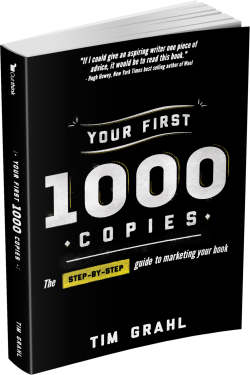
Your First 1000 copies by Tim GrahlDo you know what’s awesome about Your First 1,000 Copies by Tim Grahl?

He bases his advice on tests. Tests he’s performed with other authors and tests he’s performed with his own book.

For example, what’s more effective: advertising and posting our on places like Facebook and Twitter or a mailing list? Do authors really need to have a social presence? Or is that a bunch of bunk?

Tim has tested this question and shares what he’s found.

What about marketing? What’s the best approach to take to win new customers?

I think you’ll find his answer surprising. As a side note, I have to say I find his definition of marketing more insightful and practical than any I’ve come across. And I got a business degree!

How do you set up mailing lists and which ones should you use?

Tim tells you.

What should you blog about?

Tim shares his front-line insights.

What’s the quickest way to find new customers?

Tim discusses that as well. And it’s all put together in his framework or system he calls “Permission, Content, Outreach, Sell.”

If you’re an indie author, I think you’ll want to hear what Tim has to say. There are three books on indie publishing that I’ve found super useful. Your First 1,000 Copies by Tim Grahl is one of them.

Share

Similar Posts

  • Four-letter words and fiction

    Here’s Joseph Finder, a NY Times best-selling author, talking about how he studied his craft, why he uses outlines, and what he decided about four-letter words and why.

    I had the same reaction when my daughter came to me wanting to read my stuff. I’ve never heard of Joseph Finder–there are soooo many authors these days. But I can tell you I’m going to pick up one of his books to see what he’s all about.

    Share
  • The main thing about villains

    The main role of villains and antagonists in stories is to generate suspense, anxiety, and fear in the reader. They make it possible for us to worry that the hero will not be able to avoid a significant threat or remove a lack. There are other effects–mystery, poignancy (about the human situation like in Les Mis). But those are secondary.

    For the main things to happen the villain has to be a credible, significant, and immediate threat…all the way through the book until he or she is smushed or wins.

    If he’s not credible, the reader realizes there is no real threat. If the threat is not significant, who cares? If it’s not immediate, again, who cares?

    So how do we make a villain like that? We make him or her smart, powerful, a few steps ahead of the hero, and dedicated to doing something we root against (because it’s just plain wrong or because we love our hero and want the best for him and the villain is pitted against him). He has to be able to put the hero on his heels most of the way through the book, and our poor hero is scrambling to adjust.

    You can have all sorts of villains–liked by many or few, kooky or calculating, eccentric or plain, noble or sadistic–just as long as they remain significant, immediate, and credible threats. The minute they lose threat status, the game’s over because at that point fear, anxiety, and suspense in the reader vanish.

    Share
  • Wise reader instructions

    I value accurate reports from readers who are (a) in the audience for my books and (b) approach the book as honest readers, not critics, nigglers, axe grinders, toadies, or flatterers. I just want accuracy. In How to Write Science Fiction & Fantasy, Orson Card calls these types of folks “wise readers.” When I find one, I cheer because not every reader has time, ability, or interest. And their reports are usually very helpful.

    I know a lot of aspiring authors ask friends and family to read their work. And I know that many people can easily become wise readers with a little direction. So I thought I’d share with you what I ask of my wise readers. Maybe you’ll find it useful with yours. Here’s a revised version of a letter I just sent to one who has agreed to read draft 3 of CURSE. Every author’s a bit different in how they approach readers. Some just say, read it and tell me what you like and what you don’t. But I like to provide a bit more guidance. And I wanted to make sure this reader understood exactly what I was looking for. It might be a bit much for some, but I wanted to make sure it was clear since this was his first time reading a full book for me.

    Thanks so much for agreeing to read this draft! What I want at this point is to see how I’m managing the reader experience in 3 areas: (a) the characters, (b) each chapter and scene, and (c) with the book as a whole. So  I’m hoping you just read, and as you go along make quick marks or comments when you’re delighted or bumped. I’ve listed the types of delights and bumps I’m talking about below. Please know I’m not providing them for you to use as a checklist, i.e. it’s not my intent to have you actively search for these things like a Where’s Waldo. You may feel some of these things. You may not. I just want you to be aware of them in the back of your mind as you read and to note when you experience them. In the end, I simply want an accurate report of YOUR experience. Accuracy is key to me.

    I find with my own reading that it’s often hard to respond to the story as a regular reader if I’m always stopping to write lots of detailed comments. It seems to knock me out of the reader’s trance. So don’t feel like you must stop at the end of each chapter to assess your experience or be exhaustive in detailing your every reaction. Just make your quick marks and comments as you go, then review and write up your report when you’re done. If you feel the book’s too big to do it all at the end and actually remember what your marks and comments meant, then break it up into chunks of 100 pages or every few chapters. Whatever works for you. 

    Sometimes, despite our best wishes, we are just not in the audience for a specific book. If the book just isn’t working for you, do not read past the point where you would normally put it down. Pushing yourself beyond that point will only drive you nuts, and it won’t provide me with anything useful. So just stop there, be happy, and write your report. Remember: the most useful thing to me is accuracy. 

    As for the report, give me a summary of your general and specific reactions. For comments on specific parts or lines, it’s critical for me to know page numbers so I can go back and see exactly which part you’re talking about. Write your explanations on the specific page of the manuscript. They don’t need to be long. For example, if a page introduces too many names and you couldn’t keep track of the people and started to get confused, you might underline all their names and write “huh? too many names, can’t keep track.” If a character does something that makes you cheer, you could circle the paragraph and write “yes! yes! yes! Go Talen.” Just so that it’s clear to me what your reaction is and what your reacting to.  

    Please know whatever your reactions are, they are just as valid as anyone else’s. It’s my job to review all the reports and decide what they mean and whether they indicate I need to make any changes. Whatever I decide, know that it means a lot to me that you took the time to read and report with accuracy. 

    So, any of the following types of things count as bumps and delights. You might have others you experience as you read. Feel free to mark and comment for them as well.

    DELIGHTS
    I want to know what IS working with the characters, scenes, chapters, and plot as a whole. So any parts–story, people, or things–that elicit a strong reaction of the type you see below.

    Characters

    • You really like or enjoy them
    • Intrigued or fascinated by them, want to know more
    • Great lines
    • Envy them or think, oh man, that would be so cool to be able to do that or be there or have that skill/ability
    • Sympathize with, root for
    • Dislike, hate, root against

    Story

    • Suspense, anxiety, stress, dilemma
    • Curiosity
    • Mystery
    • Surprise
    • Cool!
    • Wonder or awe
    • Insight, poignancy
    • Sadness
    • Triumph, stand up and cheer moments
    • Laffs or grins
    • Dread, horror
    • Great action, stunts, adventure
    • Romance
    • Compelling “Dude!” chapter or scene beginnings, ends, and story turns

    Text

    • Vivid descriptions
    • Poetic beauty in the prose

    Overall

    • Did the story build well for you, bang bang in the climax, and then leave you wanting to linger and enjoy the rolling credits? Did it leave you feeling “wow” or “that was great?” If it didn’t quite make it, then give me an indication of how much on a scale of 1 – 10
    • What were the most interesting parts of the story for you?
    • Did you feel resolution and a strong tug to read more, come back to the world?

    BUMPS

    “Huh?”

    • It’s not clear what’s going on, who’s doing it, or why.
    • You really don’t understand something and you think you’re supposed to.
    • Too many terms, names, etc. and you’re getting lost or feel like you need a diagram.
    • The text itself doesn’t make sense, or it clunks badly.
    • The book contradicts itself.

    “Come on!”

    • Something just doesn’t ring true.
    • It’s just not how things work, e.g. John, there was no FBI in 1638 in China.
    • The character’s actions don’t feel logical given the situation, e.g. um, why would she do that? I’d just X and, boom, it would be over. She was stupid.
    • You just don’t buy some plot turn. It doesn’t make sense. Was too easy. Seems to ignore all sorts of things in the story.
    • A character is irritating or annoying you.

    “Yawn” or “What, that’s it?!”

    • Things are starting to get boring.
    • You start to skim the blah blah blah to get to the good stuff.
    • You were built up to expect something and instead got a fizzle. This could be some mystery, a character, an insight, conflict, the ending, etc.

    Please note that this list might change depending on the type of story I write. And the reader. For example, if I wanted a content or technical expert to report, then I’d be asking him or her:

    • Anything not ring true
    • Anything too cool or intriguing that I’ve left out.

    If the book was focused more on a romance, then I’d probably provide a slightly different list of delights. Horror would require yet a different version. Not too different. But the emphasis would probably be elsewhere. The key is in me knowing the type of experience (entertainment & drama) I’m trying to provide, what I’m trying to test, and giving the wise reader enough examples that they know what I mean by “delights” and “bumps.”

    EDIT: 11/27/12

    And here are the Beta Reader Instructions I gave to the latest batch of noble souls who offered to beta read BAD PENNY.

    Let me explain what I need you to do as a beta reader. This is basically a test screening. All I’m looking for is to have you give the novel a test ride, and then report back your experience. I’m not talking about giving feedback on small stuff like grammar and spelling. I’m talking about reporting your experience with the big story things like characters and plot.

    For plot, you simply report chapter by chapter if you were still interested and wanted to keep reading or if the story started to become a bit long (yawn). Were there any parts that stood out to you as particularly interesting, funny, heart-pounding, or suspenseful? Any that stood out as a bit dull or didn’t ring true?  Was the ending satisfying?  Did the beginning grab your interest? Anything you were uncomfortable with? There’s no wrong answer. It’s just a report of your experience. And an ACCURATE report is what I’m after.

    For characters, you report what you felt towards the main characters and any bit characters that stood out to you. Who was funny?  Who was likeable?  Who were you rooting for?  Who did you hate or fear or mistrust?  Were there any characters who are just so dumb or annoying you wanted to smack them? Where there any character moments that didn’t ring true or stood out to you as particularly entertaining? 

    Please remember: I want you to read only what you have time for AND interest in reading. If that’s one chapter, bully. Five, excellent. The whole thing, awesome. If you get a few chapters in and find it’s just not your type of story, that’s not a problem. Don’t read another word. Knowing that is helpful information as well. YOU determine the length of your test ride. I value whatever input you have to give. 

    I’m hoping to get all responses back by November 1. So send whatever you have by then.  Also because I will be shopping this to publishers, I must ask that you not copy, share, or distribute the manuscript in any way without my written permission.

    If I was looking for expert fact checking from one of the individuals, as opposed to a general story report, I’d add somethhing like this on the front.

    Let me explain what I need you to do. This is basically a test screening. All I’m looking for is to have you give the novel a test ride, and then tell me where it doesn’t ring true with your experience with [enter expertise] or where I’ve missed a detail that might be cool. Chapters 9-10 and probably 22-24 are the ones where your expertise with [enter expertise] would come in.

    If you think you’d like to provide input as a reader on the story as well, I would welcome that. I’m not talking about giving feedback on small stuff like grammar and spelling. I’m talking about reporting your experience with big story things like characters and plot . . .

    I’m hugely grateful to my beta readers. Some are shy about giving their report. Some aren’t. Either way I usually ask some clarification questions and then save all the gold they just gave me to use in my final draft.

    Share
  • Is 90% of everything really crap?

    Whenever you talk in speculative fiction circles about quality writing you will inevitably hear someone cite Sturgeon’s Law.

    Theodore Sturgeon, a science fiction writer, defended science fiction against critics of the genre who said that 90% of science fiction was crap by saying that 90% of everything–film, literature, consumer goods, etc.–was crap. Therefore, pointing out that 90% of science fiction is crap is ultimately uninformative because science fiction conforms to the same trends of quality as all other artforms do. So neener neener neener.

    The problem with this “law” is that it isn’t a law. It’s not something discovered through rigorous testing and careful evaluation of data. In fact, no testing was performed. It’s an opinion, but “Sturgeon’s Opinion” lacks the authoritative power needed to silence the critics. 

    Unfortunately, while citing the law may be a good way to give the literati what for, it’s a terrible way to think about books. I say this because we often mistake “poor quality” with “it wasn’t to my taste.” By doing so we mislabel diamonds as dirt.

    How can this be? The answer is in the true nature of quality.

    The business world has spent many years and much treasure trying to understand what quality is. I think writers and readers can benefit from the paths they’ve blazed. I found a great summary of quality on Wikipedia.

    Business has tried to define quality in a producer-consumer context, with the following variations:

    1. ISO 9000: “Degree to which a set of inherent characteristic fulfills requirements.”[2] The standard defines requirement as need or expectation.
    2. Six Sigma: “Number of defects per million opportunities.”[3] The metric is tied in with a methodology and a management system.
    3. Philip B. Crosby: “Conformance to requirements.”[4][5] The difficulty with this is that the requirements may not fully represent customer expectations; Crosby treats this as a separate problem.
    4. Joseph M. Juran: “Fitness for use.”[5] Fitness is defined by the customer.
    5. Noriaki Kano and others, presenting a two-dimensional model of quality: “must-be quality” and “attractive quality.”[6] The former is near to the “fitness for use” and the latter is what the customer would love, but has not yet thought about. Supporters characterize this model more succinctly as: “Products and services that meet or exceed customers’ expectations.”
    6. Robert Pirsig: “The result of care.”[7]
    7. Genichi Taguchi, with two definitions:
      a. “Uniformity around a target value.”[8] The idea is to lower the standard deviation in outcomes, and to keep the range of outcomes to a certain number of standard deviations, with rare exceptions.
      b. “The loss a product imposes on society after it is shipped.”[9] This definition of quality is based on a more comprehensive view of the production system.
    8. American Society for Quality: “a subjective term for which each person has his or her own definition. In technical usage, quality can have two meanings:
      a. the characteristics of a product or service that bear on its ability to satisfy stated or implied needs;
      b. a product or service free of deficiencies.”[5]
    9. Peter Drucker: “Quality in a product or service is not what the supplier puts in. It is what the customer gets out and is willing to pay for.”[10]

    The common element of the business definitions is that the quality of a product or service refers to the perception of the degree to which the product or service meets the customer’s expectations. Quality has no specific meaning unless related to a specific function and/or object. Quality is a perceptual, conditional and somewhat subjective attribute.

    What does this mean for writers and readers?

    It means that your audience defines quality. But your audience is never all of those that read. It’s only the narrow segment that reads for the type of experience you’re offering.

    It means that a story can be of the highest quality, but you still may not like it. You might even hate it.

    It means that Sturgeon’s Law is, no disrespect intended, crap.

    All writers should consider NY Times best-seller Tess Gerritsen’s experience writing for two different audiences.

    I’ve had too many smart and well-read friends like stories I do not. I’ve loved too many stories that others could not. I’ve seen too many stories I couldn’t read more than two pages of picked up by editors and find audiences. And the tales of editors passing up on stories that some other editor picked up and which became mega-sellers are legion. 

    Quality has never been an absolute. The truth is that while I enjoy many stories in a variety of genres, a lot of what’s published is not to my taste, but it’s still very good.  

    A more accurate statement of Sturgeon’s Law would be something like “90% of what’s out there isn’t to my taste.”

    For readers this means we need to be careful to distingush between something that doesn’t work for the audience it’s intended for and something that simply doesn’t work for us. For writers this means we need to write the best story we can and then avoid pressing it onto the wrong audience. And when we do get a bad review, we need to figure out if it’s the quality of the story or just a matter of taste.

    Share
  • Writing a tie-in

    I read this article today, laughed, and then thought a while. Don’t know if tie-ins will ever be in my future. I would hope to do it just once for a series or film I love. In the meantime, it’s great fun reading about someone else’s experience.

    ‘Burn Notice’: The Novel
    Does a real writer accept a gig doing books spun off from films or TV shows? A real writer found the answer to his own question.
    By Tod Goldberg, Special to The Times
    August 24, 2008

    http://www.latimes.com/features/books/la-ca-tie-ins24-2008aug24,0,1463672.story 

    Share
  • Indie Thoughts: Russell Blake’s Indie Author Myths

    This is from Russell Blake, a pseudonym for Craig Osso, a 52-year-old retired home developer who has sold close to 450,000 copies of the 25 books he published in the last 30 months. The man has made over a million bucks at this.

    1) Books Sell Themselves. No, sweetie, they don’t, at all, and never did. That’s why trad pubs spend massively on promotions. Because they know that visibility sells books, not invisible cosmic forces or author brilliance. It’s a highly competitive market with millions of choices, and it’s a retail market, and in retail, visibility is key. Which means constant promotion. Which most authors hate. But it’s reality, so get used to the idea. A companion to this aphorism is the next one…

    2) Just write the next one. Sure, if you want to have two undiscovered gems instead of one. Look, writing the next one’s important, but not if it’s used to justify not promoting the last one, which is often the case. You have to both market the last one AND write the next one. Sorry. You do.

    3) It’s all about luck. Well, perhaps some of it is. Maybe even much of it is. But so’s everything. You drive to the market, and 30 seconds after you pass the intersection some dumbass crashes into the car behind you. Luck. A hundred people start restaurants in town and two do well while the rest fail. Luck. A mugger attacks you after a movie. Luck. Sometimes good, sometimes bad. The book biz is no more or less random and chaotic than life, and yet some folks seem to consistently do better than others. I believe you need to work very hard, prepare, and be persistent, thereby creating some of your own luck. As an example, it’s possible you always wear your seat belt and the other driver didn’t today. In that case, bad luck becomes disastrous due to a simple lack of preparation. Or in the case of the restaurants, perhaps the ones that prospered had owners that worked 18 hour days and were talented chefs, and further, were savvy and inventive about getting people to try their cuisine. Preparation, persistence, hard work combine in that case to drag Lady Luck in their direction. With the mugger, maybe you have pepper spray or spent years on martial arts or have a concealed carry. Your preparation is the mugger’s bad luck.

    Luck may be a factor, but in my experience it’s only one factor, and that perspective of it all being all about luck breeds apathy.

    4) Do everything right and you’ll make it. Huh. If that were so, every book put out by big pubs would do well. The vast majority don’t. But that doesn’t mean you don’t have to do everything right, unless you want to worsen your already slim odds rather than improving them.

    . . . .

    10) Your muse cannot be forced to dance. Of course it can. If you were a writer on 24 or CSI or SNL you’d be expected to perform every week or you’d be out of a job. Most who work hard enough to get those gigs don’t want to lose ‘em, so they perform. Whether they feel like it or not. Whether they’re particularly inspired or not. The notion that you need to wait for your muse to decide to infuse you with story is fine if your books sell 10 million and you can afford to wait 4 or 5 years between each one. If that’s not you, you need to develop two things: a work ethic, and a system to inspire yourself.

    One technique I use is to ask myself how I can make this book, or this chapter, the best I’ve ever written. You get completely different answers depending upon what questions you ask yourself. “How can I consistently write 5K a day and enjoy it?” will get you a different answer than “How am I ever going to do this?” If you’re stuck, ask better questions.

    . . . .

    12) I’m too busy to read. Who’s got the time? This one kills me. How in the hell do you expect to be a good writer if you don’t read a lot of good books? Intuition? Divine guidance? Magic?

    . . . .

    1[6]) Write a good book and you will make decent money. Or write a lot of good books and you will make decent money. Would that it were so. Reality is that the overwhelming majority of good books, which is to say competently written-and-edited tomes, fail to sell much.

    . . . .

    My message is simple: working very hard and very smart can improve your terrible odds, but that’s all it can do. It’s not a magic pill, nor a recipe for success.

    . . . .

    I can tell you how to operate your writing and publishing company intelligently, but you need to recognize that most well-run publishing companies fail. Just as most well-run any-kind-of-companies fail. Most start-ups don’t last. They go belly up. Even those with the smartest people and shiniest wow products. That’s just how it works. Don’t start a company if you’re uncomfortable with that idea.

    . . . .

    I’m a big proponent of choosing a genre that can support you, which means one that’s popular, and sticking to it (with the caveat that if it doesn’t meet your expectations after a massive, concentrated effort, pay attention to the result you’re getting, and switch to something with better odds). I’m also big on publishing regularly, meaning every three or four months (more often if possible) if you intend to make this your living. I’m huge on pro editing and covers and proofreading. I consider your cover and your blurb essential to success. But those are the basics. Important basics, but still, building blocks.

    They will narrow your long odds because most authors simply don’t do what they should to make themselves successful. Understanding that is an advantage. It means you already know more than 90% of those who will publish on Amazon this year. If you do everything right, that will make you the 10% that has a chance.

    But still, it’s not a lock. By any stretch of the imagination. Get clear on that. In all businesses, this included, you can do everything absolutely, spectacularly right, and go nowhere. Because God hates you. Or because the world’s unfair. Or because you’re not good enough. Or were born under a dark star. Or didn’t get breast fed enough as a child. Pick your reason. It doesn’t matter what it is, as long as you recognize that in ALL industries, most businesses do not succeed.

    . . . .

    I wish I could tell you how to avoid being that person. I wish there were a formula. What I’ve come up with I share openly: Pick a genre you love and that’s large enough to support you, stick to it, write a lot of seriously good books, focus on improving your grasp of craft each time you sit down to write, make each book your best ever (meaning respect your reader above all else), package and quality control your books like the pros do, market intelligently, and spend massive amounts of time and energy working smarter than everyone else. And above all, be extremely realistic about everything. Some might say, cynical. I’d say pragmatic.

    . . . .

    Can you do this part time and make it? Sure you can. So can someone who starts any business part time. Just recognize that your odds of making it are lower than if you did it full time. Duh. Put in 80 hours a week, you might get better results than 10. Big surprise. Can you put in 10 or 20 and still do well? Sure. Again, anything’s possible. But you have to be unable to grasp basic business concepts if you think your odds will be the same. If they were, nobody would put in the 80. They’d all put in the 10, because their odds are identical.

    . . . .

    What’s my point? That self-publishing is both exciting in its possibilities and daunting in its requirements. And that very few businesses succeed, whether it’s a new shoe shop, or a convenience store, or a restaurant, or a software start-up…or a publishing company. But it’s more possible now to succeed than at any point in the past. I’m living proof.


    Link to the rest at Russell Blake’s Author Myths-1, Author Myths-2, and Author Myths -3.

    Blake has some of the most sensible advice I’ve read. If you want more, search for him over on KindleBoards.
    Share

9 Comments

  1. Well, it works for his book, I guess. The question I have is how well it will work for your books! 🙂

  2. Interestingly enough, the things I’ve done that have worked the best for me are exactly the things he suggests have worked best for the dozens of authors he’s worked with. And the things he’s using for his own book. I stumbled onto his book after my launch, but it’s matching up pretty well against my experience so far.

    Yes. Almost there. This is the last big project. I ought to finish it today. I don’t think the copy edit will be as big as I originally estimated. Can’t wait to release it.

  3. It seems to me that the biggest divide in marketing is between fiction and nonfiction – and I can’t tell from the very rudimentary table of contents what this book is about.

    There is no indication about the content – in the table of contents!

    If I’m going to buy another book on how to sell my book, I have to know that there is at least a section where fiction, specifically mainstream (as opposed to genre) gets enough attention to be worth the price of a book.

    Don’t tell me a book is a book and it’s all the same. At least not if I’m expected to buy it. What is it about – and does it give me what I need?

  4. Alicia,

    Grahl focuses on a couple of methods he’s found useful for both fiction and non-fiction authors. And he gives examples of both.

Comments are closed.