My copy editor just delivered the marked up manuscript. I will be making the edits over the next few days. Once those are made, it’s time to publish.
Ah, but publish just one book?
Nope. It looks like this is going to be two:
CURSE: The Dark God Book 2
RAVELER: The Dark God Book 3
Each book would be about 120k words. Novels can range from around 30-50k words like many middle grade novels (or most of the books written by Louis L’Amour) to the 50-70k length of a lot of romance novels to the 70-100k words of many thrillers to the 300-400k epic behemoths that George R.R. Martin and Sanderson have recently written. I think most adult novels are around 100k. I think most fantasies are in the 80-130k area, although many epics can be in the 200’s. The bottom line is that both volumes will be chock full of story.
This is all part of a strategy to tell the same long, big story as originally planned, but do it in quicker chunks so that the series can become viable financially more quickly, but also so readers aren’t waiting so long between books. I have tormented those who enjoyed book 1 and wanted more far too long. I want to remedy that in the future, and more frequent installments will allow me to do this. Getting these two volumes out will help set the expectation, I think.
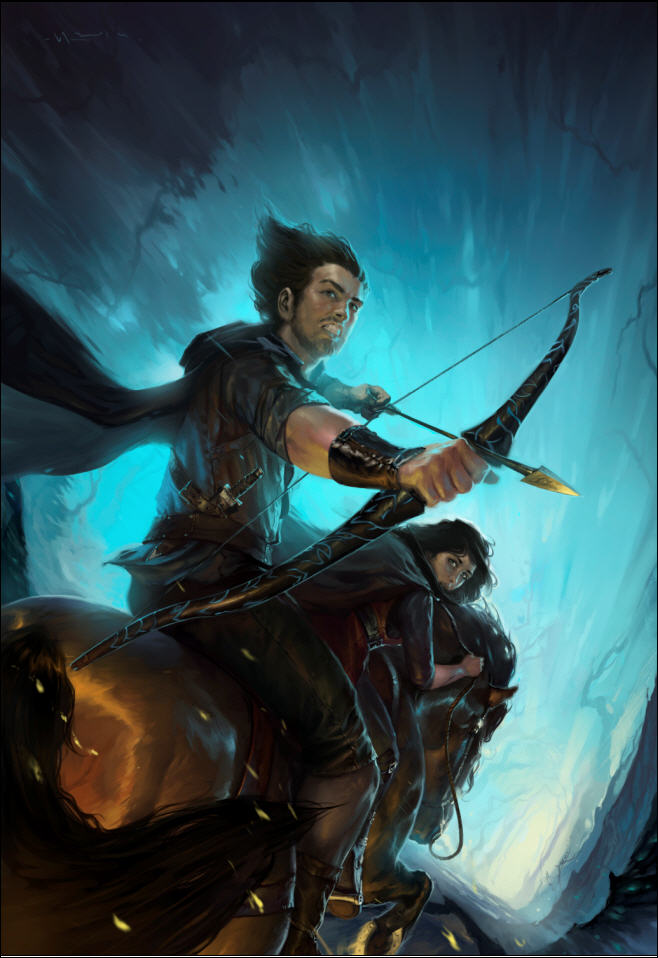
So a release of CURSE in July seems more than feasible. Then we’ll release RAVELER early August. Why August? Because we need to commission a new cover illustration. The soonest the artist can have it done would be August. Stay tuned. I can’t wait to see what art Victor comes up with next.
And if you want to get in on the new release sale for both, please sign up for the notification in the left sidebar.
You’ll note the word count on CODG is steadily rising. Today, I experienced a delightful AND maddening turn.
I find outlines to be immensely useful tools for story development. Of course, there are many more tools in the box–outlines can’t do everything. For example, there are times when you’re drafting a story that you write something and it suddenly generates new options for the story that you in no way could have imagined without getting to that point in the draft. You can get a lot of ideas with an outline, but drafts generate still more. Sometimes the options that present themselves while you’re drafting are so right they give you goosebumps. I got one of those today. Of course, part of why it was so good was not only that it put the character in a perfect dilemma and the reader in a perfect chapter cliffhanger, but also because it was completely unexpected yet logical.
This all sounds so good, right? Well, the story turn was so unexpected, it startled me. It’s thrown my outline off. Which means I’m going to have to now revise the working outline. I was tempted to make the story fit. After all, I DO have a deadline. But this story turn is so freaking juicy that I cannot justify the hackery. Besides, working outlines are made for revision.
I’m riding by the seat of my pants today folks, and it’s exciting. I think readers are going to love this turn.
I’ve just learned that Kroger Food has decided to carry Servant of a Dark God on a trial basis in its Utah Smith’s grocery stores. If it sells well, they will take it nation wide.
Folks, this is a BIG opportunity for SERVANT. To put this in perspective, Barnes & Noble, the biggest book retailer in the nation, currently operates 775 retail bookstores. For first time novelists in my genre, they usually stock 2-6 copies of a hard back book. (BTW, if after eight weeks the book has sold decently, they will model the book for the store which means when they sell out, they order some more. Other books that aren’t modeled are not reordered or are sent back to the publisher.) Kroger, on the other hand, operates 2,500 + grocery stores with book sections in them. That’s more than three times the size of B&N! That gives so many more readers the chance to preview the book. Heck, to even know it exists.
If you know someone in Utah who was thinking of buying SERVANT, let them know now’s a good time to get it at Smith’s. My fingers are crossed.
Also, if you spot the books while shopping at your local Smith’s, please let me know. I’d like to know how widely they’ve been distributed.
Here’s the latest version of the book description that will accompany the book on the various sites and on the back cover of the trade paperback. It’s purpose is to advertise: to let folks know the feel of the book and pique their interest.
A young man.
The girl he is hunting for using the dark and terrifying magic of Slethery.
And the monster who only wants to be free.
So begins the towering fantasy series that introduces an elaborate new world, a multifaceted system of magic, and a cast of compelling characters and creatures.
Trapped in a web of lies and ancient secrets, of right becoming wrong, the three must struggle not only against each other, but also a being of irresistible powers. A creature who is gathering her servants to oversee the impending human harvest.
If the three win, they will save those they love the most. If they fail, the clans of the land fall with them.
What people are saying:
~ Best Novel of the YearWhitney Awards, speculative fiction
~ EngrossingPublishers Weekly
~ ProvocativeBooklist
~ Starred Review!Library Journal
~ A great setting, a smart storyBrandon Sanderson
Do you think you can do better? See anything to cut? Have some book descriptions you think work really well? If so, comment. I’d love to see what you come up with.
On Wednesday, at 8:53 PM, I finished the first draft of Assassin.
It clocked in at just over 97,000 words, making it the biggest book in the Drovers series. Prey was 73,000 words, Outlaws 68,000, and Sura 84,000.
More importantly, Assassin finishes the story arc that began with Prey. I may return to Ferran and company for another arc in the future, but I wanted these books to have a real, satisfying ending. And now they have one, if only in first-draft form.
Nobody but me sees the first draft of what I write. For good reason.
I’ll let it sit for a week or two so I can come back to it cold and discover that I’ve changed people’s clothing mid-scene, used the word sit six times in three paragraphs, and committed other literary crimes.
Draft two goes to my beta readers, who report where they were excited, bored, confused, or questioned my grasp of reality.
Draft three addresses those issues and gets a thorough line edit, even though I’ve found the best way to discover spelling errors is to think you’ve found them all and then publish your book. At that point, the devils come out of hiding and begin dancing around on the page.
Dixon Leavitt, the artist who created the previous three covers, will be doing this one as well.
If all goes well, Assassin should be out for the holidays.
One of my favorite discoveries in the book was a lad named Weff.
I didn’t set out to write Weff. I didn’t know he existed. But I was up on the hill behind my house on one of my writing walks, walking and talking to myself about the story, when he suddenly appeared.
Broniss has streets paved with cobblestones, and the queen wants them kept clean. The problem is that horses, oxen, and other beasts have an unfortunate habit of leaving things behind.
So the city has children assigned to territories whose job is to keep those streets clear.
They’re called muck runners.
And Weff is one with an enterprising mind.
That’s one of the delights of writing for me. Sometimes you plan a character for months. Sometimes you’re walking along a dirt road talking to yourself and a manure boy shows up. And suddenly he must have a part in the tale.
While you’re waiting for the big wrap up, if you’re looking for an audiobook, I highly recommend Tim Curry’s reading of Garth Nix’s Sabriel. It’s a terrific fantasy to begin with, but Curry’s performance makes it even better. His rendition of Mogget is so enjoyable you may find yourself listening a second time.
If you’ve heard an audiobook performance you absolutely loved, tell me. I’m always looking for the next good listen.
A cracking good story idea requires five critical elements.
Until you have all five, you’ll struggle to plot. You’ll write a few scenes and run out of gas. You’ll feel like the story just isn’t going anywhere.
And that’s because it isn’t. It can’t. A story isn’t a story without all five elements.
However, once you develop these five things, your story will suddenly roar to life. There are a few other elements that are important as well, but these five things form the core of the story setup.
In this course you’re not going to merely learn about all of those story elements. You’re going to go deep and learn what can only be learned by actually doing the work and developing story idea after story idea with personal one-on-one feedback from someone who knows what they’re doing.
When you finish, you won’t just know story theory. You will be a story idea machine. And you will be that because you have put in the work. The right work.
Again, this is not a course full of lectures and videos. This is a course where you’re going to work. And develop the insights and skills that only come from doing the work.
You’re actually going to:
Come up with story setup after story setup after story setup
And improve them with one-on-one feedback.
It’s going to:
Eliminate years of you wandering about in the story wilderness trying to figure things out on your own.
Put you miles ahead of other writers who have no idea what’s really at the core of story.
You are going to learn how to develop killer story ideas on purpose instead of on accident. Which means you’ll be able to do again and again. Reliably. Like clockwork.
Course details
The focus of the class is not on learning about story, although you will do that. The majority of your time will be spent on developing stories.
You can’t become a carpenter by watching videos and reading books about it.
You have to get out on the work site, cut wood, and pound nails. You have to make the mistakes all beginning carpenters make, get feedback, and improve.
The same goes for writing.
And you’re going to work in this class. You develop 21 story setups. In fact, you develop more because the 21 are just the ones you turn into me. And with each one your skills, insights, and abilities grow.
In the beginning, your setups will be bare bones. By the end, they’ll be fully developed setups that beg to be written. Setups you can use to immediately write the first draft of your novel, whether that’s in outline or chapter form.
Here’s what you do each week.
Week 1.
Uncover the secrets of what’s really at the heart of story and how to generate ideas.
Define your genre requirements
Create story setups 1-3
Week 2.
Uncover the secrets to compelling characters
Create character sketches
Create story setups 4-7
Week 3.
Uncover the secrets to formidable obstacles
Create story setups 8-11
Week 4.
Uncover the secrets to interesting casts
Create story setups 12-15
Week 5.
Uncover the secrets to managing multiple storylines and series
Create story setups 16-19
Week 6.
Create story setups 20-21. These are your capstone projects where you apply everything you’ve learned and take it to the next level
In this class you develop story idea after story idea after story idea. You are going to be marinated in the work of developing characters, THOMs, goals, obstacles, settings, casts, and more. And because of that, each week will not only bring an explosion of insights, but new skills and abilities.
Every week you get two private, one-on-one, live sessions with me where you get encouragement and feedback on what you’ve developed. And you’ll have access to a private Facebook group where you can apply the principles to brainstorm even MORE ideas for each other’s stories.
At first you might feel a bit shy and worried about your ideas and abilities. But you’ll soon get over that. By the end of the course you’ll be one of those people that can generate terrific ideas easily. And you’ll be able to do that because you will have put in the work to become a different writer.
What’s the price?
Hours of one-on-one instruction from a professional editor or author costs thousands of dollars. An MFA program can cost $25,000 to $30,000 or more!
But this course won’t cost anywhere close to that.
Plus you’re going to learn things here you’ll never get in an MFA program (I know. I was accepted into a top-ranked program).
The cost of this course is $799. And I personally guarantee your results. You’ll be totally oh-my-gosh-I’m-so-happy-I-took-that-class satisfied, or I’ll give you your money back. No questions asked.
Now’s your chance to stop spinning your wheels. I can’t tell you how much I wish I’d had something like this when I’d started:
The secrets about the true core of story.
The secrets about how to come up with ideas.
Actual work with personal one-on-one feedback.
Laser focused on what actually matters, not a bunch of ridiculous writing rules.
When you finish, you will be a story idea machine.
You won’t know plotting. That’s a different course and set of skills. You won’t know how to write chapters. But you’ll know how to create the engine that powers all the rest of that. You’ll know how to create the core that makes awesome plots and chapters possible.
If you want to take this course, click the button below and contact me. I will tell you exactly how to apply.
I’m not going to be able to accept everyone who wants to take the class. I have a very strict limit on the number of students I can work with. So you need to get your application in before the deadline of midnight, December 11th.
If you’re a writer, you’ll find Life, The Universe, & Everything (LTUE)an excellent convention. Yes, it’s focused on science fiction and fantasy, but the principles of writing discussed apply generally and there are a lot of authors who will be there that write in different genres–YA, romance, etc. In fact, there will be a LOT of published authors there, period–including two that have recently been on the NY Times best seller list and others who have just broken in.
If I were an aspiring author, I’d be making sure I had arrangements to attend at least part of the convention. Follow the link above and look at the list of panel topics. And remember: it’s open to all and FREE of charge.
Dates: Feb 11-13, 2010
Wilkinson Center
Brigham Young University
Provo, UT 84602
(801) 422-4636 (BYU information line)
I’ll be doing the following. Hope to see you there!
BTW, Stephen Nelson has graciously offered to film the workshop. If the recording and class pass muster, we’ll post it for your viewing enjoyment!
Thursday, Feb 11
5 – 7 PM: Writing workshop: “How to Write a Story That Rocks” (John Brown, Larry Correia)
Friday, Feb 12
9 AM: Panel: “Paths to publishing: When is traditional best and when should you try an alternative” (Stacy Whitman, John Brown, Dan Willis, Eric Swedin, Sandra Tayler)
1 PM: Panel: “Killer Openings – How to write a gripping, engaging and interesting opening paragraph” (Dr. Steven C. Walker, John Brown, Mette Harrison, Heather Horrocks)
Saturday, Feb 13
9 AM: Panel: “A Guys Take on Writing Romance (Male Panelists)” (L. E. Modesitt, Jr., Clint Johnson, Aleta Clegg, Dan Willis, John Brown)
Noon: Panel: “Building different cultures….” (L. E. Modesitt, Jr., Roger White, John Brown, Brandon Mull, Marty Brenneis)
1 PM: Signing. (Wish very much I could go to Eric James Stone’s reading at the same time. I’ve gone to 2 or 3 of his and have never been disappointed)
2 PM: Reading from CURSE OF A DARK GOD.
5 Comments
I think 120 words is the perfect length for a fantasy novel. I like Martin’s books (and Steven Erikson’s too for that matter, which must be in the 300k-400k range), but they become feats of endurance (for me) at times.
I like the title “RAVELER”, very intriguing!
“I have tormented those who enjoyed book 1 and wanted more far too long.”
You can say that again! I think you are only a few months from the 5 year anniversary of the date Servant was published.
As I have said before, I think releasing shorter books more frequently is the way to go in this era of ebooks.
Probably the optimal formula is to release a book every 3 months and charge $2.99 for each book. It would be interesting to release a chapter or two every month and charge $0.99, but amazon’s ebook royalties penalize books less than $2.99, so I think the 3 months formula may be better. 3 months is short enough that fans get a new book frequently, but allows enough writing time to create a book long enough to justify paying $2.99 (at least 50K words). I think most fans are willing to pay around $12 per year for an ebook series, whether that is a 200K word ebook a year at $12, or a 50K word ebook every three months at $3/ea. But any more than that and I think most fans may balk. Actually, some fans balk at an ebook more than $10, but give them 200K words per year, divided into two or more installments, with each installment priced below $10, and many will not have a problem.
If you have 2 or 3 series going at once, you could spend 3 months on each book in each series and alternate so that fans still have less than a year to wait for the next book, even if they only read one of your series. But I doubt it is optimal to have more than 2 series going at once.
It’s good to hear you both have no issues with shorter books!
John,
3 months would be great. If I were full time, I don’t think that would be an issue. My goal now is to get two books out a year, hopefully, three. We’ll see how it goes. I did write 50k words for the ending in two months earlier this year, but I wonder if 50k is just too small to fit the complexity of story I want to tell. I’m currently trying to come up with a structure that will allow shorter installments yet still retain the big feel. Things may speed up now that I’ve gotten over the big hump of the indie learning curve. It will be exciting to test and see.
If you are releasing part of a story every 3 months (or more frequently), then I do not think it is necessary to have everything, or even anything, wrapped up nicely every 3 months. So I do not think a complex story precludes releasing every 3 months. As long as customers know not to expect closure until the story is complete (you could manage expectations by titling each ebook part something like “Dark God, Part 2”).
Unless you meant that you doubt your ability to outline the story ahead of time. If you cannot do that, then I can certainly see the problem with releasing the story in 3-month-parts, since you could write yourself into a hole in the first 3-month-part that cannot be satisfactorily resolved 6 or 9 months later.
 My copy editor just delivered the marked up manuscript. I will be making the edits over the next few days. Once those are made, it’s time to publish.
 I’ve just learned that Kroger Food has decided to carry Servant of a Dark God on a trial basis in its Utah Smith’s grocery stores. If it sells well, they will take it nation wide.

I think 120 words is the perfect length for a fantasy novel. I like Martin’s books (and Steven Erikson’s too for that matter, which must be in the 300k-400k range), but they become feats of endurance (for me) at times.
I like the title “RAVELER”, very intriguing!
“I have tormented those who enjoyed book 1 and wanted more far too long.”
You can say that again! I think you are only a few months from the 5 year anniversary of the date Servant was published.
As I have said before, I think releasing shorter books more frequently is the way to go in this era of ebooks.
Probably the optimal formula is to release a book every 3 months and charge $2.99 for each book. It would be interesting to release a chapter or two every month and charge $0.99, but amazon’s ebook royalties penalize books less than $2.99, so I think the 3 months formula may be better. 3 months is short enough that fans get a new book frequently, but allows enough writing time to create a book long enough to justify paying $2.99 (at least 50K words). I think most fans are willing to pay around $12 per year for an ebook series, whether that is a 200K word ebook a year at $12, or a 50K word ebook every three months at $3/ea. But any more than that and I think most fans may balk. Actually, some fans balk at an ebook more than $10, but give them 200K words per year, divided into two or more installments, with each installment priced below $10, and many will not have a problem.
If you have 2 or 3 series going at once, you could spend 3 months on each book in each series and alternate so that fans still have less than a year to wait for the next book, even if they only read one of your series. But I doubt it is optimal to have more than 2 series going at once.
It’s good to hear you both have no issues with shorter books!
John,
3 months would be great. If I were full time, I don’t think that would be an issue. My goal now is to get two books out a year, hopefully, three. We’ll see how it goes. I did write 50k words for the ending in two months earlier this year, but I wonder if 50k is just too small to fit the complexity of story I want to tell. I’m currently trying to come up with a structure that will allow shorter installments yet still retain the big feel. Things may speed up now that I’ve gotten over the big hump of the indie learning curve. It will be exciting to test and see.
If you are releasing part of a story every 3 months (or more frequently), then I do not think it is necessary to have everything, or even anything, wrapped up nicely every 3 months. So I do not think a complex story precludes releasing every 3 months. As long as customers know not to expect closure until the story is complete (you could manage expectations by titling each ebook part something like “Dark God, Part 2”).
Unless you meant that you doubt your ability to outline the story ahead of time. If you cannot do that, then I can certainly see the problem with releasing the story in 3-month-parts, since you could write yourself into a hole in the first 3-month-part that cannot be satisfactorily resolved 6 or 9 months later.
64% looking good! 🙂