Author: John Brown

  • Generating Story 11: Creative Q&A with Author Janci Patterson

    I was introduced to Janci Patterson at a local convention by author Sandra Tayler (some may know Sandra because of her husband Howard who does the online Schlock Mercenary comic).  Janci told me she’d just signed with a YA publisher. That was exciting. I asked her what her novel was about. She told me, and I immediately hated her because it sounded like such a fun idea, and I wanted to not only read it, but also write the story myself. Luckily I have a few scruples and did not pay the local Klingons to off her and drop her body in the Great Salt Lake for the brine shrimp to feast upon.

    BTW, did you know that back in the day hucksters placed this ad in Boy’s Life magazine?
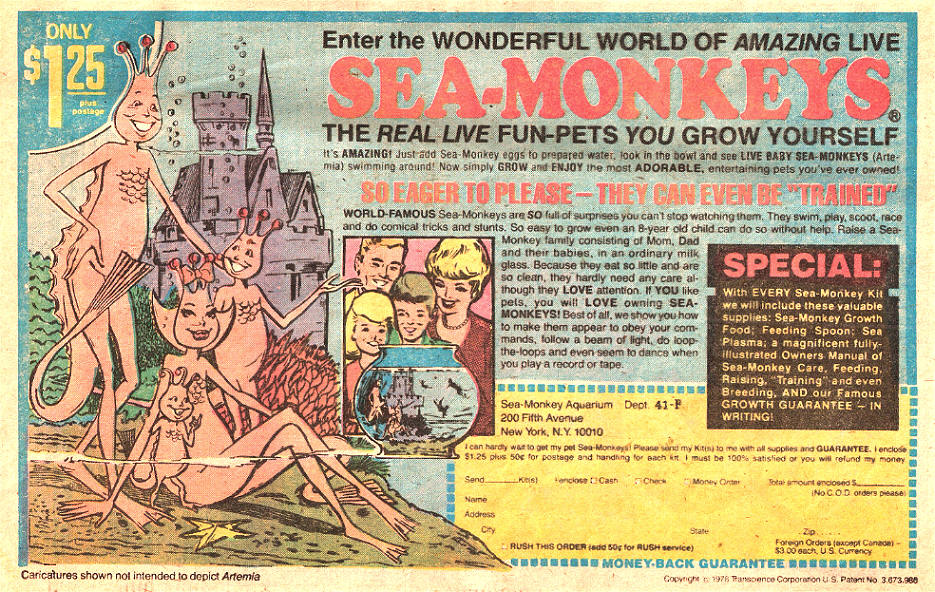
    Look at that cute sea-monkey family. Look at the picture of the human family watching the sea-monkey family swim around a castle in a bowl. Click on it. See it large.

    As a young lad, I, as every good Boy Scout should, subscribed to the magazine. I saw that ad over and over.  Who wouldn’t want a sea-monkey? So I saved up my money, earned by watering plants and trees at a nursery in the hot Utah summer sun, and ordered me a family to put on my own shelf.

    The aquarium came. It was not a bowl and did not have a castle. But, hey, there were real live sea-monkey eggs right there in the packet. They weren’t just fantasy creatures! I mixed in the water and salt and dropped the eggs in. I can’t tell you how excited I was. Days later the eggs hatched. And what did I have?

    Brine shrimp.

    BRINE SHRIMP!

    I could have had my mom drive me to the lake where I could have scooped up a million of them. For free. That was, I believe, my first great disillusionment. The first great step from child to adult.

    Alas, sea-monkeys . . .

    Anyway, back to story. Janci was one of those Codex Writers who shared how she used Q&A to develop her killer story idea. She agreed to share it with you. Here’s Janci.

    ***

    The idea for CHASING THE SKIP started with a game of existential questions.  That’s like Twenty Questions, only with no question limit and much more confusing subject matter–like the Pythagorean theorem, or gas prices.  My husband and I like to play the game on long road trips, since a really good round can take two or three hours to play out. 

    On this occasion, I chose a bounty hunter.  It took Drew about five minutes to guess that one–not my finest subject ever.  But after he guessed it, we started talking.  I knew that bounty hunters still existed, but I had no idea how chasing down a fugitive could be a part of our contemporary justice system.  Just what is it that bounty hunters did, anyway?  How did it all work?

    After our road trip, that question stuck with me, so I began to do some research.  What I discovered fascinated me.  A bounty hunter could legally chase down his mark because of the bail bond process.  In order to be released from jail before a pending trial, an arrestee had to put up bail money as collateral, to ensure they returned for their trial.  Since most people can’t afford to post the full bail amount, a bondsman will post it for them, in exchange for a smaller fee.  When the arrestee skips bail, the bondsman is out the money–unless he can get bring the arrestee back.  In fact, he’ll have that person sign away their constitutional rights to privacy in addition to paying the fee.  He’s allowed to go find them if they don’t show up in court.  He can even break and enter to do so–dragging them out against their will.  But the bondsman is a busy man, so he signs those rights over to a bounty hunter, and off the bounty hunter goes, chasing down the skip.  If a person is good at it, bounty hunter can be a legitimate career.

    As I researched, I knew I had the beginnings of a story.  This had all the elements–reality with a touch of danger, crime with a touch of justice.  I wanted to make it work. 

    But I write YA novels, and no bondsman would sign on a teenager to go after his skips.  That would have all kinds of negative legal ramifications, and even if it didn’t, no reader would believe it. Enter my Creative Q&A, the question I always ask when I’m doing idea development for a novel: where can I put a teenager in this?

    Answer: she couldn’t be the bounty hunter, but she could be the bounty hunter’s daughter.

    That posed its own problems, of course.  No dad in his right mind is going to haul his daughter along on the road with him as he tracks down skips.  (Or, in question form, what would make a dad in his right mind bring his daughter into such a dangerous situation?)  I needed a crisis, so he had to bring her along, had to track down the skip, had to keep going with all of it, even when things got rough.  And if I could work in some interpersonal drama, all the better.

    And so it was that Ricki became abandoned by her mother, forced to ride along with her bounty hunter father, a man she barely knows, as he chases down a skip who is more dangerous than his usual mark.  Why would he take this particular job with Ricki along? 

    Ricki would like to know that, too.

    ***

    John Sez: ins’t that a great idea?  I hate Janci.

    While we’re hating her, did you notice that she got some random bit of zing playing 20 questions with her hubby? She followed it up by doing some research.  After doing that, she had a lot more zing. She also knew she had a general topic for a story.  She knew she had the beginnings of a story because her zing meter was going wild. 

    But she didn’t have a story yet.  She had a vocation, which is nothing more than a bit of setting.

    To have a story you need character, problem, plot, AND setting.  So she whipped out her Creative Q&A tool to help her find a character.  And the question she asked was one she’s found is very productive for her. It’s a basic question. But it’s an excellent question. And from that Q&A she started to develop the rest of the story parts.

    The take away isn’t that playing 20 questions on road trips is the key to story ideas.

    It isn’t that one question Janci asked, as fundamental and productive as it is.

    It’s that the principles we’ve been discussing in these posts work. Develop the 6 Core Parts. Think about objectives. Start anywhere. Hunt zing. Generate your own zing. Use Creative Q&A. Work on the various parts using whatever tools you have until you have developed enough that the story comes alive in your mind.

    I hope she sells a million.

    For more in this series, see How to Get and Develop Story Ideas

  • Federal Spending 1972-2011: What The?!?

    Last week a chart made the rounds, ranking the Presidents since Reagan on spending.  Look at Reagan.  That happy man is a freaking profligate. Obama, on the other hand, heck, he’s doing better than Bill Clinton.

    Except there are a few problems.

    First, I can’t tie this data out to the official CBO numbers.

    Second, it does a bit of apples and oranges because the numbers are based on each president’s whole time in office.  What does it mean when Obama increases the debt by 35% over three years, but it takes Bill Clinton almost EIGHT YEARS to increase the debt that much?  A better measure would be an average per year.

    Third, some have suggested this chart monkeys with the numbers, allocating the first year of each president’s first term to the previous president.

    Fourth, the president isn’t the only one in Washington. Senators and Congressmen also have responsibility.

    Finally, while a % increase in debt is a helpful measure, it’s not the only story. And it can be misleading if viewed on its own. For example, if we have $1 of debt, and I increase that to $10, I’ve increased our debt by 1000%. Holy Schnitzel!  But if we have $500 million of debt and I increase it to $600 million, I’ve only increased it by 20%. Which is worse?

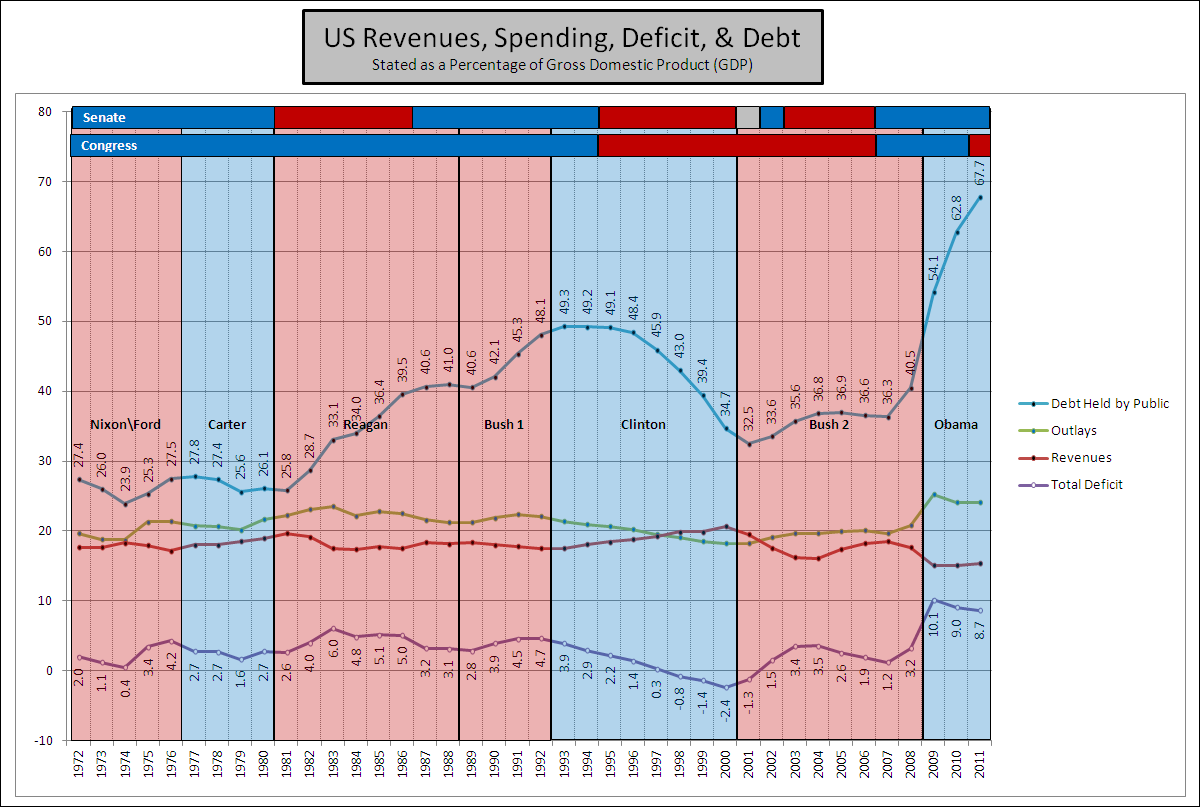
    So I went out to the CBO and took their numbers from 1972 – 2011.  You may get the XLS file yourself: http://www.cbo.gov/publication/42911. Then I made sure to identify who was in charge when and marked it with spiffy colors (Red is Republican, Blue is Democrat). Here are the results. Click on it to see it in its full size glory.


     What does this tell us?

    First, there was only ONE four-year stretch in the LAST FREAKING FORTY YEARS where the folks in Washington did not spend MORE than they took in. That was the four year period from 1998 – 2001.

    What the?!?

    Look at that chart again. There is a serious and systemic spending problem in Washington.

    What happened in 1998 to change what had been going on for almost three decades? That was when the citizens got fed up with Washington, threw out a great number of the Senators and Congressmen, and bought into the Contract with America.  This was when Newt Gingrich was Speaker of the House. This was when Clinton was getting pounded for all sorts of stuff and worked with those particular Republicans in Congress to balance the budget.

    Second, the deficit, the purple line at the bottom, tripled when Obama took office.  And stayed!  Who put that first chart together? Oh, yeah. It was Nancy Pelosi.

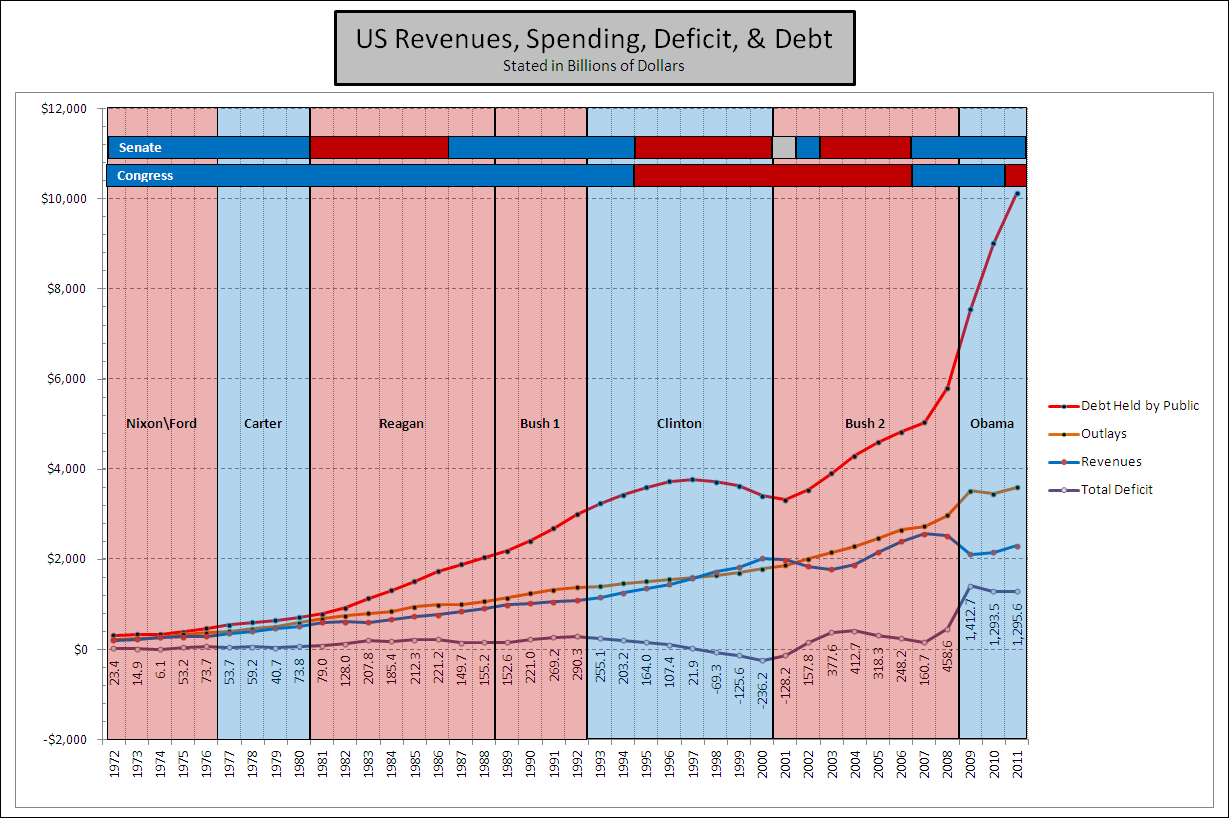
    You might say, well, raw dollars is good.  But what’s really important is how big a percentage that spending is of our nation’s GDP. If you’re spending 100 billion when the nation is producing 1 trillion, that sounds big, but it’s actually not as big a deal as when you’re spending 100 billion and the nation is only producing 200 billion. Okay, let’s look at these numbers as a % of GDP.

    Again, 1998-2001 were good years. On a % basis, the folks in Washington during that time did better than anyone else in not spending the nation’s wealth.  There’s no doubt that Reagan, Bush 1, Clinton during his fist 3 years and the Congress during those times were all happy to be big spenders.  Look at the debt burden during their years. But Obama and the Democratic majorities in Congress since 2007–drunken sailors compared to those guys. And then the Republicans come in and it doesn’t change. Gridlock?

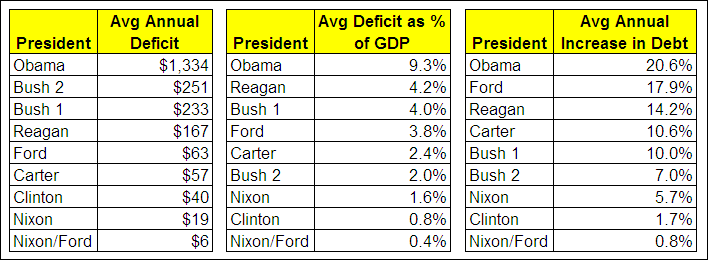
    Let’s look at our presidents since 1972 and see how well they do on an annual basis. Those numbers in the first list, BTW, are stated in billions.

    Seems to me the most fiscally responsible groups were those in charge during the latter part of the Clinton years, the Nixon years, and the year when Nixon resigned.  It appears that during that year the folks in Washinton were so busy with the Watergate scandal they forgot to feed their spending appetites.

    Bottom line: as I said before, Washington has a serious and systemic problem with over spending.

    And when I say “systemic” I mean it appears the whole thing is rigged to produce over spending. We don’t just need new people out there. We need a system that prevents the overspending. We need an ammendment that requires a balanced budget and caps the size of the government in relation to GDP.

    We also need to find a way to incentivize Congress to pass a budget each year.  No budget, no pay is a good idea. The current House has indeed passed a budget. But the Democratic Senate has not, preventing us from having a budget at all. Obama submits budgets, but not a soul in the Senate, Democrat or Republican, will vote for them. It’s only the Republican House who seems to want to actually do their job. How can that be? Read It’s Deja Vu All Over Again with National Fiscal Policy for more info.

    This November we need to get a bunch of folks like those in 1998 back in Washington. A President AND a Congress who will actually finally tame the nation’s out of control spending.  Let me suggest you look at your Congressman’s and Senators’ records.  How have they voted? As for President Obama, well, I’m looking at the numbers above.

    Related Links

  • A Response to John Scalzi

    The best way to change someone’s mind: use the skills you learned writing fiction.

    John Scalzi recently wrote a post about White Privilege.  You know: the idea that Straight White Males (SWMs) have all the cards stacked in their favor.  It’s called “Straight White Male: The Lowest Difficulty Setting There Is.” I assume he wrote it to help SWMs have more sympathy for those who aren’t SWM.

    It’s a noble cause.  Not as noble as true love, but that’s so rare–not one couple in a century has a chance at true love (at least when you live in Guilder).

    The problem is that Scalzi’s post is a great 101 on how To NOT Win Friends and Influence People.  Actually, that’s not right.  He will win new friends and increase his influence among those who are like-minded.  But if he was hoping to win over those who didn’t already see things his way, I don’t think he’s going to be very successful.

    His posts generated hundreds of comments. When you look at the comments, you’ll see that the vast majority of them are folks arguing Scalzi’s side with smug condescension and other folks arguing points against Scalzi with an equal lack of tact.

    In short, it’s a classic online bring-your-guns-to-the-party event.

    Alas.

    Except I must admit such events can be a lot of fun if you’re on the side with greater numbers.  Furthermore, there is sometimes a tremendous pleasure to be had in being provocative.  Sometimes we simply must publish something with teeth in it.  And maybe that’s what Scalzi was trying to do. 

    But if not, here’s where Scalzi’s post went admirably wrong.  And it has everything to do with principles that underlie influence as well as writing fiction.  You see, when you’re writing fiction and you want someone to root for your character, you do not turn to the reader and insult him. Insults don’t bring readers into your world.

    Equally as important, telling, or demanding someone feel a certain way towards someone else, will fail every time you try it. You cannot demand (or whine) that a reader must feel sympathy and admiration for the character.  Why?  Because emotions don’t respond to demands.  They just don’t.  It’s like trying to freeze water by seasoning it with pepper. 

    The advice “Show, don’t tell” works in real life as well as it works in fiction.

    Emotions are automatic.  If someone presents the right stimulus, we WILL feel the desired emotion in response.  We don’t experience a sympathetic change of heart when someone gets in our face and demands we feel sympathy.  We do feel that change when we see the antecedents which prompt the emotional response in us.  Show me.  Make me believe.  And the response is automatic.  

    This is what happened with Uncle Tom’s Cabin and the movie Ghandi and the TV series Roots and the more recent movie Believe in Me and the novel Les Miserables and thousands of others.  It’s what happens every day when someone in one group meets someone in another group they feel some distrust for and begins to build a friendship. 

    Show the antecedents, help folks identify, and you’ll move millions.  Get up and rant at someone, and all you’ll get is the bird.  And applause from the true believers.

    Scalzi claims that if you feel offended by his post then you’re hypersensitive because all he was doing is pointing out the facts.  Um, no.  Jim Hines is trying to establish potential facts.  You could try to verify those.  You could try to separate out causation from correlation.  But Scalzi is not doing that. He’s telling all SWM that they are playing on the kiddy version of the life video game.  Your life is so easy.  Everything is rigged for you.  You’re playing the baby version.  And because of that everyone else’s life is so much harder.

    No, he didn’t say those words exactly. But there is this thing call connotation. There is this thing called tone.  And no matter how hard you try, you’re can’t separate the non-verbal communication from the message. 

    Everyone knows that some people have it harder in life and some have it easier. Like, duh.  I think we all learn that when we showed up to the first grade.  So what’s the point of telling all the SWM’s reading his blog that they are playing the dweeb version of life, the one with training wheels?

    Furthermore, instead of helping all of us pampered SWMs identify with our brothers and sisters, he tries to erect more boundaries that would push us apart by giving all of us another way to discriminate and another reason to be resentful.

    Lowly, pampered SWMs at the bottom.  Gays, people of color, and women farther up. 

    So now we’re going to go around with a My Life’s Harder Than Yours number?  The opinions of those with low numbers will have less weight.  How could they have anything as worthwhile to say when their life has been so easy?  Those with higher numbers will have more weight. 

    A whole new group calculus will have to be developed and standardized.  And it will have to go beyond which shade of brown your skin is (yes, White people really are just a lighter shade of brown), your gender, and sexual orientation.  Because those who are handicapped, by birth or by accident have it really rough too.  We’d have to figure out if they had it more or less rough that someone who was gay, and would that change if that gay person lived in San Francisco versus Laramie, Wyoming?  A geographical element!  And what about those with idiot parents who teach their kids to take meth and don’t get them to school or beat them in alcoholic rages or who are never around?  I wonder what score that would bring.  And what about the kids who grow up with grandpa molesting them?  And what about the short, the fat, the plain?  What about those with glasses?  Those who are runty bully targets?  Or those with a minority religion.  What about those born with AIDS? 

    Are we sure it’s a good idea to start ranking ourselves, using color, gender, and sexual preference to tag our status? 

    Wait, haven’t we already tried that?

    When someone comes up to you at a party and condescends, when they’re always one-upping you with a “you think you’ve got it hard you haven’t seen squat” line, what is your response?  Even if it is legit.  What about when they get in your face for someone else?  Does that change your default response?

    It’s the same at internet parties and gatherings.

    So.

    Lesson 1: If you want to influence someone, don’t start by insulting them and continue by talking down to them. If you want to have a good time with like-minded friends, then, by all means, skewer.

    Lesson 2: Remember “show, don’t tell” to win someone’s affection.  Present the person’s story, and the reader will feel respect, trust, sympathy, sorrow, regret, and admiration automatically (okay, you’re right, some of that depends on the reader).  Tell or demand, and none of that will occur.

    Lesson 3: Don’t raise barriers between two groups when you want members of one group to identify with members of another.

    Here’s a better way. 

    Tell me a story about a real gay black woman.  Make me love her.  Make me care.  Tell me a story about her I can sympathize with.  Just show me the woman.  Make it about her, not her group category.  Or tell me a story about a Mexican man who is just trying to provide for his children in America.  Or tell me about a sympathetic SWM who goes to Asia or Polynesia and finds the cards stacked against him.  Stories like this abound.  

    In fact, why don’t you drop the whole “SWM” business.  If you want me to identify, to experience-take (yes, that official jargon), it’s probably best not to slap SWM on me and set me in one corner and slap GBM on someone else and set them in another.  Help me identify.  Focus on how we are alike. When you do discuss the differences, magnify those things that are wonderful and unique, or eccentric and unique, or goofy and unique, or weird and unique, or whatever, but make it positive.  And when you must talk about old or continuing grievances between two groups, do so with respect, with a desire to calm, not enflame.

    Lest you think I don’t know what I’m talking about, I grew up working in a family business where employees were White, Black, Hispanic, Tongan, and Japanese.  Male, female, homosexual, heterosexual.  And we were a big family.  My father and mother held out big welcoming arms.  I have Whites and Blacks in my biological family.  I hope my daughters find great men to be their husbands.  And if they happen to also be Indian or Puerto Rican or Black or Asian or Maori or Scottish or Southern or whatever, I would think it was grand.  It’s possible I might experience some of that mild “other group” anxiety that sometimes comes when you meet someone that’s not just like you.  But I know it’s possible to get beyond that by seeing what’s common, building friendships, and celebrating and laughing at and with the differences.

    My father, God rest his soul, liked to quote Edwin Markam.  I thought it fitting.

    He drew a circle to keep me out,

    A thing of scorn, and a thing to flout.

    But love and I had the wit to win:

    We drew a circle that took him in.

    You want to laugh with the like-minded?  Draw the first kind of circle.  You want to win hearts and minds?  Draw the bigger one.

  • Generating Story 10: Creative Q&A with Orson Card

    Back when Orson Card first started his online magazine Intergalactic Medicine Show, he wrote an essay in which he detailed how he developed the idea for one of the short stories he told in his Ender universe. Card’s essay is a valuable resource because he exposes his mental thought process, modeling how he approaches story development.  It’s not often that an expert takes the time to expose his mental thought process while working through something, and there’s always a lot to learn when they do.  Interestingly enough, it illustrates a number of the principles in the Story Development Framework.

    Please read How One Story Can Give Birth to Another by Orson Scott Card.

    While you are reading it, watch for:

    1. How often he uses questions as he develops the story.
    2. How story objectives influenced what he wrote.  For example, why didn’t he write from Peter’s point of view, and how did he want to portray the mother?
    3. How story principles guided his development.  For example, what were the three ways to get an audience’s interest and how did that affect the story development?
    4. What he did when his zing suggested he go another way.  Did he end up writing the story he set out to at first? (Card listens to his Spidey-sense, what he cares about and believes in, quite a bit.)
    5. What his first draft provided him.  What does this say about using drafts to help you develop the story? 
    6. How he used the four-scene “plan” he sketched of the story.  How did that outline help him?  When he had that, was he finished developing the story?
    7. How he uses improvising to continue the development as he drafts.  What did he need in order to improvise? And what was he actually doing?

    Did you notice the elements of the story–problem, character, plot, and setting?  Did you notice how his development continued while working on the text (drafting)?

    One thing I don’t think you should take away from this is that you must write exactly like Orson Card.  That you must not include much setting.  Or that your sketches of the plot, the “plan” of the story, needs to be just like his.  You may enjoy more setting than Card.  You may want more or less in your sketch.  That’s fine.  The goal here isn’t to suggest you follow his exact procedure and have his exact same objectives.  It’s to see how authors use creative Q&A to develop a story, to make it come to life.

    As a final side note, I would like to quibble with one thing Card says.  A lot of folks talk about showing and telling in writing.  The eleventh commandment is to “Show, don’t tell.”  But I would like to suggest that writers actually never show anything.  They can’t.  It’s all tell, tell, tell. 

    Showing requires the original sensory input.  So a movie can show.  A stage play can show.  Both can also provide raw auditory input.  But all an author can show are marks on a page.  Those marks guide a reader into imagining events, people, and things, but it’s telling–“imagine this, imagine that, now imagine this.”  The author can tell in scene or summary.  Both have their place.  But it’s important to realize that we’re helping the reader imagine.  I don’t have time to go into the implications of this right now, but try the idea on for a while and ask yourself what type of writing helps you imagine things more vividly.

    For more in this series, see How to Get and Develop Story Ideas
  • Generating Story 9: Creative Q&A with Author Ian Creasey

    So how do writers use questions in their story development? Let’s hear first from Ian Creasey, whose short fiction has appeared in magazines such as Asimov’s, Realms of Fantasy and Weird Tales, and has been reprinted in several Year’s Best SF anthologies.  His excellent collection Maps of the Edge was published last year. 

    Stories Are Made Of Scenes

     by Ian Creasey

    I’d like to begin by thanking John for the opportunity to write a guest post about the technique of using questions to help create stories.  This is not a “where do you get your ideas?” post.  Rather, it assumes that you already have a basic idea, which you want to develop into a complete story.

    I’ll use one of my own stories to illustrate how the question technique works in practice.  The questions themselves are sufficiently general that they can be applied across a whole range of stories.  What tends to change is the order in which they are asked.  I find that stories sometimes start from an idea for a specific detail, in which case the process involves working backwards to develop the appropriate context.  In other cases, the initial idea is rather abstract, and the task is to flesh out the premise with sufficient detail.

    My example story is “The Report of a Doubtful Creature”, which was published in Orson Scott Card’s InterGalactic Medicine Show (November 2009).  I mention the publication date, because this was actually the seed for the story.  The year 2009 marked the bicentenary of Charles Darwin’s birth, and also the 150th anniversary of the publication of Origin of Species.  I live near the Yorkshire town of Ilkley, which Charles Darwin visited just before the first edition of Origin was published.  I therefore decided to write a story about Darwin’s visit to Ilkley, with the aim of getting it published in November 2009, exactly 150 years after the first edition of Origin of Species in November 1859. 

    So I had a story I wanted to write, without any notion of what its plot might be.  The technique of asking questions helped me to shape the story, and I’ll list some of those questions here. 

    Who is the story about?

    For my particular story, the answer is already in the premise: it’s about Charles Darwin.  But other times, it’s not immediately obvious who a story might be about — for instance, if the initial idea is to explore a technological or social development, then there is a wide range of people who might be affected.  In this case the standard advice is to ask, “Who is the most hurt by this development?  Who has the most to lose?”  That person is often a suitable protagonist (or antagonist) for the story.

    What is the story about?

    In this example, it’s fairly obvious that the story has to be about evolution.  There’s not much point in writing a story targeted for the anniversary of the Origin of Species, if it’s not about evolution!

    What is the conflict?

    The Origin of Species is a famously controversial book, symbolising a clear conflict between science and faith.

    Wow… so far it looks easy, doesn’t it?  It may appear that I’ve cheated by starting with several questions to which I already know the answer.  But in fact I’m illustrating the point that if you have the germ of an idea for a story, then there are already some questions and answers implicit in your premise, no matter how vague it may initially seem to be.  It can be useful to state these answers explicitly, to help crystallise the starting position.

    What is the specific example?

    This is what John calls a “power question”, a key question that can be widely applied, and which cuts right through to the essentials.  The question “what is the specific example?” can be asked in many contexts (e.g. in considering how to show characterisation), but I find it particularly useful when framed as, “How does the conflict manifest itself?”

    This isn’t mathematics: there’s no right or wrong answer.  But you need some kind of answer.  It’s a classic beginner’s mistake to write a story entirely in abstract terms: telling the reader about the conflict, without showing it.  Stories are made of scenes.  There should be at least one scene which dramatises the overarching conflict by putting a specific example onstage.

    A short story will typically hinge upon a single scene that illustrates the core of the conflict.  A novella or novel may require more instances, e.g. a small-scale scene near the beginning, and a large-scale scene toward the end.  But the principle of needing specific examples still applies.

    If I say that I’m going to write a story about evolution, and the conflict between science and faith, I’m speaking in general terms.  I need a specific example.  The device I chose was to have Darwin encounter a strange creature, which might possibly be a fairy.

    What are the stakes?

    This is another “power question”.  It’s a way of saying, “Why does this story matter?  Why should the reader care?”

    There are different ways of addressing the question, depending on whether you develop the story on a top-down or bottom-up basis.  If you start from specific details, then you may need to establish that those details represent important issues.  Conversely, if you start from the big issues, then you need to establish that your illustrative details are sufficiently representative.

    For my story, the question of evolution (i.e. science vs. faith) is already a high-stakes issue.  So the crucial task was to establish that my specific example adequately represented the issue.  Basically, if fairies exist — so what?  Why would that affect evolution?

    Here is the answer from the story, in Darwin’s words:

    “My theory of natural selection requires that life proceeds by common descent.  All creatures are related, however distantly.  So any particular creature must possess living relatives, of some kind; and ancestral forms should be preserved as fossils.  Any beast, however unprecedented to man’s eyes, must fit somewhere within the Linnaean taxonomy.

    “If fairies exist as material creatures, what genus do they occupy?  Where are their fossils?  (The fossiliferous strata contain an imperfect sample of past organisms, yet surely we could hope for one example to be retained from the entire fairy lineage.)  If the traditional description be correct — like a small man with wings — it is clear that fairies cannot fit anywhere within the existing genera of Mammalia.  We could only accommodate them within Animalia by supposing an entirely separate line of descent, one which has left no close relatives, no intermediate forms, and no fossils.  The evidence does not support it.

    “It would be simpler, therefore, to suppose that fairies were a separate creation.  After all, why should we require all creatures to be related?

    “We indeed require it, for if we allow that any creature may be a separate creation, then we must allow the possibility to all creatures.  How could I argue that a wolf must have descended from canid predecessors, if I cannot argue likewise for a fairy?  Any opponent could simply say, ‘The wolf was independently created in its current form, just like a fairy.’  I would have no refutation for such a critique.  Even those who accepted the Wolf might balk at the descent of Man from simpler progenitors, if given the excuse of the Fairy.

    “My hypothesis must explain all creatures, or it explains none.  Everything, or nothing.  The thought burned in my mind: If this fairy truly exists, it will destroy my whole Theory.”

    What choice does the protagonist face?

    This is another “power question”.  A story tends to feel more meaningful if the protagonist faces a genuine choice — a difficult decision.  The nature of the choice obviously depends upon the overall conflict, but its onstage manifestation is determined by the specific example that illustrates the conflict.  So when deciding upon an example, it’s helpful to bear in mind the choice that the example implies.

    In my story, what choice did Darwin face when he encountered the fairy?

    “A thought struck me that it would be simple to let the creature escape, thus avoiding the revelation of what it might be, and what it might imply.  The temptation seemed to hang in the air before me, needing but a single step to reach out and grasp.”

    Where does the encounter happen?

    Once the specific example has been selected, and its importance has been established, our questions move to the realm of practicalities.  We must decide how the example is “staged”.

    Stories are made of scenes.  The scene begins when the protagonist encounters the situation, whatever the situation is.  So the author’s task is to decide where and when that encounter takes place.

    For my story, I needed Darwin to see a fairy.  How could that happen?  Maybe he goes out for a walk, and simply happens to see one.  But that feels rather coincidental: too obviously contrived by the author.  Also, at the time the story takes place, Darwin is ill: he’s in Ilkley to take the “water cure”.  So he’s not likely to be wandering very far.

    I decided to introduce a secondary character: a woman who had captured the fairy.  She knew that Darwin was a famous naturalist, so she asked him to come and see it.

    It’s important for a short story to remain focused, and not become cluttered with too many characters.  It’s dangerous to answer every question by introducing a new character.  But in this particular case, it was a useful solution.  I started off with only a protagonist, Darwin.  He didn’t have anyone to interact with.  By introducing a secondary character, I allowed myself scope for dialogue, interaction, and contrast.

    Conclusion

    I’ve deliberately ended this post on an anti-climactic note, because although stories conclude with a climax, this doesn’t mean that the climax is the last thing you work out when writing it.  Personally I find it easier to begin by shaping the overall structure of a story, including the ending, before I work out all the nitty-gritty staging details.

    The questions that I’ve listed here are, obviously, not exhaustive.  But I hope they give an indication of how an abstract idea can be turned into a detailed narrative.  In my opinion the most important thing to remember is this: Stories are made of scenes.  The most useful questions are those which help you envisage a particular scene.  Once you can imagine the scene in your head, half the task of writing it is already done.

    John sez . . .

    So are you curious about his story yet?  If so, “The Report of a Doubtful Creature” is available to IGMS subscribers at http://www.intergalacticmedicineshow.com/cgi-bin/mag.cgi?do=issue&vol=i15&article=_003 . You can also learn more about Ian and his work at www.iancreasey.com.

    I’d like to thank Ian for taking the time to write up his process on this story. I though he made a number of interesing points. Did you notice what he said about envisioning scenes? Did you see that at least one of his questions is particular to this story and might not be used on any other?

    Understand the core principles. Get a list of core questions. But then realize you’ll need to use creative Q&A as you go with all sorts of questions, large and small.

    For more in this series, see How to Get and Develop Story Ideas