A Response to John Scalzi

The best way to change someone’s mind: use the skills you learned writing fiction.

John Scalzi recently wrote a post about White Privilege.  You know: the idea that Straight White Males (SWMs) have all the cards stacked in their favor.  It’s called “Straight White Male: The Lowest Difficulty Setting There Is.” I assume he wrote it to help SWMs have more sympathy for those who aren’t SWM.

It’s a noble cause.  Not as noble as true love, but that’s so rare–not one couple in a century has a chance at true love (at least when you live in Guilder).

The problem is that Scalzi’s post is a great 101 on how To NOT Win Friends and Influence People.  Actually, that’s not right.  He will win new friends and increase his influence among those who are like-minded.  But if he was hoping to win over those who didn’t already see things his way, I don’t think he’s going to be very successful.

His posts generated hundreds of comments. When you look at the comments, you’ll see that the vast majority of them are folks arguing Scalzi’s side with smug condescension and other folks arguing points against Scalzi with an equal lack of tact.

In short, it’s a classic online bring-your-guns-to-the-party event.

Alas.

Except I must admit such events can be a lot of fun if you’re on the side with greater numbers.  Furthermore, there is sometimes a tremendous pleasure to be had in being provocative.  Sometimes we simply must publish something with teeth in it.  And maybe that’s what Scalzi was trying to do. 

But if not, here’s where Scalzi’s post went admirably wrong.  And it has everything to do with principles that underlie influence as well as writing fiction.  You see, when you’re writing fiction and you want someone to root for your character, you do not turn to the reader and insult him. Insults don’t bring readers into your world.

Equally as important, telling, or demanding someone feel a certain way towards someone else, will fail every time you try it. You cannot demand (or whine) that a reader must feel sympathy and admiration for the character.  Why?  Because emotions don’t respond to demands.  They just don’t.  It’s like trying to freeze water by seasoning it with pepper. 

The advice “Show, don’t tell” works in real life as well as it works in fiction.

Emotions are automatic.  If someone presents the right stimulus, we WILL feel the desired emotion in response.  We don’t experience a sympathetic change of heart when someone gets in our face and demands we feel sympathy.  We do feel that change when we see the antecedents which prompt the emotional response in us.  Show me.  Make me believe.  And the response is automatic.  

This is what happened with Uncle Tom’s Cabin and the movie Ghandi and the TV series Roots and the more recent movie Believe in Me and the novel Les Miserables and thousands of others.  It’s what happens every day when someone in one group meets someone in another group they feel some distrust for and begins to build a friendship. 

Show the antecedents, help folks identify, and you’ll move millions.  Get up and rant at someone, and all you’ll get is the bird.  And applause from the true believers.

Scalzi claims that if you feel offended by his post then you’re hypersensitive because all he was doing is pointing out the facts.  Um, no.  Jim Hines is trying to establish potential facts.  You could try to verify those.  You could try to separate out causation from correlation.  But Scalzi is not doing that. He’s telling all SWM that they are playing on the kiddy version of the life video game.  Your life is so easy.  Everything is rigged for you.  You’re playing the baby version.  And because of that everyone else’s life is so much harder.

No, he didn’t say those words exactly. But there is this thing call connotation. There is this thing called tone.  And no matter how hard you try, you’re can’t separate the non-verbal communication from the message. 

Everyone knows that some people have it harder in life and some have it easier. Like, duh.  I think we all learn that when we showed up to the first grade.  So what’s the point of telling all the SWM’s reading his blog that they are playing the dweeb version of life, the one with training wheels?

Furthermore, instead of helping all of us pampered SWMs identify with our brothers and sisters, he tries to erect more boundaries that would push us apart by giving all of us another way to discriminate and another reason to be resentful.

Lowly, pampered SWMs at the bottom.  Gays, people of color, and women farther up. 

So now we’re going to go around with a My Life’s Harder Than Yours number?  The opinions of those with low numbers will have less weight.  How could they have anything as worthwhile to say when their life has been so easy?  Those with higher numbers will have more weight. 

A whole new group calculus will have to be developed and standardized.  And it will have to go beyond which shade of brown your skin is (yes, White people really are just a lighter shade of brown), your gender, and sexual orientation.  Because those who are handicapped, by birth or by accident have it really rough too.  We’d have to figure out if they had it more or less rough that someone who was gay, and would that change if that gay person lived in San Francisco versus Laramie, Wyoming?  A geographical element!  And what about those with idiot parents who teach their kids to take meth and don’t get them to school or beat them in alcoholic rages or who are never around?  I wonder what score that would bring.  And what about the kids who grow up with grandpa molesting them?  And what about the short, the fat, the plain?  What about those with glasses?  Those who are runty bully targets?  Or those with a minority religion.  What about those born with AIDS? 

Are we sure it’s a good idea to start ranking ourselves, using color, gender, and sexual preference to tag our status? 

Wait, haven’t we already tried that?

When someone comes up to you at a party and condescends, when they’re always one-upping you with a “you think you’ve got it hard you haven’t seen squat” line, what is your response?  Even if it is legit.  What about when they get in your face for someone else?  Does that change your default response?

It’s the same at internet parties and gatherings.

So.

Lesson 1: If you want to influence someone, don’t start by insulting them and continue by talking down to them. If you want to have a good time with like-minded friends, then, by all means, skewer.

Lesson 2: Remember “show, don’t tell” to win someone’s affection.  Present the person’s story, and the reader will feel respect, trust, sympathy, sorrow, regret, and admiration automatically (okay, you’re right, some of that depends on the reader).  Tell or demand, and none of that will occur.

Lesson 3: Don’t raise barriers between two groups when you want members of one group to identify with members of another.

Here’s a better way. 

Tell me a story about a real gay black woman.  Make me love her.  Make me care.  Tell me a story about her I can sympathize with.  Just show me the woman.  Make it about her, not her group category.  Or tell me a story about a Mexican man who is just trying to provide for his children in America.  Or tell me about a sympathetic SWM who goes to Asia or Polynesia and finds the cards stacked against him.  Stories like this abound.  

In fact, why don’t you drop the whole “SWM” business.  If you want me to identify, to experience-take (yes, that official jargon), it’s probably best not to slap SWM on me and set me in one corner and slap GBM on someone else and set them in another.  Help me identify.  Focus on how we are alike. When you do discuss the differences, magnify those things that are wonderful and unique, or eccentric and unique, or goofy and unique, or weird and unique, or whatever, but make it positive.  And when you must talk about old or continuing grievances between two groups, do so with respect, with a desire to calm, not enflame.

Lest you think I don’t know what I’m talking about, I grew up working in a family business where employees were White, Black, Hispanic, Tongan, and Japanese.  Male, female, homosexual, heterosexual.  And we were a big family.  My father and mother held out big welcoming arms.  I have Whites and Blacks in my biological family.  I hope my daughters find great men to be their husbands.  And if they happen to also be Indian or Puerto Rican or Black or Asian or Maori or Scottish or Southern or whatever, I would think it was grand.  It’s possible I might experience some of that mild “other group” anxiety that sometimes comes when you meet someone that’s not just like you.  But I know it’s possible to get beyond that by seeing what’s common, building friendships, and celebrating and laughing at and with the differences.

My father, God rest his soul, liked to quote Edwin Markam.  I thought it fitting.

He drew a circle to keep me out,

A thing of scorn, and a thing to flout.

But love and I had the wit to win:

We drew a circle that took him in.

You want to laugh with the like-minded?  Draw the first kind of circle.  You want to win hearts and minds?  Draw the bigger one.

Share

Similar Posts

  • Obama, Romney, Rich People, Roasts, and A Good Cause

    Every year the Alfred E. Smith Foundation hosts a millionaires-only fundraising dinner for Catholic charities. It’s a custom to have the two main candidates speak in election years.  President Barack Obama and Governor Mitt Romney roasted themselves and each other this week, just two days after their brouhaha second debate.

    Not only are both talks funny, but the fact that these two men came together for this purpose says a lot about both of them. Go Obama and Romney! It’s the perfect antidote to bitter political rancor.

    Enjoy. 

    President Obama’s Speech

    Transcript: http://blogs.suntimes.com/politics/2012/10/transcript_president_obama_at_the_alfred_w_smith_dinner.html

    Mitt Romney’s Speech

    Transcript: http://blogs.suntimes.com/politics/2012/10/transcript_mitt_romney_at_the_alfred_w_smith_dinner.html

    Share
  • Conservative Republican Amnesia

    If you ask the “conservative” talking heads–Limbaugh, Beck, Hannity, etc.–who THE best conservative president of the last 100 years was, they will say Ronald Reagan. If you ask their dogs, they will bark “Ronald Reagan.” Their gerbils will say other things, but everyone knows you can’t trust rodents. Ask the regular conservative Wanda and Mack (Jane and Joe is so cliche), and they’ll give you the same response as the dogs and people. Ronald Reagan is the guy we conservatives and Republicans have been taught to worship.

    Except, when presented with a candidate as conservative as Reagan, no, probably more conservative (I’m talking Mitt Romney), many of these “conservatives” get out their inquisitional torches. Which is a big reason why the GOP primaries are as fluid as they are at this point.

    As a side note, have you noticed that these talking heads and the mainstream media either have a hobby horse they ride above all else (Rush Limbaugh and his anti global warming crusade) or they seem to promote some flavor-of-the-day litmus test for each election. In one election, they’re going on and on about homosexual marriage. The next election, it’s a talking head approved stance on Taliban bombing. The next, it’s the fact that budgets must be balanced. They line the candidates up and then start whacking them based on these flavor-of-the-day tests. It’s like going to buy a car and focusing all your attention on the steering wheel.

    Anyway, I think many of us have forgotten what THE so-called best conservative president of the last 100 years looked like. If Ronald Reagan were to run today as John Smith, the conservative talking heads would drop him like a hot potato.  You don’t believe me? Well, let’s see how he stacks up.

    1.      ILLEGAL IMMIGRATION

    1. Reagan signed in amnesty for 3 million illegal aliens. The south-west-east-north-of-the-border kind, not the ones with green antennas.
    2. Talking Head Response: After crapping a brick, they would proclaim that John Smith, aka Ronald Reagan, is a pro illegal immigration RINO and must be thrown out!

    2.      ENVIRONMENTAL REGULATION

    1. A few weeks ago Rush Limbaugh told a caller that Romney is not conservative because of his stance on man-made global warming (Romney says he doesn’t know, but there seems to be evidence men contribue; women, of course, never to contribute to such things–they’re too smart), which Limbaugh thinks will lead to big-government regulation of emissions etc.
    2. YET AS GOVERNOR, Reagan established the Air Resources Board to battle California’s worst-in-the-nation smog problem. In a 1984 radio address to the nation, Reagan took credit for the strong action he took in California to combat smog, saying: “I’m proud of having been one of the first to recognize that States and the Federal Government have a duty to protect our natural resources from the damaging effects of pollution that can accompany industrial development.”
    3. THEN AS PRESIDENT, he signed, with great pride, what many consider THE most successful environmental treaty of all time – the Montreal Protocol in 1987, which regulates emissions. Back in those days Ozone depletion was the Global Warming. Reagan believed it, despite folks questioning the science and was happy to regulate.
    4. In the 1987 State of the union he said: “We are also developing proposals that make use of market incentives to control air pollution caused by sulfur dioxide and nitrogen oxide emissions and the causes of acid rain.”
    5. What?! A cap and trade like program? Yes, putting Bush in charge. In 1990, the first Bush Administration successfully pushed through legislation establishing a cap-and-trade program to reduce acid rain—the program Reagan started!
    6. Talking Head Response: John Smith is a total pro-environmental regulation RINO, please queue Al Gore singing “Burning Ring of Fire”

    3.      ABORTION

    1. Reagan signed a permissive law that allowed abortions. Since that law went into effect more than 2,000,000 abortions have happened in the Golden State.
    2. Reagan says he failed to see how it would be abused. He blamed his own inexperience, stating that had he been in office longer he would have realized that the bill was wrong.  He blamed doctors for misinterpreting the bill. President Reagan stated his prolife position by saying: “Abortion on demand now takes the lives of up to one and a half million unborn children a year. Human life legislation ending this tragedy will someday pass the Congress, and you and I must never rest until it does.”  BUT he never introduced a bill to ban abortion or amend what he’d done. Not in California, nor as president.
    3. Furthermore, today’s conservative inquisitors would point to his Supreme Court appointments. He appointed the moderate Sandra Day O’Connor.  Anti-abortion groups were livid, fearing, rightfully as it turned out, that Mrs. O’Connor would not vote to overturn Roe v Wade.  He appointed Justice Anthony Kennedy who had a long history of supporting expanded rights of privacy, gay rights, and preserving a woman’s right to choose.
    4. Talking Head Response: actions speak louder than words–John Smith is a pro-choice RINO

    4.      UNIONS

    1. Reagan was a union president 8 times in a row.
    2. Reagan, aka John Smith, also had lots of troubling connections to the Teamsters, who endorsed him, and who suddenly saw less investigation of their leaders for corruption. This is during the Jimmy Hoffa organized crime years.
    3. Talking Head Response: choke, ack, sputter–Smith is a pro-union gangsta RINO!

    5.      GUN CONTROL

    1. It was Governor Ronald Reagan of California who signed the Mulford Act in 1967, “prohibiting the carrying of firearms on one’s person or in a vehicle, in any public place or on any public street.” Yeah, he aimed to stop the Black Panthers et al, but affected all gun owners.
    2. Twenty-four years later, Reagan was still pushing gun control. “I support the Brady Bill,” he said in a March 28, 1991 speech, “and I urge the Congress to enact it without further delay.” He was right with Clinton on that issue.
    3. The Brady Bill, for the first time ever, instituted federal background checks on firearm purchasers in the United States.
    4. NRA spent millions fighting it, when it pass they mounted cases in a number of states wanting to have it overturned as unconstitutional.
    5. Talking Head Response: anti-gun RINO!

    6.      FISCAL POLICY

    1. As Governor, Reagan signed into law the largest tax increase in the history of any state up till then. Meanwhile, state spending nearly doubled.
    2. As President he continued. While he did cut taxes his first year, he signed into law tax increases of some nature in every year from 1981 to 1987. Furthermore, the debt increased to nearly $3 trillion, roughly three times as much as the first 80 years of the century had done altogether.
    3. Talking Head Response: tax and spend RINO!

    7.      RELIGION

    1. Smith, aka Reagan, let Nancy’s astrologer affect his schedule
    2. Talking Head Response: troubling devilishness (scary for evangelicals everywhere!), even if he only did it to make Nancy feel peace

    Reagan the RINO? Are you kidding? And yet Reagan would be hounded out of the Republican party if he ran today. The talking heads would sound the warning long and loud, which is a shame.

    On the other hand, I’m not saying we need another Reagan. Clones never pan out–hasn’t anyone seen Multiplicty with Michael Keaton?! And despite the recent zombie craze, I don’t want one in the White House, even if the world would be a better place if said zombie should eat Vladimir Putin’s brains out. I tire very quickly of Reagan worship. Or any other politician worship. As good as Reagan was, I disagree with a number of things he did. What I am saying is that those who want to get another president “as good as Reagan” had better know what such a president looks like. And it ain’t the caricature that’s being held up today by many conservatives, especially the talking heads, who seem to gloss over the facts of history.

    Share
  • No Apology: Chapter 1 – The Pursuit of the Difficult

    WE MUST FACE OUR CHALLENGES OR DIMINISH

    Romney starts the chapter with a quote his dad used to recite to him: “the pursuit of the difficult makes men strong.” Romney states that over the years, he’s come to believe that this idea applies to more than individuals—it applies to businesses and nations as well.

    He maintains that America has always faced great challenges. He cites a few examples from America’s history and states that there really hasn’t been a time when we were free of challenges. It seemed, after Reagan and Bush had presided over the fall of the Soviet Union, many thought “peace and prosperity were here to stay—without threat, without sacrifice.” Of course, that proved untrue.

    America has faced great challenges in the past and faces huge challenges now. He believes we will “remain the leading nation in the world only if we face our challenges head on.” If we do not face and overcome them, we will become “the France—still a great country, but no longer the world’s leading nation.”

    The question is: what’s so bad about that?

    The answer is that some other nation or nations would fill the power vacuum. Romney poses the fundamental question: “what nation or nations would rise, and what would be the consequences for our safety, freedom, and prosperity?”

    FOUR GLOBAL STRATEGIES FOR WORLD POWER

    Romney suggests that there are a number of nations and groups who are “intent on replacing America as the world’s political, economic, and military leader.” He states that there are, in fact, “four major strategies currently being pursued to achieve world leadership.”

    The first global strategy to achieve world power is the one represented by the United States. It is a strategy based on two fundamental principles: economic freedom and political freedom. Those nations that follow this strategy have become economic powerhouses and account for more than 60% of the world’s GDP. They are also the countries who have given humankind the most freedom.

    The second global strategy is the one pursued by China. Its fundamental principles are free enterprise and authoritarian rule. He spends a couple of pages discussing how well Chinese enterprise is doing. Then he believes China is intent on becoming stronger than the United States.

    The third main global strategy is the one pursued by Russia. It’s fundamental principles are authoritarian rule and controlling energy. “By controlling people and energy, Russia aims to reassert itself as a global superpower.” He then explains how this could be possible.

    The fourth main strategy for global power is the one pursued by the violent jihadists, who count many foreign leaders in their numbers. Their strategy is based on conquest and compulsion through a variety of tactical means.

    Of these four strategies in competition today only one is founded on freedom. Romney then suggests that we can be confident that our children and grandchildren will be free ONLY IF the economic and military strength of America and the West endure. He suggests that our superpower status is not inevitable. “Three other global strategies, each pursued by at least one state or major actor, are aggressively being pursued to surpass us, and in some cases, to suppress us. The proponents of each are convinced they will succeed. And world history offers us no encouragement.”

    Because of this, he believes that “our primary objective as a nation must be to keep America strong. I am convinced that every policy, every political initiative, every new law or regulation should be evaluated in large measure by whether it makes us stronger or weaker” because “our freedom, security, and prosperity are at stake.”

    OBAMA’S DRAMATIC SHIFT IN FOREIGN POLICY

    Romney next maintains that president Obama has introduced a foreign policy that “is a rupture with some of the key assumptions that have undergirded more than six decades of American foreign policy.”

    He states that when World War 2 ended, America executed a “dramatic and profoundly meaningful shift in our relationship with the rest of the world.” Previously we had guarded our own hemisphere and attempted to stay isolated from the affairs of Europe and Asia. But we found with WW1 and WW2 that “our vital interests could not be secure in the face of threats to the cause of freedom elsewhere. At the dawn of the nuclear age, a third world war was unthinkable; it would mean the destruction of humankind.” So the president and leaders of both parties “shifted America’s foreign policy. America took on the task of anticipating, containing, and eventually defeating threats to the progress of freedom in the belief that actively protecting others was the best way to protect ourselves.”

    This new order had three main pillars:

    1. “Active involvement and participation in world affairs”
    2. “Active promotion of American and Western values including democracy, free enterprise, and human rights”
    3. “A collective security umbrella for America and her allies”

    He talks about how all the presidents, Democrat and Republican, followed this new strategy. But President Obama is engineering a dramatic shift away from it based on his own underlying attitudes.

    Obama envisions an America that arbitrates disputes rather than advocate ideals. This is one of the reasons why he apologized to countries around the globe for American arrogance, trying to placate our enemies. This is also why it seems he has undercut many allies, including Israel, Poland, and Columbia. To be an arbitrator, you need to be equidistant from both sides. Not advocating for one or the other.

    Another one of Obama’s assumptions is that “America is in a state of inevitable decline.” He, therefore, considers it futile to fight it; instead, it’s his job to help us manage our decline. Romney suggests Obama believes maintaining a dominant America is “a bad idea even if it were possible.”

    Of course, Romney fundamentally disagrees with that assessment.

    GETTING BACK ON TRACK

    Romney suggests several things we can do to get back on track:

    • Treat our allies like allies
    • Strengthen the American economy
    • Increase our defense spending
    • Remind ourselves that the most attractive thing about us is our ideas—so we should “encourage democracy where we can, give aid and comfort to those who want it, and not undermine those who already have it”

    Undergirding all of this, Romney suggests, “must be a certain conception of the goodness and greatness of America.” This “doesn’t mean America is a perfect country. We have made mistakes and committed grave offenses over the centuries.” But we should recognize that “No nation has shed more blood for more noble causes than the United States. Its beneficence and benevolence are unmatched by any nation on earth, and by any nation in history.”

    Romney concludes by saying that he believes America is “destined to remain as it has been since the birth of the Republic—the brightest hope of the world” but only IF we face our challenges head on and work to keep America strong.

    MY RANDOM COMMENTS

    First, I don’t know if I’m going to have the time to capture each chapter in such detail. We’ll see.

    Second, I found the discussion of the four strategies insightful. Particularly because it put in explained a number of questions I had about why Putin’s Russia does what it does. It also gave me insight into China, which I thought was still mostly economically socialistic.

    I found the explanation of America’s shift in foreign policy in the 20th century interesting. As well as the shift Obama has made. I think I need to understand Obama better. Does he really think this? The actions and speeches Romney cites certainly are suggestive. Has anyone seen the movie 2016? It sounds similar.

    It might appear the book will continue allocating space for attacking Obama, but I believe the six pages in this thirty-page chapter form probably the biggest appearance Obama makes in the book.

    It’s clear that Romney’s business experience, especially as a consultant, has influenced how he sees things. The whole talk of strategy and challenges and competition reminds me of Michael Porter.

    Porter is a Harvard professor and founder of Monitor, a strategy consulting firm that has been hired by corporations and countries. He is claimed to be the most cited author in business and economics. According to Wikipedia “He is generally recognized as the father of the modern strategy field, and his ideas are taught in virtually every business school in the world. His work has also re-defined thinking about competitiveness, economic development, economically distressed urban communities, environmental policy, and the role of corporations in society. . . his main academic objectives focus on how a firm or a region can build a competitive advantage and develop competitive strategy.”

    The idea that America is competing with other nations is, of course, true. But I don’t think I’ve ever heard anyone running for president claim that their central goal, the goal any president should have, is to keep America strong because of the competitive threats we face. The talk is usually all focused on this issue or that without the broader picture I found here. I found Romney’s central tenet clarifying and refreshing. The rest of the book is going to be about how to keep our competitive advantages and strength.

    Comments, observations, or issues from anyone who has read the chapter?

    Share
  • Good Stuff! Three Days in Moscow

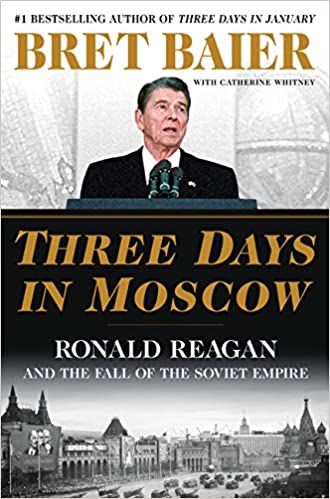
    Book cover, Three Days in Moscow

    I just finished Three Days in Moscow: Ronald Reagan and the Fall of the Soviet Empire by Bret Baier. It’s a New York Times bestseller that takes you into the world of Ronald Reagan, his rise to power in politics, and his role in ending the Cold War. And it does in a personable way with gentle humor throughout.

    I enjoyed the fascinating behind-the-scene insights about the personalities involved and the clarity about what really happened. And how the book brings Reagan to life, as if he’s almost there. Along the way you’ll also get insight into Mikhail Gorbachev, the assassination attempt on Reagan, and more.

    Baier is the chief political anchor for Fox News. In 2001, he became the station’s chief Pentagon correspondent and ended up traveling to Afghanistan 11 times and Iraq 13 times. In 2007, he became the station’s chief correspondent to the White House. More importantly, Baier seems to be one of the few journalists these days who is simply trying to get and report facts instead of spin. And that’s exactly what he’s done here.

    If you like biographies or history, if you want to know how the U.S.A. and the U.S.S.R. stepped back from decades of mutually assured destruction, if you want to get a view into how diplomacy is done, then I think you’ll love this book. And you’ll probably love it even more if you can listen to the audio book version, read by Baier himself, which also includes a recording of Reagan’s speech to the students at Moscow State University. I listened to it via the Overdrive account my public library provides. Baier’s reading was terrific.  

    Share
  • What’s driving the rise in school shootings?

    Homicide rates are down in America, but school shootings are up. What’s going on? What’s driving this?

    Some say it’s guns.

    I have an hunch that I think deserves some study.

    Back in the 1970s we had 30 school shootings with a population of about 216 million.

    Today we have a population of 320 million. If we had the same ratio of shootings to population today, we’d have 44 shootings total in the decade between 2010 and 2020. But from 2000 – 2010, we had 60. And since 2010 (if my data is correct, and it appears that’s a big if–see Edit 2 at bottom) we’ve had 146. That’s a 300% increase!

    If we want to solve the school shooting problem in the long term, we need to figure out what’s fueling it. One way to get at this is to ask what’s changed since the 1970s and 80s when the rates were lower.

    Are we killing at a higher rate in general? Is that what’s changed?

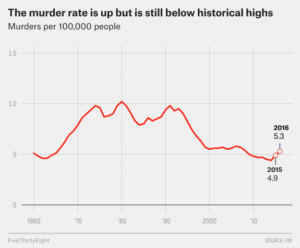
    No. FiveThirtyEight reports homicide rates have dropped. Here’s their chart.

    We’re down.

    But school shootings are up. Way up!

    Clearly, what’s driving school shootings doesn’t seem to be the same thing that’s driving general homicide rates. Otherwise, the rates would be moving in the same direction, but they’re not.

    Is it gun ownership rates?

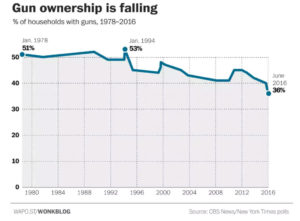
    According to the Washington Post, ownership rates are at their lowest in quite some time. Here’s their chart.

    This means that if general gun ownership rates were a major factor, then we’d be seeing school shooting rates fall. We’re not.

    Furthermore, some of the US states with the highest gun ownership rates have the lowest murder and school shooting rates. (For those wanting to know more about guns, magazines, the definition of an assault rifle, gun control, etc. see Larry Correia’s informational post below.)

    Now, it could be that while overall gun ownership rates have fallen, ownership in certain population segments has risen. That’s something to look at. But when looking at the overall ownership rate, we don’t find an answer.

    Is there anything else to study? Anything else that might be different now?

    Here’s my hunch–it’s the internet. My hunch is that an unintended consequence of social media and the ease of finding certain types of content have facilitated the development of the mindset and ability of certain youth to commit these crimes.

    We do things when we are prompted to take a specific action and we have both the ability and desire necessary to take that action. So action requires three things:

    1. A prompt
    2. The ability
    3. The desire

    If the rates are going up, then one or more of those things have changed. Either more kids are being prompted to take this specific action, we’ve made it easier for them to do it, or we’ve increased their desire to do it. Or some combination of those three.

    Let’s see if the internet might be a factor.

    First, from what I’ve read, it seems a lot of these kids feel like outcasts and seem to be seeking some kind of revenge. Does social media foster and facilitate more bullying and isolation and, therefore, more resentment? Has it increased the desire to conduct such attacks?

    Second, it is dramatically easier for kids to learn how to do all sorts of stuff now. Back in the 70s and 80s, it was hard to learn about the methods and tactics of crime, firearms, etc. Now, if you want to learn how to shoot, scope a place out, plan an attack, do all sorts of things, you can watch YouTube videos on it. Has the easy accessibility of how-to instruction facilitated the ability to plan and carry out these attacks?

    Third, back in the 70s and 80s you had limited programming. Gilligan’s Island, Brady Bunch, The Love Boat, The Donny and Marie Show, Lawrence Welk, etc. They all fostered good-citizen values. Today, kids have easy access to all sorts of crap. Violent rape porn. Evil games like Blue Whale that give challenges to the player, and the last is to kill yourself. Are there certain types of programming on the internet that foster a violent mindset? That prompt these very actions and makes them seem like a good alternative?

    Fourth, look at how well political conversations go on Facebook. Chat rooms, blogs, etc.–we all know they foster more incivility than when you talk in person. Does our social media, by its very structure, anonymity, etc. foster a more anger-filled approach to disagreements? Has it prompted, even trained, more kids to behave this way?

    Is one of the unintended consequences of the internet and social media a rise in school shootings?

    I’m not saying it’s the only part of the puzzle. But I do think it’s worth studying. We need a long-term solution.

    At the same time, we need something now while that long-term solution is being researched and implemented. One of the best ideas I’ve seen so far to stop the killings is the one mentioned here.

    Such people are screened, trained, and on-site. They can respond immediately. Plus it’s voluntary. If you’re a teacher that doesn’t want to do this, you don’t have to. Plus this doesn’t add security guards to schools. Nothing changes at the school until the shooter shows up, and suddenly there are half a dozen, dozen, two dozen deputies immediately there.

    I think at our tiny 1A middle school, there are probably 6-8 people who would do this, including my wife. The teachers know the kids, know where other teachers are likely to be, know the place like the back of their hands. We know security deters threats. I can’t see anything but positives.

    I don’t like the fact that we have to contemplate this. I want to go back to my youth in Bountiful, Utah where this never happened. Maybe we can get back to that type of a society. Until then we need an immediate, practical, and effective solution. This seems like a good part of a multi-approach solution.

    But what’s the long-term solution?

    I wonder if has to do with the internet.

    Is any organization seriously studying this?

    Do you see anything else that might have increased the prompts for this specific action, the ability to plan and conduct attacks, or the motivation to do so?

    Edit 1 – gun retention

    On Facebook today, a former deputy sheriff I know and respect was asked “Should teachers carry guns?” His answer: “No. Weapon retention is never even considered when politicians and others come up with that. Imagine some big, unfriendly student disarming a teacher during some classroom issue. Instant problem.”

    This is a good point to raise.

    I didn’t think of it. It’s clear none of the teacher defense plans are complete without it.

    But is it a show stopper?

    First of all, how big a risk is this? How many student-teacher scuffles do we have in grades 1-6 where the teacher is overpowered by a third-grader? How about in middle school? I’m sure the risk is higher in high school.

    But just because there’s a risk doesn’t always mean you shouldn’t do something. Male and female agents and officers are trained in retention. My question is whether such retention training is ineffective? Should officers not carry guns because of this?

    If it is effective, then it seems to me that if you’re trained, you’re trained. A big senior boy has just as much chance to disarm a trained cop as a trained non-cop of the same size and strength.

    This is another reason I like the suggestion of the sheriff above. It’s not just any teacher that would do this. They need to be screened and trained. They’re deputized. I could see them doing training on a frequent basis. Something goes down at at school, and you immediately have 6-8 trained deputies on site. Maybe a dozen or more. Is that not a game changer?

    It’s good to identify risks. But what would reduce the risks identified? Could we reduce them to acceptable levels? It’s a question that needs answering.

    Edit 2 – is the “rise” due to bad data?

    Just saw this. Is the “rise in school shootings” even real? Or is it bad data? Here’s an opinion on USA Today, suggesting it might not be as bad as we think. One of the things that’s maddening about all of this is what seems to be a lack of good data!

    Sources

    Share
  • Presenting at the League’s Summer Symposium

    I’ll be presenting this Saturday, June 8, at the league’s summer writer symposium at USU. Here’s the description of my presentation.

    Make ‘Em Beg For More!
    How do you keep your readers begging for one more page? The answer is probably not what you think. Come to this session to learn the surprising secret—along with plenty of examples and how-tos. When you’re done, you’ll know exactly what you need to do to write stories that are devilishly hard for readers to put down.

    Check out the schedule below. Looks like there will be some great presentations. If you attend, please come and say hello.

    https://www.leagueofutahwriters.com/summersymposium

    Share

6 Comments

  1. I read Scalzi’s post with interest, and didn’t find too much with which to disagree. I came away with more of a “So what?” feeling, because what matters more than the cards we’re dealt is whether we play the hand well. Was I dealt a better hand than some, or even most? I’ll accept that I was. What will it matter if I fritter away those cards? Should I be false to myself and not play the hand to my advantage? I think not. And if I recognize that life need not be a zero-sum game, then if I succeed I can help others do the same.

    Other than a quick Twitter comment, I did not comment on Scalzi’s blog. Nor did I waste any time reading the comments. I can only imagine the snark and vitriol, but they will have to stay in my imagination because life is too short for me to subject myself to that. I find that we indulge ourselves to that extent when we take ourselves and our positions too seriously. I like the lines from The Indigo Girls:

    “And the best thing you’ve ever done for me
    “Is to help me take my life less seriously
    “It’s only life, after all”

    That said, I think you’ve done well to examine what can be more effective ways to make one’s point. If we’re not careful in how we a) relate to one another and b) communicate with one another, we’re likely to find that we’re just (as Switchfoot sings) “adding to the noise.”

    Nicely done!

    Best,
    G

  2. Gray, I like your sentiments about what to do with the cards you’re dealt. That seems so much more productive. And is more at the heart of the matter than what I wrote. Good stuff.

  3. My argument against Scalzi’s essay is there are far more categories than race, sex, and sexual preference. Me, for example, I’m considered the classic SWM when I’ve spent my life in foster care. You want discrimination try growing up with everyone around you who see you as either a rape victim or a potential serial killer. And let’s leave out the fact that I’m actually asexual because most people classify that as either an extension of heterosexuality and evidence that I have trouble with the ladies.

  4. James, yet another category that’s got to be rough. Which just shows that it’s much more productive to deal with people as individuals. Can you imagine the proliferation of groups we’d all have to track when we start thinking it’s a good idea to categorize and rank ourselves by all these factors–race, gender, sexual orientation, handicap, home environment, body type, minority status in geographic region, religion, economic status, and on and on and on? Hundreds, thousands of combinations. I know researchers like to isolate variables. I can see how that’s useful. But on a daily basis I think it’s counterproductive to relate to people that way, e.g. “Hi, I’m John, and, boy, your life is so much easier than mine.”

  5. For me, the reason the WP theory is a con game is that is assumes race drives people – it’s projecting one’s own concerns onto the world. Like a con game, it drags in people to an argument they may want nothing to do with, by arguing that wanting nothing to do with it is proof the theory is correct. It’s semantic and intellectual gibberish, the diabolical cleverness of a grifter. It sounds great but in fact doesn’t even exist outside one’s head.

    Hines stats are more decontextualized nonsense. Where are these stats from, is Hines the researcher, who sourced them? It’s dangerous to attach morality by skin. Creating a moral hierarchy by race, gender and gender preference is simply sad.

  6. Interesting comments, Fail.

    I see a lot of good in talking about outcomes, i.e. can you identify variables that lead people to happier and healthier lives? Can you identify variables that lead to economic success? Etc. That’s going to entail grouping. And some groups are going to have better outcomes overall. It seems to me the best thing to do when you identify outcomes is be very careful not to mistake correlations for causes. And when you do find a true cause, to go to work on the variable to change it. Not stoke resentments.

    I believe group dynamics do play some role. It’s human to group yourself. And it’s human to feel some anxiety sometimes when first dealing with groups you don’t have personal experience with. And because Whites are the majority group in the US, those anxiety issues we have with other groups shows up more. But ALL groups have that. Furthermore, there are many still living who experienced the full-fledged discrimination that was once rampant in America. So group dynamics have played a role and still do. But I think they always will. It’s how you work with that instead of against it.

Comments are closed.