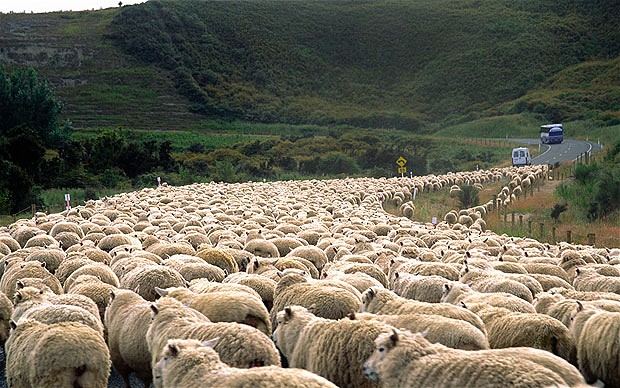
Sometimes the writing flows. And sometimes you get to the chapter you’ve sketched and realize you’re stuck until you get the sheep off the road.
You had no idea they were going to be there, but there they are, bringing you to a halt.
For me, this means I have got to do a lot more thinking to make the scene work realistically. Or work at all.
That was chapter 13.
It stopped me dead in my tracks. Some folks say to write on, get the first draft done, but that isn’t how my brain works.
Besides, I tried that strategy with my first draft of Curse. I ignored the little Spideysense warnings I had about a fundamental situation and wrote on. I ended up with a big old honking manuscript that had to be rewritten from almost the beginning because everything from about 1/3rd the way through had taken the wrong trajectory. So instead of taking 10 hours to figure it out and fix it, I spent 300-400 rewriting.
That’s called stupid writing.
So for the last ten writing sessions I was researching and thinking and researching. And when I finally had a sketch based on how things actually work, I went back into flow and wrote the chapter without much trouble at all.
Huzzah.
Chapter 14 looks like it will be quick and easy. Some sneaking, some fighting, and a big discovery of a plot turn.
My editor just emailed me another endorsement from one of the folks we sent the manuscript to. I’m so excited! This one’s from Kage Baker.
I’m a total stranger to three of the four that have responded so far. It continually amazes me how generous the pros in this genre are with both their time and praise.
Here’s the last one.
“A classic heroic saga, dealing with the bedrock issues of good and evil and identity. These are classic themes because they matter; and Brown makes them matter both to his young protagonist and the reader. It promises to continue for quite a distance, and I hope it does.”
—Kage Baker, author of House of the Stag and The Company series.
Here are the previous ones.
“Thoroughly engrossing from the first page to the last! John Brown shows himself to be a writer with remarkable depth and power. I haven’t seen a debut novel this good in years!”
—David Farland, New York Times best-selling author of Runelords and Ravenspell series
“In Servant of a Dark God, John Brown has created a complex and intricate world, filled with all the permutations of human good and evil, as well as evil that goes beyond the human, where neither heroes nor villains are quite what they seem at first, and where the cost of virtue is high indeed, yet where, in the end, the tenacity of such virtue is what is required to triumph.”
“A complex, powerful story of a youth trying to learn who he is and what he is, with no allies he can trust in a world stalked by a monster. A book that copies nothing I have read before and which goes its own way brilliantly.”
—David Drake, author of the popular Hammer’s Slammers and Lord of Isles series
Folks, a huge thanks goes to Stephen Nelson for putting all this together. You may kiss his hand when you see him.
This is a recording of “How to Write a Story that Rocks,” a two-hour seminar Larry Correia and I just put on at the annual BYU’s Life, The Universe, & Everything symposium. I think we had 130-140 people attend. This symposium is focused on writing fiction. And while the panels and presentations do include things specific to the science fiction, horror, and fantasy genres (both adult and young adult), a lot of time is also spent on story writing fundamentals that apply to ALL genres. So when I developed this workshop, I made sure I took the fundamental approach.
The two-hour seminar has been broken down into 12 segments. To switch between the segments:
Hover your mouse pointer over the YouTube below
Click the forward and back arrows that appear on the right and left sides to move to the next or previous segment, OR
Scroll through all 12 segments and select the one you want using the playlist control at the bottom
I’ve found whenever I develop any presentation or training that it takes a few iterations and revisions before it’s the best it can be. This is the first iteration of this seminar. And so below this video I’ve provided additional comments on each segment explaining key concepts, principles, and techniques that we might have failed to discuss or convey as clearly as we’d hoped. Enjoy!
It’s documented–right-wing gun nut Larry Correia sang “Kumbaya.” What’s next? The hugging of small trees? Oh, Larry, the disilluion. The disillusion.
The reason why I had Larry sing was not for his mellifluous performance, but to demonstrate the difference in reactions between him and our happy volunteer (“Country Road” by John Denver–this really was a love fest). The volunteer balked because he hadn’t taken any thought to know what to sing before he was commanded to do so. On the other hand, Larry and I had spoken before the seminar. So Larry had something to sing BEFORE he sang it. It’s a simple demonstration, but it illustrates a principle a lot of new writers forget. Writing is a performance. It helps to know what it is you’re going to perform before you perform it.
It’s one thing for you to tell yourself to write. It’s much easier to tell yourself to write the scene where the rancher finds out one of his illegal ranch hands has been kidnapped.
Now this doesn’t mean that you have to know everything. Or that you can’t write exploratory drafts to figure out what it is you want to write. But it does illustrate that whatever techniques you use, you’ll be a lot more effective in your writing when you have something to say first.
But what do you develop? What are the things that bring the story to life? How do you go about getting those things to say? That’s precisely what I wanted to address in the seminar. In the segments that follow, I try to:
Explain what I’ve found are the most important things to develop, the things that define the essence of story, that make the story come alive in the writer’s mind–the things that really matter
Demonstrate techniques to develop those things so you have something to say
Segment 2
I think this segment went fairly well. What rocks will different from person to person, even though there will often be a huge overlap between people. So it’s important for authors to seek to develop the kinds of stories that rouse their passion. Watch this interview with best seller Debbie Macomber to see what I mean. So I can’t tell you what to write about. Or if whath you think rocks will resonate with a large number of people. However, what I can do is share the techniques I use that have been most productive in helping me develop initial ideas into something that has much more power.
You can use the techniques to juice up any of the four parts of story. However, I will say that I find that the most productive, the most important parts, are character and problem. Plot and setting are important. I love them and work to juice them up. But when I get a good character and problem, that’s when the writing seems to flow the easiest.
And no, I don’t list theme as a part of story. Everyone talks about theme, but when I read what they have to say or press them for examples, it seems that it always either boils down to (1) a story element or topic that’s repeated, (2) a story problem/issue stated in an abstract manner, or (3) some moral situation. Les Miserables is about the “theme” of mercy versus justice. But saying justice versus mercy is just an abstraction of the story problem and dilemmas the story deals with. So, no theme.
I’ll be adding my comments to the rest of these segments over the next few days.
Segment 5
Segment 6
Segment 7
Segment 8
Segment 9
Segment 10
Segment 11
Segment 12
Dan Wells on Story Structure
Check it out: Dan Wells on How to Build a Story (story structure). I find Dan’s “start with the ending” technique helpful as well as thinking about a worst fears realized moment. Watch the videos and see if there isn’t something there that can help you develop your story idea.
Folks, this book was a blast to write. I feel like I did when I wrote “Loose in the Wires.” Here are my stats.
Pre-draft work: 135 hours
First draft: 252 hours
Total: 387 hours
Words: 93,131
Words per hour for draft: 362 (holy crap, that’s glacier speed!)
Chapters: 29
Words per chapter: ~3,100
I’m surprised at my drafting speed on this one. I’m usually between 500-600 words per hour. Of course, there were a few spots where I ran into huge gaping holes in my invention. For example, at the end of June I finished the climax. But I couldn’t write the last two chapters, which usually take no time at all, because I realized I knew nothing about the criminal justice system. I knew TV generalities, but not the kind of detail I need. Not enough to envision the last 5,000 words. So all my writing time in July was spent researching. There were a couple other invention stops earlier on. So that’s my excuse. Let’s hope the next one goes faster so I’m not totally embarassed.
If I were full time, I could have finished this in 10 weeks. As it was, I started drafting in January. My goal is to write two books a year. I’m not going to make it at this speed. Let’s see how book 2 goes.
Here are my next steps. I’m going to let BP sit for three to four weeks to cool. I’ll then read it and revise. Then it goes out to my readers. I hope to be shopping this one around by the end of September.
In the meantime, I’ve already been noodling around with the ideas for book two in this series. My goal is to finish the working outline while this one’s cooling off.
During the podcast I talked about my practice of debriefing after every writing project. A reader just asked what that was, and so I thought I’d explain it here.
The debrief is a simple thing. I learned it back when I worked as a business consultant. It always provides great insights. Sometimes it provides massive insights. The principle is to pull back and look at the big picture every once in a while. So here’s what I do. When I finish a project, I sit down and simply list out what I struggled with, what went well, and anything I learned. I list out things I’d do again that worked particularly well and things I’d do differently. This might be about craft or process. Sometimes I might take some time to reflect on the nature of story and read a favorite book about the craft or perform a story analysis on another movie or book. Then I write up my insights in a form that I can read later and know what the heck I’m talking about. This can take a few hours or a few days. This last debrief after draft 3 of CURSE coincided with my preparation for a day-long workshop I had agreed to give on story, and so the insights came thick and fast. I recommend the practice highly.
After discussions with my agent and a few others, I’ve decided NOT to shop BAD PENNY to New York publishers. In fact, I’ve decided I’m not going to be shopping anything to NY for the next 12 – 18 months.
My agent was certainly willing to take the property out, but given the average expected advance for thrillers ($15-20k per book; maybe up to $100k for three books) and the terms that NY currently wants, I thought that it might be worth it to try to build something on my own.
I do not hold the illusions some do about indie publishing (I probably hold others). For example, I know quite a few authors who have published indie and are selling very low numbers each month–single digits and teens. Of course, I know others, a smaller portion, who are selling just fine.
But then what’s the bar? How many copies do I have to sell on my own over a three to five year period to match what NY can do for me via brick and mortar?
Let’s look at that from a revenue and a unit perspective.
The average advance for a fantasy, according to Tobias Buckell’s survey, is about $7,000 for a new author. $12,000 for an established author. We saw the numbers I gathered for thrillers above.
So lets see how many copies I’d have to sell indie style to earn as much as I’d get in an advance from New York. Why not select a higher number? Well, my understanding is that most books don’t earn out their advance. That doesn’t mean the publisher doesn’t make money; just that a publisher’s profit isn’t dependent on an author earning out.
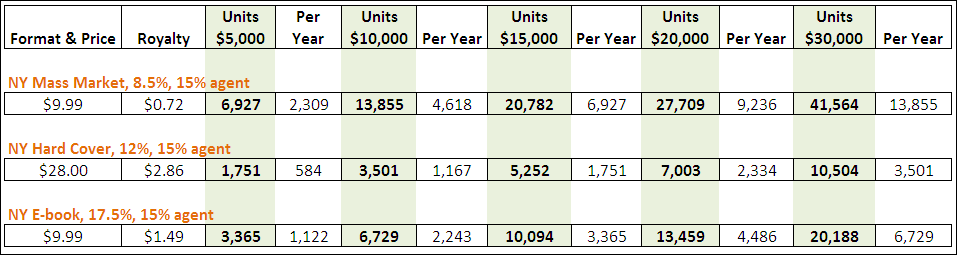
So what are the numbers? Well, here are the numbers for NY. Down the first column you’ll see the different formats. Across the rows you’ll see how many units I’d have to sell to make the advance specified at the top. And how many units I’d have to sell if I wanted to spread the total over three years.
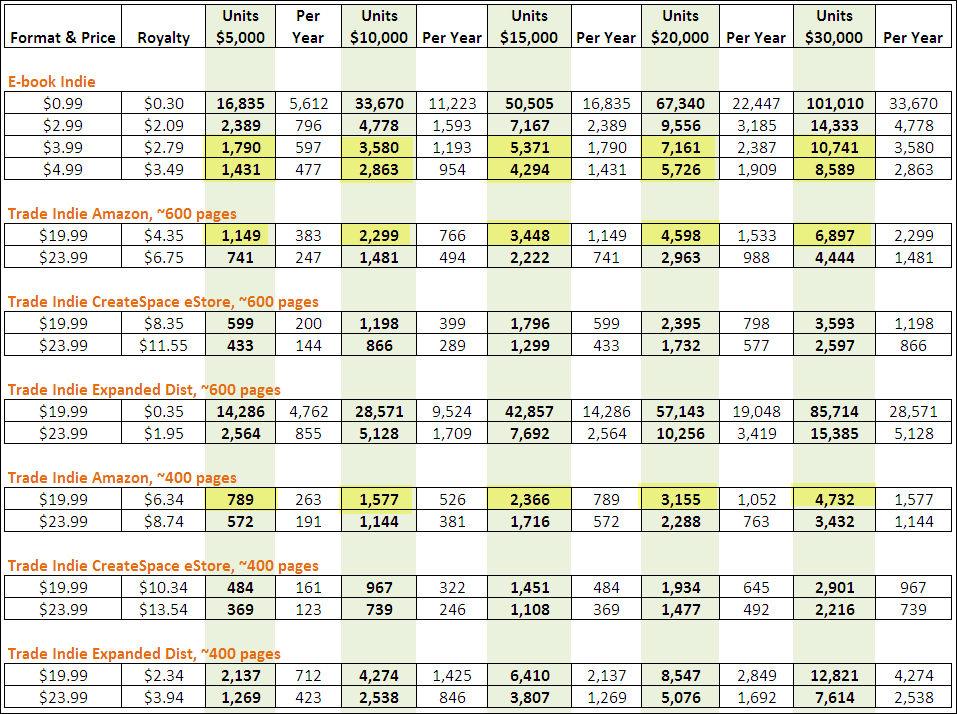
Okay, and here’s what I’d have to sell if I went indie to make the same numbers. I put in the trade paperback format for both 600 and 400 pages because that’s about how big SERVANT and BAD PENNY are going to be.
What does this tell me?
It tells me I have to sell a heck of a lot more units with NY at a much higher price than I do indie. It tells me that a $5,000 advance is not even close to being worth the control I lose with NY. And if it’s true that most books don’t earn out, then it tells me the units that are being sold by NY on the average book.
It’s true that NY could get me into brick and mortar stores. But if the book gets shelved spine out in the back, how many people will discover it?
It’s true that NY produces some spectacular hits. I looked at the USA Today bestseller list yesterday and it appears only about 10% of the books there this week are indies. But I can’t bank on becoming a NY wonder. The vast majority of NY published books DON’T make the bestseller lists.
Finally, even if I sold BAD PENNY today, it still wouldn’t hit shelves for probably 12-18 months from now. And then it would only stay on the shelves for 12-18 weeks. Going indie, I will have it up by September. And it will stay. For years and years and years.
There’s no guarantee of success either way. But the indie numbers look good to me. We’ll see how it goes.
Tor Books’ production department has moved my book’s release date out one month. I’m getting so antsy to have it hit the stores, but October’s actually a better month, it being closer to the holiday season.
You still might be able to get it earlier if you pre-order. The books actually start shipping in the second half of September. But it takes a few weeks to get them out to all the stores.
 Sometimes the writing flows. And sometimes you get to the chapter you’ve sketched and realize you’re stuck until you get the sheep off the road.

Huzzah, indeed!