Similar Posts
Life, The Universe, & Everything 2010 Schedule

If you’re a writer, you’ll find Life, The Universe, & Everything (LTUE) an excellent convention. Yes, it’s focused on science fiction and fantasy, but the principles of writing discussed apply generally and there are a lot of authors who will be there that write in different genres–YA, romance, etc. In fact, there will be a LOT of published authors there, period–including two that have recently been on the NY Times best seller list and others who have just broken in.
If I were an aspiring author, I’d be making sure I had arrangements to attend at least part of the convention. Follow the link above and look at the list of panel topics. And remember: it’s open to all and FREE of charge.
Dates: Feb 11-13, 2010
Wilkinson Center
Brigham Young University
Provo, UT 84602
(801) 422-4636 (BYU information line)I’ll be doing the following. Hope to see you there!
BTW, Stephen Nelson has graciously offered to film the workshop. If the recording and class pass muster, we’ll post it for your viewing enjoyment!
Thursday, Feb 11
5 – 7 PM: Writing workshop: “How to Write a Story That Rocks” (John Brown, Larry Correia)
Friday, Feb 12
9 AM: Panel: “Paths to publishing: When is traditional best and when should you try an alternative” (Stacy Whitman, John Brown, Dan Willis, Eric Swedin, Sandra Tayler)
Noon: I will be attending Dan Well’s Pacing and Story Structure presentation.
1 PM: Panel: “Killer Openings – How to write a gripping, engaging and interesting opening paragraph” (Dr. Steven C. Walker, John Brown, Mette Harrison, Heather Horrocks)
Saturday, Feb 13
9 AM: Panel: “A Guys Take on Writing Romance (Male Panelists)” (L. E. Modesitt, Jr., Clint Johnson, Aleta Clegg, Dan Willis, John Brown)
Noon: Panel: “Building different cultures….” (L. E. Modesitt, Jr., Roger White, John Brown, Brandon Mull, Marty Brenneis)
1 PM: Signing. (Wish very much I could go to Eric James Stone’s reading at the same time. I’ve gone to 2 or 3 of his and have never been disappointed)
2 PM: Reading from CURSE OF A DARK GOD.
No, this was the first interview!
Alas, I didn’t know Bryce had posted his. Dang the omniscient glitch! Furthermore, Bryce is a local “Utard” 😛
So read the very first interview on The Intelli-Gent Reviews where I reveal that it was Rudolph who really made me want to be a storyteller.
Writing Update: 5/21/11 – visualize first, scene goals, the power of research
I finished two chpaters this week. I’m quite a bit behind my stretch schedule which has me finishing the beginning of August although not too far behind my my conservative schedule which has me finishing the end of September. A few more weeks and we’ll see if I’m giong to meet the stretch schedule.
A lot of these first seven chapters are the same scenes as from before. Well, the same idea. But because enough has changed in the situations and because I’m writing some of the scenes from different points of view I have to rewrite them. So while I hope to catch up with some copy and paste from the last draft, I just am unable to do that here.
Visualize –> Report
I thought I’d share one of my key methods for writing scenes. Here’s what I’ve found: when I can visualize the scene, it’s fairly easy to tell the reader what’s going on and to structure it in a way that achieves my purposes. When I can’t visualize it, I have nothing to tell. So for me the first thing I have to do is to see what’s going on. Then I can report as if I were there. Or if it’s from a more deep point of view penetration, I can report from my character’s eyes.
So the sequence is to visualize (do the things that help me get that visual, feel, sound, etc.) then report in a way that will transport the reader and present the things I feel I need to present because they’re cool or because I want to generate a specific effect.
This is why I use the sketch/draft method. I sketch things out to get an idea of what’s going on first. Sure, I’ll discover details as I write. I’ll sometimes realize my first idea was off or wrong or won’t work. But if I don’t have an idea in the first place, I simply can’t write. It’s all a blank screen. One of the biggest causes of writer’s block is simply a lack of invention–of not having anything to write about because nothing’s in the mind of the writer.
First have something to say. Then say it.
Of course, you have to come up with the scenes in your mind before you have something to say. That takes some exploratory drafting, sketching, creative Q&A. You can see Orson Card doing some takes here in his writing lesson “Beginnings“, trying to help flesh it out in his mind.
The main tool I use to sketch is the summary–a bullet point or chapter outline like a posted about last week. However, sometimes it’s not enough. Sometimes I need an actual map to block out who does what and where. This week, for example, I was writing about Sugar coming into a village. She needed to enter then encounter some dead bodies. I spent something like 45 minutes typing hardly anything and then realized-duh!-I don’t know what’s going on, where she’s going, why. I can’t see this place at all. I needed helping visualizing it first, not in super detail, but enough so I could report.
So I took five minutes to sketch a simple map of the village, where she was when she entered, and where she was going, what was likely in the yards, the fences, etc. Once I saw it, I could then report, just tell what I saw as plainly as I could to the reader. I know these scenes fairly well, this being the FOURTH FREAKING DRAFT of this novel. And yet I’ve had to do some drawing for two scenes so far (the other drawing was for an ambush that wasn’t in the last draft). Because again, things had changed. And I had to see it before I could report it.
Other tools that help me visualize and hear are actual photographs of things or people. Or audio of people’s voices. I was struggling getting a character in my mind for my short story LOOSE IN THE WIRES. I was listening at the time to Susan Grafton’s O IS FOR OUTLAW and when the actor performed this one character, suddenly I HEARD it. Boom, the guy came alive in my mind. Once alive there it was relatively easy to put him down on paper. Again, I was just relaying it to the reader.
So I believe that what a writer must do is bring the situation to life in his or her mind first. It won’t be everything in exact detail. There’s a lot to be discovered in the writing. But it will be enough that it will feel like you’re simply telling something you saw or experienced.
Scene Goals
While writing, of course, I have objectives for my scenes. Sometimes I’ll do exploratory drafts, not having any goal except to see what happens and invent something cool. But that’s usually in my pre-draft stage. At this point I have a rough idea of where the story is going to go. I’ve already done a lot of the inventing. Now I have to translate it to scenes. And so I find having a quick list of objectives for the scene, along with my brief summary of what I’m expecting to happen, helps me visualize as well.
Here are two examples of what a list of scene goals might look like for me. These were for two scenes in draft 3 of CURSE.
Example 1:
- This is the time for her to make her HEROIC CHOICE. I want a heroic moment.
- Terror of Legs being lost
- Legs seeing her for the first time the next morning—he IS going to experiment because Urban is gone. Does he give something to her, his weave, twisted—Flax helped me.
- Some tenderness
- Last time with Mistress until the final battle
Example 2:
- Skir battle coolness. Need some surprises
- Ayten dragging off souls
- Sees it below on the ship
- Seafire
- What cool skir thing could there be?
- Whirlwind
- What would happen if a skir dived?
- Some missiles, stones in the wind
- First sight of that. She ship has slingers etc.
- Ayten dragging off souls
- Sugar having to choose to leave people, see the beginnings of harvest
- Oh Crap moment at end—this is going to be bad
- This is the setup for the next scene where She and Urban are spying and after the assessment, he says, we need to go. And she’s in indecision, and he says I will wait until, and then I will leave.
They’re fairly simple. Of course, I have other goals in mind that I don’t need to write down–“start and end with a hook,” or a rest, depending. “Transport the reader might be another,” meaning make sure I use what I know about presenting details. Another might be “bring the character on in an interesting way.” And because I generally know the big picture of what’s going to happen, I can focus on these other details as I write.
Research: Monster Zing & Visualize Method
Research is also a monster method for visualizing and for zing. I can’t tell you how much it has helped me in the past and on my current projects. In the thriller I’m working on where the main character is ex Special Forces, I could barely visualize anything. Some I’m reading books about it and talking to people who are in Special Forces and watching films about it. There’s no way I could build a story I cared about and believed in without research. I’m going to be doing a ride along with a cop, visit our state prison, and maybe talk to some ex-cons for this as well.
Tim Powers came to the Writer’s of the Future workshop I attended many years ago. He talked about many things. But research was one of them. In fact, one of the idea generating methods discussed in the workshop, one on which Hubbard himself had written a fine article that we read called “Search for Research” (click the Next or Continued link at the bottom to continue through all the pages of the essay), was about the power of research. So Powers recently did an interview about the latest Johnny Depp Pirates release , which is inspired by his book of the same title (which I read and loved), and restated what he did so many years ago:
Q: What inspired you to write On Stranger Tides?
A: I was already hooked into using real historical places for settings. And so I thought, you know you loved Treasure Island…And I thought I bet you can set a nice fantasy story in among the pirates, Black Beard, that crowd. So I read a million books (that is probably fifteen books) about that particular crowd of pirates that were in the Caribbean in 1718 like Stede Bonnet, Black Beard, and Anne Bonny.What I always do when I’m writing a book is first I read all the history and biographies and things like that that I can find. And I look for stuff that’s too cool not to use. ‘Ooh that’s neat. Look at that. I like that.’ And I’ll write it down. And then I’ll find something else and say, ‘Oh wow this is great. You got to have a scene happening in this place. Oh you gotta use this guy.’ Eventually, I’ll have twenty or thirty things that are too cool not to use. And it’s kind of fun then because you say, ‘Well okay, here’s twenty or thirty parts of your book. You just have to connect the dots.’ And so I thought, ‘Ok, what was Black Beard really up to?’
So to sum up.
- Visualize, then report. That’s what I’ve found I have to do. It makes it so much easier to write when I have a picture in my mind.
- Scene goals help me visualize the scene and what needs to happen.
- Research is a huge tool for helping me find zing and to visualize and invent something I can visualize.
- The Sketch/Draft process (I explained it in last week’s post and in the interview with Maya Lassiter) is another work horse of a tool for helping me visualize and invent by degrees.
Amazon, a Reader, & SERVANT
Holy smokes! I just saw that Amazon put SERVANT on sale. I don’t know when this started, but they have the mass market paperback listed for $1.75. That’s cheaper than I can buy it!
Maybe the Dark God had something to do with it . . .
Something else of note happened this week. I often get emails from readers expressing how much they enjoyed SERVANT and asking questions about the story. I simply love receiving those emails. What author wouldn’t? One email in particular this week, though, especially pleased me. You can see the review the reader wrote here: http://www.goodreads.com/review/show/146860447, but there was one thing the reader wrote in his email to me that wasn’t in the review that make me exclaim “Yes!”
One thing I didn’t squeeze into the review was how much I enjoyed the little details–names of farm implements, invented words like dreadmen, terminology for the parts of the ship, etc. It all added to the suspension of disbelief factor very nicely.
Finding and adding those details were one of the things I loved about writing SERVANT. I’m so happy to hear they paid off. I don’t think all readers will notice them. In fact, I hope they don’t. But it’s clear they’re doing their part to make the experience work for a lot of folks. And that makes me happy.
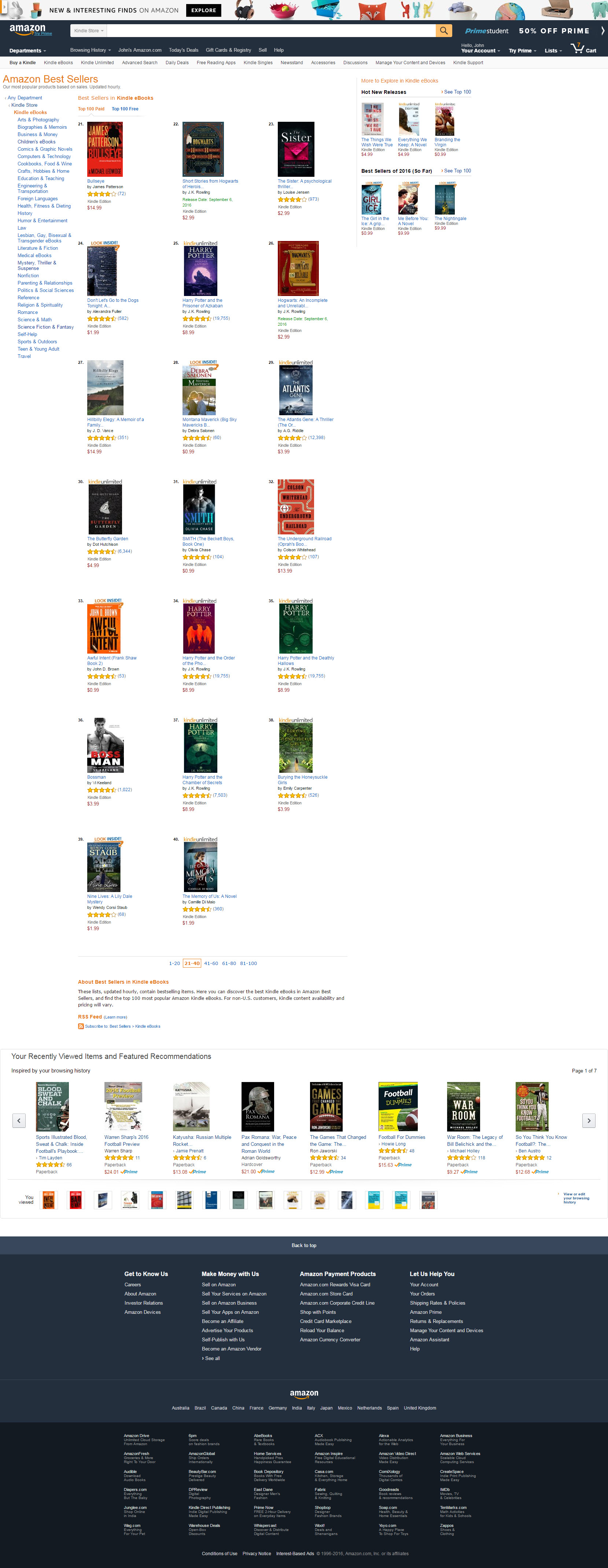
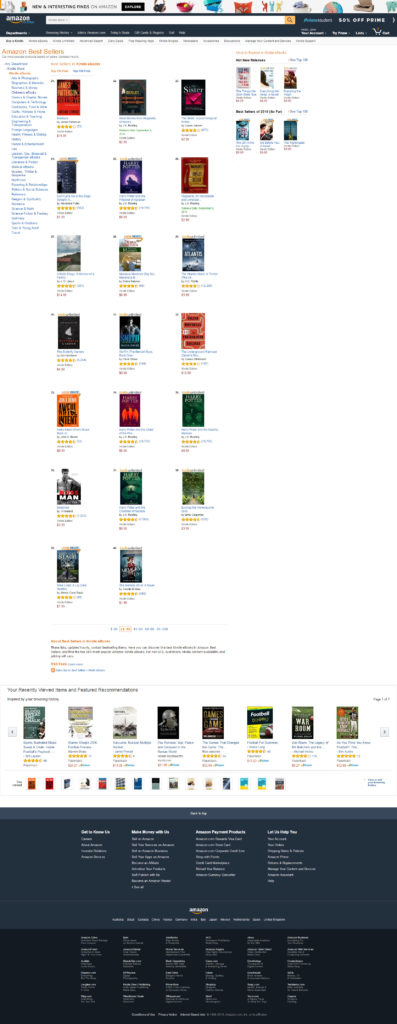
Awful Intent #33 of Top 100 on Amazon
Today Awful Intent went on sale and is currently ranked #33 in the whole Kindle store. You can enlarge the screenshot below. Nice to be on a list with Harry Potter and James Patterson 🙂 To see it in it’s full glory, click on the screen shot, then click it again to zoom.
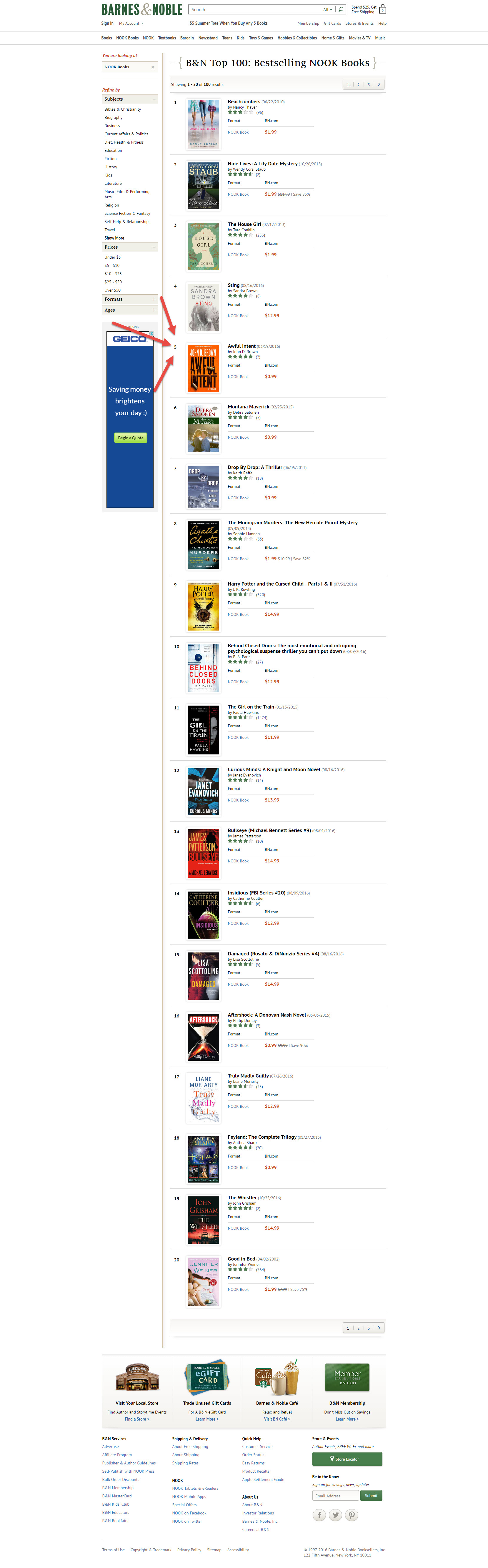
Edit 8/21/16: And it looks like its #5 in the Nook store.