SODG out to first round of possible blurbers

“Blurbers” is so much more fun than “endorsers.” Stacy has sent the manuscript of Servant of a Dark God out to the first round of people who said they would give the story a go. If they find they’re in the audience, they’ll write up a blurb for it. This is all in preparation for the launch meeting in December when my editors go to bat for me and sell the book to the salespeople inside Tor.

While I hope the potential blurbers will all find themselves in the story’s audience, I do not assume it’s a given. If they’re not, I’m still a happy man (although a bit disappointed). There are many wildly successful tales that I myself am not in the audience for.

I expect we’ll get reactions back in a month or two. I’ll post here the results.

I can’t remember the last time I was this anxious. Yesterday I read Scott Card’s review of K.J. Parker’s stuff.  All his business about great writers. And I’m thinking, holy heck. I’m a nothing. Just a little dude with this nothing book. And then I thought, what if none of these readers find they’re in the audience for the book? It’s one thing to send out a manuscript. You can always change, improve. But this is it. This is the book. It either soars or plops in the mud.

But then I read Mette Ivie Harrison’s first article on writing for IGMS and thought—you know what, I tell the stories I tell. While others may aspire to “greatness,” that’s not something I care to strive for. I want to write stories that entertain and move. And while I can learn how to write and tell better stories, they’re always going to be John Brown stories. If they plop, they plop. And I just have to forget all the greatness-everybody-must-love-me nonsense and write John Brown

I met Mette at Card’s boot camp in 2002. We’ve read each other’s manuscripts every once in a while. I respect her ideas, loved MIra, Mirror, and am grateful for that article. If you’re a writer, I recommend it to you highly.

Share

Similar Posts

  • |

    Generating Story 1: Can You Create a Redneck Crapper?

    Bugatti Veyron Super Sports $2,400,000

    Almost everyone reading this knows what they like in a car. We know what we want a car to do. We can talk about acceleration, voom-voom styling, and handling. Some of us could talk about how engines and transmissions and tires all work together to create those things. We could get really technical.

    But how many of us could then go manufacture a tire? Or the paint we’re going to put on the car? How about a windshield?

    No?

    Well, what about one little bolt? Just a little bolt. Can you do it?

    There’s a difference between knowing what a thing is supposed to do, how it works, and actually building it. A lot of people can talk about the first two topics and have no idea at all about the third.

    It’s the same with stories.

    There are three things we have to learn to write killer stories.

    1. What a story is supposed to do.
    2. How the 5 parts of story—character, setting, problem, plot, and text–do that
    3. How to come up with and develop a story idea in the first place

    We authors talk a lot about the second thing. You have books and blogs galore on dialogue, plot, characters, structure, grammar, world-building, setting—you name it. Heck, the big series I wrote last year about the key conditions for reader suspense was all about how story works.

    Some of us talk about the first thing. And really there’s no point in blathering on about the how-to’s if we don’t know the what-for’s, which is why I tried to highlight one of the core what-for’s in my series on suspense.

    But as important as those two things are, none of it matters if we don’t know how to put it to use. We’re not reviewers or editors. We’re creators. We’re writers—the ones that invent the story in the first place. And let me tell you, knowing how a story works and how to invent one are two very different things.  

    I didn’t know the principles of invention when I was first starting out. And that gap in my knowledge was one of the things that held me back for years. In fact, I almost gave up my dream of writing stories because of it.

    Very early in my attempts to start a career I wrote a story that won an award and $2,000. I was flown out to Cocoa Beach, Florida for a week-long workshop with amazing pros. Was published. And then I went home, finished another story (yea!), and proceeded not be able to finish another thing for five years.

    Five years.

    FIVE. YEARS!

    And I tried.

    After five years of failure you begin to wonder if maybe you didn’t get the wrong memo (what am I doing at this empty warehouse?). Your family begins to wonder that as well. You realize life is short and there are a lot of other things you could be spending your time on. You begin to think that only an idiot would spend more time on this. And you’d probably be right.

    Unless, of course, you realize that what’s keeping you back isn’t a manifestation of cosmic will. Rather, it’s just a lack of understanding.

    That’s what happened in my case. Just a few days before I gave up on all my dreams, the light was turned on for me. I learned some key, but simple, principles of invention that I hadn’t known. You can read the whole story here. After I learned these principles, my production took off like a rocket.

    And so what I want to do in this series is share those principles with you. Hopefully, this will unleash your abilities. You might find a huge audience for your stories. You might find only the family dog will stick around to listen to them. The popularity of your stories is a separate matter. But you can’t even find out how big your audience will be if you don’t know how to finish.

    So let’s start. A lot of people think that creativity is about passion. When they think of creativity, they think of someone like this.

    Look at him. Brushed velvet jacket. Beard. Rakish devil-may-care hair. And that gaze. Look at that gaze! It’s full of passion. It’s coming off him in waves. In fact, we all know his inner world is a vast tempestuous sea of passion that sends ideas crashing in great surges onto the rocky beaches of his soul. And those earthly forces cannot be contained. No, he must write them, write them, write them. That’s the face of a man who will channel fire onto the written page because if he didn’t, he would surely burn.

    Or maybe not.

    Maybe creativity is about being like this guy.


    Hello, Malcolm Gladwell. Look at him. There are so many ideas in that great blaze of brains they trip over themselves trying to get out. There are so many they kinked his hair with their electric heat. Oh, fecund mind!

    Or maybe not.

    Maybe creativity is all a function of being blessed.


    Or maybe it’s about alcohol (or some other chemical). After all, isn’t that how Ernest Hemmingway did it?

    Booze Makes Ernie Reel Smart

    Or it’s about being mentally unstable.

    Or it’s about having the right personality type. I remember the day of woe when I learned that I was an ENFJ but that the “natural” writers were all ISFPs!

    Alas, me being a blockhead was all scientific

    Or it’s about being eccentric.

    Patrick Rothfuss shows us the key is crazy beardage and an Alice in Wonderland chair

    Or it’s none of that. It’s about being born to it.

    I wrote my first novel when I was six

    Right? All of those things are what creativity is about. And if, as so clearly demonstrated by those pictures, you don’t have passionate hair, well then, forget about it. Except here’s Larry Correia, a New York Times bestseller, who has no passionate hair whatsoever.

    I keep guns in my basement

    Huh?!

    How could that be?

    Here’s how. All those ideas above about creativity–they’re rubbish. Creativity has nothing to do with passion or hair or whether you wear Argyle socks.

    Nothing.

    Let me show you the face of creativity.

    That is Warren Ellis. Warren is my brother-in-law, except when he’s not (do not ask me to explain this). One day our fridge started to drip. The freezer would cycle through its normal thawing, and all the water would drip down into the fridge and soak up our egg cartons and pool in the vegetable crispers. It was a mess.

    We defrosted the freezer we weren’t supposed to ever have to defrost, but the problem persisted. So we called Warren because he fixes things.

    Warren came to our house, looked the fridge over. He declared that the freezer’s drain tube was plugged. We thought up a few ideas for cleaning it out, none of which were any good, then Warren asked if we had an air compressor. We did and hauled it in.

    Warren plugged it in, let it build up the pressure, and then held the compressor nozzle to the bottom end of the tube. The compressed air went in. The obstruction flew up and out and landed on the counter. The obstruction was a fat fly that had crawled in there, gotten stuck, and died.

    We poured a quart of water into that freezer, and it all flowed down into the catch pan at the bottom. Warren fixed our freezer with an air compressor.

    Folks, that is creativity.

    What did Warren have? He didn’t have passionate hair; I can tell you that. No. He had an objective. He knew basically how fridges worked. And he came up with a couple of options to fix the issue.

    Let’s look at another example. Here’s Ed Smylie.

    Ed was like Warren. He ran into some problems. Actually, the astronauts in Apollo 13 ran into some problems. Ed was tasked to help solve them.  One of those problems was the fact that the astronauts were running out of air.

    Ed and the others designed the solution in two days. The ground crew relayed the instructions to the flight crew. The lunar module’s CO2 scrubbers started working again, saving the lives of the three astronauts on board.  Of the experience, Ed said that he knew the problem was solvable when it was confirmed that duct tape was on the spacecraft. “I felt like we were home free”, he said. “One thing a Southern boy will never say is: I don’t think duct tape will fix it.”

    Ed and his crew saved the day. The made a round peg fit into a square hole. How did he come up with such a creative solution?  

    Ed had an objective. He knew how the CO2 scrubbers and the shuttle worked. He knew about duct tape. He came up with options.

    Let’s look at a few more examples of this. I know you’ve seen some of these.


    That is creativity. So is this.


    And this . . .


    And this . . .

    Or this, if you don’t need to go so fast . . .

    Smaller size, for trolling

    And this . . .

    And this, which is officially called a Bumper Dumper . . .

    Do you really want to dig?

     These fine folks had a goal. They knew the basics of how things worked. They came up with some solutions.

    That’s all there is to creativity. Three things. You need to have an idea of what you’re trying to do. You need to have a basic knowledge of how things work. And you have to know how to come up with some solutions to meet your objective. 

    Not so mystical, is it?

    But I can hear some of you complaining. Writing is different. It’s a whole other world. It’s Fiction, which is so significant we must capitalize it. It’s passion. It IS mystical. This is a matter of the heart. It’s not a fridge or space ship or some dumb hotdog roast. You cannot compare these things.

    Except I can because they’re the same. It doesn’t matter if you’re trying to invent a different recipe like the folks at Cook’s Illustrated, or decorate your house, or come up with a way to keep the squirrels out of your bird feeders, or make people weep in a movie theater.

    What I’ve found is that when we have troubles coming up with ideas, we probably don’t know what our objectives are. Or we probably lack some understanding of how fiction works. Or we don’t know the principles of generating options.

    And so we conclude it’s a mystery. It’s arcane lore.

    But it just ain’t so. Can you create a redneck toilet? Then you can write a story.

    Now, it’s true that a lot of people feel their way through this. They don’t know what they’re doing, but they do it. I did that. Remember: I won an award. But then I couldn’t repeat it. Couldn’t find that groove I’d stumbled into.

    I don’t want to stumble around hoping to get lucky. I want to make a living at this. And if I’m going to make a living, I need to produce. Regularly. I can’t be bumbling around, hoping to create something by accident.

    The good news is that we don’t have to create by accident.  We can create on purpose. There are principles to invention. When we learn them, our productivity will shoot through the roof.

    Finding a solution to Apollo 13’s issues might seem impossible to us. But they weren’t impossible to Ed Smylie because Ed had an objective; he knew how things worked up there; and knew how to come up with options.

    My intent is that when you finish this series, you’ll know what Ed Smylie knew, except for stories.

    For more in this series, see How to Get and Develop Story Ideas

    Share
  • More Great Questions for Story Development: Governments

    Part of my model of the creative process is that it’s driven by questions. We come up with creative solutions in response to a problem. The problem triggers the process.

    Let me give an example. Let’s say I have a character named Bill who lives out in space salvaging parts of space ships and other things. Or maybe he’s on some planet.

    I don’t have a story yet. I’ve just got a dude in a general situation. I lack all the necessary parts. That lack is a problem to me as a writer. To develop the story, I state the problem as a question and begin generating options.

    So I might ask, what are the threats Bill faces on a physical and social level? Are there mysteries he encounters? Who else is there? In order to answer those questions I might need to ask what’s the planet like?

    At some point in time, I’ll feel I have generated enough answers for the key questions that it’s time to draft. When I begin to draft, I have other tasks or problems to solve. I might ask things like what’s the goal of this scene? What’s an interesting way to start and end it? What’s something surprising and bad that might happen as a result of the character’s action?

    It’s all question and answer.

    Towards the end of this week’s Writing Excuses on World Building Governments the guys share some great questions you might find fruitful when thinking about your world’s government.

    Share
  • Writing update: Envy

    Bible’s full of great stuff. Look at this.

    (Old Testament | Exodus 20:17 – 19)

    17 Thou shalt not covet thy neighbour’s house, thou shalt not covet thy neighbour’s wife, nor his manservant, nor his maidservant, nor his ox, nor his ass [we’re talking animals, folks], nor any thing that is thy neighbour’s.
    18 And all the people saw the thunderings, and the lightnings, and the noise of the trumpet, and the mountain smoking: and when the people saw it, they removed, and stood afar off.
    19 And they said unto Moses, Speak thou with us, and we will hear: but let not God aspeak with us, lest we die.
    20 And Moses said unto the people, Fear not: for God is come to prove you, and that his fear may be before your faces, that ye sin not.
    21 And the people stood afar off, and Moses drew near unto the thick darkness where God was.

    Dude, the “thick darkness where God was.” The thick darkness . . .

    I love the images in that passage. Moses going to talk to God face to face. Talk about spectacle. As for the commandment, well, let me just say that I might be smite-worthy.

    I do not covet many things. Certainly not any dude’s butt, but sometimes it’s so hard not to covet my neighbour’s writing success. And it’s not the big boys that kill me.

    I read a Lee Child or Orson Card or whoever, and I can legitimately say, “Hey, those guys have been writing for years and have produced a lot of novels; it’s unrealistic to compare my skills to their current masterly levels.” I can legitimately say, “Hey, best-sellerdom takes craft and luck, and I just need to be ready the next time the opportunity train stops at my station.” I can even say of those who start off as best-sellers, “Dude, maybe they DID start out with more skillz than me. Doesn’t mean I can’t learn. Give me some more books, you’ll see the Brown dog rise.”

    These are all true statements. I’ve got the big guys down. I can spot the Brain Nazi trying to hit me with them a mile away.

    It’s the other folks that get me. The guys at my level.

    I just had an email exchange with one of them. (No, I’m not going to tell you who it is. Author X might read this, get a fat head, and then be ridiculed and derided by small children. I’m not that heartless.) X comes up with great ideas. Has a ton of them. X is one of those other pro writers I meet who are always lamenting about how many ideas they have. Truckloads. Boatloads. They could employ all of  the peasants in a small country like Mozambique just writing the fab things that flow from their brains.

    I don’t have boatloads of ideas. I don’t have a truckful. I’ve got maybe two or three riding around on a Yike Bike.

    Covet, covet, covet.

    Author X is also funny. X can take a pedestrian idea, twist it, maybe with a great character or situation, and suddenly I’m dying to know more. X watches a TV show I’ve been watching for years. Bim! Bam! Comes up with another great idea I want to steal. (I think I average about two ideas a week I want to steal from other authors.)

    Covet, covet, covet.

    Author X has great sales. Better than mine, at least.

    Gol-leeeee, Mother of Hacks, please, put me out of my misery.

    Or not.

    I’ve got this freaking Brain Nazi’s number as well. The truth of the matter is that while Author X may have some minimal amount of writer-fu, X has also sold his/her soul to the lizard people of the hollow earth. I think they’re going to breed X. So I could have writer-fu too, but I don’t want to become anyone’s genetic experiment. I have standards.

    And with that, I’ll sign out. Happiness!

    Share
  • Indie Thoughts: The Kind of Competition Publishers Want

    David Gaughran puts it all into perspective.

    Since the huge shift to online purchasing and e-books, a common meme is that there is some kind of “discoverability” problem in publishing.

    The funny thing is readers don’t seem to have any problem finding books they love. Any readers I talk to have a time problem – reading lists a mile long and never enough hours in the day to read all the great books they are discovering.

    The real discoverability problem in publishing is that readers are discovering (and enjoying) books that don’t come from the large publishers. What these publishers have is a competition problem not a discoverability problem.

    They have reason to. I had a stab last year at estimating how much of the e-book market self-publishers have grabbed in the US, pegging it at around 25%. The much more rigorous Author Earnings reports have confirmed that estimate, showing that self-publishers had captured 30% of the unit sales on Amazon and Barnes & Noble.

    * * * *

    So when large publishers say that the discoverability puzzle hasn’t been solved online, they are really expressing despair at retailers recommending books not published by them.

    And when large publishers say that online retailers haven’t matched the experience of buying in physical stores, they mean that they wish there was some way to relegate all that stuff from small publishers and self-publishers to the warehouse, and have tables piled high with James Patterson and Snooki.

    * * * *

    The fear-mongers always forget Amazon’s core philosophy: recommend the product the customer is most likely to purchase. It’s interesting to note that this is the exact opposite of traditional co-op: recommending the book that the publisher wants purchased.

    While it’s revealing to look at sites like Bookish and consider what Big Publishing would do with retail or discovery, we already know what it does with self-publishing. Exploitative vanity press Author Solutions runs self-publishing companies for HarperCollins, Simon & Schuster, Harlequin, is owned by Penguin Random House, and is now recommended by Publishers Weekly.

    Large publishers want to decide what gets published, what gets distributed, what gets recommended, what gets discovered, and what gets sold.

    Amazon – and the digital revolution it instigated – has made that impossible.

    Anyone can publish. Distribution has been blown wide open. Large publishers have lost power over what books get recommended and discovered too, with the agnostic approach of sites like Amazon, Goodreads, and BookBub. And large publishers have definitely lost control of what is getting sold: self-publishers have grabbed a huge chunk of the market, and more and more writers are beginning to realize they don’t need a publisher to reach readers and make money.

    This is the real reason why Big Publishing hates Amazon. Large publishers face real competition for the first time and they don’t like it one bit.

    More at Let’s Get Visible.

    Publishers have lost the barriers to entry that used to keep most of the competition out. Amazon set up a totally new distribution channel that has grabbed at least 41% of the book market.

    Forty freaking one percent!

    And of that 41% percent, it appears self-publishers have about as much of that channel as traditional publishers do.

    Think about that for a second.

    Almost half of book distribution is now out of publisher control. With no barriers, the hordes are running in to sell their books, pushing publisher books out of the good spots. The number of competitors is growing. And the publishers can’t get Amazon to relegate the riffraff to the back rooms. Can’t get them to feature only their books.

    Worse still, it appears lots of readers don’t mind that at all.

    Share
  • Edward Bear Shares More Proofreading Secrets

    Mr. Edward Bear (pseudonym) shared an awesome secret for sussing out quote issues in a previous post. He’s back with a nifty way to help spot spelling issues.  It helped me spot a number of inconsistencies in Bad Penny, which I recently fixed. Take it away, Mr. Bear.

    * * * *

    Augmented Proofreading 2

    Last time, I mentioned checking spelling and spelling consistency, and this note is to fulfill my promise.

    To begin with, I’ll admit freely I do not recommend just running a spieling chucker over the text. And yes, I’m using the phrase deliberately. The spelling checker in the program I’m using to write this just waltzed right past it, despite the fact that neither word makes sense in this context. I got started trying to get some mileage out of spelling checkers a while back, when I realized that OCR scanners will work like hell trying to find a word and probably will come up with a word, but it will be the wrong word. Over at Project Gutenberg, they use the term “scanos” as an analogue of “typos.”

    The other adversary is consistency of spelling and usage. Examples might include “canceled” and “cancelled” or variant possessives, such as “Jones’” and “Jones’s” in the same text, or simply variant spellings of the same character’s name, such as “Erik” and “Eric.”

    So what do I do for these sorts of problems?

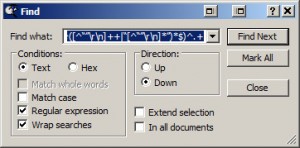
    What you need is a list of all the unique words in the story, and it’s easy with a dollop of regex. (See the first post on this topic. The one I’ve taken to using is the following:

    [^-‘‘’\w\d\r\n]

    This one I can explain, since I wrote it. 🙂

    What it says is to look for any individual characters within the brackets([]). The leading caret (^) says “Nope, they should not be in this list.” Following that are the hyphen(-), the straight  quote(‘), and the opening and closing curly single quotes(‘’). After that, it’s any character that would normally be in a word (\w), any digit (\d), any carriage return(\r) or any new line aka paragraph terminator (\n).

    And what you do with the above is to set Textpad (see previous post again) to replace all of them with a newline (\n) character.

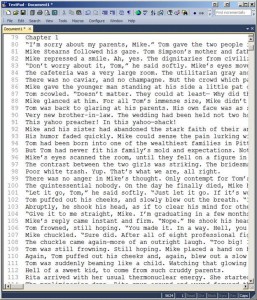
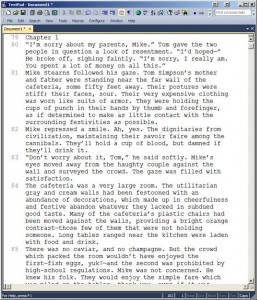
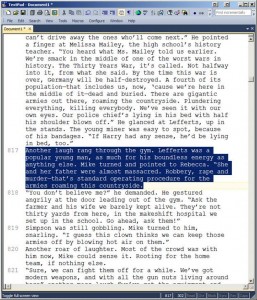
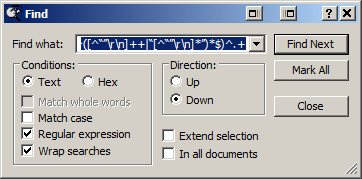
    Here’s what the search and replace box in Textpad looks like for this:

    Augmented Proofreading image001


    Notice that the “Regular expression” box is checked. And then you choose “Replace All”.

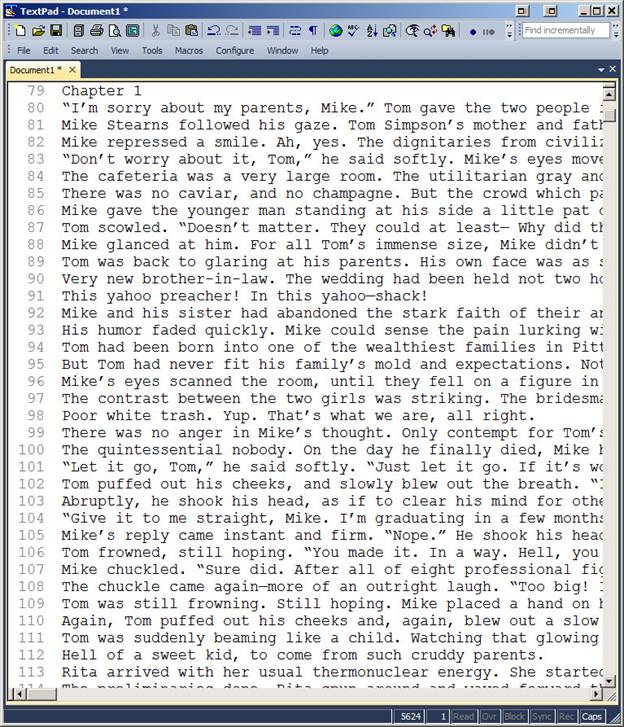
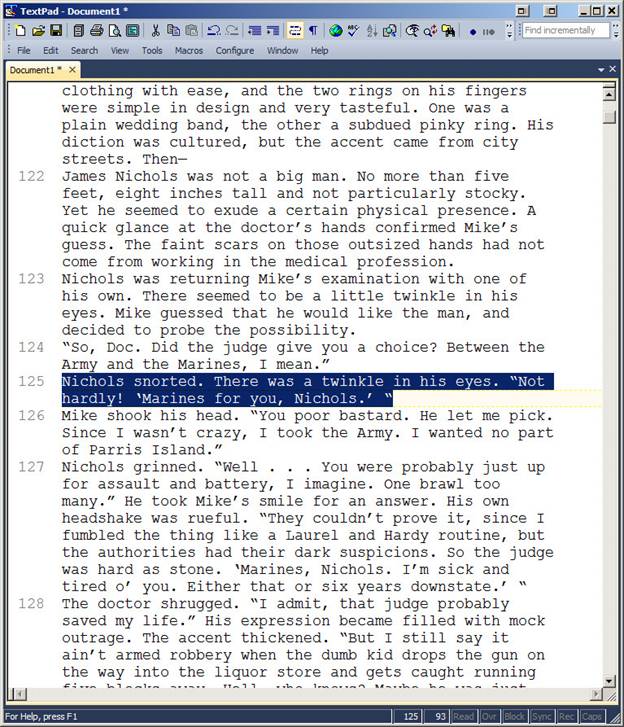
    The result is to turn this:

    Once upon a night we’ll wake to the carnival of life
    The beauty of this ride ahead such an incredible high
    It’s hard to light a candle, easy to curse the dark instead
    This moment the dawn of humanity
    The last ride of the day

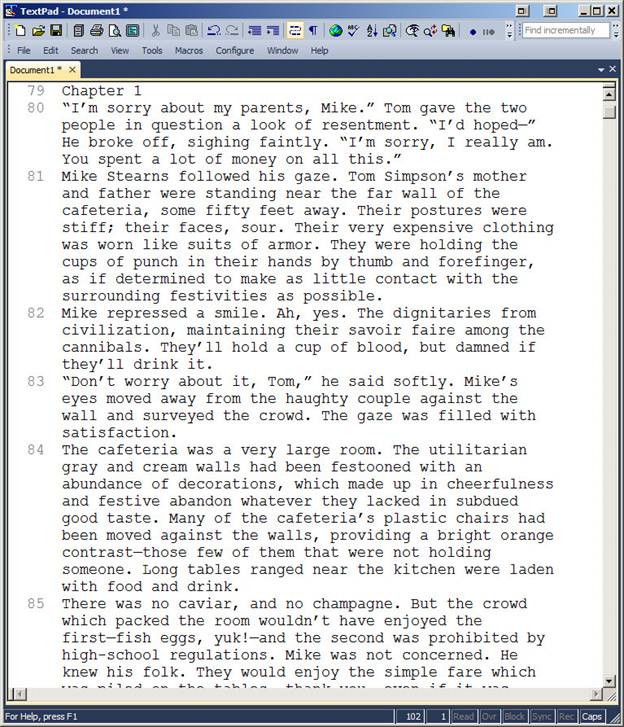
    into this:

    Once
    upon
    a
    night
    we’ll
    wake
    to
    the
    carnival
    of
    life
    The
    beauty
    of
    this
    ride
    ahead
    such
    an
    incredible
    high
    It’s
    hard
    to
    light
    a
    candle

    easy
    to
    curse
    the
    dark
    instead
    This
    moment
    the
    dawn
    of
    humanity
    The
    last
    ride
    of
    the
    day


    For a book, this means what you have as a multi-thousand line long document and LOTS of repeated words. The next step is to lose the repetitions by sorting the list. For TextPad,  you’ll find Tools->Sort on the menu bar, and I generally set the sort up as the following:

    Augmented Proofreading image002

    This is a case-sensitive sort and “Delete duplicate lines”, of course, gets rid of all the duplications of words like “a”, “an”, and “the”.

    For the above text, you get:

    It’s
    Once
    The
    This
    a
    ahead
    an
    beauty
    candle
    carnival
    curse
    dark
    dawn
    day
    easy
    hard
    high
    humanity
    incredible
    instead
    last
    life
    light
    moment
    night
    of
    ride
    such
    the
    this
    to
    upon
    wake
    we’ll

    34 unique words.

    And here’s the payoff for all this funky text munging: Run a spelling checker over this, and it will find typos, of course, but it will also generally complain about most names, which aren’t generally kept in spelling checker dictionaries, and it will also show you words and their variants, nestled fairly closely together. Here’s an example from one of my projects:

    Swiss-born
    Take
    Talking
    Tallmadge
    Tallmadge’s
    Tarelton
    Tarleton
    Tarleton’s
    Tavern
    Tecumseh
    Tell
    Ten
    Thames

    The spelling checker landed on Tallmadge and its possessive form, but do you notice the “Tarelton” on the list? That’s the time for the Aha!, and you can fix the “Tarelton” form. The same thing applies to possessive variants and any other variant form you find.

    As with the last post, I’ll be peeking in on the comments and answering any questions that come up.

    Share
  • Indie Thoughts: What drives book sales?

    gallup-poll-how-readers-select-booksWhat are the biggest factors influencing which book a person will read next?

    Many surveys have been conducted over the years to answer just that question. I’ve pasted one on the right and summarize the results of others here. One factor sits at the top of almost all of those surveys. Did you look at those other surveys? According to these surveys, folks tend to buy books by authors they already like.

    This phenomenon is called a lot of things. One of the most common is “brand loyalty.” Some might be wondering how you define a brand and what could be branded in publishing. KKR has a great piece here that answers those questions.

    So brand loyalty. How does it develop? Well, any time you please readers, their loyalty grows and inches them toward the loyal fan end of the spectrum. Your brand may not have the power of a Dean Koontz because you don’t have near the number of loyal customers as Koontz, but you still have a brand. And people who like your stuff are going to be loyal to some degree, but not the same degree.

    I think that last point is important to remember: readers that know and like your brand won’t all have the same degree of loyalty.

    You have hard-core fans who are totally dedicated to you and make an effort to know what’s happening. You’ve pleased them so much, your brand is gold to them.

    You have others who will buy your book the minute they hear it’s out, but don’t make an active effort to keep up to date on things.

    There are others who will mark it to be read when they hear about it, but don’t make a big effort to get it unless it’s convenient.

    You have others who like your stuff but are still in that period where they like but haven’t yet committed to being a fan. That sometimes may take a few books.

    That’s how it was with me and Lee Child. I read the first and liked it. Some time later I saw another and was predisposed to like it. I read that one and liked it too. I wasn’t a Child fan yet. But then I read the third. And that’s when I became a true fan. I’m not hard-core. But I now read everything he puts out within a few months of the release.

    From what I can see, branding and brand loyalty matter no less in publishing than they do in any business where you’re relying on repeat customers.

    JD Robb Celebrity in DeathI see the effect of brand loyalty all over. It was the force behind the dramatic explosion of sales when it was revealed that Robert Galbraith, the author of The Cuckoo’s Calling, was J.K. Rowling. It was the force behind the midnight book store events when Stephanie Meyer would release a Twilight book (and the Twilight balls). And other similar events with many other authors. It’s the reason why publishers make the names of a lot of authors so prominent on the cover. Good grief, sometimes that’s all you need. Look at some of the Nora Roberts or JD Robb covers. On many of those the name, the brand, takes up 75% of the cover. You can see customer loyalty blossoming in reviews on GoodReads and Amazon and elsewhere where readers say in essence, “I loved this author and I will be looking for the next book.”

    Building a base of loyal customers is they goal in businesses that rely on repeat sales. Because not only do those folks come back for more, but the also tell other folks about the product.

    Go back an look at those surveys. What was usually the number two reason someone selected a book?

    Word of mouth.

    Word of mouth comes in many forms. Recommendations from folks you know. Recommendations from other influencers–folks like Rush Limbaugh or review sites you frequent. Recommendations from some other type of social influence mechanism like a bestseller list on Amazon.

    The key takeaway for me is that top two factors driving book sales all stem from a loyal customer base. Which means building that base should be one of my main goals as a writer.

    So how do you do that?

    The same way everyone else in a repeat customer business does it. At a general level, you:

    1. Create a product (a book in this case) that’s likely to delight a certain set of consumers (readers).
    2. Let those consumers (readers) know about it.
    3. Make it enticing for them to give it a try.
    4. Make it easy for those who liked it to know when they can get another.
    5. Get more product (another book that’s similar to the last) out the door so your repeat customers can come back for more.

    I’ll be sharing more of my ideas about aspects of those five steps in upcoming posts. And I’ll be wanting to hear what you’ve found that works. Because ultimately we’re all testing various strategies. And the more we share with each other, the more we’ll each benefit.

    While you’re waiting, you might want to look at an awesome book on customer loyalty called The Loyalty Effect by Frederick F. Reichheld.

    Share