Excellent advice to improve your writing productivity
I have found every one of Maya’s practical prescriptions to work for me.
I have found every one of Maya’s practical prescriptions to work for me.
Fat head alert.
Not to be missed – the most useful speech on writing you will ever hear! Keynote speaker John D. Brown will present ‘Three things you MUST know to write killer stories.’ John Brown is a prize-winning short story writer and novelist. His epic fantasy novel, “Servant of a Dark God” will be released in North America in September 2009.
“Most useful” is nice. Let’s hope I can live up to that one. 🙂 I’m looking forward to this event. A lot of other great authors will be there as well as editors from Deseret Book, Covenant, and Cedar Fort. If you’re a regional writer, you won’t want to miss this. Full information here on the American Fork Arts Council council for writers.
Inequity and deservingness are two of the main factors that keep readers reading. If we want to write killer stories, we need to know how they affect readers. A few years ago I wrote an essay on this and thought it probably too technical for most folks’ taste. But I passed it on to a recent attendee of the killer workshop and he found it helpful. In fact, when he watched Pride & Prejudice shortly after reading the essay, he saw how these factors dramatically affected his rooting interest. So I’m thinking others will find it useful as well.
In order to understand it you must first read George Saunders’ short story “The Bohemians.” You’ll find it here in The New Yorker, January 19, 2004. It would probably be rated PG for some profanity.
Now if the story doesn’t pull you in, stop reading. Because the essay probably won’t make any sense to you. You’ll only be able to understand it if the story works for you. But if it does, then ask yourself what the main character’s problem was and what drew your interest? Then read my essay, “How Inequity Evokes Reader Interest.”
Please note “The Bohemians” does present a character with a problem, and the story cycle applies, but not in the straight-forward manner it does with most stories. BTW, if you’ve ever read Patrick Rothfuss’s excellent Name of the Wind, you’ll see inequity is what shapes the story there as well. If you haven’t read it, I recommend you give it a go.
I’ll be interested to see your responses to Saunders’ story, my essay, and/or Rothfuss’s novel.
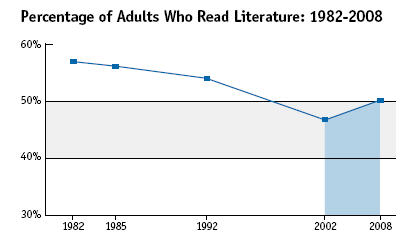
What great news!!!
Washington, D.C. — For the first time in more than 25 years, American adults are reading more literature, according to a new study by the National Endowment for the Arts. Reading on the Rise documents a definitive increase in rates and numbers of American adults who read literature, with the biggest increases among young adults, ages 18-24. This new growth reverses two decades of downward trends cited previously in NEA reports such as Reading at Risk and To Read or Not To Read.
Adults up 3.5%, young adults (ages 18-24) up by 9%. Full article here. Full report here (with nifty graphs and tables).
They attribute it to reading programs. Perhaps. I’m sure JK Rowling phenomenon had something to do with it. Whatever the reason, it’s good to hear.
For you writers who don’t get David Farland’s Daily Kick in the Pants, he just pointed to this must read blog entry by Janet Reid, literary agent. It relates what exactly it might mean when you get an agent rejection.