|

Literary reading rates on the rise

What great news!!!

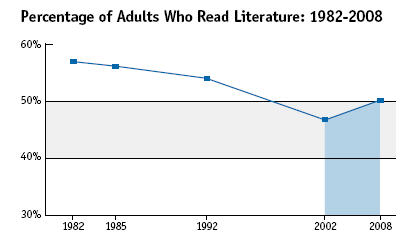
Washington, D.C. — For the first time in more than 25 years, American adults are reading more literature, according to a new study by the National Endowment for the Arts. Reading on the Rise documents a definitive increase in rates and numbers of American adults who read literature, with the biggest increases among young adults, ages 18-24. This new growth reverses two decades of downward trends cited previously in NEA reports such as Reading at Risk and To Read or Not To Read.

Adults up 3.5%, young adults (ages 18-24) up by 9%. Full article here. Full report here (with nifty graphs and tables).

They attribute it to reading programs. Perhaps. I’m sure JK Rowling phenomenon had something to do with it. Whatever the reason, it’s good to hear.

Share

Similar Posts

  • |

    Will readers completely die off?

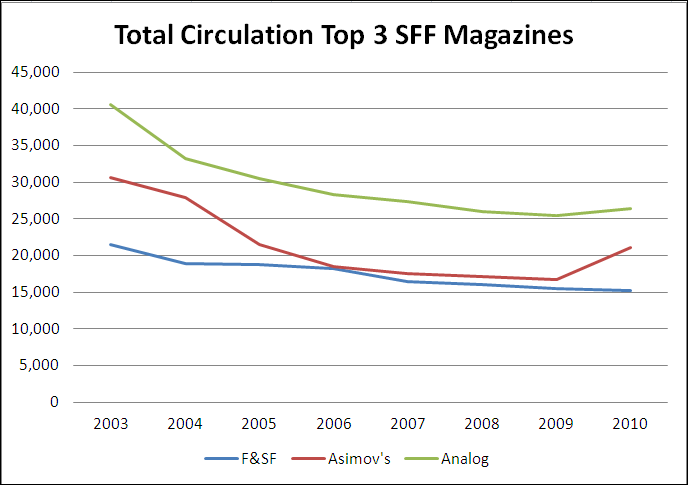
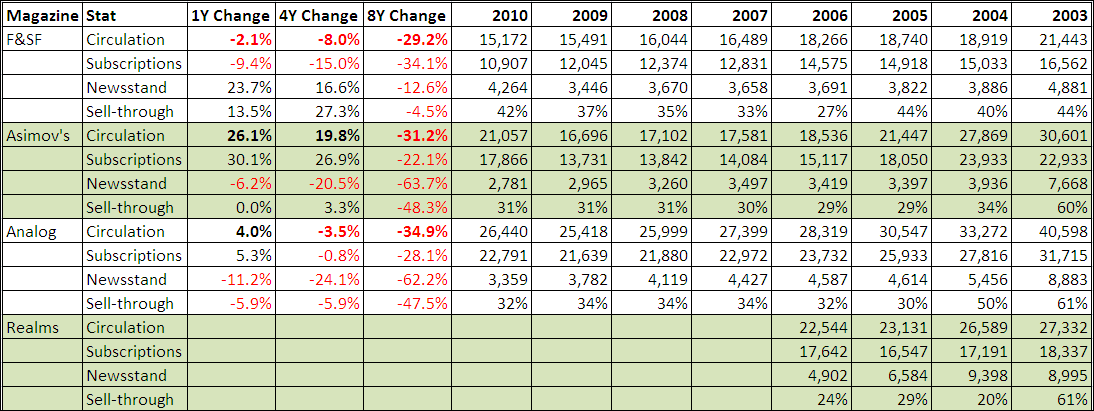
    For many years people have been predicting the death of literature because the stats on the reading public  show fewer and fewer books are being sold because fewer people are reading. For an author it’s a bit depressing. However, you might find this article provides some hope: http://www.newsweek.com/id/136961.

    Generation R (R Is for Reader)
    The book business may be flat, but there’s at least one bright spot: the booming sales of books for teens–and no, it’s not all Harry Potter… Contrary to the depressing proclamations that American teens aren’t reading, the surprising truth is they are reading novels in unprecedented numbers. Young-adult fiction (ages 12-18) is enjoying a bona fide boom with sales up more than 25 percent in the past few years, according to a Children’s Book Council sales survey…”

    If that trend holds, it means we’ll have a fine wave of readers to replace all of us who die off, and then some. Someone praise JK Rowling for Hogwarts and for awakening pleasure reading in the hearts of children (and adults).

    And take it as a lesson. The future is in the next generation. Perhaps reading provides just as much entertainment as anything else. The kids just have to discover it.

    Hopefully, Nellie will be doing her part to awaken that joy in the hearts of the marvelous youth of our small town. As I wrote before, she’s going to be following the steps of Nancie Atwell who has done amazing things for 20+ years up in Maine.

    http://www.amazon.com/Middle-Understanding-Writing-Learning-Workshop/dp/0867093749
    http://www.c-t-l.org/about.html

    It’s all about reading and writing for the intrinsic joy of reading and writing. Only 15 minutes of her 65 minute class will be spent in traditional lecture. The rest is for the kids to read and write. This isn’t study hall. It’s rigorous. And again, it follows the principles I learned in my last 20 years of teaching and learning how to write.

    I cannot wait to see what happens this fall!

    Share
  • Generating Story 9: Creative Q&A with Author Ian Creasey

    So how do writers use questions in their story development? Let’s hear first from Ian Creasey, whose short fiction has appeared in magazines such as Asimov’s, Realms of Fantasy and Weird Tales, and has been reprinted in several Year’s Best SF anthologies.  His excellent collection Maps of the Edge was published last year. 

    Stories Are Made Of Scenes

     by Ian Creasey

    I’d like to begin by thanking John for the opportunity to write a guest post about the technique of using questions to help create stories.  This is not a “where do you get your ideas?” post.  Rather, it assumes that you already have a basic idea, which you want to develop into a complete story.

    I’ll use one of my own stories to illustrate how the question technique works in practice.  The questions themselves are sufficiently general that they can be applied across a whole range of stories.  What tends to change is the order in which they are asked.  I find that stories sometimes start from an idea for a specific detail, in which case the process involves working backwards to develop the appropriate context.  In other cases, the initial idea is rather abstract, and the task is to flesh out the premise with sufficient detail.

    My example story is “The Report of a Doubtful Creature”, which was published in Orson Scott Card’s InterGalactic Medicine Show (November 2009).  I mention the publication date, because this was actually the seed for the story.  The year 2009 marked the bicentenary of Charles Darwin’s birth, and also the 150th anniversary of the publication of Origin of Species.  I live near the Yorkshire town of Ilkley, which Charles Darwin visited just before the first edition of Origin was published.  I therefore decided to write a story about Darwin’s visit to Ilkley, with the aim of getting it published in November 2009, exactly 150 years after the first edition of Origin of Species in November 1859. 

    So I had a story I wanted to write, without any notion of what its plot might be.  The technique of asking questions helped me to shape the story, and I’ll list some of those questions here. 

    Who is the story about?

    For my particular story, the answer is already in the premise: it’s about Charles Darwin.  But other times, it’s not immediately obvious who a story might be about — for instance, if the initial idea is to explore a technological or social development, then there is a wide range of people who might be affected.  In this case the standard advice is to ask, “Who is the most hurt by this development?  Who has the most to lose?”  That person is often a suitable protagonist (or antagonist) for the story.

    What is the story about?

    In this example, it’s fairly obvious that the story has to be about evolution.  There’s not much point in writing a story targeted for the anniversary of the Origin of Species, if it’s not about evolution!

    What is the conflict?

    The Origin of Species is a famously controversial book, symbolising a clear conflict between science and faith.

    Wow… so far it looks easy, doesn’t it?  It may appear that I’ve cheated by starting with several questions to which I already know the answer.  But in fact I’m illustrating the point that if you have the germ of an idea for a story, then there are already some questions and answers implicit in your premise, no matter how vague it may initially seem to be.  It can be useful to state these answers explicitly, to help crystallise the starting position.

    What is the specific example?

    This is what John calls a “power question”, a key question that can be widely applied, and which cuts right through to the essentials.  The question “what is the specific example?” can be asked in many contexts (e.g. in considering how to show characterisation), but I find it particularly useful when framed as, “How does the conflict manifest itself?”

    This isn’t mathematics: there’s no right or wrong answer.  But you need some kind of answer.  It’s a classic beginner’s mistake to write a story entirely in abstract terms: telling the reader about the conflict, without showing it.  Stories are made of scenes.  There should be at least one scene which dramatises the overarching conflict by putting a specific example onstage.

    A short story will typically hinge upon a single scene that illustrates the core of the conflict.  A novella or novel may require more instances, e.g. a small-scale scene near the beginning, and a large-scale scene toward the end.  But the principle of needing specific examples still applies.

    If I say that I’m going to write a story about evolution, and the conflict between science and faith, I’m speaking in general terms.  I need a specific example.  The device I chose was to have Darwin encounter a strange creature, which might possibly be a fairy.

    What are the stakes?

    This is another “power question”.  It’s a way of saying, “Why does this story matter?  Why should the reader care?”

    There are different ways of addressing the question, depending on whether you develop the story on a top-down or bottom-up basis.  If you start from specific details, then you may need to establish that those details represent important issues.  Conversely, if you start from the big issues, then you need to establish that your illustrative details are sufficiently representative.

    For my story, the question of evolution (i.e. science vs. faith) is already a high-stakes issue.  So the crucial task was to establish that my specific example adequately represented the issue.  Basically, if fairies exist — so what?  Why would that affect evolution?

    Here is the answer from the story, in Darwin’s words:

    “My theory of natural selection requires that life proceeds by common descent.  All creatures are related, however distantly.  So any particular creature must possess living relatives, of some kind; and ancestral forms should be preserved as fossils.  Any beast, however unprecedented to man’s eyes, must fit somewhere within the Linnaean taxonomy.

    “If fairies exist as material creatures, what genus do they occupy?  Where are their fossils?  (The fossiliferous strata contain an imperfect sample of past organisms, yet surely we could hope for one example to be retained from the entire fairy lineage.)  If the traditional description be correct — like a small man with wings — it is clear that fairies cannot fit anywhere within the existing genera of Mammalia.  We could only accommodate them within Animalia by supposing an entirely separate line of descent, one which has left no close relatives, no intermediate forms, and no fossils.  The evidence does not support it.

    “It would be simpler, therefore, to suppose that fairies were a separate creation.  After all, why should we require all creatures to be related?

    “We indeed require it, for if we allow that any creature may be a separate creation, then we must allow the possibility to all creatures.  How could I argue that a wolf must have descended from canid predecessors, if I cannot argue likewise for a fairy?  Any opponent could simply say, ‘The wolf was independently created in its current form, just like a fairy.’  I would have no refutation for such a critique.  Even those who accepted the Wolf might balk at the descent of Man from simpler progenitors, if given the excuse of the Fairy.

    “My hypothesis must explain all creatures, or it explains none.  Everything, or nothing.  The thought burned in my mind: If this fairy truly exists, it will destroy my whole Theory.”

    What choice does the protagonist face?

    This is another “power question”.  A story tends to feel more meaningful if the protagonist faces a genuine choice — a difficult decision.  The nature of the choice obviously depends upon the overall conflict, but its onstage manifestation is determined by the specific example that illustrates the conflict.  So when deciding upon an example, it’s helpful to bear in mind the choice that the example implies.

    In my story, what choice did Darwin face when he encountered the fairy?

    “A thought struck me that it would be simple to let the creature escape, thus avoiding the revelation of what it might be, and what it might imply.  The temptation seemed to hang in the air before me, needing but a single step to reach out and grasp.”

    Where does the encounter happen?

    Once the specific example has been selected, and its importance has been established, our questions move to the realm of practicalities.  We must decide how the example is “staged”.

    Stories are made of scenes.  The scene begins when the protagonist encounters the situation, whatever the situation is.  So the author’s task is to decide where and when that encounter takes place.

    For my story, I needed Darwin to see a fairy.  How could that happen?  Maybe he goes out for a walk, and simply happens to see one.  But that feels rather coincidental: too obviously contrived by the author.  Also, at the time the story takes place, Darwin is ill: he’s in Ilkley to take the “water cure”.  So he’s not likely to be wandering very far.

    I decided to introduce a secondary character: a woman who had captured the fairy.  She knew that Darwin was a famous naturalist, so she asked him to come and see it.

    It’s important for a short story to remain focused, and not become cluttered with too many characters.  It’s dangerous to answer every question by introducing a new character.  But in this particular case, it was a useful solution.  I started off with only a protagonist, Darwin.  He didn’t have anyone to interact with.  By introducing a secondary character, I allowed myself scope for dialogue, interaction, and contrast.

    Conclusion

    I’ve deliberately ended this post on an anti-climactic note, because although stories conclude with a climax, this doesn’t mean that the climax is the last thing you work out when writing it.  Personally I find it easier to begin by shaping the overall structure of a story, including the ending, before I work out all the nitty-gritty staging details.

    The questions that I’ve listed here are, obviously, not exhaustive.  But I hope they give an indication of how an abstract idea can be turned into a detailed narrative.  In my opinion the most important thing to remember is this: Stories are made of scenes.  The most useful questions are those which help you envisage a particular scene.  Once you can imagine the scene in your head, half the task of writing it is already done.

    John sez . . .

    So are you curious about his story yet?  If so, “The Report of a Doubtful Creature” is available to IGMS subscribers at http://www.intergalacticmedicineshow.com/cgi-bin/mag.cgi?do=issue&vol=i15&article=_003 . You can also learn more about Ian and his work at www.iancreasey.com.

    I’d like to thank Ian for taking the time to write up his process on this story. I though he made a number of interesing points. Did you notice what he said about envisioning scenes? Did you see that at least one of his questions is particular to this story and might not be used on any other?

    Understand the core principles. Get a list of core questions. But then realize you’ll need to use creative Q&A as you go with all sorts of questions, large and small.

    For more in this series, see How to Get and Develop Story Ideas

    Share
  • |

    “The Fringe Benefits of Failure, and the Importance of Imagination” by J.K. Rowling

    This is J. K. Rowling’s 2008 Harvard commencement speech, “The Fringe Benefits of Failure, and the Importance of Imagination.” It’s one of the best speeches I’ve ever heard. Watch and then watch again. Read the full text here.

    Two quotes that in no way can do justice to the whole thing.

    And so rock bottom became the solid foundation on which I rebuilt my life.

    You might never fail on the scale I did, but some failure in life is inevitable. It is impossible to live without failing at something, unless you live so cautiously that you might as well not have lived at all – in which case, you fail by default.

    . . . 

    Though I personally will defend the value of bedtime stories to my last gasp, I have learned to value imagination in a much broader sense. Imagination is not only the uniquely human capacity to envision that which is not, and therefore the fount of all invention and innovation. In its arguably most transformative and revelatory capacity, it is the power that enables us to empathise with humans whose experiences we have never shared.

    One of the greatest formative experiences of my life preceded Harry Potter, though it informed much of what I subsequently wrote in those books.

    Share
  • How readers select books

    Gallup did a poll in 2005 asking readers how they selected the books they read. Here are the results.

    gallup-poll-how-readers-select-books

    What this says to me as an author is that the most important thing I can do to help my career is write the best dang story I can, seeing that almost 60% of what readers select is driven by the experience they or someone else had with the book.

    The next most important factor has to do with helping my book stand out for browsers. This would include the cover, store placement, blurbs, flap text, and the opening pages. The only part of this an author can really focus on is the opening pages–again, writing the best dang story I can.

    So it seems authors, especially debut authors, can’t do much to affect sales. But not being able to do much doesn’t mean they can’t do anything. Somewhere, somehow the first readers have to be enticed to give the book a go. Robert Sawyer talks about some of the methods to do that here.

    EDIT: 4/8/2011

    Kris Rusch adds more information that confirms the findings of the poll above in “The Business Rusch: Promotion”. READ HER WHOLE ARTICLE. Notice she does concede that publishers can get some notice for a book. So there ARE things that can be done to make the offer. But I agree with her advice that the best thing to do is get more product out the door. The studies she cites are:

    2010 Survey of Book-buying Behavior by VERSO Advertising. The key conclusion on book-buying is that “Multiple factors impact consumer awareness of a particular title, but final purchase decision (online and offline) driven by author reputation, personal recommendations, and price.” If I were you, I’d read the whole presentation.

    # Reason % Respondents
    1 Author reputation 52%
    2 Personal recommendation 49%
    3 Price 45%
    4 Book reviews 37%
    5 Cover artwork/blurbs 22%
    6 Advertising (including on-line) 14%

    2007 Survey on what motivates readers to by a book by Spier Advertising, reported in Publishers Weekly

    # Reason % of Respondents
    1 Friend’s Recommendation 49%
    2 Familiarity with Author 45%
    3 Description on Jacket 32%
    4 Reviews 22%
    5 Advertisement 21%
    6 Place on bestsellers list 17%
    7 Reading group pick 16%
    8 Cover design 12%
    Share
  • Writing update: Envy

    Bible’s full of great stuff. Look at this.

    (Old Testament | Exodus 20:17 – 19)

    17 Thou shalt not covet thy neighbour’s house, thou shalt not covet thy neighbour’s wife, nor his manservant, nor his maidservant, nor his ox, nor his ass [we’re talking animals, folks], nor any thing that is thy neighbour’s.
    18 And all the people saw the thunderings, and the lightnings, and the noise of the trumpet, and the mountain smoking: and when the people saw it, they removed, and stood afar off.
    19 And they said unto Moses, Speak thou with us, and we will hear: but let not God aspeak with us, lest we die.
    20 And Moses said unto the people, Fear not: for God is come to prove you, and that his fear may be before your faces, that ye sin not.
    21 And the people stood afar off, and Moses drew near unto the thick darkness where God was.

    Dude, the “thick darkness where God was.” The thick darkness . . .

    I love the images in that passage. Moses going to talk to God face to face. Talk about spectacle. As for the commandment, well, let me just say that I might be smite-worthy.

    I do not covet many things. Certainly not any dude’s butt, but sometimes it’s so hard not to covet my neighbour’s writing success. And it’s not the big boys that kill me.

    I read a Lee Child or Orson Card or whoever, and I can legitimately say, “Hey, those guys have been writing for years and have produced a lot of novels; it’s unrealistic to compare my skills to their current masterly levels.” I can legitimately say, “Hey, best-sellerdom takes craft and luck, and I just need to be ready the next time the opportunity train stops at my station.” I can even say of those who start off as best-sellers, “Dude, maybe they DID start out with more skillz than me. Doesn’t mean I can’t learn. Give me some more books, you’ll see the Brown dog rise.”

    These are all true statements. I’ve got the big guys down. I can spot the Brain Nazi trying to hit me with them a mile away.

    It’s the other folks that get me. The guys at my level.

    I just had an email exchange with one of them. (No, I’m not going to tell you who it is. Author X might read this, get a fat head, and then be ridiculed and derided by small children. I’m not that heartless.) X comes up with great ideas. Has a ton of them. X is one of those other pro writers I meet who are always lamenting about how many ideas they have. Truckloads. Boatloads. They could employ all of  the peasants in a small country like Mozambique just writing the fab things that flow from their brains.

    I don’t have boatloads of ideas. I don’t have a truckful. I’ve got maybe two or three riding around on a Yike Bike.

    Covet, covet, covet.

    Author X is also funny. X can take a pedestrian idea, twist it, maybe with a great character or situation, and suddenly I’m dying to know more. X watches a TV show I’ve been watching for years. Bim! Bam! Comes up with another great idea I want to steal. (I think I average about two ideas a week I want to steal from other authors.)

    Covet, covet, covet.

    Author X has great sales. Better than mine, at least.

    Gol-leeeee, Mother of Hacks, please, put me out of my misery.

    Or not.

    I’ve got this freaking Brain Nazi’s number as well. The truth of the matter is that while Author X may have some minimal amount of writer-fu, X has also sold his/her soul to the lizard people of the hollow earth. I think they’re going to breed X. So I could have writer-fu too, but I don’t want to become anyone’s genetic experiment. I have standards.

    And with that, I’ll sign out. Happiness!

    Share