Excellent advice to improve your writing productivity
I have found every one of Maya’s practical prescriptions to work for me.
I have found every one of Maya’s practical prescriptions to work for me.
Back in May I wrote about a Gallup survey that shed some light on how US adults select books to read. That poll revealed that book reviews only play a role 7% of the time with readers. The most important things to readers are prior experience with an author and recommendations from someone they know.
But there’s another important block of buyers that don’t buy the same way. In fact, for them reviews are KING.
Who are these buyers?
Public libraries.
And the library market isn’t small. According to a fascinating Library Journal article, “there are more than 9,000 in the US, and that’s not counting branches.” Furthermore, “library purchases account for over ten percent of the $27 billion industry (excluding print textbooks for K–12 and higher ed). In contrast to consumer buying, which relies on discretionary dollars, the library market remains a consistent sales channel for publishers.”
When looking at how many books average authors sell and what it takes to make a living writing, it becomes very apparent that libraries can have a huge effect on a midlist writer’s career.
Of course, we all know there’s more to it than sales. The article points out:
Libraries are far more than a market, however. Libraries create readers. They are the test bed, the petri dish for books, a place where people can discover a passion for reading as children and indulge it as adults and where passionate readers can sample new authors. Librarians are the ultimate handsellers of books (though they call it readers’ advisory), and increasingly they put their considerable technical skills into making library web sites rich interactive social networks for book lovers.
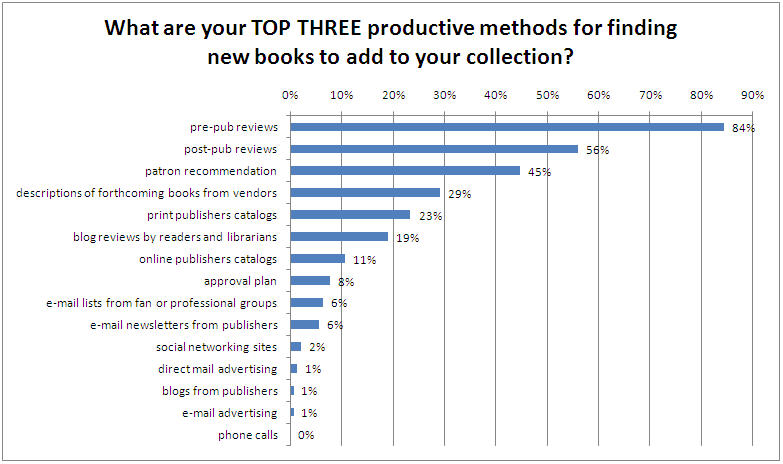
I love libraries for this very reason. And because there’s no way I could purchase all the books I read. No way in heck. So how do they find the books for their collections? I mentioned above that they used reviews. But I didn’t know how much until I saw the data. Holy schnitzel (click on the graphic to see it full size).
 .
.
This only makes sense. Study after study has shown that buyers don’t want unlimited choice. Readers use prior experience and recommendations from people they know to manage the chaos. Libraries use reviews and then patron recommendations. Of course, this use of reviews has other implications as shown below.
I get a lot of requests from self-published authors asking me to buy their books, and I have to explain that with limited resources and only so much space on the shelves, we have to go with books that are reviewed, that have been professionally edited. With nearly half a million books published each year—maybe half of them self-published, and most of those pretty awful—I just don’t have time to go beyond trusted sources. This usually doesn’t go over well.
About 9 months ago I wrote about how cumulative advantage can drive product popularity–products that get early positive notice tend to get more notice. It appears that cumulative advantage is at work again. It’s just that with libraries the method isn’t a download counter. The article’s author concludes, “the best way to reach the library market is indirectly: by publishing books that people want to read and having them assessed objectively in reviews.”
So what are the major sources for pre-publication book reviews? The article lists five big ones:
But what can an author do with this information? Authors can’t control reviews. Heck, according to the article the Library Journal itself only reviews about 10% of the books they receive.
We all know the answer. Authors can control one thing: they can strive to write the best holy freaking heck book in their power. After all, what’s a review but a recommendation? Besides, patron recommendations were #3 on the librians’ list anyway. Nevertheless, it DOES help to have a publisher who sends your book out to the reviewers and their catalogs out to libraries. It helps to have a team that’s connected with librarians.
The article ends by saying publishers and libraries are actually working together. I liked how the author summed it up.
What publishers offer:
- Discovery of talent
- Shaping and refining books
- Design, distribution, marketing, and promotion
What librarians offer:
- Discovery of books
- Nurturing of diverse reading communities
- Selection, distribution, marketing, and promotion
Here’s to libraries! (And good reviews. And grandmas. And the little house trolls that give writers fabulous ideas.)
How would you like to sit down and get writing tips from someone who created or co-created nearly 40 television series? Someone who wrote more than 450 episodes for those and other series and then went on to produce around 1,500 more. Oh, yeah, and then after his thirty or so years in television, he published 18 novels. Whoa–eighteen. Like I’m shaking, right?
It’s not like the guy knows much about telling stories. I mean, millions of viewers entertained–big deal. Still, do you think you might be interested in seeing if he hasn’t maybe one piece of advice that’s useful?
If so, the guy’s name is Stephen J. Cannell. He wrote about 9,000 words on developing stories and called it his Writing Seminar. I thought it was pretty good. Well, for a piker.
SFWA has asked M.C.A. Hogarth to head up the new self-publishing committee. Hogarth posted about this and asks:
So here’s my question for those of you who self-publish, either entirely or as a hybrid author: what services would you look for in a professional organization? What would make you say, “Wow, that’s worth $90 a year, sign me up?”
I applaud SFWA’s move. And the many good things SFWA has done in the past. However, as an indie and SFWA member, here’s what would interest me: Business.
That’s with a big B.
That means . . .
Distribution into brick and mortar venues. So indie authors can get on the Ingram’s catalog. Big whoop. The retailer still has to order. If SFWA was able to facilitate the sales function in some way, that alone would be worth it.
One idea is a SFWA catalog of vetted work. I don’t know how you’d vet. Maybe some certain sales and revenue level. And revenue would have to be part of it. Brick and Mortar isn’t going to be interested in stocking the person who “sold” 50,000 units but only made $300 because 99% of them were free downloads.
You might also consider the back lists of authors with work that was once published that has been brought back indie style. So a catalog of that includes new stuff and a section for the back list. Quality and popular indie work.
BTW, this catalog would ALSO go to libraries.
Education in cover design AND art direction. Maybe adding this to an awards category chosen NOT by the general membership but art pros.
The Nebulas recognize author’s who sell. But what about recognizing those who are author-publishers, what about recognizing and celebrating quality and achievement in the key elements of publishing?
Education in Marketing that has actually been tested and shows positive ROI. Not a bunch of articles about bookmarks and conventions. Real ROI.
Interior formatting. Principles. Awards.
News. What’s new on the indie front. New markets etc.
Selling foreign rights as an indie with and without an agent.
What about an award like RWA’s Golden Heart, but for indie books? Or make indies more inclusive in the Nebulas.
A vendor forum where folks who provide services to indie authors (editors, artists, etc) can be listed and rated, GoodReads style, but only by SFWA members.
And two things I have submitted to SFWA before as a trad pub author.
Education and discussion of contracts and contract terms. What’s current. What’s alarming. I get more off of Kris Rusch’s blog than the professional organization I belong to. I should be giving my $90 bucks to Kris. What the heck?
Education and discussion of current contract rates. Same as above. For a professional organization to not have data on current rates for novels is a real head-scratcher.
How is it that Tobias Buckell can run a survey, but it never occurs to SFWA to survey and publish annual numbers?
How is it that Brenda Hiatt, the romance writer who does an annual “Show Me The Money” and “Indie Earnings” report, provides more info on Tor advances than SFWA? Romance writers are better organized than any writing group on the planet, but do they need to spank us in our own house?
These last two are no-brainers.
This is a trade organization. These types of things would be a HUGE help.
 I don’t know how it’s possible to aruge that media does not influence our decisions. The evidience is simply overwhelming. Here’s another report of a study linking media sexuality to teenage decisions about sexuality.
“CHICAGO — Groundbreaking research suggests that pregnancy rates are much higher among teens who watch a lot of TV with sexual dialogue and behavior than among those who have tamer viewing tastes.” Full article here.
The study shows that while teenage pregnancies have dropped overall, those teens watching racey shows had, not just a small incremental risk, but TWICE the risk of getting pregnant.
Now, I know this article by the Guttmacher Institute focuses on the 1990’s, but it still is enlightening. It discusses the reasons for the dropping teenage pregnancy rates during those years. It’s conclusion is that both abstinence and usage of more effective contraception are the main factors for the drop in teenage pregnancies.
When I put the two articles together, it makes me wonder if the racey shows are encouraging more sex among the teens who watch them or the use of less-effective contraception or both. My guess is that the shows are influencing a decision for more sexuality.
Either way, what does this mean for a writer?
To me, it means that while I’m never responsible for someone’s actions nor in 100% control of what people take from my writing, I AM responsible for those things I know are highly likely to influence folks one way or another. I hope my works provide a wonderfully entertaining experience, but also avoid influencing people into decisions that will lead them down paths that will limit their happiness.
It’s widely known that total circulation (sales) numbers for the main science fiction and fantasy magazines have been dropping for years. For example, in 1983 Analog’s circulation was around 115,000. Asimov’s and Magazine of Fantasy and Science Fiction, while not that high, were in the same general ball park. A lot has changed since then. Sales took a huge hit in the early 1990’s and continued to drop almost every year. However, last year something wonderful happened. Numbers went up.
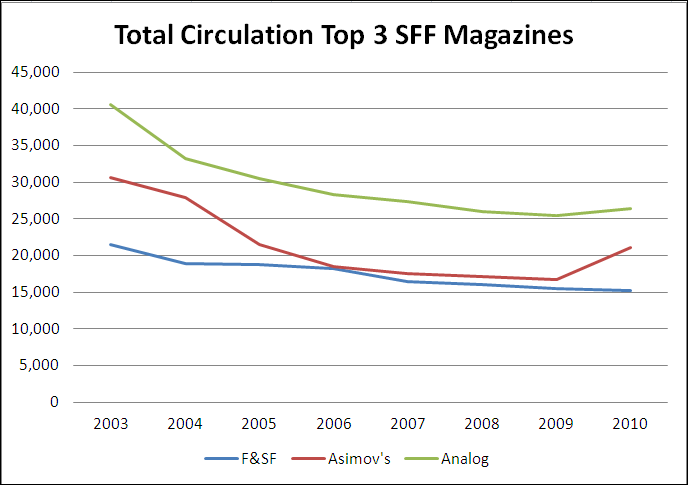
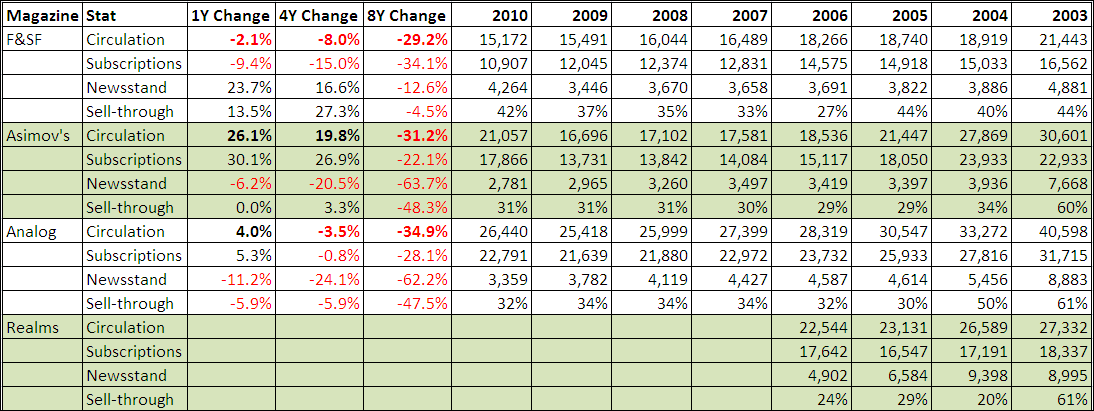
Gardner Dozois, in his summation of the SFF industry for 2010, found in The Year’s Best Science Fiction Vol 28, from which 2010 and 2009 numbers were taken, mentions that the growth numbers for Asimov’s subscriptions were driven in large part by “digital copies sold for e-readers through devices such as the Kindle,” and that Analog’s increase in subscriptions was “also largely because of digital sales.”
We all know that ebook took off last year. It will be very interesting to see the increase in total circulation continues for these magazines in 2011. Here is the supporting data that was collected from the reports in The Year’s Best Science Fiction volumes 20 – 28. Total circulation is made up of subscriptions and newsstand sales. Sell-through is a measurement of the % of the copies displayed in newsstands (at Barnes & Noble etc.) which sold. I added the Realms of Fantasy figures just so we could see, with the magazine recently dying its third death, just how big it once was.
Of course, a fascinating question is: what are the chief factors that led to such a drastic decline in the first place? But I don’t know anyone who has been able to provide data to suggest what the chief cause(s) are. If anyone knows of one, please post in the comments.
Wikipedia: Analog Science Fiction and Fact,
The top two factors driving book sales both stem from having a loyal customer base. Building that base is the goal as it is in any business that depends on repeat customers. In a previous post I outlined these parts to building that base.
In this post I’m going to share some thoughts on #3.
So how do you entice someone new to give you a try? There are a lot of things I see that play into that: a great cover, description, sample chapters, and reviews that all say quality and scream genre. But there’s another huge factor to making something enticing. And that is price. Or rather price vs. perceived value.
I’m looking at Mark Corkers reports from Smashwords.
I’m looking at slides 65-69. I know many of us have seen them.
If the patterns are similar at Amazon, which sells more ebooks than anyone else, then a price of $3.99 on average will sell more than double the copies of $6.99.
$3.99 means MORE readers who might develop some level of loyalty, MORE word of mouth, and it means MORE revenue than at other price levels.
It means more than double the chances of getting your stuff in front on an influencer.
More than double the chances for luck to come into play.
And those odds grow exponentially.
And, again, all along the way that price earns you more than if you were pricing at $6.99 or $9.99 because you sell more books.
Of course, these are averages, which means folks are winning at prices above and below this. Furthermore, it’s not the same across genres. For example, it appears romance tends to sell better towards the lower end of the range Corker shows. But it clearly shows that price is an important part of enticing a reader to give you a try.
And when I look at the indies who are selling huge numbers and have built their customer base, the vast majority of them seem to have gotten there by tapping into the market forces Corker shows on these slides.
That doesn’t mean they price all their books the same. Some are doing very well using a loss-leader/sample strategy where they offer the first book in a series for 99 cents or free. This also doesn’t mean they set their price and forget. it. They seem to do just the opposite, experimenting with different prices. I noticed the Joe Konrath, who became a mega-seller at $2.99, raised his prices to $5.99 recently. He’s dropped them back down to $2.99 and $3.99. But he was clearly testing something. In an interview earlier this year with Simon Duringer, Russell Blake who is doing very well in the thriller category recently said this.
Probably the most effective thing I did over the last two years other than Select, which came and went in terms of usefulness, was making the first book in my JET and my Assassin series free. That lowered the barrier to giving my work a whirl to nil, and my readership exploded from there. About a month and a half ago I stopped doing that because I saw my conversion rates were averaging about 12-13% from the first to the second book, and I questioned whether, with, say, 500 downloads a day, and seeing 60 sales of book two, it might not be more desirable to get 70 paid sales of book one, and seeing that same 60 on the conversion (because if someone pays for your first book, they’re probably going to read it, and soon, whereas if they get it free, it could take years, or more likely, never happen). So far so good.
Clearly the folks who are doing well with this are experimenting with price to see which levels maximize revenue and loyal customers. And I think that’s the key. They are looking at what seems to be working for others, experimenting, and basing decisions on results.
