News – updates on books, events, appearances, etc.

  • | |

    Teachers (and writers)! Free Class Next Monday on How to Teach Narrative for the Common Core

    If you feel a bit lost or anxious about how to teach narrative for the new core, especially stories, I think I can help.

    I’m an educator in the private sector and an award-winning novelist and short story writer. I’ve been teaching authors in various venues how to write for the last five years. I’ve been on writing podcasts with thousands of listeners, taught at a number of writers conventions, and had a series of articles published by the national Science Fiction and Fantasy Writers of America organization, an organization for professional authors. I’ve also been helping Nellie, my wonderful wife, teach her 7th and 8th grade language arts students the unit on short stories during that same period. We’ve taught it to twenty different classes and picked up a number of important insights along the way.

    This last year I couldn’t help but examine all the materials Nellie brought home during the district’s writing program adoption investigations. Some programs looked very promising; others not so much. Some got some things about writing flat out wrong. Most of the programs had gaps.

    Furthermore, because I work with so many people wanting to write, I know that it’s difficult to teach if you really don’t understand what stories really are and how they work. For lots of people, the subject matter can seem impenetrable. And yet writing stories is such a wonderful way to teach writing, especially because so many kids love it. You won’t find a kid who will spend extra hours writing a business letter or poem analysis, but you will find quite a few who will go crazy writing stories. And the whole time they’re practicing their writing skills.

    The question is how DO you write a story?

    What is a story?

    How can you tell if it’s good?

    How do you come up with ideas?

    Where do you start?

    And what the heck is this chart? Do writers really use this? (Not many that I know.)
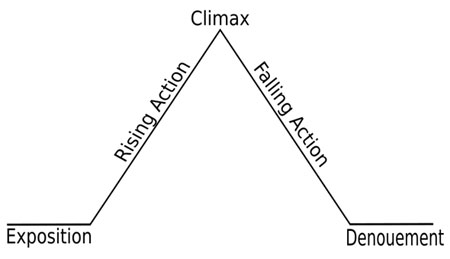
    Story Diagram plot-mountain-pic

    And does anyone think changing the diagram to look like Aspen, Colorado actually helps?
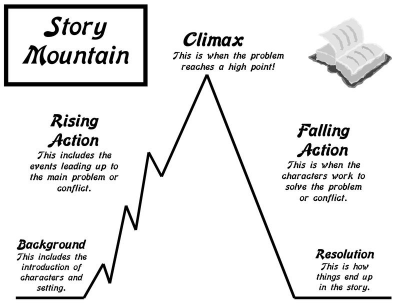
    Story Diagram Aspen 

    Hey, students—please make your story look like Aspen, Colorado!  (Yeah, that’s going to be effective.)

    And yet it’s not as difficult as it appears. Nellie and I have seen a lot of kids really get into writing stories. We’ve seen kids WILLINGLY going way beyond the assignment to write stories that are eight, twelve, twenty-five plus pages. And as they’re writing, they’re practicing grammar, spelling, structure, vocabulary, etc. without knowing it and having a great time. I know that if you enable your students, many of them will write, write, write. Especially in grade school. But also in the higher grades.

    Stories can be a blast. The assignments can connect to many students. And the results can be wonderful. I’ve laughed out loud at some of the stories coming out of Nellie’s class. Others have been enjoyable on other levels.

    But for this to work in your class, you need to know some key things. You need to understand the core of story and the story development process. You need a lesson plan that details everything step-by-step so your students don’t flounder. And you need to know some fundamental tips (secrets?) about teaching this content.

    So I’m going to hold this day-long class for you. A full eight hours. And share everything Nellie and I have learned. This class will be for teachers at ALL levels (I’ll show you some ways to scale the complexity of what you’re doing). There will be NO cost. The only thing you have to bring is a pencil, paper, whatever program materials you have, and a willingness to have a good time.

    When we finish, you will know how to write a simple story like the ones your students will write because, ta-dum, you will write one! AND you’ll have a step-by-step lesson plan that builds on whatever materials you have—an official program or one of your own. AND you’ll understand story better than 99% of the population. AND you’ll have a bundle of techniques to help your students. AND you’ll solve both world peace and maybe the lost sock conundrum.

    Truly, I think that instead of feeling stress, you’ll actually be looking forward to teaching and writing stories with your students. If not, you may bring tomatoes and huck them at me, but please be aware that I will not stand still; to find satisfaction, you will have to be able to hit a moving target.

    If you’re interested, just click the Contact John link under my photo in the left sidebar and send me an email letting me know.

    Hope to see you in class!

    GET READY FOR A FUN DAY OF LEARNING!

    Topic: Teaching writing (narrative & the common core)

    Who: Teachers (and writers at least 18 years old), seats are limited

    When: Monday, July 29th, 8:15 AM – 5:00 PM

    Where: Rich Middle School, 54 E 100 S  Laketown, UT 84038

    Materials you need to bring:

    • Pencil
    • Paper
    • The writing program you’ll be using this year
    • Kooky socks, for those who cannot resist the urge
    • A lunch or a way to get one

    AGENDA

    8:15 AM Arrive

    8:30 AM – 9:20 AM

    • Can you create a redneck crapper?
    • The 1st secret to teaching writing: Attributes & techniques
    • The 5 parts of story
    • Thieves prosper – using existing patterns
    • A car, a beggar, and an idiot — basic pattern 1

    9:30 AM – 10:20 AM

    • The 2nd secret to teaching writing: Do it with them
    • Technique: Sketch then draft
    • Workshop 1: Zombies and kisses
    • Technique: Zing hunting
    • Workshop 2: Hunt zing

    10:30 – 11:20

    • What makes a story big or small
    • Workshop 3: Select a right-sized THOM and character
    • Workshop 4: Select a Goal
    • Workshop 5: Make character sympathetic
    • Workshop 6: 3 tries
    • Workshop 7: Resolution

    LUNCH

    12:00 – 12:50

    • The 3rd secret to teaching writing: Cognitive modeling and the 6-step process
    • The 4th secret to teaching writing: Our tiny brains
    • Writing is telling: Narrative & description
    • Technique: Yes, SiR
    • Technique: Broad-brush + 1
    • Technique: The Pause

    1:00 – 1:50

    • The 5th secret to teaching writing: Have fun
    • Workshop 8: Write your story

    2:00  – 2:50

    • How the pros revise—concept, line, & copy
    • Workshop 9: Content edit
    • The 6th secret to teaching writing: Our brains are still tiny
    • Workshop 10: Line edit

    3:00 – 3:50

    • The 7th secret to teaching writing: The 3 grunts (responding to a story and grading)
    • Share stories
    • What the heck did we just do?

    4:00 – 4:50

    • How to adjust for grade level
    • Common core
    • Your program and lesson plan
    • Identify black holes
    • Wrap up & next steps
  • NEWS: Finished line edit of Servant

    It took me 33 hours, but I just finished reading through SERVANT and marking the manuscript up with the line edits I need to make.

    Holy smokes, folks, but it’s going to be a bigger edit than I originally thought. I knew I wanted to resequence chapters 1-8 back to the way I originally intended them. I knew there were some typos. And I knew I needed to add some content surrounding Purity’s story. But as I read I found that I was making line edits on almost every page.  For those unfamiliar with the term, you have basically four edits.

    • Content or story edit
    • Line edit
    • Copy edit
    • Proof edit

    The story edit is just what it says: you’re looking at plot and character. In this edit, you might add or cut whole chapters or story lines.

    Once the story is good, you do a line edit. In this edit you’re looking for how well the actual words on the page flow. You’re looking for parts where what you’re trying to say isn’t clear, where sentences or paragraphs are awkward, or where you haven’t been consistent. In this edit, you rewrite sentences and paragraphs. 

    Next, there’s the copy edit. Back in the old days, you had essentially three versions of the work. You had the original manuscript, which might go through many edits for the story and flow. Once it was good, the manuscript would be given to an editor who created a “copy” that could be used by the typesetters.  Of course, before you handed that over to the folks setting the type, you wanted to make sure it was clean because making changes in type is a pain in the butt. So in this edit, you’d go over it one more time, looking for typos and grammar issues. At this level, you fix words within sentences, although many times this edit will be combined with a line edit.

    Finally, there’s the proof edit. A proof was a copy of the work that had been set into type and printed. The typesetters would look at the their typesetters copy and then physically take metal sorts and mount them in a press to match it. To print it, they would ink the sorts and make an impression onto blank paper. That’s how stuff was printed. 

    Nowadays, you don’t need to manually set the type–you just print directly from document on your computer.  So you don’t have to worry about errors introduced into the text because of the typesetting. However, as many writers will attest, you simply do not see things on the computer screen that are obvious on the printed page. And so you always want to print out a proof and then edit it one last time for any errors in formatting or for small copy or line edits.

    So this last read was more or less a line edit. I did make some content-sized changes. And I did mark it up for typos and grammar stuff. But the bulk of the changes were line-level stuff, and I have to say I’m amazed at how many there are. I guess this simply means I’ve grown as a writer. But it is going to take some time to finish. I’ll then give the manuscript to my wife who is great with copy editing. And do another revision.

    I have to say I enjoyed reading the stories of Talen, Sugar, Argoth, and Hunger again. Some of the events had dimmed with time, and I was delighted to read them again. Parts of this book just make me so happy. With a couple of them I was all, dang, this story is awesome!

    ***

    Still working on the cover design for the Dark God books. Hope to finalize the basic structure this week and commission an artist. I’ll post the process and get your feedback as we go.

  • NEWS: The Man is going all indie for the next little while

    After discussions with my agent and a few others, I’ve decided NOT to shop BAD PENNY to New York publishers. In fact, I’ve decided I’m not going to be shopping anything to NY for the next 12 – 18 months.

    My agent was certainly willing to take the property out, but given the average expected advance for thrillers ($15-20k per book; maybe up to $100k for three books) and the terms that NY currently wants, I thought that it might be worth it to try to build something on my own.

    I do not hold the illusions some do about indie publishing (I probably hold others). For example, I know quite a few authors who have published indie and are selling very low numbers each month–single digits and teens. Of course, I know others, a smaller portion, who are selling just fine.

    But then what’s the bar? How many copies do I have to sell on my own over a three to five year period to match what NY can do for me via brick and mortar?

    Let’s look at that from a revenue and a unit perspective.

    The average advance for a fantasy, according to Tobias Buckell’s survey, is about $7,000 for a new author. $12,000 for an established author. We saw the numbers I gathered for thrillers above.

    So lets see how many copies I’d have to sell indie style to earn as much as I’d get in an advance from New York.  Why not select a higher number? Well, my understanding is that most books don’t earn out their advance. That doesn’t mean the publisher doesn’t make money; just that a publisher’s profit isn’t dependent on an author earning out.

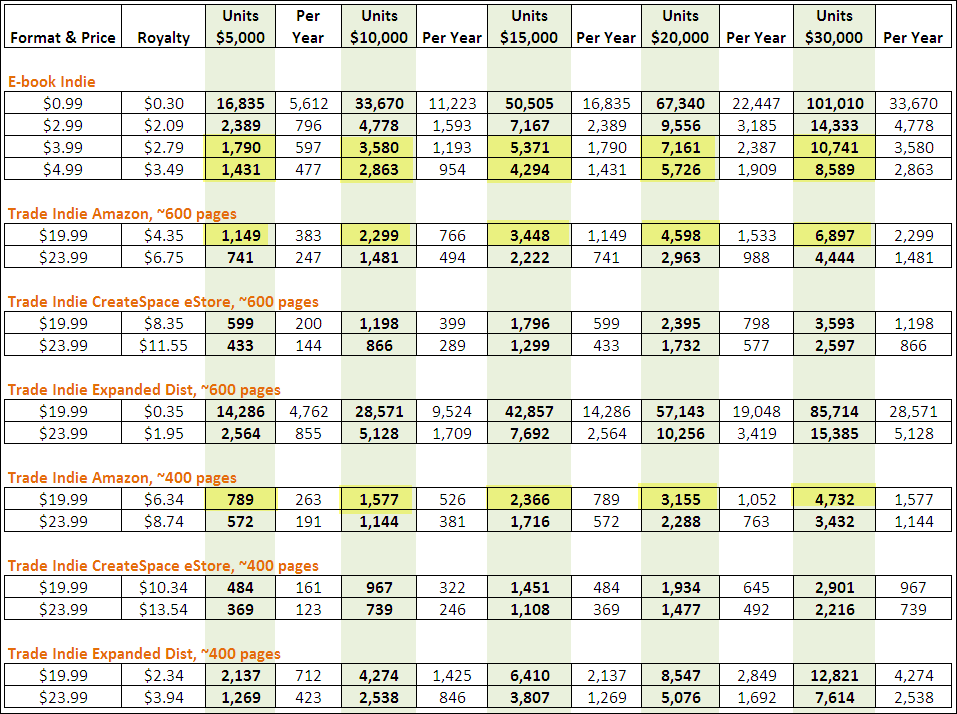
    So what are the numbers? Well, here are the numbers for NY. Down the first column you’ll see the different formats. Across the rows you’ll see how many units I’d have to sell to make the advance specified at the top. And how many units I’d have to sell if I wanted to spread the total over three years.

    IndieNYComparisonNYNumbers

    Okay, and here’s what I’d have to sell if I went indie to make the same numbers. I put in the trade paperback format for both 600 and 400 pages because that’s about how big SERVANT and BAD PENNY are going to be.

    IndieNYComparisonIndieNumbers


    What does this tell me?

    It tells me I have to sell a heck of a lot more units with NY at a much higher price than I do indie.  It tells me that a $5,000 advance is not even close to being worth the control I lose with NY.  And if it’s true that most books don’t earn out, then it tells me the units that are being sold by NY on the average book.

    Back in 2009 I shared this: How Many Copies Do Average Authors Sell? This was from an editor at Tor Books. Seems like my numbers are in the ball park.

    It’s true that NY could get me into brick and mortar stores. But if the book gets shelved spine out in the back, how many people will discover it?

    It’s true that NY produces some spectacular hits. I looked at the USA Today bestseller list yesterday and it appears only about 10% of the books there this week are indies. But I can’t bank on becoming a NY wonder. The vast majority of NY published books DON’T make the bestseller lists.

    Finally, even if I sold BAD PENNY today, it still wouldn’t hit shelves for probably 12-18 months from now. And then it would only stay on the shelves for 12-18 weeks. Going indie, I will have it up by September. And it will stay. For years and years and years.

    There’s no guarantee of success either way. But the indie numbers look good to me. We’ll see how it goes.

  • NEWS: Book Updates

    I finished draft three of BAD PENNY last week and have updated the progress bars.

    I’ve given the book to my agent, but because there are some contract terms that I’m unwilling to sign going forward, I need to make sure she’s comfortable representing me on it. I don’t want her doing a lot of work and bringing back what she thinks is a good deal only to have me refuse it. I’d rather discuss these up front and make sure we’re both on the same page. I hope to have her response back this week.

    I am now turning my focus to SERVANT and CURSE. I need to re-read both of them and then write up an outline of what I need to revise. I hope to finish SERVANT in June and CURSE in July. I’ll post my progress on the side bars as I go.

    The cover artist I’d hoped to use for both of these is unavailable at this time, dang it! So I’m currently reviewing candidates. If you know of an up-and-coming artist who you think would be good, click on the Contact Me link under my photo in the sidebar or post it in the comments.

  • NEWS: Curse of a Dark God has a release date!

    Curse of a Dark God, book 2 of the Dark God series, can now be published!

    That’s the short version.

    Here’s the long version that will probably not be what you expect.  A little over nine months ago I initiated a contract termination with my publisher Tor Books.  A few days ago Tor reverted the rights. This means I have all the rights to all the books in the series back.

    But why would I initiate such a thing? Tor’s like THE publisher of science fiction and fantasy.

    There are a couple of factors, but I think the biggest issue is that we had differences in our vision for the story. This meant there were things I didn’t like about where the project was going and how it was progressing. It also meant there were things Tor didn’t like about the project and how it was progressing. This translated into some big delays. 

    We could have hung together–Tor never raised the idea of termination. But I saw no benefit in limping along. If things aren’t working, I tend to want them fixed. So after I raised the issue, all involved agreed that a termination of the agreement would be the best option.

    And although all of us were disappointed it didn’t work out, this was an amicable parting. Tor went to bat for me with Macmillan, their overlord, to get this thing done. And we ended up with, I feel, a fair agreement. Of course, my agent was a valuable resource every step of the way.

    I don’t look at these last years as a loss. The series was introduced to thousands of readers. And I learned a number of valuable things about the business and craft working on this project with the folks at Tor. We’re farther along now that we were, even if we didn’t take the rocket ship to the stars.

    Most importantly, the good news is that for those of you who have been waiting, I can now move forward! The series will be published by Blacksword Books, my own imprint. We’ll start with e-book and trade paperback formats. Both will be available online from Amazon, Barnes&Noble, and other retailers. Once that’s rolling, we’ll look to see if audio is feasible.

    I’m very excited about CURSE. My agent loved it. I loved it. My early readers have loved it. I think all of you who enjoyed SERVANT will enjoy this just as much if not more.

    Mokad is coming.  And bringing all its might to root out and obliterate the sleth in the New Lands.  And they’re not alone.  You’re going to meet a Guardian of awesome and cunning power who leads Mokad ‘s dreadmen army.  You’re going to meet the Dogmen of Toth.  And sleth who have rallied to Argoth’s call.  And a fearsome ally who lives in the Wilds.  All the main characters are back with Sugar and Talen learning new magic, facing new creatures, and discovering unsettling insights into what’s really going on.

    I love this book. I can’t wait to get it into your hands.

    But there’s a lot to do to get it out the door.

    I need to make some edits to SERVANT. There are a number of maddening typos that crept into the manuscript. I’ll also be changing the sequence of the first eight chapters back to my original sequence, starting with Sugar and Legs and then moving to Talen. I know some readers like the sequence my Tor editors requested that starts the book with Talen sitting around in his under pants, but I structured it for him to follow Sugar for specific reasons, and starting with Talen undermines a number of those things. Finally, because I don’t have a word limit, I’m going to be adding some clarity to the ending that wasn’t in the Tor version. I also need to make some revisions to the last draft of CURSE, which has been done for almost two years, and then put it through a rigorous copy edit. And then there’s cover design, interior formatting for the print versions, and the publishing part.

    So lots of work. But I think it’s going to be worth it. At the very least I will satisfy the young woman, soon to be a mother, dining at a pizza place I went to this last week who told me she loved SERVANT, thought it was awesome, and was angry at me because there’s no book two!

    I’ll post a schedule soon. My hope is to have both books up sometime in August.

    Oh, and when they do come out, please know that both the e-book and trade paper versions will be on sale for two weeks.  I’m going to put SERVANT on for a massive discount so those of you wanting the author’s cut can get it cheap. I don’t want you to have to buy the book twice at full price. And I’m going to put CURSE on sale as well because those of you who have stuck with me deserve a reward.  

    Then it’s on to DARK GOD’S GLORY which I’ve already completed the working outline for. There might be another book in the same world about a team of fell-maidens (the female version of dreadmen) given a difficult task. And then there’s a whole other series—different world, different awesome magic—waiting in the wings. The first one in that series is tentatively titled LORD OF BONES.

    Get zinged, Baby!  The Dark God is back in action.