NEWS: Curse of a Dark God has a release date!

Curse of a Dark God, book 2 of the Dark God series, can now be published!

That’s the short version.

Here’s the long version that will probably not be what you expect.  A little over nine months ago I initiated a contract termination with my publisher Tor Books.  A few days ago Tor reverted the rights. This means I have all the rights to all the books in the series back.

But why would I initiate such a thing? Tor’s like THE publisher of science fiction and fantasy.

There are a couple of factors, but I think the biggest issue is that we had differences in our vision for the story. This meant there were things I didn’t like about where the project was going and how it was progressing. It also meant there were things Tor didn’t like about the project and how it was progressing. This translated into some big delays. 

We could have hung together–Tor never raised the idea of termination. But I saw no benefit in limping along. If things aren’t working, I tend to want them fixed. So after I raised the issue, all involved agreed that a termination of the agreement would be the best option.

And although all of us were disappointed it didn’t work out, this was an amicable parting. Tor went to bat for me with Macmillan, their overlord, to get this thing done. And we ended up with, I feel, a fair agreement. Of course, my agent was a valuable resource every step of the way.

I don’t look at these last years as a loss. The series was introduced to thousands of readers. And I learned a number of valuable things about the business and craft working on this project with the folks at Tor. We’re farther along now that we were, even if we didn’t take the rocket ship to the stars.

Most importantly, the good news is that for those of you who have been waiting, I can now move forward! The series will be published by Blacksword Books, my own imprint. We’ll start with e-book and trade paperback formats. Both will be available online from Amazon, Barnes&Noble, and other retailers. Once that’s rolling, we’ll look to see if audio is feasible.

I’m very excited about CURSE. My agent loved it. I loved it. My early readers have loved it. I think all of you who enjoyed SERVANT will enjoy this just as much if not more.

Mokad is coming.  And bringing all its might to root out and obliterate the sleth in the New Lands.  And they’re not alone.  You’re going to meet a Guardian of awesome and cunning power who leads Mokad ‘s dreadmen army.  You’re going to meet the Dogmen of Toth.  And sleth who have rallied to Argoth’s call.  And a fearsome ally who lives in the Wilds.  All the main characters are back with Sugar and Talen learning new magic, facing new creatures, and discovering unsettling insights into what’s really going on.

I love this book. I can’t wait to get it into your hands.

But there’s a lot to do to get it out the door.

I need to make some edits to SERVANT. There are a number of maddening typos that crept into the manuscript. I’ll also be changing the sequence of the first eight chapters back to my original sequence, starting with Sugar and Legs and then moving to Talen. I know some readers like the sequence my Tor editors requested that starts the book with Talen sitting around in his under pants, but I structured it for him to follow Sugar for specific reasons, and starting with Talen undermines a number of those things. Finally, because I don’t have a word limit, I’m going to be adding some clarity to the ending that wasn’t in the Tor version. I also need to make some revisions to the last draft of CURSE, which has been done for almost two years, and then put it through a rigorous copy edit. And then there’s cover design, interior formatting for the print versions, and the publishing part.

So lots of work. But I think it’s going to be worth it. At the very least I will satisfy the young woman, soon to be a mother, dining at a pizza place I went to this last week who told me she loved SERVANT, thought it was awesome, and was angry at me because there’s no book two!

I’ll post a schedule soon. My hope is to have both books up sometime in August.

Oh, and when they do come out, please know that both the e-book and trade paper versions will be on sale for two weeks.  I’m going to put SERVANT on for a massive discount so those of you wanting the author’s cut can get it cheap. I don’t want you to have to buy the book twice at full price. And I’m going to put CURSE on sale as well because those of you who have stuck with me deserve a reward.  

Then it’s on to DARK GOD’S GLORY which I’ve already completed the working outline for. There might be another book in the same world about a team of fell-maidens (the female version of dreadmen) given a difficult task. And then there’s a whole other series—different world, different awesome magic—waiting in the wings. The first one in that series is tentatively titled LORD OF BONES.

Get zinged, Baby!  The Dark God is back in action.

Share

Similar Posts

  • |

    How to Write a Story that Rocks

    Folks, a huge thanks goes to Stephen Nelson for putting all this together. You may kiss his hand when you see him.

    This is a recording of “How to Write a Story that Rocks,” a two-hour seminar Larry Correia and I just put on at the annual BYU’s Life, The Universe, & Everything symposium. I think we had 130-140 people attend. This symposium is focused on writing fiction. And while the panels and presentations do include things specific to the science fiction, horror, and fantasy genres (both adult and young adult), a lot of time is also spent on story writing fundamentals that apply to ALL genres. So when I developed this workshop, I made sure I took the fundamental approach.

    The two-hour seminar has been broken down into 12 segments. To switch between the segments:

    • Hover your mouse pointer over the YouTube below
    • Click the forward and back arrows that appear on the right and left sides to move to the next or previous segment, OR 
    • Scroll through all 12 segments and select the one you want using the playlist control at the bottom

    If you prefer, you can watch all 12 on the How to Write a Story that Rocks YouTube playlist page.

    I’ve found whenever I develop any presentation or training that it takes a few iterations and revisions before it’s the best it can be. This is the first iteration of this seminar. And so below this video I’ve provided additional comments on each segment explaining key concepts, principles, and techniques that we might have failed to discuss or convey as clearly as we’d hoped. Enjoy!

    Handout

    How to Write a Story That Rocks – Handout

    Segment 1

    It’s documented–right-wing gun nut Larry Correia sang “Kumbaya.” What’s next? The hugging of small trees? Oh, Larry, the disilluion. The disillusion.

    The reason why I had Larry sing was not for his mellifluous performance, but to demonstrate the difference in reactions between him and our happy volunteer (“Country Road” by John Denver–this really was a love fest). The volunteer balked because he hadn’t taken any thought to know what to sing before he was commanded to do so. On the other hand, Larry and I had spoken before the seminar. So Larry had something to sing BEFORE he sang it. It’s a simple demonstration, but it illustrates a principle a lot of new writers forget. Writing is a performance. It helps to know what it is you’re going to perform before you perform it.

    It’s one thing for you to tell yourself to write. It’s much easier to tell yourself to write the scene where the rancher finds out one of his illegal ranch hands has been kidnapped.

    Now this doesn’t mean that you have to know everything. Or that you can’t write exploratory drafts to figure out what it is you want to write. But it does illustrate that whatever techniques you use, you’ll be a lot more effective in your writing when you have something to say first.

    But what do you develop? What are the things that bring the story to life? How do you go about getting those things to say? That’s precisely what I wanted to address in the seminar. In the segments that follow, I try to:

    1. Explain what I’ve found are the most important things to develop, the things that define the essence of story, that make the story come alive in the writer’s mind–the things that really matter
    2. Demonstrate techniques to develop those things so you have something to say

    Segment 2

    I think this segment went fairly well. What rocks will different from person to person, even though there will often be a huge overlap between people. So it’s important for authors to seek to develop the kinds of stories that rouse their passion. Watch this interview with best seller Debbie Macomber to see what I mean. So I can’t tell you what to write about. Or if whath you think rocks will resonate with a large number of people. However, what I can do is share the techniques I use that have been most productive in helping me develop initial ideas into something that has much more power.

    You can use the techniques to juice up any of the four parts of story. However, I will say that I find that the most productive, the most important parts, are character and problem. Plot and setting are important. I love them and work to juice them up. But when I get a good character and problem, that’s when the writing seems to flow the easiest.

    And no, I don’t list theme as a part of story. Everyone talks about theme, but when I read what they have to say or press them for examples, it seems that it always either boils down to (1) a story element or topic that’s repeated, (2) a story problem/issue stated in an abstract manner, or (3) some moral situation. Les Miserables is about the “theme” of mercy versus justice. But saying justice versus mercy is just an abstraction of the story problem and dilemmas the story deals with. So, no theme. 

    Segment 3

    Loved this bit about scenes from David Mamet: http://www.slashfilm.com/2010/03/23/a-letter-from-david-mamet-to-the-writers-of-the-unit/ 

    Segment 4

    I’ll be adding my comments to the rest of these segments over the next few days.

    Segment 5

    Segment 6

    Segment 7

    Segment 8

    Segment 9

    Segment 10

    Segment 11

    Segment 12

    Dan Wells on Story Structure

    Check it out: Dan Wells on How to Build a Story (story structure). I find Dan’s “start with the ending” technique helpful as well as thinking about a worst fears realized moment. Watch the videos and see if there isn’t something there that can help you develop your story idea.

    You can get the PowerPoint of How to Build a Story on Dan’s site.

    If you find this approach useful, you might want to check out what novelist Larry Brooks has written about the same material on StoryFix.com.

    Share
  • | |

    Teachers (and writers)! Free Class Next Monday on How to Teach Narrative for the Common Core

    If you feel a bit lost or anxious about how to teach narrative for the new core, especially stories, I think I can help.

    I’m an educator in the private sector and an award-winning novelist and short story writer. I’ve been teaching authors in various venues how to write for the last five years. I’ve been on writing podcasts with thousands of listeners, taught at a number of writers conventions, and had a series of articles published by the national Science Fiction and Fantasy Writers of America organization, an organization for professional authors. I’ve also been helping Nellie, my wonderful wife, teach her 7th and 8th grade language arts students the unit on short stories during that same period. We’ve taught it to twenty different classes and picked up a number of important insights along the way.

    This last year I couldn’t help but examine all the materials Nellie brought home during the district’s writing program adoption investigations. Some programs looked very promising; others not so much. Some got some things about writing flat out wrong. Most of the programs had gaps.

    Furthermore, because I work with so many people wanting to write, I know that it’s difficult to teach if you really don’t understand what stories really are and how they work. For lots of people, the subject matter can seem impenetrable. And yet writing stories is such a wonderful way to teach writing, especially because so many kids love it. You won’t find a kid who will spend extra hours writing a business letter or poem analysis, but you will find quite a few who will go crazy writing stories. And the whole time they’re practicing their writing skills.

    The question is how DO you write a story?

    What is a story?

    How can you tell if it’s good?

    How do you come up with ideas?

    Where do you start?

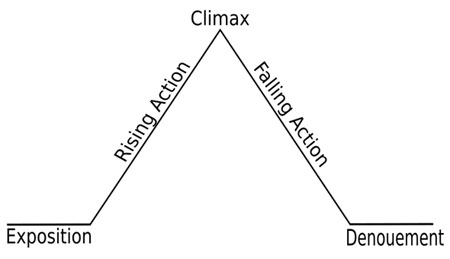
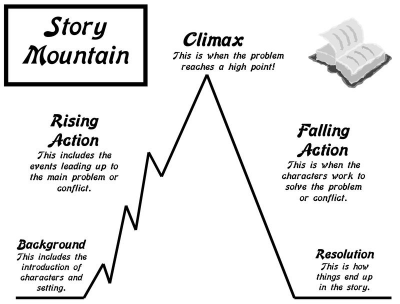
    And what the heck is this chart? Do writers really use this? (Not many that I know.)

    Story Diagram plot-mountain-pic

    And does anyone think changing the diagram to look like Aspen, Colorado actually helps?

    Story Diagram Aspen 

    Hey, students—please make your story look like Aspen, Colorado!  (Yeah, that’s going to be effective.)

    And yet it’s not as difficult as it appears. Nellie and I have seen a lot of kids really get into writing stories. We’ve seen kids WILLINGLY going way beyond the assignment to write stories that are eight, twelve, twenty-five plus pages. And as they’re writing, they’re practicing grammar, spelling, structure, vocabulary, etc. without knowing it and having a great time. I know that if you enable your students, many of them will write, write, write. Especially in grade school. But also in the higher grades.

    Stories can be a blast. The assignments can connect to many students. And the results can be wonderful. I’ve laughed out loud at some of the stories coming out of Nellie’s class. Others have been enjoyable on other levels.

    But for this to work in your class, you need to know some key things. You need to understand the core of story and the story development process. You need a lesson plan that details everything step-by-step so your students don’t flounder. And you need to know some fundamental tips (secrets?) about teaching this content.

    So I’m going to hold this day-long class for you. A full eight hours. And share everything Nellie and I have learned. This class will be for teachers at ALL levels (I’ll show you some ways to scale the complexity of what you’re doing). There will be NO cost. The only thing you have to bring is a pencil, paper, whatever program materials you have, and a willingness to have a good time.

    When we finish, you will know how to write a simple story like the ones your students will write because, ta-dum, you will write one! AND you’ll have a step-by-step lesson plan that builds on whatever materials you have—an official program or one of your own. AND you’ll understand story better than 99% of the population. AND you’ll have a bundle of techniques to help your students. AND you’ll solve both world peace and maybe the lost sock conundrum.

    Truly, I think that instead of feeling stress, you’ll actually be looking forward to teaching and writing stories with your students. If not, you may bring tomatoes and huck them at me, but please be aware that I will not stand still; to find satisfaction, you will have to be able to hit a moving target.

    If you’re interested, just click the Contact John link under my photo in the left sidebar and send me an email letting me know.

    Hope to see you in class!

    GET READY FOR A FUN DAY OF LEARNING!

    Topic: Teaching writing (narrative & the common core)

    Who: Teachers (and writers at least 18 years old), seats are limited

    When: Monday, July 29th, 8:15 AM – 5:00 PM

    Where: Rich Middle School, 54 E 100 S  Laketown, UT 84038

    Materials you need to bring:

    • Pencil
    • Paper
    • The writing program you’ll be using this year
    • Kooky socks, for those who cannot resist the urge
    • A lunch or a way to get one

    AGENDA

    8:15 AM Arrive

    8:30 AM – 9:20 AM

    • Can you create a redneck crapper?
    • The 1st secret to teaching writing: Attributes & techniques
    • The 5 parts of story
    • Thieves prosper – using existing patterns
    • A car, a beggar, and an idiot — basic pattern 1

    9:30 AM – 10:20 AM

    • The 2nd secret to teaching writing: Do it with them
    • Technique: Sketch then draft
    • Workshop 1: Zombies and kisses
    • Technique: Zing hunting
    • Workshop 2: Hunt zing

    10:30 – 11:20

    • What makes a story big or small
    • Workshop 3: Select a right-sized THOM and character
    • Workshop 4: Select a Goal
    • Workshop 5: Make character sympathetic
    • Workshop 6: 3 tries
    • Workshop 7: Resolution

    LUNCH

    12:00 – 12:50

    • The 3rd secret to teaching writing: Cognitive modeling and the 6-step process
    • The 4th secret to teaching writing: Our tiny brains
    • Writing is telling: Narrative & description
    • Technique: Yes, SiR
    • Technique: Broad-brush + 1
    • Technique: The Pause

    1:00 – 1:50

    • The 5th secret to teaching writing: Have fun
    • Workshop 8: Write your story

    2:00  – 2:50

    • How the pros revise—concept, line, & copy
    • Workshop 9: Content edit
    • The 6th secret to teaching writing: Our brains are still tiny
    • Workshop 10: Line edit

    3:00 – 3:50

    • The 7th secret to teaching writing: The 3 grunts (responding to a story and grading)
    • Share stories
    • What the heck did we just do?

    4:00 – 4:50

    • How to adjust for grade level
    • Common core
    • Your program and lesson plan
    • Identify black holes
    • Wrap up & next steps
    Share
  • Warwick Castle

    This last June, I stood outside Warwick Castle next to a longbowman and stared up at the massive structure. The curtain walls rose forty to fifty feet high. The great tower soared even higher—one hundred and twenty feet. But it wasn’t just the walls. 

    The moat. Holy schnitzel, folks, the MOAT. 

    On one side of the castle, the River Avon provided a barrier. On the other, a dry moat stretched forty to sixty feet wide and twenty to thirty feet deep. Standing at the bottom, you’d be staring up at seventy feet of turf and stone. That’s like staring up at a six-story building—with armed soldiers waiting at the top. 

    My only thought was: good night, what kind of madman would assault these defenses? 

    The answer, of course, is almost no one. Medieval sieges were usually about starving the defenders out, not storming the gates in a blaze of glory. Unless you had a trebuchet—which I also saw demonstrated that day. 

    It was the kind of moment that makes a writer’s brain spark. Assassin, the fourth book in my Drovers series, is set in the capital city of Broniss, which bristles with towers and walls of its own. Standing there at Warwick, I realized: no sane army would attack such walls directly. Which is why the High King of Osson has other dark plans. 

    Of course, Warwick had more than just military lessons. There was a falconry show where hawks, vultures, eagles, and even a condor soared just above our heads. Here’s a tip. If you go, sit on the benches, not under the tree. The benches are where you get the most flyovers.  

    There was a dungeon tour that turned into a hilarious series of skits, complete with a plague doctor and a judge who convicted one of us.  

    And afterward, we went into the city to a Thai place called The Giggling Squid (yes, that’s really its name). The food was amazing. 

    It was a glorious day, and it reminded me that some of the best research often comes from first-hand experience. Although some things—like being pierced through with a sword—I’m happy to leave to my imagination. 

    I’m back at the desk now, hard at work on Assassin. It’s turning into a terrific ride, and I can’t wait to share more soon. 

    Here’s to Ferran, Sura, and Lagash—will they foil the traitor’s plot and stop the hashida’s creature, or will Ferran and the others fail and find all their dreams dashed to pieces?  

    You’ll soon be able to find out.  

    Sincerely, 

    John 

    Share
  • |

    Handout to “How to Write a Story that Rocks”

    I had an absolute BLAST with Larry and the audience at LTUE. I think the workshop went very well for the first time. Of course, I’m going to make some tweaks. Paul Genesse had some interesting feedback and I’ll have to see if I can’t do more with character. Two hours is such a short period of time.

    The good news for those who couldn’t attend is that we have a recording and will be posting probably next week. Everyone should thank Stephen Nelson!

    We ran out of handouts. I printed 80. Then Mark Holt generously had 30 more printed. We still didn’t have enough. For those of you who didn’t get one or who want an electronic copy, here it is.

    How to Write a Story That Rocks – Handout

    Share
  • Believe In Me, Cyber War

    A Man and a Team of Girls

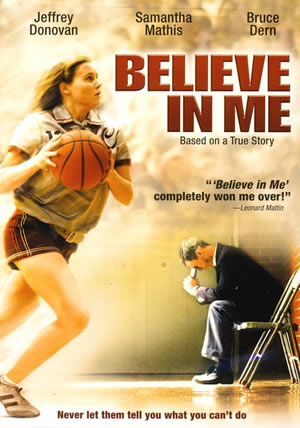
    Back in 1964, Jim Keith took a job at an Oklahoma high school to coach boy’s basketball.  But when he arrived, the administrators changed their minds and gave his job to someone else.  Keith’s contract didn’t specify which gender he’d coach, just that he’d coach.  So they switched him to the girls.  Keith was extremely disappointed.  Who wanted to coach girls when it was the boys who played real ball?  Especially when Keith was supposed to be head coach.  Keith tried to get the promised position back, except the girls he coached had other things in store for him.  Harold Keith, Jim’s brother, wrote a novel based on what happened.  That novel was made into a movie in 2006 called Believe In Me.  

    Now, we all know the plot line of sports movies: a losing underdog of a team rises up to win.  It’s predictable, right?  But we could say that of all crime shows as well—in this episode investigators discover a crime and figure out who did it!  Wow, what a shocker.  We could say it of all romantic comedies as well—in this movie a couple at odds gets together.  No way!  We could say it of lots of stories.  And yet we love these stories anyway.  Why?  

    Because the characters suck us in.  Because the story tellers do such a good job with the particular details we forget we’re watching a movie or reading a book.  We forget to think about the ending.  Furthermore, the stories are often about more than just winning games.  And so we worry about these people who have become real to us and focus on their immediate situation.  At least, that’s what happens when the story tellers do a good job.

    And Robert Collector, who both wrote and directed the film, did a great job with Believe In Me.  Now, I don’t know how accurate the film’s depiction of five-on-five play is; I believe the girl basketball teams of that era played six-on-six.  But that’s a niggling technical detail.  Besides, the movie isn’t about technique anyway.  It’s about a man and a group of country girls who have to face difficult obstacles, not so much on the court, but off it.  If you have girls or like sports at all, I think you’ll love this movie. 

    Cyber War

    I recently reviewed America The Vulnerable which explained how exposed we are as individuals, corporations, and a country to cyber crime, cyber espionage (both state and corporate), and cyber attacks.  Of all the cyber threats we face as individuals and a nation, the least likely is an all out cyber war.  But just because it’s less likely that doesn’t mean the threat isn’t real.  Especially since cyber warfare has been in use since the 1990’s.  We used cyber weapons openly in the gulf war in 2003, knocking out Iraqi air defenses.  Israel used them to own Syria’s air defenses when bombing their clandestine nuclear site in 2007.  Russia used them against Estonia in 2008 and Georgia in 2009 on a variety of targets, bringing many critical systems to a halt.  In 2010, somebody, most likely the US or Israel, developed the Stuxnet worm to sabotage the uranium enrichment facility at Natanz in Iran.  China has already conducted trial runs of cyber attacks on the US and has planted logic bombs and trap doors to activate in the future.

    In Cyber War, Richard Clarke shares his insights into what cyber war is, how cyber weapons work, and how vulnerable we are as a nation.  He discusses the cyber warriors (hackers) we now employ in the US military, and how a cyber war is like and unlike other wars.  In the second half of the book, he discusses the factors that have created our current vulnerability, how to set up a defense, and what we need to think about when conducting a cyber war. 

    And Clarke knows his stuff.  He worked for the State Department during the presidency of Ronald Reagan.  In 1992, President George H.W. Bush appointed him to chair the Counter-terrorism Security Group and to a seat on the United States National Security Council.  President Bill Clinton retained Clarke and in 1998 promoted him to be the national coordinator for security, infrastructure protection, and counterterrorism, the chief counterterrorism adviser on the National Security Council.  President George W. Bush kept him in the same position and later made him special adviser to the president on cyber security.    

    The thing I liked most about the book is that in addition to describing cool cyber war weapons, threats, and incidents, Clarke examines answers to many critical questions.  For example, how can we set up a defense without the government becoming a 1984 nightmare?  Would arms agreements work in cyber space?  (No.)  How do you prevent a cyber war from turning into a kinetic (guns and troops) war?  How do you attack your enemy when it’s sometimes hard to know who launched the attack in the first place?  He discusses these and many more questions.

    The book does have one fault.  Clarke has an obvious axe to grind with the Bush administration, and can’t help but make snide and irritating comments whenever he brings them up.  The good news is that those spots are few and far between.  If you want an excellent introduction into how cyber weapons are used and will likely be used in the future, you’ll want to read this book.

    Share
  • It has begun

    The very observant will note that the progress bar for draf 4 of CURSE OF A DARK GOD has moved. Here’s the opening, although I’m sure it will change. We’re on our way, folks.

    It was well past midnight, and they were deep in enemy Fir-Noy territory.  There were eight of them: Talen, Sugar, River, and five of Shim’s soldiers, all of them staying back in the deep moon shadows at the edge of the wood, crouching low in the dry autumn weeds that had not yet been eaten down by the village livestock.  They had to be careful.  Talen, Sugar, and River all had sizeable Fir-Noy bounties on their heads.  And even though they wore weaves of might, being multiplied didn’t make their flesh impervious to arrows and blades. 

    This vulnerability had been made abundantly clear to Talen in his training.  In addition to his many fine bruises and the finger which had recently healed from a break, he wore a bandage around his arm where a soldier had cut him in practice two days ago with a spear. 

    The night shadows of the clouds played over the moonlit fields and houses and road that ran through the village of Plum.  The village where Sugar’s father had been killed and her mother taken and beaten.  The village where the Fir-Noy had burned her life to the ground.  The village that was their destination.

    Purity, Sugar’s mother, had hidden valuables there.  Weaves and maybe a codex of lore.  Talen and the others had been tasked to steal into the village and retrieve the items, right under the noses of the sleeping Fir-Noy.

    Except this wasn’t right.  They were supposed to have come out across from the ash ruins of Sugar’s old house.  “I think you’ve brought us to the wrong end,” Talen whispered to Sugar.

    “No, I’m just coming to get what’s mine first.”  Sugar pointed up the road to the entrance of the village.

    Talen followed her finger.  The Fir-Noy here had begun to build a wall around their village.  A wooden palisade atop a mound of dirt.  But she wasn’t pointing at the half-finished wall with its timber supports still showing like bones.  She was pointing at a tall pole that had been erected at the gate of the village.  Something had been fastened to the top of the pole.  Talen peered closer and saw a skull shining pale in the moonlight. 

    “That’s your father’s, isn’t it?”

    “You’re going to help me,” she said.  “He deserves better than that.”

    Share

27 Comments

  1. Congratulations on publishing your own books! It sounds like a great way to go. I look forward to reading Curse as soon as it is available.

  2. That’s good news. I’m glad you have control of your story back. I don’t like that a publisher has so much control over the art. That’s probably why so much of today’s music and movies suck so bad, and why so many writers are doing the self pub thing. The business people need to learn that they should stick to the business side of things and allow the artists the freedom to do what they do best. Anyway, good luck with your writing. Looking forward to reading your stories.

  3. It’s is great news! I am very much looking forward to the continuation of this series.

  4. I was sure that Curse would end up another big publisher screwing over an author casualty. Glad to hear that isn’t the case!

  5. I hate to see you part ways with Tor, because they’re kind of my go-to publisher, but this is still great news. Good on you for staying with your vision even though it means uncertainty and more work for you. I respect that.

    Also glad to hear you’re putting it out in paper! Looking forward to August!

  6. why not go for a Kickstarter like Bradley P. Beaulieu did after leaving nightshade books, and Michael J. Sullivan did for hollow world?

    seems like it could big a good fit

  7. Wait, wait… does that mean I don’t get a hard bound copy to go with my copy of Servant. Well, anyway I look forward to the new version of Servant and the much awaited Curse.

  8. Good luck with it, John. I’m sad it was such a long and frustrating road with Tor, but it’s good to see you taking hold of your future with both hands.

  9. I’m reading about more and more authors who are taking control of the direction of their work, and it’s exciting. I can’t wait to read about your world and characters as they were meant to be!

  10. Julie, alas, no. Then again, a fine trade paper is so much better than vaporware 🙂

  11. So glad you will be able to move forward! It takes a lot of work to self-publish and do it well. Let me know if you need any help with the typesetting (that’s what I do for a living). Good luck!

  12. Thanks, Marny! I just might take you up on that. I’m taking a class on interiors. I know, I know, there’s a lot more to it than one class can teach. I hope what I learn will get me most of the way there, but I may want some review. I’ll let you know.

  13. This is really good news.
    I really loved Servant and was sad to hear that there were difficulties with Tor, but I can’t wait to read the “Writer’s Cut” for both books. I’d almost given up hope of seeing Curse, but now…:)

    Kev

  14. Super excited for you, John. I’m with the man above. A kickstarter would be a great way to go for the second book. You could time it with the discount price on the ebook of Servant and re-ignite the fanbase. There are plenty of stories that get funded on kickstarter that I don’t feel hold a candle to your first book, so I’m sure you could get it funded. And you know I’d be on full media blitz to help. Add in a Correia book bomb for either the first book OR the kickstarter itself, and you’ll be good to go.

    Man, super excited about this. So many ideas and possibilities. This is going to rock.

  15. If anything needs funding, it’s going to be the cover art for both books. Because I want to release them at the same time. The rest of it I can take care of no problem. I’ll look into the kickstarter to see what I think.

  16. This makes me sad that you left Tor. Publishing with a real company is one in a million chance that I can only dream of doing. I do fear that self-publishing won’t bring in the number of fans or the recognition your series deserves. Its hard enough for my own book to be noticed without a label. At least I can look forward to the continuation of the series finally. You had an awesome start. I wish you luck.

  17. ND,

    Only time will tell. I can say with 100% confidence that if I sell even one book of CURSE, that will be more than I was selling of that book with Tor. After writing and re-writing and then waiting for four and a half years, it’s time to move on.

    And this doesn’t mean I’ll never work with a traditional publisher again. It just means that for right now I’m not. The situation on the ground will change with time and with later projects.

    I also want you to look at this blog I posted back in 2009.

    http://johndbrown.com/2009/08/how-many-copies-do-average-authors-sell/

    Some books published via traditional publishers do indeed sell tens of thousands of copies. But the vast majority do not. To verify that, look at the annual Publishers Weekly surveys of best-selling books. Count the titles. Only a fraction of what’s published makes it onto those lists.

    The good news is that I still have readers like you interested in my work. For folks who really loved the series, they will soon be able to finish it. And that makes me happy.

    Going indie certainly is a different model. Let’s see what happens over the next 12 to 18 months 🙂

  18. I was just sitting here on my bed and my eyes fell on Servant, sitting on my shelf, and I thought, “Where the heck is book 2?”

    And here I find the answer.

    As an indie-published author, I have mixed feelings about the path you’re taking, but who am I to second guess your decision? I just think you’re an awesome guy and a great story-teller, and I look forward to reading anything you produce. Best of luck!

    Oh, and I have to agree with the guy above who said something about a book bomb with Larry, who mentioned my latest trilogy of book–not really even an endorsement–and it resulted in TONS of traffic that helped my book literally for months. Larry has quite the huge and rabid following.

  19. Thanks, Stephen.

    Yes, Larry has already asked when he can plug the books. I’m going to see if I can’t do some bookbub promotion and a few other things. But know that I have mixed feelings too. I wish it would have worked out. But I’ve got to deal with the facts on the ground.

    I know the averages on indie sales. So I know it’s not going to be a cakewalk. But I keep looking at the numbers that I share in my post on going indie and can’t help but want to give this option a go for a short time.

  20. You know when thinking about the body, fire, and soul in SERVANT I always end up thinking about time. How the Fire ( or spirit) is the future, your remaining days, the extent of how long you will live. Then there is the body, the here and now, the physicality of what is happening at this moment to this body. Finally there is the soul the thing that is the past, it has always been there.
    Anyway thanks for the awesome read, and for getting me to work my noodle. (even if I am completely of the mark of what you intended. (^_^))

  21. Ryan,

    That’s actually an interesting way to look at it. Shoot, that might show up somewhere in one of the books 🙂

Comments are closed.