News – updates on books, events, appearances, etc.

  • Servant cover art

    The cover illustration for SERVANT is finished!

    (and there was much rejoicing.)

    yea.

    Actually, there was DANCING. Because I think the final piece rocks. The artist is Victor Minguez. Here are two of his pieces that I really enjoy.

    The first is “Angel.” I love the bright contrast, the face, and the fact that there’s so much rich detail.

    The next is “Champagne Havoc.” Again, a wonderful face, but also an awesome idea (a robot carrying a woman in the palm of its hand), and then the lines and chopper give the whole piece a lot of energy.

    Click here to see other works in his portfolio.

    So we kicked the project off by me sharing the goals I had for the cover and tons of reference on everything from color scheme to character costume. I asked Victor to develop some concepts for an ensemble of Hunger, Sugar, and Talen as well as some for the cave scene towards the end of the book. He came back with these sketches.
    Servant Sketch 1 cave Servant Sketch 2 horse ensemble

    Servant Sketch 3 ensemble Servant Sketch 4 cave

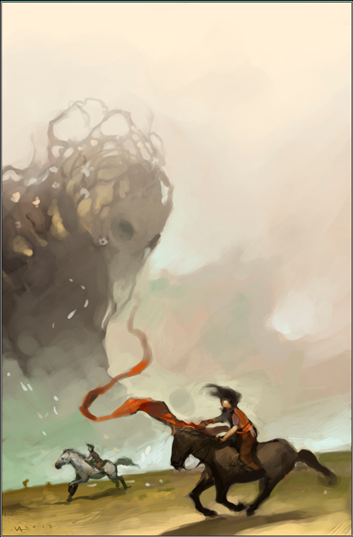
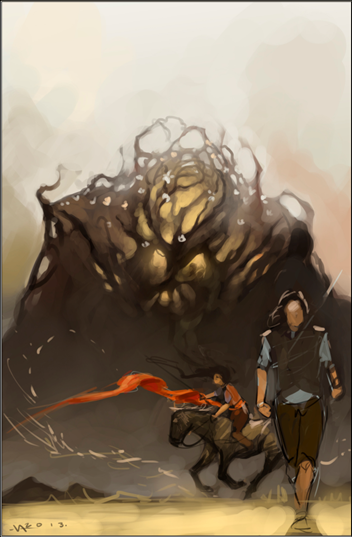
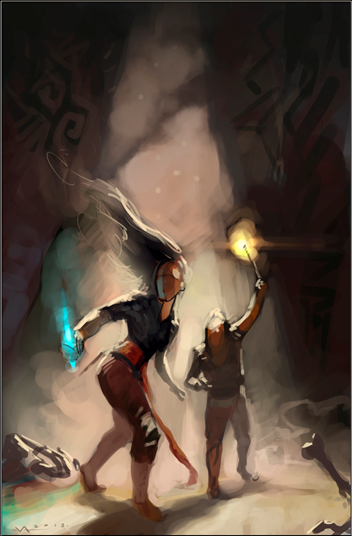
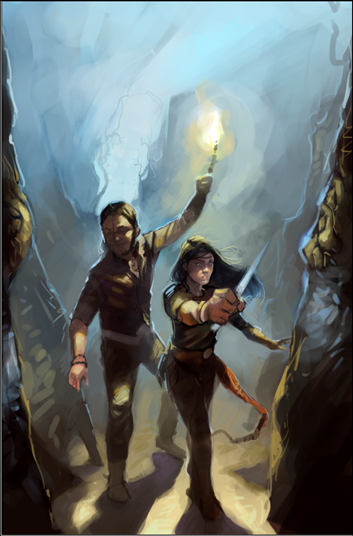
    I liked the first because it would allow us to see the figure’s faces more clearly. And there was a lot of interesting detail with the cave. Look at the roots by the entrance. I also liked the structure. I liked the third because it included Hunger, and Victor was taking Hunger in a new direction. I also thought we could do some neat things with the energy of Sugar on the horse and that long sash. The fourth one, however, just felt right. It had so much potential energy. I was immediately drawn to the body language. And so this is the one we decided to develop.  Then one of my beta art viewers suggested moving closer and putting in more strong diagonals. It was a perfect idea. Victor agreed and came back with this.
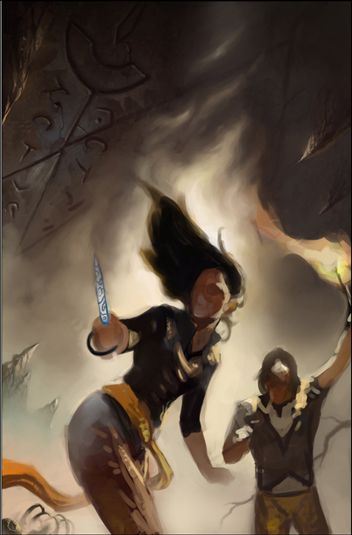
     

    Servant WIP 1

    I liked the lines of her stance but wondered if she needed something stronger with her legs. Victor adjusted, but my idea just wasn’t an improvement.
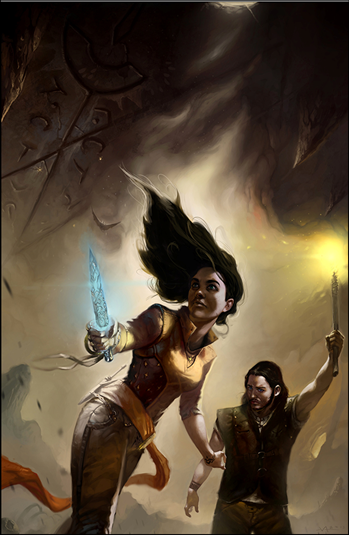
    Servant WIP 2

    So we decided to stick with the previous version. However, this was all too dark. Way too much gray. When looking at things in thumbnail, the cover has to pop. I shared more reference images. And Victor went back and delivered this.
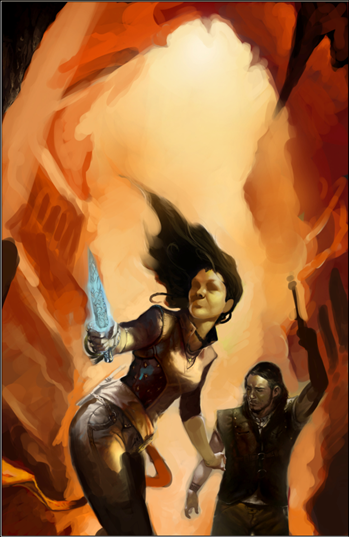
    Servant WIP 3

    Boom! That was exactly what I was looking for. Bright, dynamic. However, we needed a more neutral bit at the top for the title and author’s name. And the brightest spot had to be behind Sugar to draw the eye to her. Here was the next version.
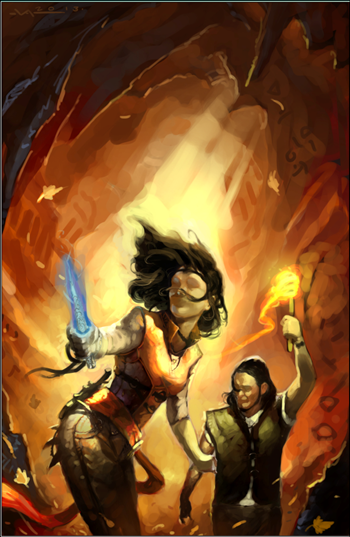
    Servant WIP 4

    At this point I started to dance. This was IT! There was a lot going on here. We had the high contrast I wanted. We had the energy. The wind with the hair and leaves and sash and torch all add kinetic energy. As do all the diagonals. Notice as well the cave details–we have hints at previous habitation, runes, and some interesting contrast with the dark foreground. I had shared a number of N.C. Wyeth and Tim and Greg Hildebrandt pieces as reference, and I think this captured elements of those and gave them a new twist. Note as well the sharp projections on Sugar’s behind. Victor put them in there purely for aesthetic reasons. He had no idea what they were. I loved them. He loved them. They worked. We would just have to make them make sense.

    After a few more iterations, he delivered the final.
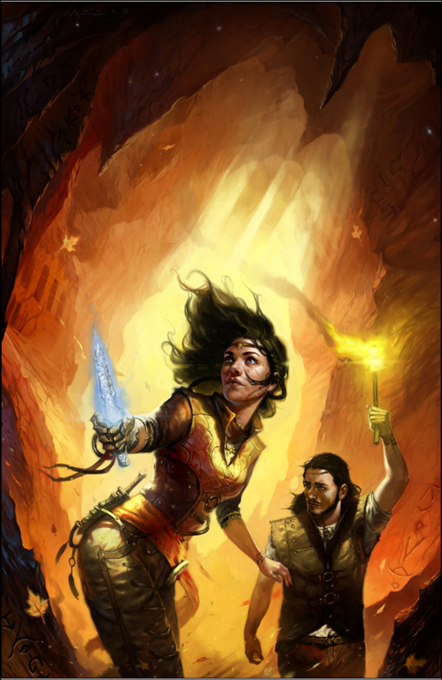
    Servant Final

    I think it’s gorgeous. And will advertise the book perfectly. In a few days I will reveal the final cover with title etc. Shortly after that, SERVANT will be available again to please English readers worldwide.


  • Update on book releases

    Folks, were are so close to having the cover work done for SERVANT and BAD PENNY. But it’s not done yet. So we’re slipping the delivery into November. CURSE will move back to early December. We lost two months with the issues we encountered with our original art projects. This time, though, we’re going to make it. And you will be pleased with the results.

  • What changed in the author’s cut of SERVANT?

    Because a number of folks have emailed or posted asking this question, I figured I should address it in a post.

    This edit of SERVANT was signficant, but it involved mostly line edits, copy edits, resequencing, and one important adjustment and addition.

    Line edits are things that make individual sentences or paragraphs read more clearly. I made line edits to almost every page. I think most readers won’t notice these. But then that’s the point.

    Copy edits catch small things like typos and misspellings. There were a number of maddening copy issues that were introduced into the manuscript in the publisher’s version and others that weren’t flagged. I fixed a number of these and then had two copy editors read over the manuscript to find more. No book is perfect. I’m sure there are still some gremlins lurking in the text. But we caught a lot of the little buggers. 

    Resequencing is moving chapters or sections around and does affect the experience. The biggest resequence was switching the first eight chapters back to the original order I intended. This is an important change and will have a large effect on the reader for the first quarter of the book. Then there were three other smaller sections inside the story that needed to be moved around to make the chronology clearer and improve the suspense.

    The line, copy, and resequencing edits make up the bulk of the edits. But I did adjust and add a short section to the ending immediately after the climax to clarify a few things that should have been revealed in the first version and that lead into book two.

    What does this all mean?

    It means that while this is a superior version of the tale, the base story remains the same. I care about the stories of Sugar, Talen, Argoth, Hunger, and the dilemmas they face. So I did not change their tales. However, I did significantly change the experience of those tales for the reader.

    If you have already read SERVANT, you know everything that happens. However, you will want to get a hold of a copy of the new version to review the updated ending for the new information it includes.  To avoid spoilers and confusion, I will not be releasing the ending in a separate document. But if you sign up for my release notification, I’ll let you know when I have my release sale so you can get it cheap. 

    One final note. Because I feel this is a superior version of the story, and because I do not want readers to be confused about which version to read, I’m releasing it with a different title and different cover art. It will be called “Servant” and include the series label “The Dark God Book 1.” 

    I think readers are going to be very pleased with this version. I know I am. And then we can move on to “Curse,” the next in the series, followed by “Glory.”

  • Passed the 75% mark on the final draft of BAD PENNY

    Working on the copy edits of BAD PENNY today and passed the 75% mark to general rejoicing.

    You normal folks may now go back to work. For you passionate grammarians, my fab copy editor marked a hundred uses of “then” in my manuscript.

    No, I wasn’t having issues with the then/than confusion.  

    I was having issues when using “then” when tying two clauses together. The question: did I always have to use “and” with “then”?

    EXAMPLE 1: “Frank backed out of the parking stall then rumbled out onto Dewar Drive.”

    Was “then” naked without an accompanying “and”? Should I make it read as “Frank backed out of the parking stall and then rumbled onto Dewar Drive”?

    And if it doesn’t need the full “and,” does it need at least a comma for a miniskirt so it reads “parking stall, then rumbled out onto . . .”?

    EXAMPLE 2: “The tension ratcheted up, then Senor Zombie’s eyes slid to the side.”

    Can you use “then” as a coordinating conjunction? Or must it always be used with “and,” as in “the tension ratcheted up, and then Senor Zombie’s slid to the side.”

    I looked in the Chicago Manual of Style. I looked in Garner’s Modern American Usage. I could not find the answer. So I emailed Annette Lyon, author of There, Their, and They’re: A No-Tears Guide to Grammar From The Word Nerd.

    Saint Annette’s response:

    Your first example is correct as is, with no AND: “Frank backed out of the parking stall then rumbled out onto Dewar Drive.”

    The only time you grammatically need AND before THEN is if we’re connecting two independent clauses, because THEN isn’t one of the conjunctions that can do that. You’ll find those in a text box in the book, and they include AND, OR, FOR, NOR, YET, BUT, SO.

    The only issue in the above sentence is whether to use a comma before THEN. The current stylistic trend is to leave out the comma, so you can leave it just like you have it above. Some people balk at that and want the comma for the pause it provides. Depending on the house style guide, that may be something you can argue, or maybe it won’t be. Neither is really grammatically more correct; the comma before THEN is more of a style issue. 

    In the next example, we do need AND or some other conjunction from the list, because both sides of the sentence are independent clauses. So this would be wrong: “The tension ratcheted up, then Senor Zombie’s eyes slid to the side.”

    But this would work: “The tension ratcheted up, and then Senor Zombie’s eyes slid to the side.”

    To avoid the issue altogether, we can rephrase it. A couple of variations:

    -The tension ratcheted up when Senor Zombie’s eyes slid to the side.

    -Senor Zombie’s eyes slid to the side; the tension ratcheted up. (Semicolons replace conjunction + comma)

    Rules of thumb:

    -If you’ve got 2 independent clauses, don’t use THEN as the conjunction. Add AND or another one.

    -It the sentence has just 1 independent clause, THEN is enough by itself.

    Thank you, Annette.

    And wouldn’t you know, I opened A Wanted Man by Lee Child, and what did I see? A bunch of then’s illustrating exactly what Ms. Lyon suggested.

    “Reacher heard the roar of the shot, quieter than some, but still deafening in a closed room, and simultaneously he heard the wallboard explode above and behind his head, and then he hit the floor, knees first, then his hip, then his side, sprawling, down low behind the counter, out of sight.” (159)

    I think all I’m going to see while reading for the next while are the then’s.