We are fast approaching one of the most important days of the year–April 1st. Not only is it an excellent day to have a birthday, it’s also a good excuse to eat bunny cakes and torment loved ones.
So in the spirit of this fine day, please share some April Fool’s gags so I may replicate. Last year’s tape-the-sink-sprayer-in-the-on position was a hit (thank you Ms. Barlow). Mostly because I kept forgetting I’d taped it and sprayed myself a number of times. Doh!
Also here’s the google of “bunny cake recipe.” If you have one that you’ve tried and loved, please share. The most often used pattern in the Brown house results in a bunny like this one. Although I must say Eriks H’s is entirely too happy. I’m feeling the need for a zombie or fantasy version. I’ve also moved away from frosting–too sweet. Now my cakes must be topped with real whip cream.
Radio and TV have incredible power. But until the last decade they were always constrained by time and signal power. You had to listen when the station broadcast it, and you had to listen where you could pick up the signal.
Living out in the boonies we don’t get good radio or TV reception (no I don’t subscribe to satellite). Which is why the internet is so wonderful.
You can listen and watch almost anything when you want from almost any location–yes, even in Laketown, UT, Boonie Central. Millions listen to music, conservative talk, or libral talk (NPR) via the internet. I enjoy all three depending on my mood. But there’s so much more out there than music and blah blah blah, as much as I love it. For example, you can listen to the British BBC. You can listen to the Dutch. See what’s going on in Australia. Doesn’t matter that they are a number time zones away and all asleep when I’m working. I love the internet.
One of the best programs I’ve heard in the last six months is the three-part “Parasites” presented by Radiolab. In a fascinating hour they address the following questions:
Parasites: are they evil, or are they awesome?
Should you get infected with hookworms?
Can parasites exercise mind control over their hosts?
Along the way they tell a number of amazing stories. Listen now. You won’t be able to stop.
Two quotes that in no way can do justice to the whole thing.
And so rock bottom became the solid foundation on which I rebuilt my life.
You might never fail on the scale I did, but some failure in life is inevitable. It is impossible to live without failing at something, unless you live so cautiously that you might as well not have lived at all – in which case, you fail by default.
. . .
Though I personally will defend the value of bedtime stories to my last gasp, I have learned to value imagination in a much broader sense. Imagination is not only the uniquely human capacity to envision that which is not, and therefore the fount of all invention and innovation. In its arguably most transformative and revelatory capacity, it is the power that enables us to empathise with humans whose experiences we have never shared.
One of the greatest formative experiences of my life preceded Harry Potter, though it informed much of what I subsequently wrote in those books.
Here, watch this book trailer for Scott Westerfield’s Leviathan.
Yeah, I know you want to–go ahead, watch it again.
Miller looks at book trailers, sees that the vast majority of them are lame, lame, lame (actually, this is the FIRST I’ve seen that’s any good). Sees that they reach no markets and then concludes that all trailers are silly. It’s true: lame trailers ARE a waste of time and money. But ANY advertisement (print, video, audio, whatever) that’s lame is a waste of time and money. Making killer trailers that nobody sees is an even bigger waste of time and money. But that’s true of ANY killer advertisement that nobody sees.
Look. I’ve never read Westerfield. Don’t know much about him or his books. But I saw that clip and now want to read that book. Hum, trailer worked for me. I AM a reptoid mutant, but I suspect there are others out there like me. I mean, come on. Good gravy, woman–“Do you oil your war machines? Or do you feed them?” Killer!
Movie trailers, book trailers–any advertisement–isn’t about delivering what the person is going to experience on the spot. If that were the case, then you’d never show a print ad of a meal at Olive Garden because it doesn’t deliver the goods right there on page 10 of Woman’s Day. Nope, all you’d do is go around giving out samples in places with Italian mood.
Miller’s error is not understanding the difference between making an offer and delivering on one. What an ad is supposed to do is make the offer. Let you know this thing is available. Because you’re not delivering the actual experience, you can make the offer via all sorts of media. Now, if you can give them a taste, that’s great. But you don’t need to deliver the full deal right there.
So what do you need in an offer? You need the offer to say, “Hey, I’ll deliver this type of experience.” It needs to call to some action, either directly or by implication–“buy this” or “be here.” You also need it to say, “You can trust this will be worth it” and make the consumer believe that’s likely to be true. It communicates this last bit by being a quality piece of work.
Making an offer is exactly what book covers do–they make the offer and give the consumer a little taste. And book covers matter. This has been proven over and over. Just like most people, when I see a cool cover, I pick up the book and check it out. When I see a lame one, or one that offers something I’m not interested in, you’re going to have to threaten me to pick that book up. Or it better dang well have some righteous word of mouth. It’s that simple. We all judge books by their covers because the cover is making an offer. And lame offers don’t get very many takers.
Book trailers are nothing more than deluxe book covers. The cool thing about them is the cool thing about movie trailers–you can make the offer by providing a little taste. You do that by giving the audience the story situation, the pitch. You do it by communicating the feel of the experience and raising curiosity. You do it by making it a pro job. The good ones make you laugh, say cool!, or raise curiosity and expectation.
And that Westerfield trailer does that.
Dang, “Do you oil your machines? Or do you feed them?”
Run that on TV. Run it on the radio. Put it up on sites where people are likely to see and click. Confirm it in print. Make the offer to real people. Get it infront of young readers. I’ll stake my eyebrows that ad can sell as many books as a good movie trailer can sell movie tickets.
Very effective advertising for the book. I think the content of the book is crap, but that trailer made me pick it up just to see what it was all about.
Do you notice that this one and the Westerfield one combine extreme professionalism AND they make the pitch in a clear and grabbing way? The pitch for both was what the book was about. For fiction it’s the concept. For non-fiction how to it’s the promise.
So many of the book trailers lack one or more of those things. For example, look at the book award finalist for THE FALLEN: http://www.youtube.com/watch?v=vsLE6bNaIrk. I don’t know what the heck the book is even about after a long 2 minutes. They’re trying to make a movie.
Something else. On both of these you have a voice over PITCHING the book to you just as someone might do it in person or to an editor. It’s a powerful method, I think.
Notice also how short the Westerfield one is. Just over a minute. Westerfield’s really is like a query pitch or cover copy–in just a few lines tell me what your story is about. We get genre, setting, character, and the story problem or concept.
Tor is posting ALL the stories in the Year’s Best Fantasy 9 anthology (published summer 2009) for FREE. Mine was in the second installment, but you can already get it here. What you want are all the others! For example, installment 3 has one of my favorite short stories I read last year: Kij Johnson’s “26 Monkeys and the Abyss.”
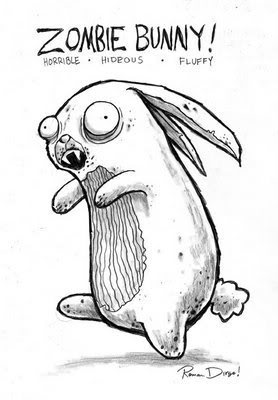 We are fast approaching one of the most important days of the year–April 1st. Not only is it an excellent day to have a birthday, it’s also a good excuse to eat bunny cakes and torment loved ones.
 Radio and TV have incredible power. But until the last decade they were always constrained by time and signal power. You had to listen when the station broadcast it, and you had to listen where you could pick up the signal.