Cranford, Balsamic Vinaigrette, Nebo Grotto Falls

Cranford
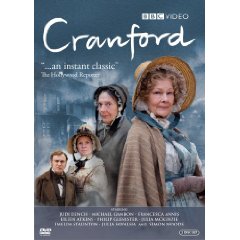
For those of you who love stories like Pride and Prejudice, have I got a TV mini-series for you—the BBC’s five-part Cranford.

The series is set in the 1840’s in England in the fictional village in North West England and focuses primarily on a handful of the town’s single middle-class ladies who are forced to deal with lace-eating cats, marriage prospects, and prank valentines, as well as death, loss, and a changing culture. There are also two stories about the male inhabitants woven in as well—one about a new doctor and another about a young boy of the lower class who has a chance for something better.

I will confess that when I saw this arrive in the Netflix envelope, I wasn’t at all excited. The cover’s too cold–all blue with a bunch of sour-looking women. In fact, I decided not to watch it. But the laughter of my wife and daughters lured me back upstairs to the TV, where it took about seven seconds for me to revise my earlier decision. The characters are delightful. In fact, some of their lines are such a joy to listen to, we had to rewind many parts to watch them again and again.

The series is based on three novels by Elizabeth Gaskell, a British novelist, which were published between 1849 and 1858. The sets made us feel as if we where there. For example, one of the things I noticed was the lighting. Incandescent bulbs weren’t invented until the late 1800’s and took many more years to find their way into most houses. So the directors, instead of making it feel all Hollywood, seemed to rely heavily on the light at hand, as those inhabitants would have. When a scene was in a house, it felt as if they were only using the natural light coming in the windows or the candles being burned. Of course, this is just one of the many details that made this series an excellent period piece.  

The best news of all is that I just found out there’s more–a two-part special called Return to Cranford. I can’t wait until it comes in the mail. Don’t let the cover fool you. This is a wonderful mini-series. It has poignant and sad moments, but is also full of humor and wit.  And the ending is perfect.   

Kroger’s Balsamic Vinaigrette Dressing

I love balsamic vinegar and oil on bread. But I never think to make it. And I never thought of what else it might go with. That was until a relative left behind a bottle of Kroger brand Balsamic Vinaigrette Dressing.

I just happened have a homemade bagel handy, squirted out a bit onto a plate and dipped.  Lovely.  So then I tried it on salad and even splashed some on tomato or turkey sandwiches. It’s delicious. Only 80 calories for a whole tablespoon. In fact, it was so good we bought four more bottles because I don’t want to run out.

Kroger, of course, is a grocery conglomerate. In Utah, it owns the Smith’s, and that’s where you’ll find this delight.

Nebo Grotto Falls

The mountains and canyons of Utah are literally desert oases. That’s where our clear streams run, the forests grow, and the wildlife congregates. In the summer, the canyons are a refreshing source for cooling winds. All this meant that, as I grew up, “forest” and “refreshing” became intertwined in my mind. Only when we moved to Ohio did I learn that some forests can also be muggy and hot and not at all refreshing to a desert boy perishing in the humidity.

Because I love Utah’s canyons so much, we hike and walk them all throughout the summer.  We recently went down to enjoy the Stadium of Fire and the heat (yes, I love dry heat) in Provo. However, we didn’t just hang out in the city. We made time to hike a few trails in the surrounding canyons.

We love Rock Canyon (just above the Mormon temple in Provo), Hobble Creek Canyon (Springville), as well as Mapleton and Santaquin canyons.  However, there’s another special place that you’ll want to visit should you find yourself in the Provo area. It’s a short little hike just off of S Canyon Road (also known as Nebo Loop Road) which runs from Payson south through the Mt Nebo Wilderness area to Highway 132.

The trail head is just a few miles into the canyon south of Payson and is marked with a simple sign that says “Grotto.” There’s a little bit of parking on the side of the road. The hike is 0.6 miles along a wooded stream.  The grotto itself is more than worth it.  You can find directions here: http://www.utah.com/thingtodo27245.htm

Share

Similar Posts

  • The Veggie from Outer Space & The Mentalist

    I’ve been trying to increase my intake of vegetables and fruits because you are what you eat, and I think I’d like to look like a broccoli—long, sturdy, and with a lot of bushiness on top. So we’ve enjoyed our weekly box of fruits and veggies from the Bountiful Baskets co-op that we pick up in Garden City each Saturday.

    And we’ve enjoyed the surprises. Because someone else orders the produce, we never know quite what we’re going to get. Of course, this also means we sometimes get things we don’t normally seek out. Take cauliflower, for instance. We received a number of heads three or four weeks in a row back in October.

    Cauliflower?

    Who eats cauliflower? You ever hear anyone say: “Cauliflower’s on—let’s make a run to Brigham City to get some,” or “LaVern, I believe I’m going to knock back another floret,” or “It’s a party! You bring the chips and soda, I’ll bring the cauliflower?”

    No. We don’t hear those things because cauliflower is just weird. It’s the stuff that nobody eats on the vegetable tray. It looks like some growth spore from the planet Xenon. In fact, I want to know who started the rumor that aliens had big eyes and spindly limbs. That’s all propaganda. The aliens are already living among us, and cauliflower is their freaky pupal metamorphosis growth stage!

    Or, at least, that’s what I thought. Then I ate a serving of creamy mashed cauliflower at Ruby Tuesday’s and gained a testimony of both Ruby Tuesday’s and the weird white cousin of cabbage.  

    So when we received our surprise veggie, did I despair or use it for target practice on the idiot orange tom cat that comes around our house? No. I went to search for that Ruby Tuesday’s recipe. And through the miracle of the internets, I found it. Or something close enough for government work.

    Here it is. Enjoy.

    CREAMY MASHED CAULIFLOWER

    • 1 head cauliflower
    • ¾ C water
    • 1 T corn starch
    • 1/3 C heavy cream
    • 1 t granulated sugar
    • ¾ t salt
    • Pepper to taste
    • 1/8 t garlic powder
    • 1/8 t onion powder
    1. Divide the head of cauliflower into florets that are all roughly the same size. Steam or microwave until cauliflower is tender (we pressure cook it). Drain and toss it into a bowl of ice water to bring the cooking process to a screeching halt.
    2. Put florets into a food processor along with ½ C water. Puree on high speed until smooth, but with some small bits for texture. Or you can simply mash it like you do potatoes.
    3. Pour all the puree into a medium sauce pan. Dissolve the corn starch in the remaining ¼ cup of water and add to the puree.
    4. Add the cream, salt, pepper, garlic powder, and onion powder to the mixture and stir. Set the saucepan over medium heat and cook, stirring often, for 5-10 minutes, or until thick.

     You can experiment and switch the water for milk if you’d like, or if you don’t have cream. Leftovers are delicious. Of course, if I end up lumpy and round, you know it’s the cauliflower’s fault, or the alien’s that has set up shop in my chest cavity, whichever’s the truth. 

    For those who haven’t tried Bountiful Baskets, go to bountifulbaskets.org for more info. For those who wonder if cauliflower has any nutritional value at all, here’s the wikipedia on its goodness:

    “Cauliflower is low in fat, high in dietary fiber, folate, water and vitamin C, possessing a very high nutritional density. As a member of the brassica family, cauliflower shares with broccoli and cabbage several phytochemicals which are beneficial to human health, including sulforaphane, an anti-cancer compound released when cauliflower is chopped or chewed. Boiling reduces the levels of anti-cancer compounds, with losses of 20–30% after five minutes, 40–50% after ten minutes, and 75% after thirty minutes. However, other preparation methods such as steaming, microwaving, and stir frying had no significant effect on the compounds.

    Along with other brassica vegetables, cauliflower is a source of indole-3-carbinol, a chemical which boosts DNA repair in cells and appears to block the growth of cancer cells. The compound also appears to work as an anti-estrogen, appearing to slow or prevent the growth of tumors of the breast and prostate. Cauliflower also contains other glucosinolates besides sulfurophane, substances which may improve the liver’s ability to detoxify carcinogenic substances. A high intake of cauliflower has been found to reduce the risk of aggressive prostate cancer. Cauliflower is also a good source of carotenoids.”

    I guess the short version of all that is blah blah blah science says it’s good.

    ***

    Nellie and I have been enjoying The Mentalist for two years now. It’s a CBS crime thriller mystery series about a “mentalist,” a guy named Patrick Jane, played wonderfully by Simon Baker, who used to be a professional mind-reader and psychic, and a very good one at that, but gave it up and came clean. All psychics, he says in the pilot episode, are either fakes or deluded.

    But he was so good at it and made so much money–why would he give it up?

    Because a serial killer named Red John murdered his wife and daughter. So Jane has dedicated his life to hunting down and killing the murderer. To do that, he becomes a consultant to the California Bureau of Investigation (CBI) and works with a team of investigators.

    Some of the episodes are about the hunt for Red John. Many more are about other cases the team has to solve.

    Patrick Jane is the main attraction of the series. His outrageous behavior, acute observation skills, and keen wit all fascinate and delight. As the series progresses, the other characters take on their own interesting personalities as well. Agent Cho, for example, provides many moments of laugh-out-loud deadpan humor.

    The series is into its third season, but with the miracle of Netflix you can start at the beginning and watch them all commercial free at your own leisure.

    Share
  • A Wowser Mouse & Financial Peace

    Dis Eez A Mouse

    I’m a Luddite, which means that even though I work in the software industry, I do not rush out to purchase the latest and greatest gadget.  Our family computer, for example, is running Windows 98, primarily because we purchased the computer itself in 1999.  In human years that computer is like 432 years old.  Maybe we’ll retire the old boy this year.  The point is that I don’t like to churn through tons of gadgets.  I want something to work.  I want it to work well.  And then I want to use it for a long time. 

    Recently, my mouse started acting up.  So I went out and found a new one.  I settled on a Microsoft Wireless Mobile Mouse 4000.  It comes with three parts: the mouse, an AA battery, which is supposed to last for up to ten months, and a tiny transceiver you insert into one of your computer’s USB ports.  The mouse has a great hand-feel.  The clicks are smooth.  If you want to take your mouse with you somewhere, there’s an easy storage slot inside the mouse for the transceiver.

    But the best thing of all is its BlueTrack technology.  This is not an ancient mouse with a track ball that you have to clean every so often.  It’s an optical mouse.  But unlike earlier versions of optical mice (why do I have a terrible urge to use “mouses” or “meece”?) that didn’t work very well on a number of surfaces, this BlueTrack technology works like a charm on everything I’ve tried it on, including glass. 

    You need a new mouse?  This is a good one.

    Dave Ramsey’s Complete Guide to Money

    If you’re like 70% of America, you are living paycheck to paycheck, which means that if you or your spouse (assuming you have one) were laid off, you would probably have difficulties meeting your mortgage the next month.  If you didn’t go into default on the house, you certainly would on other payments and bills. 

    You also have very little retirement. 

    You probably have around $7,000 in credit card debt.  Maybe a lot more.

    You also have a car payment or two.  Or, heaven forbid, a lease. 

    You might be house poor—the house payment is so large you can’t seem to do anything else. 

    You might have creditors hounding you. 

    You might be one of those folks throwing their money away on the lotto instead of investing it. 

    Did you know that if you invested $50 a month, an average of what many lotto players spend, in the stock market for 40 years, you’d very likely end up with $316,000 in the bank  (over the last 40 years of ups and downs, the annualized return of the market was almost 10%). You would have put in only $24,000 over that time period, which means you would have made $292,203!  But instead, if you’re a lotto player, you just throw all that out the window.  (No, you’re not going to win; not even maybe in your dreams.)

    You probably think your kids will have to take out loans to go to college. And you think that’s a good idea.  In fact, you probably think it’s a good idea to have a credit card just in case there’s an emergency because you don’t have any savings to cover any emergencies.

    The list goes on.  The sad part of this is that our finances cause us average Americans a lot of stress in our lives and marriages and families (even if we’re in denial) and very often heartbreak. 

    I know that a lot of us look at our financial chains and throw our hands up in despair—what can I do?  The mountain of debt and bills are just too high.  Besides, this is how everybody lives.

    But it’s not.

    There is a way out.  And it doesn’t matter how old you are, it’s not too late.

    Dave Ramsey has written his hands-down best book ever, which will take you step-by-step through the process of turning a financial mess into financial peace.  He’ll do it in a down-to-earth easy-to-read style. No confusing ten dollar words that make your head spin.

    Ramsey himself went through financial hell.  He was the guy that made all the mistakes with his money.  Lost everything.  Had collection agencies coming after him.  Didn’t know how he was going to feed the family.  He turned that all around.  Yes, he’s a millionaire, but more importantly, he has been working for the last twenty years to teach regular people with regular jobs the simple principles that lead to financial peace.  They’re becoming debt free and working their way towards huge net-worth.  

    You want a step-by-step plan?  You want to educate yourself about money and family finances from one of the nation’s leading experts?  Then go and purchase Dave Ramsey’s Complete Guide to Money today and start reading it.  You will not regret it.  If you already have his Total Money Makeover and don’t think this will be worth it, think again.  This goes into all sorts of things the Total Money Makeover doesn’t.

    Be free, people.  Be free.


    Related Stuff

    Look at the links and the video.

    Share
  • The 2009 BBC version of Austen’s Emma

    Emma BBC Romola GaraiYou read some reviewers because they regularly set you back in your chair with keen insight. You read others because their phrasing and voice are so delightful that you find yourself unable not to read, even when they venture forth into exciting areas like soup cans and lug nuts. I, alas, fear I cannot occupy either role when I tell you about the BBC’s 2009 mini-series production of Jane Austen’s Emma.

    I cannot because have no keen insight into acting or film-making or film adaptations. I am not an expert on the late 18th and early 19th century England.  I am not an Austen junkie (although you can be sure I intend to become one shortly).

    Surely, as a writer, I could come up with some kind of amazing assessment. But I cannot because I am speechless. I am filled with a fine joy. I have spent nearly four hours with my wife and two of my lovely daughters watching a delightful tale unfold about the fates of a number of characters–some foolish, some arrogant, some quirky, but most of them splendidly human and noble.

    This. THIS is what I go to story for. To be transported. To laugh. To cry. To hope and fear and feel suspense for another.  To spend time with wonderful characters.  To have lived just a little more while under the story’s sway.

    Gush, gush, gush.

    Such an unmanly thing to do. But to hell with that. I am a man who loves Jane Austen and shoot ’em up thrillers both.

    And if you enjoy Cranford or Pride & Prejudice or Downton Abbey, then you will love this production of Emma too. You will want to own it.

    Romola Garai plays the star role of Emma. I enjoyed every minute she was on the screen. I didn’t know who she was, but it appears she was in the 2006 Amazing Grace with Ioan Gruffudd. I might have to watch that one again just to see more of her work. Mr. Knightly, Emma’s lifelong friend, is played by Jonny Lee Miller who starred in Eli Stone, one of my favorite TV series. I loved watching every minute with him equally as well. There were some other familiar British actors; and more I hadn’t seen before. I thought they all did an excellent job.

    As for the story, it’s about Emma, who believes she has an amazing ability at match making and prognosticating and very soon runs into to trouble because of it. It’s also about kindness, and generosity, and, most of all, love. Of so many varieties.

    If you’re wondering what to watch this next week, order this one now.

    Share
  • |

    Writing Update: Curse, trebuchets, CONduit, book industry, & Robinson Wells

    As of 5 PM this last Saturday I have finished 15,000 words of the climax of Curse of a Dark God. I think I have another 10,000 to go and the book will be done. I’m so close to the end of this draft! So don’t let the progress bars fool you. The ending is coming together fabulously–lots of spectacle, big reveals, and major heroics. At least, I think so.

    While working on this, I had to spend a number of hours finding out how strong a wind must be to pick up humans and stones. I also needed to know the destructive forces of various classes of tornados and hurricanes. Why would I need to know such things? I write fantasy, for Leroy’s sake!

    (Yes, that’s good English; I’m a writer, and one of my prerogatives is to make up silly versions of common expletives using the names of friends and enemies.)

    Here’s why: I just can’t write if I don’t believe in what I’m writing. And when I’ve got monsters (skir) that can generate winds that will be used in a siege, well, I had to know the terminal velocities of what these creatures could throw, and what that might mean for fortress defense. I had to know the limitations and ramifications.

    I won’t rehearse all the fascinating details (and it WAS fascinating), but all that research did lead me to a wonderful documentary. It’s called Secrets of Lost Empires 2: Medieval Siege and was produced by Nova in 2000. You can get it on Netflix or Amazon.  In the film, fifty carpenters worked day and night to create and test what they dubbed “the fourteenth century version of the atom bomb”–the trebuchet (tre-byou-SHAY). The trebuchet as the most popular throwing machine in Europe during the middle ages. If you love the history of medieval war, you’ll love this film. You might want to add to it a reading of the excellent Ancient and Medieval Siege Weapons by Konstantin Nossov, which you can get via the inter-library loan program.

    I’ll share two cool factoids for you history fans. “Catapult” means “shield-breaker,” “cata” meaning break or penetrate and “pelta” being the name of the shield used by the Greek light infantry. The original catapults were NOT big spoons–they sped arrows and balls along a track like a crossbow. However, instead of using the spring force of a bow, they used torsion-springs, which is what you get when you twist fibers that want to be straight. In the case of catapults the fibers were ropes made out of animal sinews or hair (horse or human, a woman’s hair being considered the best) and soaked in oil. Click on the image to see a larger picture. 

    A modern example of a torsion-spring are those balsa wood airplanes with propellers attached to a rubber band that’s hooked to the belly of the plane. To fly them, you rotate the propeller round and round, twisting the rubber band. Then you let the propeller go. Because the rubber wants to be straight, it reverses the twist, spinning the propeller the opposite way you twisted it. 

    You might think these torsion-spring engines were weak. But one catapult was reported as being powerful enough that an arrow shot from it broke through a shield, and the armored warrior standing behind it, at a distance of 400 yards! Hence, the name.

    The other factoid is that “trebuchet” comes from the French term meaning to overthrow. If you saw Return of the King, you’ll recognize them as the engines used on the towers of Minas Tirith. Trebuchets are simply an evolution of the staff sling. When it came to breaking castle walls, there was nothing more effective until the cannon appeared. Of course, in my book I use them a bit differently. You’ll see.

    One funny thing. I watched the movie with my oldest who was just as fascinated with the engines as I was. When she was telling my wife about the film, she kept referring to trech-uh-butts. Which, I guess, is as fair an attempt at “trebuchet” as any. However, my wife kept picturing buttocks and couldn’t figure out what the heck my daughter was talking about–“You were watching what with your father?!”

    The French make things so hard . . .

    ***

    The Monday after CONduit I left for work in Mexico and then Vegas. I didn’t get back until this week. So I just wanted to say I had a great time at the con. Loved chatting with all the folks there.

    It was great to see the Larry Correia, Paul Genesse, Jessica Day George, Isaac Stewart (and his brother Dan), Mette Harrison, Eric James Stone, Darren Egget, Julie Frost, Sandra Tayler, LE Modesitt, Josh Perkey, Nicole (whose husband is an Orem cop and I lost his number), Daniel Who-I-Sacrificed-to-My-Editor, and the Dungeon Crawlers Radio guys.

    It was also nice to speak with Julie Wright who was one of the initial judges for the Whitney Awards. She’s always nice to chat with, but this time it was especially nice since she said reading Servant of a Dark God was like eating chocolate. I’ll take chocolate praise any day.

    I also met new author Janci Patterson who just sold a YA with a great premise. It’s called SKIP and is about a young girl whose parents are divorced. The girl has to go stay with her dad who lives in a trailer and is a bounty hunter. I’m a sucker for bounty hunter stories. Especially this one, because she goes out with him and falls in love with one of the guys her dad has to haul in. I’ve slaughtered the pitch, but I got that good old writer’s envy when she told me about it. Can’t wait to read it.

    I also got to see Barbara Hambly. I was at LTUE when she was there like 20 years ago. We loved her stuff. She suddenly dropped out of the writing scene in the early 90’s and now I know why–it appears Del Rey dropped all their midlist authors except for Anne McCaffery and someone else. Hambly was one of the causalities.

    ***

    After Hambly’s main address, I sat with a few authors and had a brief discussion about the book industry where it was suggested the industry was shrinking–fewer readers, fewer sales, doom, doom, doom. But that is exactly opposite all the data I’ve seen.

    1. Book sales have an annual average growth over the last seven years of 1.1%, adult paperbacks are growing 2.9% http://www.publishers.org/main/IndustryStats/indStats_02.htm or http://www.publishers.org/main/IndustryStats/documents/S12009Final.pdf . Now, this doesn’t show units sold. So it could be that they sold fewer units for more money per unit. Still, it shows at the very least that $$$ aren’t shrinking.
    2. The New Book Titles report here shows an increase in the number of titles: http://www.bowker.com/index.php/book-industry-statistics — 80% increase from 2002 to 2009.
    3. Reading rates are actually on the rise: http://johndbrown.com/2009/03/literary-reading-rates-on-the-rise/
    4. Finally, I contacted Bookscan for their numbers for an ALA conference I did last summer. This is just juvenile fiction, but the numbers are in units. Now, I don’t know if they added more sources to their database and so that caused a rise, but I explained to them what I was trying to do—see trends over time—and this is the data they provided. According to their numbers, more juvenile books are being sold now than in 2004. Click on the graphic below. This means we have more and more readers rising up through the ranks! One author asked how much of that was Rowling and Meyer. During that period books by those authors accounted for an average of 7-10% of all juvenile fiction. Bookscan categorizes “juvenile” as everything for kids. That means from Go, Dog Go up through what we consider Young Adult. R&M accounted for an average of 33-36% of what Bookscan categorizes as science fiction, fantasy, or magic within the juvenile mega-category. What all that means is the growth is across the whole category, not just with their books.

    So I’m very sanguine about the book industry’s prospects. Today’s youth seem to be able to play computer games AND read in great quantities.

    ***

    Finally, one last bit of news. Robinson Wells was the one of the main ones to start the Whitney Academy and the Whitney Awards. Well, he just got some fabulous news. Here’s the announcement from Publishers Marketplace: “Robison Wells’ YA debut dystopian thriller VARIANT, a modern-day LORD OF THE FLIES, set at a boarding school where not everything is as it seems and every day is a fight for survival, in a significant deal, in a three-book deal, to Erica Sussman at Harper Children’s.”

    For those of you who don’t know, here are the PM deal categories.

    • “nice deal” $1 – $49,000
    • “very nice deal” $50,000 – $99,000
    • “good deal” $100,000 – $250,000
    • “significant deal” $251,000 – $499,000
    • “major deal” $500,000 and up

    Oh, baby. Someday. Someday. Of course, I’m nothing but happy for Mr. Wells!

    Links

    Share
  • Good Stuff! Tiny Habits

    We’re told we can change.

    We’re told that a key is to write “SMART” goals. Make them specific, measurable, realistic, and focused on results. Give them a deadline. And, for heaven’s sake, put them to paper because “a goal that is not written down is just a wish.”

    We’re told a key is to dream, that “whatever the mind can believe, it can achieve.”

    We’re told that the key to changing our life is changing our habits, and that they way to change our habits is to stick with something for twenty-one days.

    Except, well, how many habits have you been successful in establishing?

    How many of those lofty goals have you achieved?

    How many New Year’s resolutions have you really followed through with?

    The problem is that all of the good advice on goals and habits seems to only work for other people. And I grant that there might be some AAA+++ personalities out there with megawatts of motivation who seem to be able to do whatever they set their mind to.

    But that triple A plus personality passed me by. It passed a lot of us by.

    So are we doomed?

    B.J. Fogg, a Stanford researcher, says no. There’s hope for all of us. Because the key is not in having megawatts of motivation.

    It’s not that we disregard the power of motivation. It’s just that motivation, Fogg has found, is never constant. It comes in waves. And while we certainly want to take advantage of it when it comes and do things that increase it, a much more effective way to grow habits and meet goals and change our lives is to focus on the other things that drive behavior.

    Fogg has spent his career studying persuasion and habit. He works with companies to help them create products that are habit-forming. Think about Facebook, Twitter, or Candy Crush, and the habits those products form. These and similar companies have implemented the principles of habit so well that their products have become, for some, something of an addiction.

    So what’s the secret?

    Fogg has identified three things that must be present if we’re going to do something:

    1. The motivation to do it
    2. The ability to do it
    3. A trigger to remind us to do it

    When those three things are present, we act. And we often do so without thinking. If one of those three elements is missing, we don’t act. So if we want to start a new habit, we need to focus on these three things.

    But if motivation goes up and down, then we don’t want to rely on that part of the equation. Fogg’s insight is that it’s much easier and more effective to focus on the ability and the trigger parts.

    When we focus on the ability, we make the habit we want to form so tiny and small that it’s super easy to do. Such tiny behaviors require only the smallest levels of motivation. And if we’ve planted them in good ground (at a time of day where they can expand and linked to a good trigger), those tiny habits eventually grow into the full blown big habit we wanted all along.

    Does this work?

    Well, I started Fogg’s Tiny Habits back at the beginning of December. And I’m happy to report that starting new habits using this approach has been easy.

    Like falling off a log easy.

    For example, because I work on the computer, I know that to increase my health, I need to get at least forty minutes of good, heart-pumping activity each day. But did I start there? No.

    Did I start at twenty minutes?

    No.

    Ten minutes?

    No.

    Five? Surely, I started at five minutes.

    No.

    The Tiny Habits approach suggests starting much smaller. I started with doing one push up after I used the restroom. And it was an incline pushup on the stairs, which my daughter found hilarious.

    Yes, that’s how tiny you start them. Something that takes less than 30 seconds.

    That tiny habit grew. And I am now doing 60 regular floor pushups each day, plus 75 curls, 75 flies, 75 squats, and 75 bicycle crunches. It’s about 25 minutes of good activity. And it’s only going to grow. Come April, I’m pretty sure I’ll be around 100 pushups every day.

    And there was no twenty-one day business. Fogg has found that’s not the secret. Habits can form in just a few days.

    I started the delicious habit of kissing my wife for at least five seconds each day. Along with a five-second hug. And then a little more kissing, and little more hugging, and a little more kissing (when I can steal it). Did I mention it was delicious? This is a highly-recommend habit.

    I started the habit of daily morning scripture reading. I have tried to be consistent for years and couldn’t do it. But with this new approach, I think I’ve missed three times in the last two months.

    I started the habit of beginning the day with a positive thought, the habit of turning off my wireless mouse when I’m done at my desk, and I’ve also made great headway against the mother of all habits for me—going to bed by 10 PM.

    I can easily stay up until one a.m. reading, “researching” on the internet, wasting time watching political videos, or Facebooking. Or a million other things. This bad habit is so ingrained it is almost like someone else is controlling me. All day long I say I’ll go to bed only to find myself, yet again well past dark, screwing up my life plans. It’s like some evil villain has me on remote. I can’t tell you how many times I’ve tried to “motivate” myself to change this. All to no avail.

    But with the tiny habits approach, I finally figured out the triggers that were driving it. Then I engineered other triggers and tiny habits to replace them. And now my computer is off and behind a closed door most of the time in the evenings. I’m actually getting to bed. It’s huge progress. There are still some kinks to work out, but it’s only going to grow.

    I found the Tiny Habits program through my insurance provider. They had an annual wellness check in November, and on their website they had a link to Tiny Habits. I clicked, signed up for their tiny program, and I’m so happy I did.

    I’m hooked on tiny habits.

    And the cool thing is that you can begin learning and developing your ability to plant and grow tiny habits too. For free.

    If you want to change your life, I think you will love their free five-day, three-habit program. It’s there to teach you how to create tiny habits, triggers, and celebrate.

    Let me also recommend a few videos. Here’s the best video I’ve found that explains Fogg’s model of behavior and why tiny habits work.

    And here’s the best video that explains the pitfalls of relying mostly on motivation instead of bringing in the other two Musketeers.

    Researchers say that between 40-70% of all we do each day is driven by habit and external triggers. We think we’re exercising our agency all day long, but it’s an illusion. We’re not. Most of the day we’re running on auto pilot and responding to triggers. But we can change those routines. That’s the promise of tiny habits. And so far, the results for me have been promising. Give it a try. I think you’ll be happy you did.

    Notes

    SMART stands for specific, measurable, achievable, results-focused, and time-bound. SMART goals are helpful. But the key, Fogg has found, is in not trying to eat the whole SMART whale in one bite. Instead, you start with the tiniest part of the very first step. And then watch as the habit grows.

    I reviewed The Power of Habit by Charles Duhigg back in 2012. It provided great insight about habits, but not a tested program to actually change them. In fact, the author states himself that his book doesn’t provide a program, just a way of thinking about habits. Duhigg isn’t a behavioral scientist; he’s a reporter, trying to share what he’s found. The book was great. However, I tried to apply his insights, and, as expected, wasn’t very successful in changing things. But Fogg and his Tiny Habits fills that gap in a spectacular way. Fogg is a behavioral scientist and has taught thousands how to form habits. So read Duhigg for great stories and insights about habits in general. But go to Fogg for a tested program that will guide you step by step.

    Share
  • Good Stuff: Poldark, Monk, and the cure for dragon feet

    For all of you longing for just one more season of Downton Abbey, I’ve found a new series from the BBC I think you’ll enjoy (thank you Duane Robinson for the recommendation).

    It’s called Poldark and is set in the late 1700s in Cornwall, that little southwestern leg of England that juts out into the Atlantic. The dark-haired and handsome Ross Poldark returns to England after having fought in the American War of Independence and finds that his father has died, and he’s inherited the estate. Except the estate is in ruins.

    The house, which is a long way from being anything grand, is a mess and being inhabited by the deceased father’s last two servants. A man and a wife who are equal parts louts and lushes. The land isn’t producing. The mine is closed. And Poldark has very little money.

    By the way, when we think of British aristocracy, we most often think of dances and fine clothing and large tracts of lands. We seldom think of mines. But Cornwall has been mining tin for a very long time, and so were its lords. In fact, Cornwall was known outside of the Isles anciently, and some historians suggest that Cornwall was probably selling tin to the seafaring Greeks and Phoenicians many hundreds of years B.C.

    So our young and handsome lord has come home to a mess and very little money. But he immediately sets about trying to repair things. And what unfolds is a wonderful story with love, action, humor, injustice, and villains plotting Poldark’s downfall.

    We loved Downton in part for the refinement and high society (and Lady Grantham’s hilarious one-liners). However, Poldark isn’t about the top of the aristocracy. It’s about a man almost at the bottom. And many of those of the lower class who are his friends. There’s a refreshing earthiness about it even while you still have scenes of the high society and all that goes with it.

    We just finished the first season and are hooked. In fact, I stood up and cheered at the end of the last episode we watched. So if you love English historicals, you’re going to enjoy Polkdark.

    *

    The humorous detective series Monk debuted in 2002 and ran for eight seasons. It was a huge hit. But because I’m a cave dweller I didn’t get to it until now. But, boy, I’m happy I did.

    If you haven’t seen it yet, you’re in for a treat. Monk is one of those brilliant detectives like Patrick Jane in The Mentalist or Sherlock Holmes who sees all sorts of details that so many others miss. But unlike those guys, Monk has obsessive-compulsive disorder plus a number of phobias.

    And so he can’t just walk in and stun everyone with his brilliance because at any moment he might get sidetracked straightening pictures or moving lamps or trying to avoid germs. In one funny scene he’s being chased on foot by someone intent on killing him, and he can’t help but touch the poles as he runs by. However, he’s not all helpless because he’s hired a female nurse, Sharona Fleming, to help him. And the interaction between the two of them adds another enjoyable dimension.

    And so you get to experience all the awe of watching someone like Sherlock solve crimes plus laugh along the way. I couldn’t help but laugh out loud during a number of episodes.

    If you like The Mentalist, Elementary, or Psych, I think you’ll really enjoy Monk.

    *

    This last review is for all of you who have dragon feet.

    That’s what I had until two months ago. Dry dragon feet. So dry and with such sharp and jagged calluses that I regularly wore the area on my sheets around my feet to shreds. Nellie’s side of the sheets were nice and smooth. My side, after a year or two, looked like the dog had attacked it.

    The calluses were so bad I periodically sanded them off with 400 grit sandpaper.

    I also got stress cracks in the winter, which I tried to heal with band-aides and Neosporin. And that worked a decade ago. But the stress cracks were just getting more frequent and longer-lasting. This last winter I had three that stayed for weeks and weeks.

    And so when I went into my dermatologist for my annual skin cancer check, I asked him if there was anything to be done. He said, “Get CeraVe cream with SA, salicylic acid. It has to have SA.”


    After the appointment, I promptly drove to Walmart and walked down to the cosmetic aisle and purchased a little tub of CeraVe Renewing SA Cream. And I began to use it that night, putting socks on after I applied it. I applied it every morning and night.

    And, miracle of miracles, a few weeks later my feet were normal human feet again. The calluses were gone. The stress cracks gone. The pain gone. My sheets love me. My wife loves me. I’m saving money on sand paper.

    Folks, if you have dragon feet and want to be human again, let me suggest CeraVe with SA.

    Share