I wanted to let you know about two films I recently watch with the family and enjoyed. Both are based on real events.
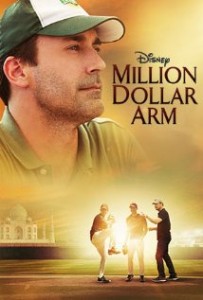
The first is Million Dollar Arm. This is a great film based on the true story of the search for the first pro American baseball players from . . . India.
They were hoping to find some pitchers. But it’s not about what you’re thinking. Because there were no pros in India. There was no baseball. There was only the game of cricket, and bowling in cricket requires a totally different arm movement than pitching in baseball.
This film features plenty of good humor, a cast of very enjoyable characters, and a romantic subplot that’s more about becoming something better than it is about the romance.
The next is Remember the Titans. I know. It was released in 2000. So I’m late to the party, arrest me. With the internet, the party goes on forever.
This is another film based on real events. This time its about a the introduction of racial integration at a West Virginian high school in 1971. Denzel Washington plays Herman Boone, the new black coach.
This one has plenty of drama, food for thought, and was so good daughter number 3 wants if for her personal library.
If you like sports movies, you’ll love these. If you don’t like sports movies, you’ll love them, because these two films aren’t about the sports. They’re about something more important. Do yourself a favor, sit down with the family and give them a go.
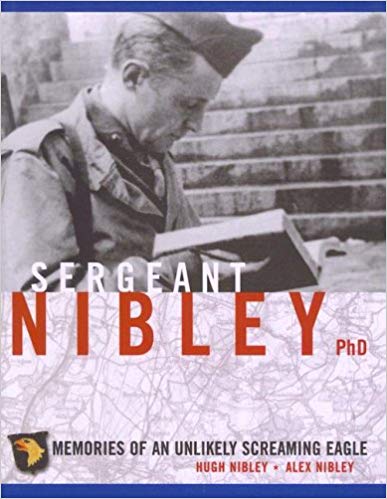
There are many good accounts of soldiers in World War 2, but I just finished one that is unlike any others I’ve read. It’s the delightful Sergeant Nibley PhD: Memories of an Unlikely Screaming Eagle by Hugh Nibley and Alex Nibley.
It details the experiences of Hugh Nibley, the famous BYU
scholar of ancient history, as a soldier in the war, starting from when Nibley
was on his mission for The Church of Jesus Christ of Latter-day Saints and met
Hitler coming out of a bathroom in Germany.
This book made me laugh and wonder and sorrow. It includes
insights, surprises, and anecdotes that I haven’t found anywhere else. The
authors also include many pictures that help the whole thing come alive. If you
like history or biographies or are a fan of Nibley’s works, I think you’ll love
this book.
*
Some of the wonderful residents of Rich County, Utah where I live are not going to like this next one. But I have to share it because if what’s detailed in this next book is accurate, it could help so many.
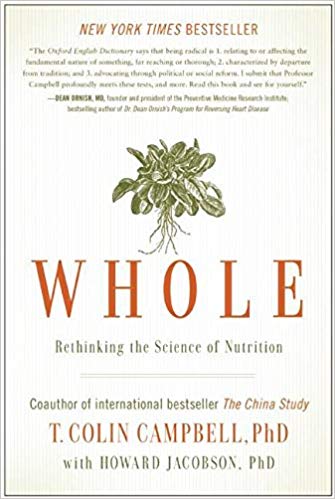
The book is Whole: Rethinking the Science of Nutrition by T. Colin Campbell who has been one on the forefront of nutrition research for over forty years.
Campbell’s legacy, the China Study, is the most comprehensive
study of health and nutrition ever conducted. He’s a renowned researcher at Cornell
University. He has worked as a senior science adviser to the American Institute
for Cancer Research, and sits on the advisory board of the Physicians Committee
for Responsible Medicine.
I share all that to simply suggest that he might have a little bit of expertise that’s worth listening to.
Campbell grew up the son of a dairy farmer and went into the
field of nutrition, believing animal protein, specifically dairy, could help
solve nutrition problems in countries with starving populations.
What he found shocked and surprised him. And at first, he didn’t believe it. But he and others ran study after study, and the science led to one conclusion: a diet high in animal products and processed foods increases the risk of many cancers, heart disease, diabetes, and a host of other maladies just as surely as tobacco increases the risk of lung cancer. What he found is that the healthiest populations ate a whole-food, plant-based diet.
Now that goes against a lot of what we’ve been told. Milk is
supposed to do a body good. And surely there’s nothing more healthy than lean
cuts of meat. And aren’t there studies that prove this?
In this book Campbell explains the science behind the
evidence for what he and other scientists are seeing, the ways our current
scientific paradigm ignores the fascinating complexity of the human body, and
why, if we have such overwhelming evidence that everything we think we know
about nutrition is wrong, our eating habits haven’t changed.
I know this may seem like yet another whiplash science report. You know the kind—one report says red wine is bad for you and the other says red wine is good. But in this book, Campbell explains why we get such goofy and contradictory claims.
If you or someone you love is dealing with heart disease, cancer, including breast cancer, obesity, or diabetes, you will want to hear him out. Whether what he has to say persuades you and what you will do about it, is up to you. But I think you’ll benefit from listening. If you’re interested in science, this book will give you surprising insights about its practice that you probably haven’t considered. Listening to Campbell has been eye-opening. I highly recommend this book. If, after hearing it, you want more information, I recommend his previous book called The China Study.
Karl Marx was not a scientist. Nor was Adam Smith before him. They were philosophers. Theorists. Idea men. That’s what all economists in those days were. They had little tested knowledge, and so which economic system was best was all a matter of opinion.
But things are now much different. Nations and local governments tried the various theories. And we’ve seen the results. We now have a whole century of data. Furthermore, economists now are scientists. They use scientific methods and deal with tested knowledge. Sure, there are still controversies, just as there are in any science, but the basic principles of economics today are NOT matters of opinion.
For example, we know what happens when governments impose price controls in all their many varieties—rent caps, minimum wages, laws against price gouging, and medical care cost limits. These last few years we’ve seen a dramatic demonstration of what happens when they meddle with the prices of home loans. We know what happens when they impose tariffs or give subsidies to special groups like farmers or steel producers. We know what happens when they create barriers to people entering a market to compete, like they’ve done with immigrants. We know what taxes do.
The unfortunate thing is that many of these principles seem to be ignored by our politicians. And by those who vote them in. And so we can have a Congress pass massive health care legislation that will cause health care shortages just as similar laws caused shortages in other countries. This is how we have a president who in a recent speech to the U.S. Chamber of Commerce suggested, in good Marxist fashion, that it was business owners who kept the American workers down by hoarding all the profits. Has he not looked at the data which shows that huge profits invite more competition, which tries to get ahead of the leader by cutting prices, which allows the American workers to get more for less, thus raising their standard of living?
In the 1980’s and 1990’s India and China began to make fundamental changes to their economic policies, doing the things that have been proven to work. Suddenly, the economies of those nations started to grow. It’s estimated that 20 million people in India rose out of poverty in a decade. In China, more than a million people rose out of poverty EACH MONTH.
But this seems lost on a number of politicians. Don’t let it be lost on you. We have critical elections coming up. One of the best things we can do is educate ourselves about these basic economic principles so we can cut through all the political blarney. I haven’t found a better, more enjoyable book on the subject than Basic Economic Principles: A Common Sense Guide to the Economy by Thomas Sowell. Sowell is an economist and Senior Fellow on Public Policy at the Hoover Institution at Stanford University. His book is written for the general public and so foregoes dry charts and theoretical ho-hum for lots of real-life examples and straight-forward explanations. There are times when I wish he would have gone into more detail on a few subjects, but what he lacks in depth in a handful of areas, he makes up with breadth. Furthermore, the way he presents the topic was interesting enough to make me stay up late a number of nights well past my bedtime.
Great family entertainment
Do you want some fun family entertainment that includes laughs, wonder, and moments of poignancy? Something you can watch and enjoy with the kids? Then let me recommend the animated TV series Avatar: The Last Airbender. This is NOT the movie Avatar by James Cameron with all the big blue people Nor is it the movie The Last Airbender, based on the TV series, which many fans disliked. This is the original. The one that millions love.
Through the miracle of Netflix, I started watching it with my girls a few months ago. And we’ve all been sucked in. It’s unlike any “cartoon” I’ve seen. In fact, you can’t call it a cartoon just as you can’t call The Incredibles or Lion King cartoons. This is great story telling. Furthermore, instead of it being a bunch of unconnected episodes, this series is telling a long story. It ran for three years on Nickelodeon and includes more than sixty 22-minute episodes.
The series follows the adventures of the main protagonist Aang and his friends, who must save the world by ending the destructive war with the Fire Nation. Aang’s world is divided up into four nations—Air, Earth, Water, and Fire. In each nation are “benders” who can powers with the element of that nation. So Air Benders can fly and create huge winds; Fire Benders can generate and throw fire; Water Benders can create ice and waves.
So it’s fantasy, and all of that is cool, but it’s the characters that we enjoy the most. We quote and laugh at some of their lines. And then there are the episodes with true dramatic moments.
Avatar has been nominated for and won many awards, including the Annual Annie Awards, the Genesis Awards, the primetime Emmy awards and a Peabody Award. It’s excellent entertainment.
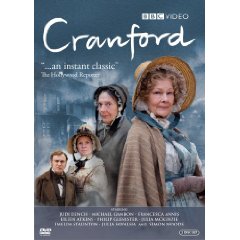
For those of you who love stories like Pride and Prejudice, have I got a TV mini-series for you—the BBC’s five-part Cranford.
The series is set in the 1840’s in England in the fictional village in North West England and focuses primarily on a handful of the town’s single middle-class ladies who are forced to deal with lace-eating cats, marriage prospects, and prank valentines, as well as death, loss, and a changing culture. There are also two stories about the male inhabitants woven in as well—one about a new doctor and another about a young boy of the lower class who has a chance for something better.
I will confess that when I saw this arrive in the Netflix envelope, I wasn’t at all excited. The cover’s too cold–all blue with a bunch of sour-looking women. In fact, I decided not to watch it. But the laughter of my wife and daughters lured me back upstairs to the TV, where it took about seven seconds for me to revise my earlier decision. The characters are delightful. In fact, some of their lines are such a joy to listen to, we had to rewind many parts to watch them again and again.
The series is based on three novels by Elizabeth Gaskell, a British novelist, which were published between 1849 and 1858. The sets made us feel as if we where there. For example, one of the things I noticed was the lighting. Incandescent bulbs weren’t invented until the late 1800’s and took many more years to find their way into most houses. So the directors, instead of making it feel all Hollywood, seemed to rely heavily on the light at hand, as those inhabitants would have. When a scene was in a house, it felt as if they were only using the natural light coming in the windows or the candles being burned. Of course, this is just one of the many details that made this series an excellent period piece.
The best news of all is that I just found out there’s more–a two-part special called Return to Cranford. I can’t wait until it comes in the mail. Don’t let the cover fool you. This is a wonderful mini-series. It has poignant and sad moments, but is also full of humor and wit. And the ending is perfect.
Kroger’s Balsamic Vinaigrette Dressing
I love balsamic vinegar and oil on bread. But I never think to make it. And I never thought of what else it might go with. That was until a relative left behind a bottle of Kroger brand Balsamic Vinaigrette Dressing.
I just happened have a homemade bagel handy, squirted out a bit onto a plate and dipped. Lovely. So then I tried it on salad and even splashed some on tomato or turkey sandwiches. It’s delicious. Only 80 calories for a whole tablespoon. In fact, it was so good we bought four more bottles because I don’t want to run out.
Kroger, of course, is a grocery conglomerate. In Utah, it owns the Smith’s, and that’s where you’ll find this delight.
Nebo Grotto Falls
The mountains and canyons of Utah are literally desert oases. That’s where our clear streams run, the forests grow, and the wildlife congregates. In the summer, the canyons are a refreshing source for cooling winds. All this meant that, as I grew up, “forest” and “refreshing” became intertwined in my mind. Only when we moved to Ohio did I learn that some forests can also be muggy and hot and not at all refreshing to a desert boy perishing in the humidity.
Because I love Utah’s canyons so much, we hike and walk them all throughout the summer. We recently went down to enjoy the Stadium of Fire and the heat (yes, I love dry heat) in Provo. However, we didn’t just hang out in the city. We made time to hike a few trails in the surrounding canyons.
We love Rock Canyon (just above the Mormon temple in Provo), Hobble Creek Canyon (Springville), as well as Mapleton and Santaquin canyons. However, there’s another special place that you’ll want to visit should you find yourself in the Provo area. It’s a short little hike just off of S Canyon Road (also known as Nebo Loop Road) which runs from Payson south through the Mt Nebo Wilderness area to Highway 132.
The trail head is just a few miles into the canyon south of Payson and is marked with a simple sign that says “Grotto.” There’s a little bit of parking on the side of the road. The hike is 0.6 miles along a wooded stream. The grotto itself is more than worth it. You can find directions here: http://www.utah.com/thingtodo27245.htm
Lots of great stuff here. I love the idea that “creativity thrives best in solving problems in an environment of flexible rules.” I would replace “rules” with “constraints” or “objectives.” I loved what he had to say about the goal of his poetry and developing a sense of quality. Enjoy
Everybody knows that we got into this recession because banks began lending money to people who had terrible credit ratings, right? People who didn’t have to prove they even had a job. I mean, how long are you going to stay in business when you keep handing out dough to people you never hear from again?
But is that all there is to it? And was it really just the fault of congress because they told Freddie Mac and Fannie May (the organizations that purchased loans) that they had to start purchasing these highly risky things? Or was it all those greedy Wall Streeters?
In this must-read article, “How it All Came Crashing Down,” BYU econ professors explain how we got into this mess—and what we can learn from it.
But that’s not the end of the story. Ira Glass and the folks at This American Life uncover deeper causes of the problem in their must-listen show “The Watchmen” (no, not the movie). I mean, come on, we were told these high-risk loans were as dangerous as milkshakes. Shouldn’t SOMEBODY have seen it?
President Obama keeps saying that the root of the problem was that there wasn’t enough government oversight. Sounds good, doesn’t it? We’ll get disinterested Uncle Sam to protect us from all these investment bullies. But if we dig a bit deeper, it appears that Uncle Sam was one of the major players at the root of the mess.
The joy of music. Pure, unadulterated joy–this is what I recently stumbled across on YouTube.
I was watching the The Piano Guys and thought I saw something new from them. I clicked, but it wasn’t The Piano Guys. It was Simply Three doing a cover version of the popular “Wake Me Up” by Avicii.
For those unfamiliar with the term, a “cover” or “cover version” is a reworking, updating, or interpretation of an existing song. And this cover simply blew me away.
Simply Three is an electrifying trio made up of cellist Zack Clark, bassist Nicholas Villalobos, and violinist Glen McDaniel, although they have switched in other violinists, including Alex Weill and Olivia Lemmelin. But don’t let the instruments fool you–this isn’t some stuffy classical music gig. And it’s not muzak in the elevator. Not even close.
They are doing what Lindsey Stirling and The Piano Guys are doing: taking modern songs in wonderful new directions and, in the process, making these classical instruments cool again.
I went on to watch a number of their other covers, and then I had to purchase the songs because I simply had to be able to listen to their great beats and interpretations on the road.
Here’s their cover of “Wake Me Up.” The joy Zack Clark (the cellist) exhibits sells the whole thing for me.
Here is their cover of “Demons” by Imagine Dragons.
And finally their cover of “Counting Stars” by OneRepublic.
If you like them, you can get each of these on Amazon for less than a buck with these links:
Buying them not only supports the artists, but it lets them know there’s a demand for it and encourages them to make more. And I hope they make more.
***
By the way, “Counting Stars” has some interesting lyrics. Ryan Tedder, the songwriter, is a professed Christian. He grew up in a Charismatic household and graduated from Oral Roberts University.
However, you might look at some of the lyrics and think he’s given all that faith up.
I feel something so right
Doing the wrong thing
I feel something so wrong
Doing the right thing
I could lie, could lie, could lie
Everything that kills me makes me feel alive
But you need to look at the lyrics in context of the rest of the song and the artist’s statements about the song to see he’s singing about something totally different.
Some poets, and songwriters are poets (song is where poetry lives these days), think being obscure is cool. Tedder follows that more obscure approach in this song, which is unlike the immediate clarity he put into the lyrics of the fantastic “Halo,” performed by Beyonce, or his own OneRepublic’s “Apologize.”
Sometimes the artist writing gnomic lyrics doesn’t want to pin down a message for the listener—they think it’s cool for each person to make up their own message (I prefer clarity). Other times they do have a message, but they want the listener to work for it, and so they try to be subtle. Or sometimes they simply goof and don’t realize their lyrics are being so vague.
I have no idea which path Tedder was trying to take with these lyrics, but I do know that he’s made statements about the song. And these statements give us a guide.
In an interview with 5280, the Denver magazine (Denver is where Tedder lives) we get the first glimpse.
At 15, he began writing his own songs. “I obsessed over music and just loved it,” Tedder says. “But I never considered it as a career. Where I grew up you go to high school, you go to college, you find a wife in college, you get married, you have 2.3 kids, and if that hasn’t all happened by the time you’re 24, some people think there’s something wrong with you—or the assumption is that maybe you’re not into the opposite sex.”
But he couldn’t keep away.
Back in Oklahoma, at Oral Roberts University, the largest charismatic Christian university in the world, Tedder majored in public relations and advertising. At least that’s what his diploma says. Based on the time he put into sneaking into the Timko-Barton Performance Hall’s piano rooms, he probably could have been a double major. He spent hours on the piano and the guitar deconstructing his favorite albums—like Eric Clapton and B.B. King’s Riding with the King—figuring out the chords and then trying to write new songs using those same chords. He was skipping classes—even meals—to write songs.
No one knew. Not friends. Not his roommate. He sang in secret. He was in the school choir, but his friends always thought it was odd that a person who didn’t seem overly musically inclined would be taking a singing class. When he was in one of the piano rooms he would tape a piece of notebook paper over the small window in the door so that no one could see him.
Tedder says there were two reasons he hid his passion. The first was that he believed there were so many bad singers and bad songs in the world that he didn’t want to add to the noise. He wanted to be certain he would be successful before he revealed himself. The second reason was more deep-seated: Being raised in a religious home, Tedder had been taught that there was a purpose for his life, and that because God had ordained that purpose, he should live the life expected of him—one that was pious and humble. “Deciding you want to go into the music business is about the most narcissistic thing in the world,” Tedder says. “I had this constant battle—and to some degree I still do.”
So Tedder felt “wrong” about songwriting. But he eventually began to see it as his gift to share.
Billboard: Given “Counting Stars”‘ uplifting, faith-based message, it must be gratifying to be connecting with such a meaningful song.
Tedder: I think it’s our responsibility as a band, and what separates us from everyone else. I took that from being a fan of U2 for two decades now, since “Achtung Baby.” To this day, they might be the only band on that level who sings about things other than just boy-girl troubles or the kind of selfish, “I’m a badass” stuff. I’ve spoken with Bono about this when we toured with him, and he said the same thing. I felt a responsibility to actually write and sing about things that have a level of human gravity to them. If everybody else sings about sex and love and lust and money, then somebody’s gotta be singing about life and faith and hope and things of that nature.
So if “Counting Stars” isn’t about sex, lust, and money, what’s it about?
In another interview with Radio.com, he indicated that the whole counting stars bit was for anyone who loses sleep wondering how they’re going to be able to afford their rent or provide for their family. When he was first starting out, things were rough.
“A lot of time I just lay in bed awake, stressing out,” Tedder said. “Everybody does it. And I just thought, I can’t wait until I’m counting stars and not counting dollars anymore. Things will be so much better.”
To me, it’s clear that Tedder is singing about his story. And he’s singing for people like him who have a passion, but society says it’s not the practical thing to follow or dedicate your life to. Songwriting is what makes him feel alive. Furthermore, he had flashing signs indicating that if he sought, he would find—in other words, it was the thing God wanted him to do. And he just had to have hope, a four-letter word for those who are practical- and money-minded, and follow that passion.
We can argue the merits of that follow-your-passion message, but I think we’re all happy Tedder followed his.
***
And while we’re talking about the joy of music, how about this baritone saxophone and drum.





 Everybody knows that we got into this recession because banks began lending money to people who had terrible credit ratings, right? People who didn’t have to prove they even had a job. I mean, how long are you going to stay in business when you keep handing out dough to people you never hear from again?