Create Story Ideas That Beg to be Written
I’m happy to announce the release of Create Story Ideas that Beg to be Written, a new handbook to help make novel writing easier. It’s available now on Amazon.
I’m happy to announce the release of Create Story Ideas that Beg to be Written, a new handbook to help make novel writing easier. It’s available now on Amazon.
Where do you get your ideas? How do you turn them into story?
Those are fabulous questions. The answer is a bit longer than I have time for today. But I have posted my list of idea generation methods, structured ways of performing creative Q&A.
These have been collected over the years from a number of sources and are now passed on to you, faithful reader. Use them, cherish them, and, if you wish, start an order of crazed monks to preserve the fabulous secrets.
John Browns’s Idea Generation Method List
Enjoy!
The city of American Fork is putting on what looks to be a great writer’s conference. I’m very pleased to announce that I’ve been asked to present the keynote speech.
Keynote: The 3 Things You Must Learn to Write Killer Stories
When: Saturday, April 25, 2009, 9:00 AM
Location:
American Fork City Arts Council
31 N. Church Street
American Fork, UT 84003
(801)763-3081
This looks like a great opportunity if you’re a writer. Here’s what the organizers envision.
We have editors from Desert Book, Covenant and Cedar Fort coming to speak as well as National Book Award finalist Sara Zarr, Kristen Langdon, Ginger Churchill, Linda Bethers, Anita Stansfield and others. The goal is to provide a space for local writers to interact with local editors and local authors for inspiration, motivation and guidance in the tricky world of writing and publishing. To that end, the editors will be holding a query letter clinic using query letters from participants, which I think will be super useful. The editors are also speaking on what they want and don’t want as far as submissions, and the state of regional publishing in 2009 given the world upheaval. The authors will all be speaking on how they got an agent, how they got a book deal, what they have learned about writing.
More info: American Fork Arts Council
This is from Russell Blake, a pseudonym for Craig Osso, a 52-year-old retired home developer who has sold close to 450,000 copies of the 25 books he published in the last 30 months. The man has made over a million bucks at this.
1) Books Sell Themselves. No, sweetie, they don’t, at all, and never did. That’s why trad pubs spend massively on promotions. Because they know that visibility sells books, not invisible cosmic forces or author brilliance. It’s a highly competitive market with millions of choices, and it’s a retail market, and in retail, visibility is key. Which means constant promotion. Which most authors hate. But it’s reality, so get used to the idea. A companion to this aphorism is the next one…
2) Just write the next one. Sure, if you want to have two undiscovered gems instead of one. Look, writing the next one’s important, but not if it’s used to justify not promoting the last one, which is often the case. You have to both market the last one AND write the next one. Sorry. You do.
3) It’s all about luck. Well, perhaps some of it is. Maybe even much of it is. But so’s everything. You drive to the market, and 30 seconds after you pass the intersection some dumbass crashes into the car behind you. Luck. A hundred people start restaurants in town and two do well while the rest fail. Luck. A mugger attacks you after a movie. Luck. Sometimes good, sometimes bad. The book biz is no more or less random and chaotic than life, and yet some folks seem to consistently do better than others. I believe you need to work very hard, prepare, and be persistent, thereby creating some of your own luck. As an example, it’s possible you always wear your seat belt and the other driver didn’t today. In that case, bad luck becomes disastrous due to a simple lack of preparation. Or in the case of the restaurants, perhaps the ones that prospered had owners that worked 18 hour days and were talented chefs, and further, were savvy and inventive about getting people to try their cuisine. Preparation, persistence, hard work combine in that case to drag Lady Luck in their direction. With the mugger, maybe you have pepper spray or spent years on martial arts or have a concealed carry. Your preparation is the mugger’s bad luck.
Luck may be a factor, but in my experience it’s only one factor, and that perspective of it all being all about luck breeds apathy.
4) Do everything right and you’ll make it. Huh. If that were so, every book put out by big pubs would do well. The vast majority don’t. But that doesn’t mean you don’t have to do everything right, unless you want to worsen your already slim odds rather than improving them.
. . . .
10) Your muse cannot be forced to dance. Of course it can. If you were a writer on 24 or CSI or SNL you’d be expected to perform every week or you’d be out of a job. Most who work hard enough to get those gigs don’t want to lose ‘em, so they perform. Whether they feel like it or not. Whether they’re particularly inspired or not. The notion that you need to wait for your muse to decide to infuse you with story is fine if your books sell 10 million and you can afford to wait 4 or 5 years between each one. If that’s not you, you need to develop two things: a work ethic, and a system to inspire yourself.
One technique I use is to ask myself how I can make this book, or this chapter, the best I’ve ever written. You get completely different answers depending upon what questions you ask yourself. “How can I consistently write 5K a day and enjoy it?” will get you a different answer than “How am I ever going to do this?” If you’re stuck, ask better questions.
. . . .
12) I’m too busy to read. Who’s got the time? This one kills me. How in the hell do you expect to be a good writer if you don’t read a lot of good books? Intuition? Divine guidance? Magic?
. . . .
1[6]) Write a good book and you will make decent money. Or write a lot of good books and you will make decent money. Would that it were so. Reality is that the overwhelming majority of good books, which is to say competently written-and-edited tomes, fail to sell much.
. . . .
My message is simple: working very hard and very smart can improve your terrible odds, but that’s all it can do. It’s not a magic pill, nor a recipe for success.
. . . .
I can tell you how to operate your writing and publishing company intelligently, but you need to recognize that most well-run publishing companies fail. Just as most well-run any-kind-of-companies fail. Most start-ups don’t last. They go belly up. Even those with the smartest people and shiniest wow products. That’s just how it works. Don’t start a company if you’re uncomfortable with that idea.
. . . .
I’m a big proponent of choosing a genre that can support you, which means one that’s popular, and sticking to it (with the caveat that if it doesn’t meet your expectations after a massive, concentrated effort, pay attention to the result you’re getting, and switch to something with better odds). I’m also big on publishing regularly, meaning every three or four months (more often if possible) if you intend to make this your living. I’m huge on pro editing and covers and proofreading. I consider your cover and your blurb essential to success. But those are the basics. Important basics, but still, building blocks.
They will narrow your long odds because most authors simply don’t do what they should to make themselves successful. Understanding that is an advantage. It means you already know more than 90% of those who will publish on Amazon this year. If you do everything right, that will make you the 10% that has a chance.
But still, it’s not a lock. By any stretch of the imagination. Get clear on that. In all businesses, this included, you can do everything absolutely, spectacularly right, and go nowhere. Because God hates you. Or because the world’s unfair. Or because you’re not good enough. Or were born under a dark star. Or didn’t get breast fed enough as a child. Pick your reason. It doesn’t matter what it is, as long as you recognize that in ALL industries, most businesses do not succeed.
. . . .
I wish I could tell you how to avoid being that person. I wish there were a formula. What I’ve come up with I share openly: Pick a genre you love and that’s large enough to support you, stick to it, write a lot of seriously good books, focus on improving your grasp of craft each time you sit down to write, make each book your best ever (meaning respect your reader above all else), package and quality control your books like the pros do, market intelligently, and spend massive amounts of time and energy working smarter than everyone else. And above all, be extremely realistic about everything. Some might say, cynical. I’d say pragmatic.
. . . .
Can you do this part time and make it? Sure you can. So can someone who starts any business part time. Just recognize that your odds of making it are lower than if you did it full time. Duh. Put in 80 hours a week, you might get better results than 10. Big surprise. Can you put in 10 or 20 and still do well? Sure. Again, anything’s possible. But you have to be unable to grasp basic business concepts if you think your odds will be the same. If they were, nobody would put in the 80. They’d all put in the 10, because their odds are identical.
. . . .
What’s my point? That self-publishing is both exciting in its possibilities and daunting in its requirements. And that very few businesses succeed, whether it’s a new shoe shop, or a convenience store, or a restaurant, or a software start-up…or a publishing company. But it’s more possible now to succeed than at any point in the past. I’m living proof.
Link to the rest at Russell Blake’s Author Myths-1, Author Myths-2, and Author Myths -3.
Blake has some of the most sensible advice I’ve read. If you want more, search for him over on KindleBoards.
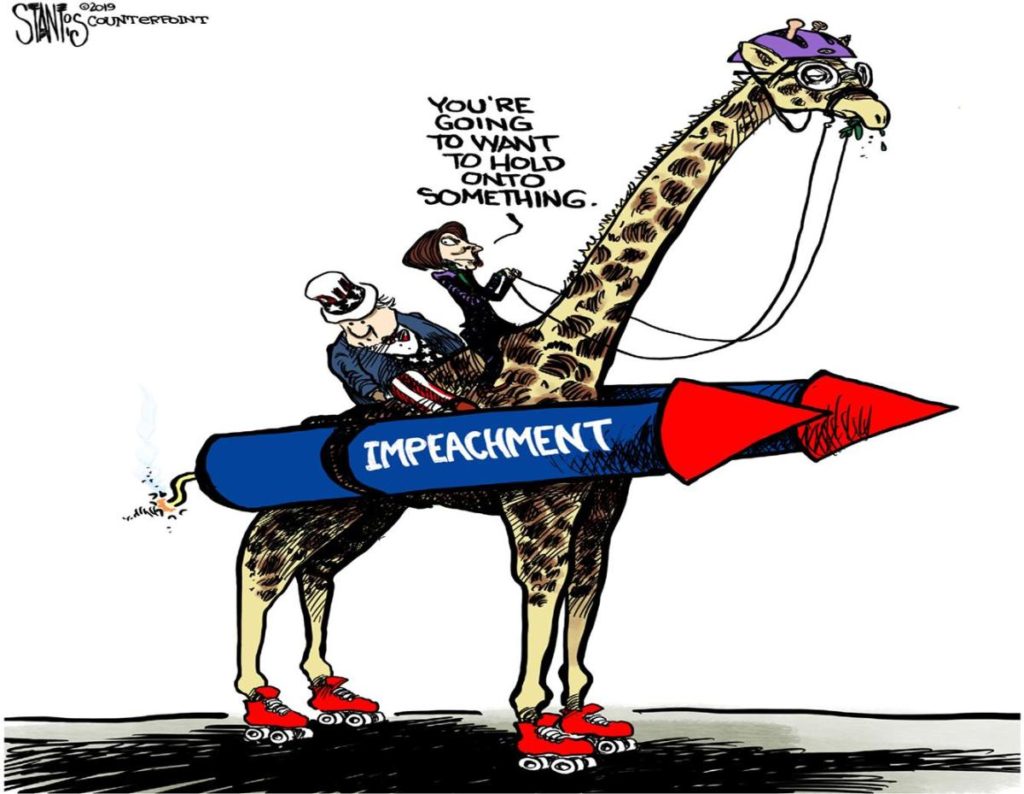
I’ve come to realize I didn’t understand the process of impeachment and the standards by which it is conducted. Here are a few key things I’m betting most of us didn’t know. Some of them will surprise you.
First, the process has three steps:
There are two big questions in all of this. First, what standard of proof is used for passing the articles and then convicting the person of the allegations?
It appears that the standard of proof required for impeachment and conviction is left to the discretion of each individual representative and senator. There is no standard defined. So while some may use the standard of beyond a reasonable doubt, others may not.
Second, what can someone be impeached for?
According to the constitution they can be impeached for “Treason, Bribery, or other high Crimes and Misdemeanors.” However, the phrase “high Crimes and Misdemeanors” is not defined in the Constitution itself.
The most authoritative explanation of what “high crimes and misdemeanors” are appears to be a document written by the staff of the House Judiciary Committee. The latest version of this was written in 2015 and is called “Impeachment and Removal.”
According to the Wikipedia article on impeachment, “While this document is only staff recommendation, as a practical matter, today it is probably the single most influential definition of “high Crimes and Misdemeanors.””
A key take away from that house committee report is that not all crimes are impeachable offenses and not all impeachable offenses are crimes. So what are grounds for impeachment? Well, it’s a bit vague.
In 1788, Alexander Hamilton argued in the Federalist Paper 65 that impeachment was for “the misconduct of public men, or in other words from the abuse or violation of some public trust.” The House Committee report expounds on that, including the following general grounds:
The report goes on to say the following.
“Congressional materials have cautioned that the grounds for impeachment “do not all fit neatly and logically into categories” because the remedy of impeachment is intended to “reach a broad variety of conduct by officers that is both serious and incompatible with the duties of the office.” Nonetheless, congressional precedents reflect three broad types of conduct thought to constitute grounds for impeachment, although they should not be understood as exhaustive or binding: (1) improperly exceeding or abusing the powers of the office; (2) behavior incompatible with the function and purpose of the office; and (3) misusing the office for an improper purpose or for personal gain.”
But the report doesn’t give much definition beyond this, just a few examples of what individuals have been impeached for since the founding of the country. What does all of this mean?
I think the Wikipedia article sums it up well.
“Several commentators have suggested that Congress alone may decide for itself what constitutes a “high Crime or Misdemeanor”, especially since the Supreme Court decided in Nixon v. United States that it did not have the authority to determine whether the Senate properly “tried” a defendant. In 1970, then-House Minority Leader Gerald R. Ford defined the criterion as he saw it: “An impeachable offense is whatever a majority of the House of Representatives considers it to be at a given moment in history.””
Impeachment is a political remedy, not a criminal justice or civil justice one. And given the vague definition of grounds for impeachment and the lack of any required standard of proof, what this all means, unfortunately, is that the process, especially in our current climate, is going to be rife, not with objectivity, but partisan politics. On both sides.
Here’s more for the curious.
Want to get the basics in a very succinct article? Read Algis Budrys on story.
 The Writing Excuses guys have posted another good podcast: this one on world-building a history.
I wanted to add a few comments. You’ll notice that a lot of the blurbs for my novel mention my world-building, so I guess it’s a strength in my writing. However, I don’t write huge world building documents in the pre-draft stage. I do write some history, of course. But I don’t think it would take up more than a few pages. A lot of world-building happens in draft.
It seems to me there are two levels of “history” and a lot of it can be done on-the-fly.
1. There are small hints of CHANGE in places and people.
Dave Wolverton taught me this one. You come upon an orchard in the woods that’s gone wild and is overgrown. It takes two lines to describe it and it gives a strong feel of past. The reader wonders who was there, what happened. Maybe you tell them. Maybe you don’t. You mention that the village Knight used to be fat but is wasting or vice versa. I find I can do these types of things usually on-the-fly as I’m writing. And I don’t need to know much about them. I just ask myself if anything has changed with the location or characters in the current scene.
A few touches of CHANGE throughout the novel give a strong sense of history.
2. There are events, groups, and individuals who impact or impacted your characters and their community in large ways.
There was a war with a neighboring country not five years ago. Your characters have to travel through that land, or maybe half the male population went to war and never came back. Or perhaps your character lost his sister in a drowning he could have prevented. Or he lost her to slavers. Or perhaps there is a secret police (like the Roman couriers) who arrived two years ago.
Again, many of these things can be thought up on the fly as you look for conflict and the stories of a place and community. However, I’ve found that it helps to ask a few key questions in the pre-draft stage to lay some (NEVER ALL) the groundwork.
— What kind of conflicts do these nations and groups have?
— What events have had a large impact on my character and his community? They can be terrible or wonderful events.
— Who in the community are my characters friends and enemies? What’s the history?
— What are the local and regional stories of events (or people) that were eccentric, odd, mysterious, dangerous, or revolutionary?
I never get all my answers up front. But I will get some. And then as I write I just keep in mind that it’s neat to indicate change every once in a while and to briefly bring up stories from the past that relate to the current matter at hand in the present story.
Finally, I really like the idea the Writing Excuses guys brought up of sharing multiple explanations for an event (multiple histories) when it fits and to include more than one cause, although I’m pretty sure the 80/20 rule applies to causation.
Comments are closed.

You are a great writer and an even better man, John. I hope you find a lot of success with this!
Thanks! I hope so too. But even if it doesn’t go viral, I hope it helps clarify and simplify for those who do read it.
Great read! Any estimated date for book 2, the one on outlining?
Glad to hear you enjoyed it. No ETA at the moment. Probably next year. I’m focused right now on a contracted book I’m writing with Larry Correia for Baen Books. Once that’s off my plate, I will turn to my the next in my 3 series. So it will be a while. In the meantime, look for presentations and pages on my site about the story cycle. It will help you with figuring out what comes next. You might also want to read Bickham’s SCENE AND STRUCTURE. That should give you a good start 🙂