Good Stuff! Easy WFPB

If you’ve decided to try the whole-food, plant-based lifestyle (WFPB) to lose weight or lower your risk of certain diseases, you will immediately find there’s a bit of a learning curve.

That’s because the food culture in the United States is geared towards foods that are animal-based and processed—cheese, meats, sugar, flour-based products, chips, candy, etc. In fact, WFPB is such a large change, you might wonder if you’ll be eating anything other than cardboard.

I can happily report that WFPB eating is satisfying and delicious.

Let’s review the general guidelines. With WFPB there are three things to avoid or minimize.

  • Added sugar (and artificial sweeteners)
  • Flour-based products
  • Animal-based products (meat, dairy, eggs)

And there are five things you eat. The main four include:

  • Legumes
  • Grains (as close to whole kernel as you can get it)
  • Vegetables
  • Fruits (natural form, not canned)

The fifth category is some added fat on the side. That includes things like a tablespoon of mayo, peanut butter, oil, avocado, etc. Or it could be an ounce of nuts or seeds.

We’ve found it easiest to compose a meal by simply thinking about the five categories and filling in the blanks. If you don’t include one of the main four groups in a meal, that’s fine. Just be sure you’re not excluding it all the time.

There are dozens and dozens of delicious meals. Over the next months I’ll be sharing some of those we love. Let’s start with the base.

The base

Grains

Our InstaPot has been a huge help with grains. It makes them so easy to cook. You can make them in a batch and enjoy them over the course of a few days.

Wheat

  • 2 cups food storage wheat berries (Yes! Finally a use for all those bags of food storage wheat in the basement!)
  • 5.5 cups water (or use vegetable stock if you want it savory)
  • ½ tsp salt
  • Cook for 35 minutes on high pressure followed by immediate pressure release. Drain if necessary.

Rye berries, oat groats, pearled barley, brown rice

  • 2 cups grain
  • 2.5 cups water (or vegetable stock if you want it savory)
  • ½ tsp salt
  • Cook for 22 minutes on high pressure followed by 10 minutes of natural pressure release. Drain if necessary.

When you want the grain as a savory dish, use vegetable broth or stock. It gives the grain a wonderful flavor. It’s total magic. You can get cartons at the grocery store for under two bucks. 

For rice, we love the Lundberg wild rice mix. Lundberg also happens to be California rice which doesn’t have the high levels of arsenic that rice from the Southern United States has.

Legumes

Lentils

  • 1 cup brown or green lentils (do not use red for this)
  • 2 cups vegetable broth (the broth is the magical ingredient)
  • ½ tsp salt
  • Cook for 15 minutes on high with 10 minutes of natural pressure release. Drain if necessary.

For other beans, we just purchased them in the can. They’re cheap and easy. Pinto, black, white, black-eyed peas, etc. You might find it easiest to start with pinto and garbanzo beans.

Fruits

Easy. Just get whole fruits. You can also get the frozen berries and cherries.

Vegetables

Easy. Just get a variety of veggies and salad.

Nuts and seeds

Easy. Get whole almonds, pecans, walnuts, etc. Whatever you like. Try to get them raw. You can heat them up in a pan on the over before you eat. Stove-roasted pecans are tasty.  

Added oils

Olive oil, avocado oil, coconut oil. You’re not going to be using a ton. If you want to use mayo and salad dressing, do it. Again, you’re not going to be using much.

Spices

Use all you want—cinnamon, ginger, basil, etc. Also use mustard, soy sauce, hot sauce. Balsamic vinegar is great on many things.

Recipes

With meal recipes we mix and match. Here are some meals we like.

Grain Bowl

For 1 person.

  • 4-6 oz of grain
  • 6 oz of berries, cherries, or 1 whole fruit
  • Some almond milk
  • Some spices like cinnamon or pumpkin pie spice or ginger (could do fresh ginger if you like it), or cocoa.
  • 1 oz of nuts, 1 tablespoon of peanut butter, or 1 tablespoon of coconut cream
  • Heat in microwave if desired

Great for breakfast. Using different fruits and spices gives it lots of variety from day to day.

Homemade Costa Vida Salad

For 1 person.

  • 4-6 oz beans
  • 3-4 oz salad greens (you will need a big bowl)
  • Some mango salsa
  • 1 tablespoon Ranch dressing or may
  • 2 or 3 tablespoons of balsamic vinegar
  • Salt and pepper to taste

Just mix it all up and enjoy. You can add cooked rice if you want and other sautéed veggies. You can also add rosemary leaves and turmeric for the health benefits.

Other tips

Here are some other things we’ve found.

  • Broccoli tastes the best, hands down, when cooked in a steamer.
  • Cabbage is great when steamed and stir fried with soy sauce, ginger, garlic powder, and onion powder
  • Succotash is tasty, especially if you make it with some small cubes of potato.
  • You can substitute lentils for ground beef in many meals. We’ve done it with stuff green peppers, shepherd’s pie, and many others, and our picky, teenage daughter actually likes it.
  • Some corn added to beans for a burrito or chili gives it a nice sweet flavor.
  • Sautéed mushrooms are great with onion powder, garlic powder, and thyme.
  • Garbanzos go really well with peanuts.

We’re not fanatics about this. But I’d say we’ve been able to get 90% of the way to a WFPB lifestyle. And we’re enjoying the food. In fact, the longer we eat this way, the tastier it becomes.

For about two years, we ate a diet high in vegetables and animal-based foods (meat, dairy, and eggs). We were diligent, but didn’t see the results we hoped for. Four months ago, we switched over to WFPB. I recently had some blood work done. After four months of eating this new way, I’ve dropped about fifteen pounds. My total cholesterol is down from 214 to 188. My blood sugar levels went from 107 to 83. And my blood pressure has improved. And that’s after just four months with some days of holiday eating mixed in. I can’t wait to see what happens after eating this way for a year.

If you want to hear the research behind this to consider the evidence yourself, I recommend the following:

  • The China Study: The Most Comprehensive Study of Nutrition Ever Conducted (Revised and Expanded) by Colin T. Campbell, PhD
  • Whole: Rethinking the Science of Nutrition by Colin T. Campbell, PhD
  • How Not to Die: Discover the Foods Scientifically Proven to Prevent and Reverse Disease by Michael Greger, M.D.
  • How Not to Diet: The Groundbreaking Science of Healthy, Permanent Weight Loss by Michael Greger, M.D.

You can get all of them from your local library. If they don’t have the books there physically, ask the librarian how to use their Overdrive account to check out an ebook or audio book version online.


Share

Similar Posts

  • Good Stuff! Savory Thai, Planters Medley, Everest, The Arrival

    I love finding little, non-chain restaurants with excellent, reasonably priced food. And I just found another one this week. It’s called Savory Thai, and it’s on 182 W Center Street in Orem, UT.

    Oh, baby. If you decide to go, you are in for a treat. We ate there in celebration of my third daughter’s call to do missionary work in the middle and western Pennsylvania area (go Steelers, Amish, and “yous all”).

    I learned to love Thai food because it’s so close to Indonesian food. And I learned to love that because I lived in the city of Nijmegen in the Netherlands for five months and in Amersfoort, which is maybe an hour away, for seven. In Nijmegen, I lived in the attic of a row house with a series of missionary companions. In Amersfoort, I lived in a spare bedroom with another series of companions. Both homes were owned by Indonesian grandmothers who cooked one or two Indonesian meals a day for us. Think about that—home cooked Indonesian food every day. It was marvelous. When I came back to the States, Indonesian restaurants were few and far between, but to my delight I found that the Thai cuisine is very close, and so that became my stand in.

    If you’ve never had Thai food, it’s kind of like Chinese, but it’s got curries, so it’s a little like Indian as well, but that doesn’t describe it either because it has its own separate taste that’s entirely wonderful.

    This place is in a little strip of stores. It’s small enough that you could drive right past and never know it existed. But when you walk in, you’ll see that they know how to make a good first impression. It’s clean, smells good, and the host is friendly, but these guys go farther than that. You’ll notice, of all things, the menu cover. Instead of handing out some flimsy paper or laminated thing, they hand out these thick menus covered in what looks like some kind of leather. It gives a feel of permanence, of solidity, as if the restaurant has been there for years (it’s two months old). But of course we weren’t there for menus or friendly servers. We were there for the food. And we were not disappointed.

    I can happily report that their green curry (spicy), pineapple curry, massaman curry (a lovely peanuty sauce), orange chicken, chicken cashew, fried rice, and pad Thai were all excellent. They use no MSG, cook it fresh, and keep it reasonably priced, $8-$10 per dish. I can promise you that we’ll be back.

    If you’re in the area and want some great food, stop at Savory Thai.

    *

    I love almonds and have been for many years a big fan of the W?nderful brand bags of roasted and salted almonds you can find in Sam’s Club. However, this last week, I came across something new from Planters called their Almond Lover’s Medley, which is a blend of four different varieties of almonds, dry roasted and unsalted. It includes the Marcona, Nonpareil, Fritz, and Butte-padres, which is the variety used in the W?nderful bags. I can report that this mix from Planters is delicious. The differences in taste and texture between the varieties is subtle, but real. And I was surprised at how much I enjoyed them unsalted. If you love nuts, you’ll want to give this blend a try.

    *

    I did not want to watch a movie about climbing Mt. Everest. Everest? Were you kidding me? I couldn’t think of anything more boring, but this is what my daughters wanted, and it was Thanksgiving weekend, and so we watched Everest, the 2015 movie.

    I am happy to report that it ended up being a great, disaster thriller, based on a true story, which was captured in the book Into Thin Air by Jon Krakauer. I cared about the characters, was on pins and needles during great portions, and exclaimed out loud during a number of tense parts. And after all that sweating, the story made me think about the things we do and how to prioritize when life is on the line.

    If you like stories about survival, you’ll love this. If you don’t, I still think there’s a good shot you’ll really enjoy it.

    *

    My wife is a sport. We were in the big city to watch a movie with our youngest daughter who is in high school. Our daughter, with her teenage brain, had the wild idea of a double-feature. My original man brain thought that sounded capital—how long had it been since we’d squandered five or six hours watching movies! The wise man brain didn’t think it was a very practical idea, and suggested it would be much better to do a double-feature next week we we could start at three in the afternoon. But the wise man brain was outnumbered and soon succumbed. And then all of the crazy brains ganged up on my wife, who graciously relented, and so we watch The Arrival and Fantastic Beasts and Where to Find Them and got home at like 1:30 am.

    As for Fantastic Beasts, if you like Harry Potter stuff, you’ll love it. If you’re not mad for Harry Potter, it’s not going to rock your world (although you still might have a good time). Enough said.

    What about The Arrival?

    This is a movie about the arrival of aliens, but it’s not a shoot-em-up like Independence Day or War of the Worlds. It’s more like Contact, the one with Jodie Foster. It’s a film that makes you think and is for those who are willing to be a little patient. If you can slow down and just enjoy the film, I think you’ll end up loving it because it’s about far more than meeting mysterious creatures. It ends up being about the choices a woman makes about her family. If you go and give it the space it needs, I guarantee you’ll chat about it and savor it afterwards.

    I won’t tell you anything more because you’ll only understand what’s going on in the woman’s life when you get to the last fourth of the movie, and I don’t want to spoil the delicious revelation for you. So just know that the alien tech and the alien themselves are strange and mysterious and cool, but that this movie is about so much more.

    If you liked Contact or even Inception (sans the frustrating non-ending), you’ll love this.

    Share
  • |

    Your single biggest challenge writing novels

    I’m about to put together a brand-new novel writing boot camp, but before I do that I want to know what would be most helpful to YOU.

    So if you want to write novels, my question to you is this…

    When it comes to writing novels, what’s YOUR single biggest challenge, frustration, or concern?

    Please CLICK THE LINK to tell me.

    Click here.

    As a thank you, those that answer the question will get a seat at a virtual, 1-hour training session I’m putting on where you discover 3 key principles of keeping your readers hooked.

    I look forward to the insights.

    You’re awesome ?

    Share
  • Good Stuff! Just Mercy

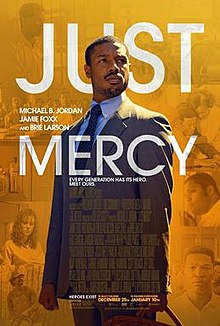
    Just Mercy movie poster

    In other countries, the government can throw you in jail for no cause. It can keep you there indefinitely awaiting trial. And it can manipulate the trial to prevent you from mounting a defense.

    In other countries, there is no trial by your peers. Instead the government is prosecutor, judge, and jury. 

    Our criminal legal system has so many wonderful protections in it. But there are times, as good as it is, when it convicts people of wrongs they didn’t do. Including murders they did not commit.

    I can’t imagine being in that position. One day I’m pursing my dreams, enjoying my family, going to the movies, walking my dog, hiking. The next I’m hauled off to jail, convicted, and put on death row.  And nobody will listen to me.

    Luckily this doesn’t happen in the vast majority of cases. But it does happen. And if it happens to you, wouldn’t it be nice to have someone show up one day and say, “I’m going to work like a dog to reveal the truth and get you out of here.”

    The movie Just Mercy tells the true story of just such a case. Walter McMillian is on death row for a murder he did not commit. And then one day a young defense attorney shows up and says he’s come to help.

    This movie will have you on the edge of your seat and make you think. There are two or three moments where some crass language is used. So check it to make sure it meets your requirements. If you end up watching, I think you’ll really enjoy this tale. We did.

    Share
  • Good Stuff: Books Worth Multiple Readings Part 1

    Would you like to improve your relationship with your spouse or children?

    Would you like to improve your experience with teachers, coaches, and administrators this coming year at school as you try to influence them and work with them for the benefit of your children?

    Would you like to simply have a better time with the people in your community?

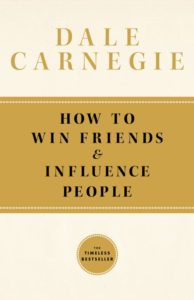
    There are some books so full of practical wisdom about relationships that they deserve to be read every year or three. I want to recommend two such books to you. The first is How to Win Friends and Influence People by Dale Carnegie.

    This book has been in print for eighty years. And not only that, it has been, year after year, one of the bestselling books out there for almost each of those eighty years. For example, Amazon right now ranks it the #9 most read book. You’ll see other books come and go on that list. But books like this and Stephen R. Covey’s The Seven Habits of Highly Successful People stay.

    There are thousands of how-to books published each year on relationships in business and personal settings. Most are never seen again. But this one has stayed because people find it so useful they recommend it over and over again.

    And I wish to heck I’d not waited ten years to pick my copy up again.

    As I re-read the book this last month, I saw that if I’d been thinking about the practical guidelines Carnegie shares, I could have avoided a number of public and private arguments I’ve had over the last few years.

    I could have avoided subjecting those relationships to attack, coming to my senses, and then trying to clean up the mess, large or small.

    But even more important, I could have added a little more sweetness to my life and the life of others I encounter on my way. There are only so many days we have here on earth, and how much better it is to add additional drops of honey to them instead of vinegar.

    One of the wonderful things about his book is that Carnegie shares the wisdom in a down-to-earth way with lots of examples and stories. He shares wisdom on building relationships, being liked, winning people to your way of thinking, and how to make your requests for change known without giving offense or rousing resentment. And he does it simply and in a way that you feel like you’re sitting down with a good-humored grandfather. There are no dry, abstract parts. Just look at a sampling of the chapter titles.

    • “If You Want to Gather Honey, Don’t Kick Over the Beehive”
    • “He Who Can Do This Has the Whole World with Him. He Who Cannot Walks a Lonely Way”
    • “An Easy Way to Become a Good Conversationalist”
    • “If You Must Find Fault, This Is the Way to Begin”
    • “Give a Dog a Good Name”

    I can tell you that every time I try to approach things the way he proposes, they almost always seem to go better.

    If you have an issue you want to discuss with a school teacher, coach, or administrator this year, let me suggest you first listen to what Carnegie has to say. I can promise you you’ll get much farther. And you will probably end up enjoying the interaction.

    If you want to improve your time with your wife and kids, open this book and look for insights.

    If you want to have a better time with your co-workers or boss, I suggest reviewing the wisdom you’ll find here.

    Carnegie doesn’t possess all the wisdom there is to be had about relationships. There are many people out there with great insights. But, gee whiz, he provides a great start. If you want to add some sweetness to your life, I think you’ll find this book a great help.

    Let me illustrate this Carnegie stuff with an experience I had with one of our high school coaches two years ago. I have a vast background in basketball that includes, well, nothing. I basically know how to dribble a ball. Oh, yeah, I also played church ball two or three years in a row back in the 1980s. So, as you can see, my knowledge is vast.

    And not to toot my own horn, but this wasn’t just any church ball team. This was a team that improved the sport.

    How? You ask.

    Well, during one of those church ball years, me and the guys from my ward (“congregation” for those not familiar with the Mormon faith) thought it would be capital to make jeans and concert tee-shirts our uniforms. Back in those days concert tee-shirts looked like this.

    This meant we ran up and down the church courts with drugs, sex, and rock and roll on our chests (I’m sure that’s precisely what the brethren had in mind for the program).

    As you can see, we were way up there on the basketball ladder.

    So back to this coach. My daughter was playing on the high school team, and the team was having a consistently hard time with one type of defense. And I thought, “Self, there’s got to be a way to break that defense.” These are the big thoughts that basketball gurus like myself have.

    And so I researched and watched and talked to folks who had actually played basketball competitively (unfortunately, without concert tee shirts) and identified an offensive counter that looked like it might work.

    And I sent an email to the coach sharing my idea.

    Now, the coach could have reacted in many ways. Especially given the fact that (1) he had already thought of the idea I was proposing, (2) had already tried it in games that, yes, I had attended, and (3) probably knew just a teensy bit more about basketball and his team than I did even though my church ball team had vastly superior uniforms.

    But this coach, whether he knew it or not, was following a number of the principles found in Carnegie’s book, including the chapter titled “Let the Other Person Save Face”. This meant that instead of rolling his eyes or ridiculing or saying something like, “Brown, are you blind?”, he explained what he was doing and then expressed his appreciation. He was happy I was so invested. He thanked me.

    And here’s the thing: he meant it.

    I replied that if he ever wanted someone to suggest an idea he was already trying, to just call. I’d be happy to help.

    We laughed, but the important thing is that what could have been a wedge became a good experience for all. And, more than ever, I wanted to work with him to help my daughter in the program.

    I will give you one more example. There’s a mother who had four of her children go through my wife’s seventh and eighth grade language arts classes. Now, Nellie is a worker. She expects her students to work. She wants to have a good time, loves having great interactions with the kids, but she also wants them to improve and learn, and knows that’s going to take some work. Sometimes the assignments, despite her best efforts, aren’t clearly understood. Sometimes they’re a bit challenging. And this sometimes creates frustration.

    There are a lot of ways that parents deal with this. But this one mother took an approach that, whether she knew it or not, followed many of the principles in the book including those shared in “You Can’t Win an Argument” and “A Formula That Will Work Wonders For You”. This resulted in a fabulous working relationship. It helped the mother have less stress. Helped her kids. And helped Nellie improve her program.

    The issues the mother encountered could have become wedges, but instead, because of how she handled them, they became stepping stones. And this didn’t happen with this one individual. There are many mothers and fathers who have taken a similar approach with similar results. The principles work every time.

    I could go on with many more examples in other situations, but why listen to mine? Carnegie has a book full of them. If you want to improve your relationships or persuade others to your way of thinking, you’ll want to start by reading this book.

    The second book I want to recommend is I Don’t Have to Make Everything All Better by Gary and Joy Lundberg. But this post is full, so stay tuned, and next time I’ll explain what awaits you in its fabulous pages.

    Share
  • Conservative Republican Amnesia

    If you ask the “conservative” talking heads–Limbaugh, Beck, Hannity, etc.–who THE best conservative president of the last 100 years was, they will say Ronald Reagan. If you ask their dogs, they will bark “Ronald Reagan.” Their gerbils will say other things, but everyone knows you can’t trust rodents. Ask the regular conservative Wanda and Mack (Jane and Joe is so cliche), and they’ll give you the same response as the dogs and people. Ronald Reagan is the guy we conservatives and Republicans have been taught to worship.

    Except, when presented with a candidate as conservative as Reagan, no, probably more conservative (I’m talking Mitt Romney), many of these “conservatives” get out their inquisitional torches. Which is a big reason why the GOP primaries are as fluid as they are at this point.

    As a side note, have you noticed that these talking heads and the mainstream media either have a hobby horse they ride above all else (Rush Limbaugh and his anti global warming crusade) or they seem to promote some flavor-of-the-day litmus test for each election. In one election, they’re going on and on about homosexual marriage. The next election, it’s a talking head approved stance on Taliban bombing. The next, it’s the fact that budgets must be balanced. They line the candidates up and then start whacking them based on these flavor-of-the-day tests. It’s like going to buy a car and focusing all your attention on the steering wheel.

    Anyway, I think many of us have forgotten what THE so-called best conservative president of the last 100 years looked like. If Ronald Reagan were to run today as John Smith, the conservative talking heads would drop him like a hot potato.  You don’t believe me? Well, let’s see how he stacks up.

    1.      ILLEGAL IMMIGRATION

    1. Reagan signed in amnesty for 3 million illegal aliens. The south-west-east-north-of-the-border kind, not the ones with green antennas.
    2. Talking Head Response: After crapping a brick, they would proclaim that John Smith, aka Ronald Reagan, is a pro illegal immigration RINO and must be thrown out!

    2.      ENVIRONMENTAL REGULATION

    1. A few weeks ago Rush Limbaugh told a caller that Romney is not conservative because of his stance on man-made global warming (Romney says he doesn’t know, but there seems to be evidence men contribue; women, of course, never to contribute to such things–they’re too smart), which Limbaugh thinks will lead to big-government regulation of emissions etc.
    2. YET AS GOVERNOR, Reagan established the Air Resources Board to battle California’s worst-in-the-nation smog problem. In a 1984 radio address to the nation, Reagan took credit for the strong action he took in California to combat smog, saying: “I’m proud of having been one of the first to recognize that States and the Federal Government have a duty to protect our natural resources from the damaging effects of pollution that can accompany industrial development.”
    3. THEN AS PRESIDENT, he signed, with great pride, what many consider THE most successful environmental treaty of all time – the Montreal Protocol in 1987, which regulates emissions. Back in those days Ozone depletion was the Global Warming. Reagan believed it, despite folks questioning the science and was happy to regulate.
    4. In the 1987 State of the union he said: “We are also developing proposals that make use of market incentives to control air pollution caused by sulfur dioxide and nitrogen oxide emissions and the causes of acid rain.”
    5. What?! A cap and trade like program? Yes, putting Bush in charge. In 1990, the first Bush Administration successfully pushed through legislation establishing a cap-and-trade program to reduce acid rain—the program Reagan started!
    6. Talking Head Response: John Smith is a total pro-environmental regulation RINO, please queue Al Gore singing “Burning Ring of Fire”

    3.      ABORTION

    1. Reagan signed a permissive law that allowed abortions. Since that law went into effect more than 2,000,000 abortions have happened in the Golden State.
    2. Reagan says he failed to see how it would be abused. He blamed his own inexperience, stating that had he been in office longer he would have realized that the bill was wrong.  He blamed doctors for misinterpreting the bill. President Reagan stated his prolife position by saying: “Abortion on demand now takes the lives of up to one and a half million unborn children a year. Human life legislation ending this tragedy will someday pass the Congress, and you and I must never rest until it does.”  BUT he never introduced a bill to ban abortion or amend what he’d done. Not in California, nor as president.
    3. Furthermore, today’s conservative inquisitors would point to his Supreme Court appointments. He appointed the moderate Sandra Day O’Connor.  Anti-abortion groups were livid, fearing, rightfully as it turned out, that Mrs. O’Connor would not vote to overturn Roe v Wade.  He appointed Justice Anthony Kennedy who had a long history of supporting expanded rights of privacy, gay rights, and preserving a woman’s right to choose.
    4. Talking Head Response: actions speak louder than words–John Smith is a pro-choice RINO

    4.      UNIONS

    1. Reagan was a union president 8 times in a row.
    2. Reagan, aka John Smith, also had lots of troubling connections to the Teamsters, who endorsed him, and who suddenly saw less investigation of their leaders for corruption. This is during the Jimmy Hoffa organized crime years.
    3. Talking Head Response: choke, ack, sputter–Smith is a pro-union gangsta RINO!

    5.      GUN CONTROL

    1. It was Governor Ronald Reagan of California who signed the Mulford Act in 1967, “prohibiting the carrying of firearms on one’s person or in a vehicle, in any public place or on any public street.” Yeah, he aimed to stop the Black Panthers et al, but affected all gun owners.
    2. Twenty-four years later, Reagan was still pushing gun control. “I support the Brady Bill,” he said in a March 28, 1991 speech, “and I urge the Congress to enact it without further delay.” He was right with Clinton on that issue.
    3. The Brady Bill, for the first time ever, instituted federal background checks on firearm purchasers in the United States.
    4. NRA spent millions fighting it, when it pass they mounted cases in a number of states wanting to have it overturned as unconstitutional.
    5. Talking Head Response: anti-gun RINO!

    6.      FISCAL POLICY

    1. As Governor, Reagan signed into law the largest tax increase in the history of any state up till then. Meanwhile, state spending nearly doubled.
    2. As President he continued. While he did cut taxes his first year, he signed into law tax increases of some nature in every year from 1981 to 1987. Furthermore, the debt increased to nearly $3 trillion, roughly three times as much as the first 80 years of the century had done altogether.
    3. Talking Head Response: tax and spend RINO!

    7.      RELIGION

    1. Smith, aka Reagan, let Nancy’s astrologer affect his schedule
    2. Talking Head Response: troubling devilishness (scary for evangelicals everywhere!), even if he only did it to make Nancy feel peace

    Reagan the RINO? Are you kidding? And yet Reagan would be hounded out of the Republican party if he ran today. The talking heads would sound the warning long and loud, which is a shame.

    On the other hand, I’m not saying we need another Reagan. Clones never pan out–hasn’t anyone seen Multiplicty with Michael Keaton?! And despite the recent zombie craze, I don’t want one in the White House, even if the world would be a better place if said zombie should eat Vladimir Putin’s brains out. I tire very quickly of Reagan worship. Or any other politician worship. As good as Reagan was, I disagree with a number of things he did. What I am saying is that those who want to get another president “as good as Reagan” had better know what such a president looks like. And it ain’t the caricature that’s being held up today by many conservatives, especially the talking heads, who seem to gloss over the facts of history.

    Share
  • Impeachment might not be what you think it is

    I’ve come to realize I didn’t understand the process of impeachment and the standards by which it is conducted. Here are a few key things I’m betting most of us didn’t know. Some of them will surprise you.  

    First, the process has three steps:

    1. The Congress starts an investigation, which can be conducted by any part of that body—the House, Senate, a special counsel, etc.
    2. The House leadership decides on whether to vote on “articles of impeachment.” The articles need only a simple majority to pass. If they do pass, the person is impeached. However, the articles of impeachment are not a conviction; they are a formal allegation of wrongdoing. The analog to this in the criminal justice system is an indictment.
    3. The Senate then holds a trial to decide if the allegations are true with both sides bringing witnesses, evidence, cross-examination, etc. The chief justice presides when the president is impeached. If two-thirds of the senators deem the allegations true, then the person is convicted and removed from office and may be barred from holding future positions. If the super majority isn’t reached, the person is acquitted of the charges.

    There are two big questions in all of this. First, what standard of proof is used for passing the articles and then convicting the person of the allegations?

    It appears that the standard of proof required for impeachment and conviction is left to the discretion of each individual representative and senator. There is no standard defined. So while some may use the standard of beyond a reasonable doubt, others may not.

    Second, what can someone be impeached for?

    According to the constitution they can be impeached for “Treason, Bribery, or other high Crimes and Misdemeanors.” However, the phrase “high Crimes and Misdemeanors” is not defined in the Constitution itself. 

    The most authoritative explanation of what “high crimes and misdemeanors” are appears to be a document written by the staff of the House Judiciary Committee. The latest version of this was written in 2015 and is called “Impeachment and Removal.”

    According to the Wikipedia article on impeachment, “While this document is only staff recommendation, as a practical matter, today it is probably the single most influential definition of “high Crimes and Misdemeanors.””

    A key take away from that house committee report is that not all crimes are impeachable offenses and not all impeachable offenses are crimes. So what are grounds for impeachment? Well, it’s a bit vague.

    In 1788, Alexander Hamilton argued in the Federalist Paper 65 that impeachment was for “the misconduct of public men, or in other words from the abuse or violation of some public trust.” The House Committee report expounds on that, including the following general grounds:

    • “Constitutional wrongs that subvert the structure of government, or undermine the integrity of office and even the Constitution itself”
    • “Abuse of the particular powers of government office or a violation of the “public trust””

    The report goes on to say the following.

    “Congressional materials have cautioned that the grounds for impeachment “do not all fit neatly and logically into categories” because the remedy of impeachment is intended to “reach a broad variety of conduct by officers that is both serious and incompatible with the duties of the office.” Nonetheless, congressional precedents reflect three broad types of conduct thought to constitute grounds for impeachment, although they should not be understood as exhaustive or binding: (1) improperly exceeding or abusing the powers of the office; (2) behavior incompatible with the function and purpose of the office; and (3) misusing the office for an improper purpose or for personal gain.”

    But the report doesn’t give much definition beyond this, just a few examples of what individuals have been impeached for since the founding of the country. What does all of this mean?

    I think the Wikipedia article sums it up well.

    “Several commentators have suggested that Congress alone may decide for itself what constitutes a “high Crime or Misdemeanor”, especially since the Supreme Court decided in Nixon v. United States that it did not have the authority to determine whether the Senate properly “tried” a defendant. In 1970, then-House Minority Leader Gerald R. Ford defined the criterion as he saw it: “An impeachable offense is whatever a majority of the House of Representatives considers it to be at a given moment in history.””

    Impeachment is a political remedy, not a criminal justice or civil justice one. And given the vague definition of grounds for impeachment and the lack of any required standard of proof, what this all means, unfortunately, is that the process, especially in our current climate, is going to be rife, not with objectivity, but partisan politics. On both sides. 

    Here’s more for the curious.

    Share