Similar Posts
War Predictors
What’s the best predictors of which nations are most likely to go to war or exhibit instability?
Up until now these three factors were assumed to be the most predictive: poverty levels, lack of democracy, and the nation’s adherence to Islamic values. However, Valerie Hudson and the folks of WomanStats have found a fourth factor that is a better predictor:
These results indicate that if a scholar or policymaker had to select one variable—level of democracy, level of wealth, prevalence of Islamic culture, or the physical security of women—to assist them in predicting which states would be the least peaceful or of the most concern to the international community or have the worst relations with their neighbors, they would do best by choosing the measure of the physical security of women.
I found it interesting that their research indicates of all the predictors prevalance of Islamic culture is the weakest. So much for the idea that Islam is the bogey man.
Before presenting their findings, they make a theoretical case by synthesizing insights from evolutionary biology and psychology, political sociology, and psychology. When summarizing the ideas from evolution, they state:
Evolutionary theory suffers from two common misconceptions. The first is that evolutionary predispositions are intractable. No evolutionary theorist believes this. Richard Dawkins explains, “It is perfectly possible to hold that genes exert a statistical influence on human behavior while at the same time believing that this influence can be modified, overridden, or reversed by other influences.” The second misconception is that evolutionary theory posits static and essential characteristics for males and females. This has been debunked as well. In debunking this myth, Theodore Kemper notes, “Across the spectrum of the social sciences, the results show that females are not essentially pacific, retiring, unaggressive, lacking in motives and psychological need for power and dominance. While successful ideological socialization may persuade many women that this is true of themselves, it is not biologically true.”
These misconceptions are very interesting indeed and should be remembered when examining genetic based arguments for all sorts of behavior. When they discuss social learning theory from psychology, they reiterate this point:
First, social learning psychologists argue that biology does increase the likelihood that a child will engage in aggressive or violent behavior, but does not guarantee it. For example, twin and adoption studies find that genes make a small contribution to various forms of antisocial behavior compared to environmental factors. For example, while finding that having a biological parent who was antisocial increased the risk for antisocial behavior to be seen in an adopted child, these same studies also demonstrated that having a disrupted home environment contributed more significantly to the risk for a child to engage in antisocial behavior.
They then discuss specific environmental factors that lead to violent behavior against women. It’s a fascinating article. I highly recommend it. You can find the original, “The Heart of the Matter: The Security of Women and the Security of States,” in Harvard university’s International Security, volume 33, issue 3.
Okay, okay, so how do the countries rank? Here’s a summary from the Deseret News:
A WomanStats map reveals highest levels of women’s physical insecurity in the Middle East, India, much of Africa, Brazil and Mexico. On a Violence Against Women scale, the United States sits smack dab in the middle, at a level 3 on a 5-point scale, with moderate levels of domestic violence and rape.
Buffett’s Letter to Berkshire Hathaway Shareholders on 2008
 I got my masters degree in accounting and information systems. While going to school I started an investment club and learned about a man named Warren Buffett.
Warren Buffett is humble, full of folksy humor, and trades places with Bill Gates as the richest man in the world, depending on the year you’re counting. His annual letters to his shareholders are a delight to read. This year’s is full of wisdom about the current financial crisis. Moreover, within a few minutes of reading you will be able to get some key insights that can help as you evaluate the plans being hatched in Washington and how to prevent this particular type of crisis from happening again.
If you’re not that into finance, I recommend reading:
- The introduction starting on page 2 and ending on page 3
- The “Finance and Financial Products” section starting on page 10 and running through page 12
Once you’ve read those, if you want to laugh and see Buffet’s humor, skip to page 21 where Buffett talks about the annual meeting of shareholders. Tell me you wouldn’t want to attend.
The Berkshire Hathaway homepage
This year’s letter to shareholders (you will click on 2008 because he’s discussing the results of that year)
Why crows are better than flying monkeys
I’ve wanted a cool animal friend for some time. And I mean a friend, not a pet. Pets you have to take care. Friends come, delight you, then leave. And lest you think I’m a meanie, I’ve got five cats that came with the house we moved into a few years ago. Love ’em, but I don’t need any more pets.
But a friend, now that’s different. Up here in the sticks we’ve got lots of interesting candidates: foxes, coyotes, raccoons, neighbor dogs that get into your garage and abscond with nifty chew toys like your expensive new hiking boots.
I’ve always wanted a bird gang as friends (I think it’s an unfortunate Disney heroine-envy syndrome). We’ve got eagles and magpies up here. But we also have crows and ravens. And ravens, according to some sources, are as smart as wolves. In fact, I’m so taken with the bird gang idea that I’m using it in the series I’ve titled LORD OF BONES. The hero has two raven friends who will be characters in their own rights.
So you can imagine my delight when I read the article on NPR and saw this.
Australian Uses Oil Background to Harness the Seas
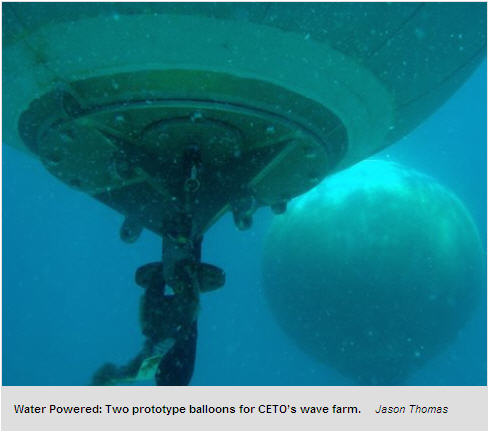
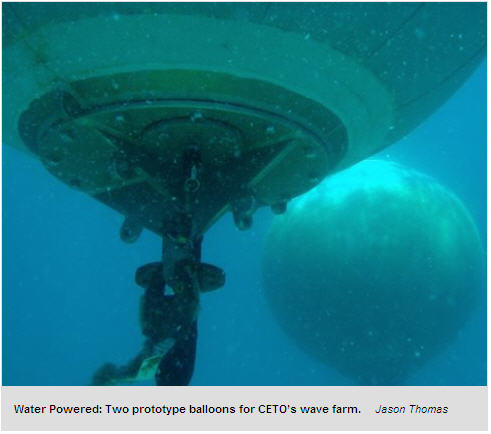
This is a fantastic article summarizing some key issues with wave energy and the solution Alan Burns, an oil bloke from Australia, has come up with. It appears he’s taking lessons from his expertise in off-shore drilling (it’s safer to work on the bottom of the sea) and applying it to wave energy. It’s a must read.
http://www.popsci.com/kalee-thompson/article/2008-09/burning-tide
No ideas yet on how to use this in a story. If you have any, post in the comments section.
Wait, what if our hero is an inventor like Mr. Burns? Naw, what if we actually do go to the seas? It seems like a no-brainer. So we go to the seas. And our hero is the guy who is replacing parts. Humm, maybe. Of course, if our power generation is out there in the sea, then a perfect target for a terrorist is the pipe pumping the water in. Or what if they find a sea wreck while installing a huge one of these? And would the ocean floor suddenly become real estate? What kind of agent would sell it? Hummm
Books for Breasts!
 James Maxey loved met and loved a woman named Laura. She told him she had breast cancer. He didn’t care. Later when the disease advanced, he offered to marry her. She turned him down, but not because she didn’t love him back. The disease progressed.
His posts about this experience are tender and poignant. When you read them you will rejoice. You will sorrow. And you will think about life.
He begins like this:
She was dying when I met her. We met through online personal ads, and she wrote me saying that she liked the philosophy I had sprinkled through my post. I don’t even recall what it said, really–something about finding humor and hope even in down times, I think. And she told me she’d been through some down times. She’d fought breast cancer, her husband had left her when she was diagnosed with the disease. This might send other people into a spiral of despair and self-pity that they could never pull out of. But, she hadn’t surrendered to her worries and woes. She bested them, and went on to live a terrific life. She had gotten a butterfly tattoo–it was her symbol of transformation. The time of her cancer and her divorce were when she had been drawn into her cocoon. But she’d emerged with wings.
Here are the five I would read. They’re short. So take some time. Savor them.
When you finish, you might then want receive a free book of his in exchange for a donation (of any size; yes, even for just one buck), to the Susan G. Komen Breast Cancer foundation. To make a donation vist his Books for Breast webpage.
Then live and love while the sun shines. And be glad.
The Weaponization of Insects
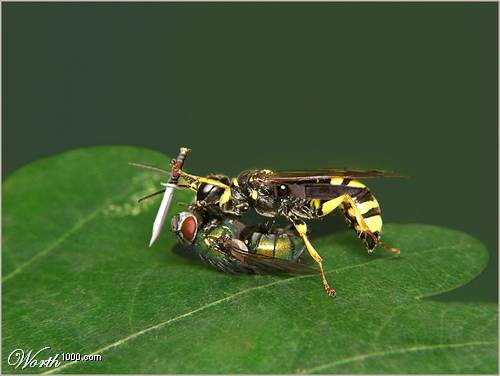
This idea.
Oh, my, heck.
One of my first novelettes was about using insects as military grade spies. Just a bit of wetware to get control of their brains. Then mount a nano recording and transmitting device…
How are you going to stop that?
But wait–insects can be far more sinister.
Jeffrey A. Lockwood has written Six-Legged Soldiers: Using Insects as Weapons of War. I can’t wait to read this. I hope it’s not a fluff book. Can’t wait to report my findings to you. Read more about it.
Oh, and did I mention that I’ve got weaponized insects in the novel I’m currently working on? Crown of a Dark God is turning into such a blast to write.