The best way to change someone’s mind: use the skills you learned writing fiction.
John Scalzi recently wrote a post about White Privilege. You know: the idea that Straight White Males (SWMs) have all the cards stacked in their favor. It’s called “Straight White Male: The Lowest Difficulty Setting There Is.” I assume he wrote it to help SWMs have more sympathy for those who aren’t SWM.
It’s a noble cause. Not as noble as true love, but that’s so rare–not one couple in a century has a chance at true love (at least when you live in Guilder).
The problem is that Scalzi’s post is a great 101 on how To NOT Win Friends and Influence People. Actually, that’s not right. He will win new friends and increase his influence among those who are like-minded. But if he was hoping to win over those who didn’t already see things his way, I don’t think he’s going to be very successful.
His posts generated hundreds of comments. When you look at the comments, you’ll see that the vast majority of them are folks arguing Scalzi’s side with smug condescension and other folks arguing points against Scalzi with an equal lack of tact.
In short, it’s a classic online bring-your-guns-to-the-party event.
Alas.
Except I must admit such events can be a lot of fun if you’re on the side with greater numbers. Furthermore, there is sometimes a tremendous pleasure to be had in being provocative. Sometimes we simply must publish something with teeth in it. And maybe that’s what Scalzi was trying to do.
But if not, here’s where Scalzi’s post went admirably wrong. And it has everything to do with principles that underlie influence as well as writing fiction. You see, when you’re writing fiction and you want someone to root for your character, you do not turn to the reader and insult him. Insults don’t bring readers into your world.
Equally as important, telling, or demanding someone feel a certain way towards someone else, will fail every time you try it. You cannot demand (or whine) that a reader must feel sympathy and admiration for the character. Why? Because emotions don’t respond to demands. They just don’t. It’s like trying to freeze water by seasoning it with pepper.
The advice “Show, don’t tell” works in real life as well as it works in fiction.
Emotions are automatic. If someone presents the right stimulus, we WILL feel the desired emotion in response. We don’t experience a sympathetic change of heart when someone gets in our face and demands we feel sympathy. We do feel that change when we see the antecedents which prompt the emotional response in us. Show me. Make me believe. And the response is automatic.
This is what happened with Uncle Tom’s Cabin and the movie Ghandi and the TV series Roots and the more recent movie Believe in Me and the novel Les Miserables and thousands of others. It’s what happens every day when someone in one group meets someone in another group they feel some distrust for and begins to build a friendship.
Show the antecedents, help folks identify, and you’ll move millions. Get up and rant at someone, and all you’ll get is the bird. And applause from the true believers.
Scalzi claims that if you feel offended by his post then you’re hypersensitive because all he was doing is pointing out the facts. Um, no. Jim Hines is trying to establish potential facts. You could try to verify those. You could try to separate out causation from correlation. But Scalzi is not doing that. He’s telling all SWM that they are playing on the kiddy version of the life video game. Your life is so easy. Everything is rigged for you. You’re playing the baby version. And because of that everyone else’s life is so much harder.
No, he didn’t say those words exactly. But there is this thing call connotation. There is this thing called tone. And no matter how hard you try, you’re can’t separate the non-verbal communication from the message.
Everyone knows that some people have it harder in life and some have it easier. Like, duh. I think we all learn that when we showed up to the first grade. So what’s the point of telling all the SWM’s reading his blog that they are playing the dweeb version of life, the one with training wheels?
Furthermore, instead of helping all of us pampered SWMs identify with our brothers and sisters, he tries to erect more boundaries that would push us apart by giving all of us another way to discriminate and another reason to be resentful.
Lowly, pampered SWMs at the bottom. Gays, people of color, and women farther up.
So now we’re going to go around with a My Life’s Harder Than Yours number? The opinions of those with low numbers will have less weight. How could they have anything as worthwhile to say when their life has been so easy? Those with higher numbers will have more weight.
A whole new group calculus will have to be developed and standardized. And it will have to go beyond which shade of brown your skin is (yes, White people really are just a lighter shade of brown), your gender, and sexual orientation. Because those who are handicapped, by birth or by accident have it really rough too. We’d have to figure out if they had it more or less rough that someone who was gay, and would that change if that gay person lived in San Francisco versus Laramie, Wyoming? A geographical element! And what about those with idiot parents who teach their kids to take meth and don’t get them to school or beat them in alcoholic rages or who are never around? I wonder what score that would bring. And what about the kids who grow up with grandpa molesting them? And what about the short, the fat, the plain? What about those with glasses? Those who are runty bully targets? Or those with a minority religion. What about those born with AIDS?
Are we sure it’s a good idea to start ranking ourselves, using color, gender, and sexual preference to tag our status?
Wait, haven’t we already tried that?
When someone comes up to you at a party and condescends, when they’re always one-upping you with a “you think you’ve got it hard you haven’t seen squat” line, what is your response? Even if it is legit. What about when they get in your face for someone else? Does that change your default response?
It’s the same at internet parties and gatherings.
So.
Lesson 1: If you want to influence someone, don’t start by insulting them and continue by talking down to them. If you want to have a good time with like-minded friends, then, by all means, skewer.
Lesson 2: Remember “show, don’t tell” to win someone’s affection. Present the person’s story, and the reader will feel respect, trust, sympathy, sorrow, regret, and admiration automatically (okay, you’re right, some of that depends on the reader). Tell or demand, and none of that will occur.
Lesson 3: Don’t raise barriers between two groups when you want members of one group to identify with members of another.
Here’s a better way.
Tell me a story about a real gay black woman. Make me love her. Make me care. Tell me a story about her I can sympathize with. Just show me the woman. Make it about her, not her group category. Or tell me a story about a Mexican man who is just trying to provide for his children in America. Or tell me about a sympathetic SWM who goes to Asia or Polynesia and finds the cards stacked against him. Stories like this abound.
In fact, why don’t you drop the whole “SWM” business. If you want me to identify, to experience-take (yes, that official jargon), it’s probably best not to slap SWM on me and set me in one corner and slap GBM on someone else and set them in another. Help me identify. Focus on how we are alike. When you do discuss the differences, magnify those things that are wonderful and unique, or eccentric and unique, or goofy and unique, or weird and unique, or whatever, but make it positive. And when you must talk about old or continuing grievances between two groups, do so with respect, with a desire to calm, not enflame.
Lest you think I don’t know what I’m talking about, I grew up working in a family business where employees were White, Black, Hispanic, Tongan, and Japanese. Male, female, homosexual, heterosexual. And we were a big family. My father and mother held out big welcoming arms. I have Whites and Blacks in my biological family. I hope my daughters find great men to be their husbands. And if they happen to also be Indian or Puerto Rican or Black or Asian or Maori or Scottish or Southern or whatever, I would think it was grand. It’s possible I might experience some of that mild “other group” anxiety that sometimes comes when you meet someone that’s not just like you. But I know it’s possible to get beyond that by seeing what’s common, building friendships, and celebrating and laughing at and with the differences.
My father, God rest his soul, liked to quote Edwin Markam. I thought it fitting.
He drew a circle to keep me out,
A thing of scorn, and a thing to flout.
But love and I had the wit to win:
We drew a circle that took him in.
You want to laugh with the like-minded? Draw the first kind of circle. You want to win hearts and minds? Draw the bigger one.




I agree with you on this! Just because Hugos have been the most prestigious Science Fiction award a SciFi author can get doesn’t mean we couldn’t make a new one that gets votes from scifi readres all over the world. 🙂
The Nebula is up there too. It all comes down to what you want to recognize and promote.
So true, John. If you create a new one (I’ll call it The Quantum for the moment) and readers see that the books that they enjoy fill the Hugo list, and the ones they like are in Nebula, but the ones that really turn them around, make them think, make them feel, make them love to read even more are in the Quantum list–then they will begin to give it power. It will become the Second Foundation.
I write YA sci-fi, and one thing that I’ve noticed is that, with no exceptions I can think of off the top of my head, all YA authors treat each other nicely. What is it about adult sci-fi and fantasy tear each other apart, both publicly and harshly?
I don’t know. Is it the infusion of political stances, of crusades for right and wrong, however that’s defined? Do you find that in the YA community?
It may or may not be the right strategy, but it definitely got some attention, and that can’t be a bad thing.
There are an awful lot of folks that read SciFi and Fantasy in the seventies and eighties that don’t read it now. The Hugo conundrum is just the tip of the iceberg. I’ve read several of the blogs on this subject, and there are several ex-readers of these genres that are willing to get their feet wet again, now that they have an inkling that there might be writers of the “old school” out there, albeit either Baen writers or indie.
I think the more attention the better right now.
About awards? I think there ought to some acknowledgement that the genres have splintered, and that the SJW saturated stories should get their due, and the old school stories should get theirs.
Just my auld two and a half pence on it.
Yes, all the magazines seemed to take a weird turn. And the editorial houses seemed to follow, although there were many exceptions. I dropped my subscriptions to Asimov’s and F&SF in the early ’90s because the stories just bored me.
Politics are definitely talked about by the YA community, and the genre definitely leans left. Nine out of ten authors are female, if that has anything to do with it.
So much for my theory. Or, if it all leans left, maybe the minority is too much a minority to care to make waves?
The Sad Puppy campaign has gotten a lot of attention in a couple of interesting places. There’s an article on Breibart that showed a lot of people the issues in SFF, and on Mike Glyver’s blog there’s an interesting conversation going on.
My thought on this is it might not change what’s going on in the Hugos, but the attention appears to be bringing back some old time SFF readers.
Give someone that hasn’t had a good space opera to read in twenty years, something that fits, they might start looking for more of the new stuff to read.
If someone was an avid fantasy reader twenty years ago and more, and couldn’t find anything to read at the end of the nineties and gave up, Larry Correia and the Harry Dresden series might bring them back.
That can’t hurt us, the indies and the aspiring writers.
Very true.
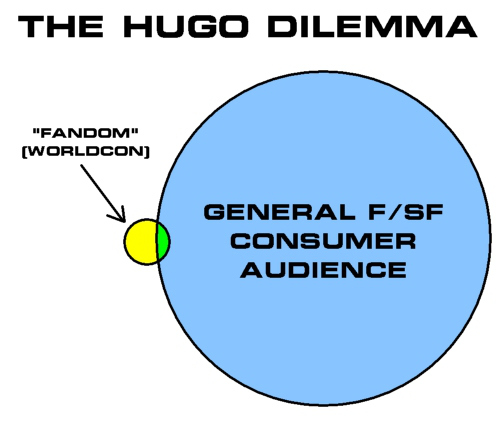
You really nailed it, John. The issue with Brad’s Venn diagram is that his exact diagram is identical to one you would have created when the Hugo Awards were created, and people don’t seem to understand that it was designed that way.
It’s a small group that created an award that represented a small group. The disconnect here is that thanks to those people’s dedication the award is considered prestigious and people are mistaking prestigious with “represents all of fandom,” but at its heart it is still a small group award.
It’s like complaining about the Nebulas because they only represent the opinion of writers. Well, exactly. Replace Nebula with Hugo and writer with con attendee, and the logic still applies.
Right. And I think shining a bright light on it, has been helpful. But I think the best alternative is an award that does what Sad Puppies really wants.
Totally agree with this. Thanks for the well-reasoned post.
I hate it when someone tells someone else that the thing they like is “wrong” or they like it for the “wrong reasons”.
No reason to go take away someone else’s toy; have a good time with your own toy and people will come over to see what you’ve got going on.
Yes. I’m in agreement. It’s time for a new SFF award, of the type that takes into account the tastes of mega-readers.
In other words: It’s not an award for the most high-brow SFF book (that might be the Hugo). And it’s not an award for the most popular SFF book (that might be Goodreads Reader’s Choice). Any reader who’s read at least, say, 30 SFF books that year can nominate candidates. But that’s the requirement–not how much you can pay, not who you know, not what social media you’re on. Just how much you read.
To me the argument loses any credibility when it claims most Hugo voters aren’t part of fandom
That wouldn’t make sense, would it? However, I don’t think they claim they aren’t part of fandom. I think they feel they don’t represent the vast majority of fandom. The Worldcon circle should probably be a smaller circle within the larger one.
I think the award should be tied to SLCC. You can add a comic category to keep it relevant to all the attendees there.
I would name it the “Saltys”
Now that’s an interesting idea.
The disconnect here is that thanks to those people’s dedication the award is considered prestigious and people are mistaking prestigious with “represents all of fandom,” but at its heart it is still a small group award.
The disconnect needs somewhat better explanation. It isn’t that “people” are mistaking prestigious, it’s that the people handing out the award were touting it as “represents all fandom”. “People” is entirely too nebulous, too ambiguous a word to use here. With the Nebulas it’s known that it’s a writer’s award, and in fact a specific group of writers, i.e. the SFWA. Pulling back the curtain on the small group nature of the Hugos is partially what SP has been about.
Is SP the best approach? Perhaps, perhaps not. It is the approach that’s in play now though. One could certainly get a good story out of some alternative approaches. Who knows how the world will look 70 million years from now with Sad Puppies, and without?