Good Stuff! Mike Loades on Swords and Bows

Mike Loades is an expert on medieval fighting. He brings energy and, not just bookish learning, but insights from hands-on use. I loved the five-part Weapons That Made Britain television series for which he was the host and chief consultant. And so I looked to see if there was anything else he’d done. I found he’d written two books, which I am so happy to have read.

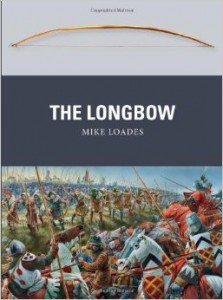
The Longbow is not just a book about the longbow. It’s about its construction and how it impacted the development of armor, and types of armor, and the wood used for the bow, and how to make arrows, and what the various points were for, and how people trained, and then cared for the bows, and how it was used in war. And, again, the insights are not just bookish ones. He’s walked the battlefields. He’s used bows for years. He’s performed tests with them. It is a 80-page book that carries a monstrous bang for the buck and one of the best purchases I’ve made for my library. I loved it.

MikeLoades_TheLongBow

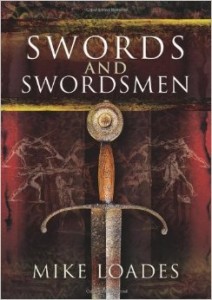
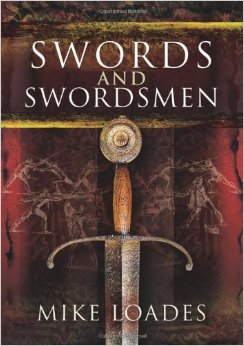
Of course, after that experience, I had to get his Swords & Swordsmen. This book is almost 500 pages long, and I was rapt reading each page of it. Instead of focusing on one version of this weapon, Loades discusses exemplars of various types of swords through time, starting with the sword of Tutankhamun in Egypt all the way through the swords of J.E.B. Stuart and G.A. Custer in the American Civil War. There are 15 chapters all discussing different eras and swords that provide a mountain of insight. The love Loades has for and the practical experience he has with the topic shines through on every page. Just as with The Longbow, you’ll learn about use, construction, the interplay with armor, and much more. Heck, I got the ideas for at least three novels reading this book. I loved it as much as I loved the first.

MikeLoades_SwordsAndSwordsmen

If you enjoy military history and arms and armor, you will love these books. Guaranteed.

While you’re waiting for them to arrive in the mail, treat yourself to five hours of fascinating video below.

Weapons That Made Britain E01 – The Sword

Weapons That Made Britain E02 – The Longbow

Weapons That Made Britain E03 – The Lance

Weapons That Made Britain E04 – The Shield

Weapons That Made Britain E05 – Armour

Share

Similar Posts

  • The Road by Cormac McCarthy

    If I’d known Cormac McCarthy’s The Road had won a Pulitzer Prize in 2007, I might not have picked it up. So many books that have won the award just bore my underpowered literary sensibilities to death. Luckily, I’d listened to McCarthy’s All The Pretty Horses a few years ago and enjoyed it. So when I saw the audio book, performed by Tom Stechschulte, in the library I checked it out. I’m so glad I did.

    The story is set in the Eastern US (although you don’t learn that into well into the book, and then only by one reference to them traveling through “the Piedmont”) years after a holocaust (meteor, nuclear, a caldera–it’s not ever really confirmed) and the resulting choas that turns America in a bleak place of ash and death. A father and son travel a mostly deserted road south to warmer weather, pushing a grocery cart with their few belongings. The father’s sick; he might be dying. And if he dies, we know the boy will die too because there’s nothing to eat but tins of what they can scavenge from houses that were ransacked and abandoned years before. And because others who survived have turned to hunting and eating people.

    This is an incredible story about the relationship between this father and son and the dangers they face. McCarthy tells the story in plain detail. In fact, his understatement and attention to detail in this terrible landscape make it all the more powerful. Stechschulte’s reading is perfect.

    The film is due out in 2009 and features Viggo Mortensen. But I wouldn’t wait for the movie if I were you. I’d get the book now. Or the recording. I couldn’t put this tale down. I’m betting you won’t be able to either.

    Share
  • |

    Black Chokecherry Syrup

    When you live where we do, you cannot hope to landscape likes folks in a warm suburb. First of all, at 6,000 feet with a min temp of -30 Fahrenheit you can’t grow a lot of warmer climate plants. Second, the deer seem to eat everything else you do grow. So we’ve been looking and I think I’ve found a tree to add.

    I actually found it earlier when I was biking around the beautiful Round Valley and had to stop and go back to revel in the delicious fragrance. But I didn’t know what it was at the time. I do now. 

    It’s the black chokecherry.

    It grows naturally up here. Has beautiful fragrant blossoms in the spring. And it produces fruit that can be made into a delicious syrup. Oh, the raccoons like it as well.

    Now when you eat the raw berry, unless you eat it late in the fall, you’re in for an astringent, alum after-punch. But we picked the berries up a canyon behind our town after the first frosts. In fact, many of our berries were wrinkled. They just fine raw. Even Lilia, my pickiest eater, enjoyed them.

    We picked about 1.25 gallon ice cream buckets of the stuff. Then we followed this recepie and made about 4 quarts of syrup.

    • 3 cups chokecherry juice (see first step)
    • 3 cups apple juice (not from a store, but cooked from apples)
    • 6 1/2 cups sugar
    • (I’ve heard some folks add 1/4 teaspoon almond extract for a stronger cherry taste)
    1. Wash chokecherries, place in a large kettle, barely cover with water and cook, covered, for about 30 minutes till the cherries are soft. Mash gently and strain the chokecherry juice through a sieve or cheesecloth.
    2. Do the same with the apples.
    3. Pour the juice into a large kettle; stir in the sugar.
    4. Cook on high, stirring constantly.
    5. Boil hard for 1 minute.
    6. Remove from heat and skim foam.
    7. To can: Pour hot syrup into sterilized hot jars to within 1/8th inch from top.

    It’s absolutely delicious on pancakes. 


    Share
  • Black Hawk Down, Pete Blaber, Not Waving But Drowning

    A Ferocious Battle

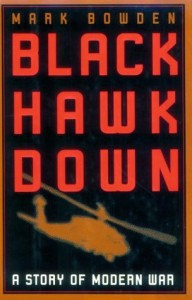
     I just finished reading Black Hawk Down by Mark Bowden. It is the most gripping account of any battle I have ever read.

    In 1992 a Somali warlord attacked and killed U.N. peacekeeping forces. As a result, the US put a $25,000 bounty on his head and attempted to arrest and try him for war crimes. On October 3, 1993, by the order of President Bill Clinton, a force of United States Army Rangers and Delta Force operators, the Army’s most elite warriors, set out to capture several lieutenants of the warlord’s militia in an area of the Somali capital city of Mogadishu that was controlled by the warlord.

    The force of about a hundred U.S. soldiers helicoptered in during broad daylight. They roped down to the streets surrounding the target building. It was supposed to take them no more than an hour. They would bag the warlord’s lieutenants, put them on a convoy of Army trucks that had barreled into the city and were waiting right around the corner, and get out.

    But the citizenry, loyal to the warlord, weren’t going to take it lying down. They began to swarm with guns and rocket propelled grenades. They attacked, almost heedless of the danger. One Somali with an AK-47 rode a cow out in a strange charge, a number of other Somali’s taking cover behind (yeah, he and the cow died). But the Americans were overconfident of their Black Hawk helicopters. They didn’t think the types of weapons the Somalis had could bring them down.

    One chopper was hit and crashed. Then another. A third and then a fourth were damaged and barely made it back to safety before they crash landed. As for the Rangers and D-boys, they were in for the fight of their life.

    The book tells the story of their courage, but it also brings in the point of view of a number of actual Somalis who fought and were injured. In the process, we get a view of the battle that is both thrilling and poignant.

    Bowden did an excellent job researching and writing this. I could not put it down. It does include some military grade profanity, but it wasn’t there to titillate or shock. I’ve talked to those who saw the movie based on this book, and I could tell the book is, per usual, better than the movie. If you’re at all interested in the military and the military operations we conduct overseas, let me recommend that you read this book. 

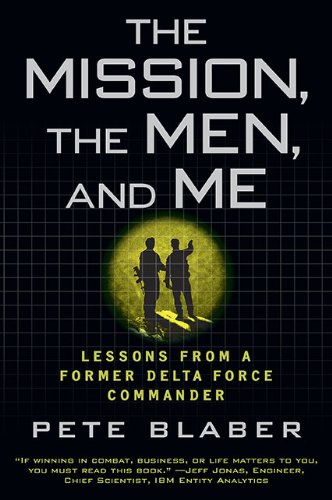
    Delta Force Commander Shares Insights
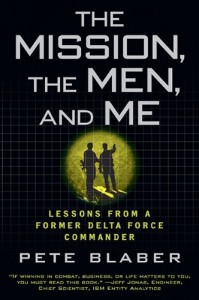
    Delta Force is the world’s most elite counterterrorist fighting force. Pete Blaber was a Delta Force operator that worked his way up to become a Delta Force commander and took part in some of the most dangerous, controversial, and significant military and political events of our time.

    During his time in uniform, he learned a number of lessons about life, about how we make decisions and act on them. In The Mission, The Men, and Me, Blaber writes about a number of the missions he conducted and the lessons he learned from them.

    The missions were conducted in Montana, Iraq, Bosnia, and Afghanistan. One featured a commander stupidly ordering Blaber to take his men into sure destruction. Another featured some of the first plans to capture Osama Bin Laden, before 9/11. Another included a man in a gorilla suit.

    The lessons Blaber draws from these experiences are fascinating and apply to more than military operations. For example, the lesson he drew from the operation featuring the gorilla suit is something I use every day with my writing. Anyone who leads or manages or works in groups will find other critical lessons. This was another book I couldn’t put down. Anyone interested in special forces will love this book.

    Not Waving But Drowning

    “Not Waving but Drowning” is a poem by female British poet Stevie Smith. It was published in 1957 as part of a collection with the same title. The work is her most famous poem and describes a man whose distressed thrashing in the sea causes onlookers to believe that he is waving to them, not drowning

    I hadn’t thought about this poem since I was a student at BYU. Then a local poet read it as part of his remarks at a conference I recently attended. The image and message lingered with me for hours. I thought about it off and on over the following weeks. This is, for me, an incredibly powerful poem. It needs to be read aloud, I think, to be appreciated. Not in some silly way, but with the appropriate feeling. I’m going to record a reading for my website, but you can read it aloud for yourself. Or have someone else do it for you. Then read it again.

    Nobody heard him, the dead man,
    But still he lay moaning:
    I was much further out than you thought
    And not waving but drowning.

    Poor chap, he always loved larking
    And now he’s dead
    It must have been too cold for him his heart gave way,
    They said.

    Oh, no no no, it was too cold always
    (Still the dead one lay moaning)
    I was much too far out all my life
    And not waving but drowning.

    How often does this happen? Those onlookers, caring only superficially, thinking it was too cold, thinking he was funning. But it wasn’t too cold. And his heart didn’t give out. He was struggling for his life, and they were too preoccupied to see it.

    Too preoccupied to really see. 

    I wonder. Is there someone around me, that if I just looked, just paused from my rush, I’d see they were much too far out, and not waving, but drowning.
    Share
  • Last Word & Park City Peaks

    LastWordGameMy youngest’s birthday fell on Thanksgiving this year. We asked her what she wanted to do. She said she wanted to go to a hotel to swim and then play a game as a family, so Nellie and I went to work. Nellie got the game. I got the hotel. Both were great.

    The game was Last Word by Buffalo Games Inc. It’s fairly simple. There are subject cards with categories on them like “vegetables,” “breeds of dogs,” or “places you find water.”  Then there are letter cards. Each player gets a subject card.

    The round starts when someone flips over a letter card. If you can think of a word that starts with that letter in your category, you shout it out, slam your subject card down, and then everyone else tries to come up with words that start with that letter and fit the category.  Or you try to think of words in someone else’s category if they beat you to it.  There’s no order to it–you just shout out the words as they come to your head.  The last one to come up with a word before the timer buzzes wins that round. The twist that makes it so fun, however, is that the timer is random.

    You can play individually, in teams, or some mix (our youngest and I teamed up). Because of the random timer, anyone who can think up a word can play, which means our daughter who is eight could compete with the one that was seventeen.

    We had a great time. One of the funniest things about it is that everyone is desperately trying to come up with words. Some fit, some don’t. Some don’t even exist. For example, when we did the category “male names,” number 3 shouted out “Mancake.” We couldn’t stop laughing. I think that one is going to enter the family vocabulary.

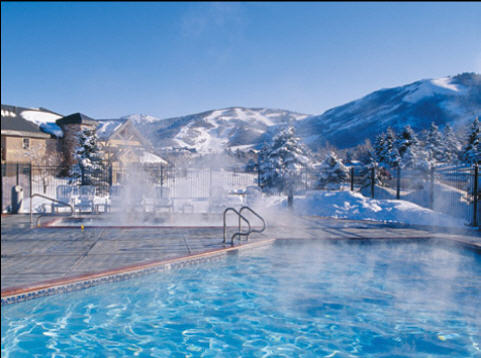
    ParkCityPeaksHotelWe also had a great time at the Park City Peaks hotel. As far as rooms go, they were good rooms. The bed was a bit too soft for me, but perfect for my wife. We got them for $65 a night, which isn’t bad at all. But it was the pool that made the experience. 

    The pool is an actual pool, not the big bathtubs some newer hotels offer. For example, the deep end is six feet deep. But the cool thing is that half of it is indoors and half of it is out. And the outdoor portion is heated. There’s also a large heated hot tub outside as well. In the picture it’s the thing producing the long row of steam in the back.

    It helped that we didn’t have much snow so the place wasn’t crawling with skiers. In fact, we had the pool mostly to ourselves. So imagine: there we were on a November night in this alpine setting, the steam rising off the water, swimming and horsing around underneath the winter stars. It was marvelous. You can be sure we’re going back.

    BTW, we had Thanksgiving dinner at a restaurant. Let me recommend this to you. It makes the day a breeze. You can still have your homemade turkey dinner, but picking up the turkey  a few days after the holiday allows you to get them for cheap, cheap, cheap.

    Share
  • Buck, America the Vulnerable

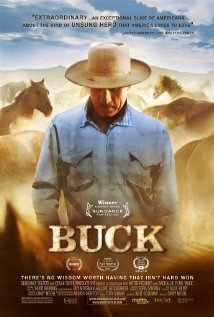
    Buck

    About two years ago I was walking out in Round Valley and saw a rider on a horse coming down a hill through the brush.  I got to him just as he moved onto the road. Right away, I noticed that there was something a bit off with the horse’s gear—the rider was not using a bridle. The rider, Wayne Batty, was using nothing more than a rope harness that went around the horse’s head. I was amazed; how did you steer the horse without a bit in its mouth?

    I asked Wayne if I might walk alongside as he rode. He agreed, and then began to talk about training and riding horses. I stuck with him for little over a mile before I had to turn back. I learned in that short period that Wayne was able to communicate with that horse with small nudges. The horse also communicated to him many things with its stance, ears, the cock of its head. Most importantly, I learned they both had built up a trust of each other. Wayne’s methods were not based on fear, it seemed, but something else.

    It reminded me a lot of the fascinating and compelling The Man Who Listens to Horses, the autobiography of Monty Roberts, that shares Roberts’ life and his development of natural horsemanship methods. Unlike many training approaches which seek to break a horse’s will through harsh punishment-based methods that often veer into abuse, natural horsemanship employs methods that are much gentler and seek to build trust in the handler. Roberts can join up with (he doesn’t “break” horses) a wild or un-ridden horse, be up on the saddle calmly riding the animal, in an incredibly short period of time.

    But Batty and Roberts aren’t the only ones practicing this. These methods have been around some time. One of the most famous practitioners and teachers is Buck Brannaman, who found his years of being severely physically abused by his father actually provided some insight into training horses.

    Says Brannaman: “I’ve started horses since I was twelve years old and have been bit, kicked, bucked off and run over. I’ve tried every physical means to contain my horse in an effort to keep from getting myself killed. I started to realize that things would come much easier for me once I learned why a horse does what he does. This method works well for me because of the kinship that develops between horse and rider.”

    Recently, a film was produced that looks at Brannaman’s life and methods. It’s called Buck and is worth every minute. If you love horses, you’ll love this movie. If you have a horse and think you might want to learn these methods, or just want to watch and listen, you might want to check out Brannaman’s teaching schedule at his site brannaman.com. He travels all over the country and is likely to hold a class within driving distance.

    America The Vulnerable

    A few years ago I received an email from my bank. At least, it looked legit to me. I opened it. It said it needed me to update some parts of my account and provided a link to the bank’s website. I clicked on the link, which took me to my bank’s website. At least, it looked exactly like my bank’s website. I entered my account number, login, and password. I made the requested changes and logged out.

    Two days later, somebody in Spain cleared every penny out of my account—thousands of dollars stolen.

    That email was a phishing (fishing) scam. The website had been a fake. I had willingly handed over my account number, login, and password to thieves.

    Luckily, the bank insures such thefts. But the problem of information security remains. Thieves living in Spain, or Russia, or LA, or China, can rob me blind from their bedrooms in their pajamas. They can do this because our information processing nowadays is increasingly tied to the internet.

    And they don’t just rob dopes like me, because it’s not just individual criminals who are in the business. Corporations and governments are in this business as well.

    They steal billions of dollars of trade secrets, engineering designs, and other intellectual property from American companies through computer hacking. They steal military secrets. For example, the US Navy spent years and about $5 billion dollars to develop a quiet electric motor for submarines that would make them incredibly hard to find and track. Chinese spies stole that technology. The Navy then spent billions more to develop a new radar for their top-of-the-line Aegis Cruiser. Chinese spies stole that, too.

    And they not only steal. Terrorists, crime organizations, and foreign governments can now insert malicious software into the computers that control, among other things, our electrical grid. They can use this in an attack, not just to shut the grid down for a while, but to destroy power generators. They can insert such software into our air traffic control system. Our train transportation systems. Our banks. They have already done this. They have already breached some of our most secure government systems.

    It sounds too far-fetched to be true, but it’s reality. Joel Brenner, who has served as the former senior counsel at the National Security Agency (NSA), the national counterintelligence executive in the office of the director of National Intelligence, and as the NSA’s inspector general writes about what he’s seen in America The Vulnerable: Inside the New Threat Matrix of Digial Espionage, Crime, and Warfare. In the book, he explains the cyber threats to individuals, corporations, and the country and what we can do about it. If you want a fascinating look into the next phase of crime, espionage, and warfare, and an introduction to some of the things you need to do to protect yourself and your company, and what we need to do as a nation, you’ll want to read this book.

    Share