|

Learn plot, character, scene, and more this Saturday, Oct 9!

All you Utah and mountain area writers & teachers, or those close enough to travel, I will be presenting and conducting workshops from 9:00 am until 4:30 pm this Saturday, Oct 9th as part of the Autumn Writers Conference sponsored by the American Fork Arts Council and the National Endowment for the Arts.

The sessions I’ll conduct include:

  • Finding and Working With an Agent
  • How to Write a Story That Rocks: First Principles & Story Concept
  • Creating Characters that Rock
  • Plot
  • Writing Scenes: The Basic Units of a Novel

There are four other tracks. Find all the details, including cost and contact info, on the organizer’s site: CalebWarnock.blogspot.com. I’m totally stoked for this. I’ll be sharing what I think are the Pareto factors in each of these areas — things I wish I would have known when I started and would have shaved years off my journey to publication.

A number of other authors will be there including:

  • Annette Lyon (women’s fiction and a new cook book called Chocolate Never Faileth)
  • Josi Kilpack (mystery and suspense)
  • LeAnne Tolley (health and wellness)
  • Scott Livingston (poetry)
  • Caleb Warnock (self-sufficiency)
  • Loraine Scott (mystery)
Share

Similar Posts

  • When the workshop works

    From a workshop participant at MountainCon:

    I’m going to give a shout out to all the goodness I experienced. So if you don’t really care what happened at the con, you can stop after this paragraph and take this message away with you: Brandon Sanderson (who does Writing Excuses, has published several novels, and is the chosen one to finish Jordan’s Wheel of Time series) and John Brown (with a must buy novel coming up next year) are incredible teachers. If you ever get a chance to attend a class or workshop by any of them, don’t let it pass.

    We loves to hear these things, Precious.

    But we loves it just as much when we can make the students shiver with excitement: more here: http://www.amichopine.com/blog/?p=318

    To those who missed this run of the 3 Things You Must Learn to Write Killer Stories Workshop, know I’ll be holding it again. Check back to see when.

    Share
  • How libraries select books

    Back in May I wrote about a Gallup survey that shed some light on how US adults select books to read. That poll revealed that book reviews only play a role 7% of the time with readers. The most important things to readers are prior experience with an author and recommendations from someone they know.

    But there’s another important block of buyers that don’t buy the same way. In fact, for them reviews are KING.

    Who are these buyers?

    Public libraries.

    And the library market isn’t small. According to  a fascinating Library Journal article, “there are more than 9,000 in the US, and that’s not counting branches.” Furthermore, “library purchases account for over ten percent of the $27 billion industry (excluding print textbooks for K–12 and higher ed). In contrast to consumer buying, which relies on discretionary dollars, the library market remains a consistent sales channel for publishers.”

    When looking at how many books average authors sell and what it takes to make a living writing, it becomes very apparent that libraries can have a huge effect on a midlist writer’s career.

    Of course, we all know there’s more to it than sales. The article points out:

    Libraries are far more than a market, however. Libraries create readers. They are the test bed, the petri dish for books, a place where people can discover a passion for reading as children and indulge it as adults and where passionate readers can sample new authors. Librarians are the ultimate handsellers of books (though they call it readers’ advisory), and increasingly they put their considerable technical skills into making library web sites rich interactive social networks for book lovers.

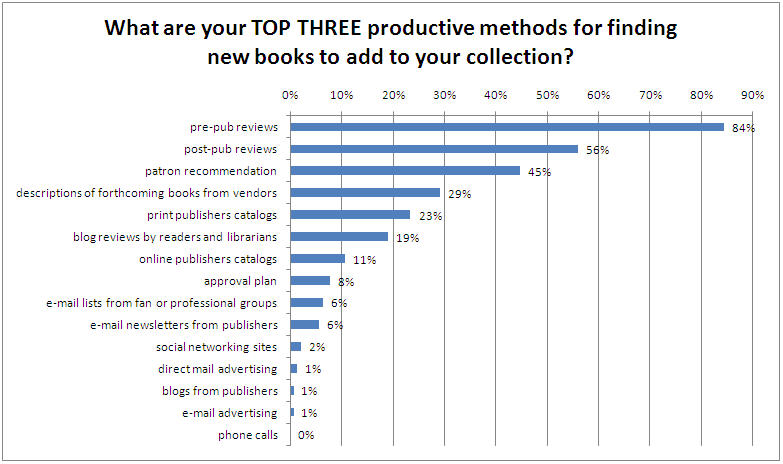
    I love libraries for this very reason. And because there’s no way I could purchase all the books I read. No way in heck. So how do they find the books for their collections? I mentioned above that they used reviews. But I didn’t know how much until I saw the data. Holy schnitzel (click on the graphic to see it full size).
    HowLibrariesSelectBooks.

    This only makes sense. Study after study has shown that buyers don’t want unlimited choice. Readers use prior experience and recommendations from people they know to manage the chaos. Libraries use reviews and then patron recommendations. Of course, this use of reviews has other implications as shown below.

    I get a lot of requests from self-published authors asking me to buy their books, and I have to explain that with limited resources and only so much space on the shelves, we have to go with books that are reviewed, that have been professionally edited. With nearly half a million books published each year—maybe half of them self-published, and most of those pretty awful—I just don’t have time to go beyond trusted sources. This usually doesn’t go over well.

    About 9 months ago I wrote about how cumulative advantage can drive product popularity–products that get early positive notice tend to get more notice. It appears that cumulative advantage is at work again. It’s just that with libraries the method isn’t a download counter. The article’s author concludes, “the best way to reach the library market is indirectly: by publishing books that people want to read and having them assessed objectively in reviews.”

    So what are the major sources for pre-publication book reviews? The article lists five big ones:

    • Booklist
    • Kirkus Reviews
    • Library Journal
    • Publishers Weekly
    • School Library Journal

    But what can an author do with this information? Authors can’t control reviews. Heck, according to the article the Library Journal itself only reviews about 10% of the books they receive.

    We all know the answer. Authors can control one thing: they can strive to write the best holy freaking heck book in their power. After all, what’s a review but a recommendation? Besides, patron recommendations were #3 on the librians’ list anyway. Nevertheless, it DOES help to have a publisher who sends your book out to the reviewers and their catalogs out to libraries. It helps to have a team that’s connected with librarians.

    The article ends by saying publishers and libraries are actually working together. I liked how the author summed it up.

    What publishers offer:

    • Discovery of talent
    • Shaping and refining books
    • Design, distribution, marketing, and promotion

     What librarians offer:

    • Discovery of books
    • Nurturing of diverse reading communities
    • Selection, distribution, marketing, and promotion

    Here’s to libraries! (And good reviews. And grandmas. And the little house trolls that give writers fabulous ideas.)

    Share
  • |

    What Separates the Gifted from the Schlubs and How Praise Can Backfire

    What makes someone gifted?

    Raw talent?

    Sure. An apptitutde for something always helps. But it appears it’s not enough. True expertise takes work. And those trying to help (i.e. parents, teachers, coaches) can hinder if they give the wrong kind of praise.

    I wanted to share three articles reporting the results of a number of interesing studies on expertise which often appears as a skill level that seems unobtainable by normal, motivated individuals.

    The Meadow Mount School of Music

    This music school in the Adirondacks has “trained such luminaries as Pinchas Zukerman, Itzhak Perlman, Joshua Bell, Lynn Harrell, and Yo-Yo Ma.” A number of researchers wanted to see what the difference was between the students who seemed most skilled and those who weren’t. They divided students “into three skill levels, including one the faculty had identified as having the best chance of becoming world-class soloists.” Then they looked at the differences.

    According to the report, “the results were clear-cut, with little room for any sort of inscrutable God-given talent. The elite musicians had simply practiced far more than the others…Psychologists found a second attribute in elite players that is less obvious than sheer hours of practice. While most of us think of practice as the repetition of tough spots (and this is how many young people do practice), elite musicians, they found, took a different approach.”  Read full article.

    The majority of childhood prodigies never fulfill their early promise

    Why? According to these researchers it’s because so many early-bloomers get warped by their experience and fail to develop perseverance. More here.

    Praise that Undermines Achievement

    It appears that how we praise achievement affects performance. Sometimes in large and startling ways.

    You may think that it’s good to praise your child for being “smart” or “good” in some subject. But there’s growing evidence that giving kids such labels doesn’t improve or motivate performance, but actually reduces it.

    Psychologist Carol Dweck and her team have studied the effect of praise on students in a variety of settings. “Repeating her experiments, Dweck found this effect of praise on performance held true for students of every socioeconomic class. It hit both boys and girls—the very brightest girls especially (they collapsed the most following failure). Even preschoolers weren’t immune to the inverse power of praise.” So what type of praise actually works? Read here.

    When does genius bloom?

    We often think genius must be tied to being precocity. After all, Motzart was doing musical flips when he was still a kid.  For writers, however, it appears this isn’t the case. More here.

    Share
  • Some lessons from Tom Clancy’s first novel

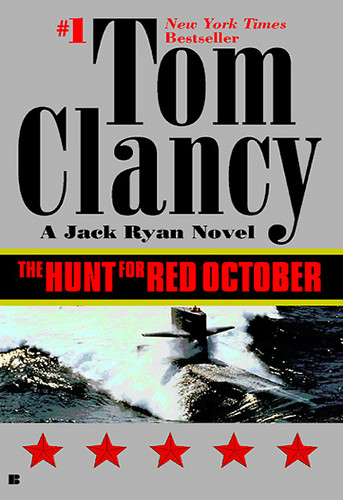
    tom-clancy-the-hunt-for-red-octoberTom Clancy is one of the biggest authors of our time. How did he break in? It’s an interesting story that Deborah Grosvenor, the editor who acquired The Hunt for Red October (Clancy’s first book), tells here.

    And this early interview provides more insights.

    So what conclusions can you draw from this? Here’s what I picked up.

    1. Writing a good book is one thing. That book finding success is quite another.

    2. Endorsements from the right people make a huge difference. More here in my blog Is Product Popularity Random?

    3. Know what you write. And if you don’t know it, do the research. And then invent what you have to.

    4. It’s not always a bad thing to start with a small press, especially if they’re going to put as much $$ into marketing and PR as this one did.

    5. To finish your novel, you’re going to have to set aside time and get it done.

    6. Finally, follow the zing. Clancy loved this stuff. Notice how his book was fed by the stories he heard and read.

    Share
  • Curse edit finished & other news

    A couple of quick updates.

    I just finished the edit of CURSE. I now have 697 pages all marked in red. Most of the revisions are small things. But there are some larger scene level edits. I hope to finish these in the next few weeks. Then we do the copy edit, print the proof, do the proof edit, and then at long last this baby will be available for readers. We’re so very close.

    In other news, Larry Correia did a book bomb for BAD PENNY yesterday. At 6:30 a.m. this morning it was ranked number 457 at Amazon. It was the #3 book in the Thriller>Military category and #50 in the Thriller>Suspense. Hundreds of folks purchased the book. A couple even finished and began posting glowing reviews on Amazon and Larry’s site. I can’t tell you how excited I am to get the story into the hands of new readers. Both series are now launched.

    Both books are available at:

    • Amazon (trade paperback and ebook)
    • Barnes&Noble (ebook)
    • Kobo (ebook)
    • Diesel (ebook)

    I’m still working with the blasted Smashwords to get it up at iTunes and the Sony eReader store. I’ve been working since the middle of December on that. I’m going to give them one more shot, and then we’ll have to figure something else out. Those of you wanting to get it on iTunes, I hope to have it resolved by this time next week. Thank you so much for your extreme patience.


    Share

4 Comments

  1. This looks really awesome. If only I’d seen it before October 1st! (me = poor).
    But my wife is gone this weekend, so this could be an awesome way to get my writing groove on. Thanks for the tip! Maybe I’ll see you Saturday! 😀

  2. I’m still trying to decide if I will join you this Saturday. It sounds like all sorts of fun, but my daughters may need some time and attention. I laud the author and his brilliant parts, but I would prefer to avoid bunny cakes at all costs!:-}

  3. Number1,

    Not those kinds of bunny cakes! Sheesh. I’m talking real cakes. Birthday time :0

Comments are closed.