Work hard for 45 minutes, then take a break

My first semester in college I earned a GPA of, ta dum, 0.68.  How do you earn such amazing grades? Well, I’ll tell you: the super secret strategy is to get an F in everything except ballroom dance. In that you get an A.

I couldn’t squeeze any juice out of my textbooks, but I sure could fox trot.

And I wasn’t partying. Dope and beer bongs were never for me. I wasn’t skipping class. I was lugging this huge valise around with every textbook I had. I think it weighed something like forty pounds. I was stitting in classes looking studious and taking notes. Well, except for physics which started early. 7:30 a.m. if I recall. What kind of a nut job takes a class at 7:30 a.m.? I did. I tried really hard to stay awake. I know I saw the professor shoot a gorilla with a tennis ball once. But the rest of the time I was in la la land catching z’s.

A 0.68, and I was in the honors program.

Obviously, I didn’t know how to go about learning. I’m glad the university didn’t give up on me. They put me on probation and told me I had to take a class on studying. A class on how to take the reponsibility for learning into my own tentacles. A class that shared techniques that actually helped.

One of the techniques was taking breaks. You were to work hard for 30 or 45 or 50 minutes and then take a break. Why? Well, because studies had shown that someone who, for example, was going to study for two hours could learn more by taking a ten or fifteen minute break in the middle than someone who worked the whole two hours.   Spending more time on studying actually meant you learned less.

I’ve found this method applies to more than just reading textbooks.  It also applies to writing. My practice is to set a time for 45-50 minutes. My goal is to write as hard and fast during that period as I can. To be totally focused on the task at hand. And then, when the timer dings, to literally get up out of my chair, walk about, and take a break. Then come back at the top of the next hour and start another 45 minute session.

But I’m not the only one doing this. A lot of folks use this method. Author Annie Bellet writes about her use of it in The Quest for Productivity and shares some of the reasons why it helps her. Read what she says there. If you haven’t done a 45/15 or 48/12 session, give it a go. See if you don’t actually get more done in less time.

Oh, btw, as for my grades, not only did I NOT drop out (or get kicked out) and become a hobo living in a trailer by the river, I ended up getting a 3.8 in my masters of accounting program. I think it’s safe to say I figured that school thing out. 🙂

Share

Similar Posts

  • How Inequity and Deservingness Propel Readers Through Story

    Inequity and deservingness are two of the main factors that keep readers reading. If we want to write killer stories, we need to know how they affect readers. A few years ago I wrote an essay on this and thought it probably too technical for most folks’ taste. But I passed it on to a recent attendee of the killer workshop and he found it helpful. In fact, when he watched Pride & Prejudice shortly after reading the essay, he saw how these factors dramatically affected his rooting interest. So I’m thinking others will find it useful as well. 

    In order to understand it you must first read George Saunders’ short story “The Bohemians.” You’ll find it here in The New Yorker, January 19, 2004. It would probably be rated PG for some profanity.

    Now if the story doesn’t pull you in, stop reading. Because the essay probably won’t make any sense to you. You’ll only be able to understand it if the story works for you. But if it does, then ask yourself what the main character’s problem was and what drew your interest? Then read my essay, “How Inequity Evokes Reader Interest.”

    Please note “The Bohemians” does present a character with a problem, and the story cycle applies, but not in the straight-forward manner it does with most stories. BTW, if you’ve ever read Patrick Rothfuss’s excellent Name of the Wind, you’ll see inequity is what shapes the story there as well. If you haven’t read it, I recommend you give it a go.

    I’ll be interested to see your responses to Saunders’ story, my essay, and/or Rothfuss’s novel.

    Share
  • |

    Orson Card’s Literary Boot Camp

    Just apply already!

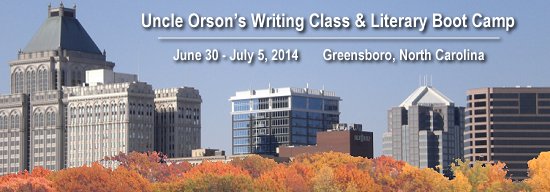
    Orson Card has just announced the dates and location for this year’s literary boot camp. This one is in North Carolina. Card usually usually holds a session in the west every other year. But here’s the deal: east or west, if you are a new writer, this is THE workshop to attend. It is hands-down THE best workshop I have ever attended.

    If you want to learn how to write fiction from one of the masters, you will apply (the boot camp is limited to 12 people) and then do whatever it takes to attend if you’re selected.  The two day writing class is also great. I don’t know that I would spend hundreds of dollars to fly in for that, but I would and did spend hundreds to attend the boot camp (way back in ye year 2002).

    For more information, go here: http://www.hatrack.com/misc/bootcamp2014/

    Share
  • |

    John guest posts about writing memorable fiction on ReidWrite

    Luc Reid is the author of, among other things, Talk the Talk: The Slang of 65 American Subcultures.  He is also the lizard king of Codex, which he started and of which I’m so happy to be a member. He’s always starting provocative threads on Codex, making us all think and reexamine the principles of story and the whole writing business. He recently posted some insights about what makes memorable stories. A lot of other fellow Codexians joined in the discussion. Happily, he asked me to share some of my thoughts on his site, ReidWrite. They begin as follows:

    YOU’RE MINE, DEAR READER

     Mwuhahaha.

     Okay, maybe not. But you are wired to be mine. And you wouldn’t have it any other way.

    Let’s back up. Luc wrote about writing memorable. I agree with the idea that the stories that produce a strong emotional reaction are the most memorable. In fact, I believe that triggering of emotion is THE reason why linear narrative that puts us into the trance has lasted so long in so many forms and makes so much money.

    But can writers guide reader emotions? Or is it all just by accident?

    Read the rest here: http://reidwrite.livejournal.com/8331.html.

    BTW, when you’ve finished that, you might want to check out Luc’s new site, WillpowerEngine.com. It’s a place where he shares what he’s found in his research for his current book project, The Willpower Engine, on how self-motivation works. I think you’ll find a number of the posts there very interesting.

    Share
  • How libraries select books

    Back in May I wrote about a Gallup survey that shed some light on how US adults select books to read. That poll revealed that book reviews only play a role 7% of the time with readers. The most important things to readers are prior experience with an author and recommendations from someone they know.

    But there’s another important block of buyers that don’t buy the same way. In fact, for them reviews are KING.

    Who are these buyers?

    Public libraries.

    And the library market isn’t small. According to  a fascinating Library Journal article, “there are more than 9,000 in the US, and that’s not counting branches.” Furthermore, “library purchases account for over ten percent of the $27 billion industry (excluding print textbooks for K–12 and higher ed). In contrast to consumer buying, which relies on discretionary dollars, the library market remains a consistent sales channel for publishers.”

    When looking at how many books average authors sell and what it takes to make a living writing, it becomes very apparent that libraries can have a huge effect on a midlist writer’s career.

    Of course, we all know there’s more to it than sales. The article points out:

    Libraries are far more than a market, however. Libraries create readers. They are the test bed, the petri dish for books, a place where people can discover a passion for reading as children and indulge it as adults and where passionate readers can sample new authors. Librarians are the ultimate handsellers of books (though they call it readers’ advisory), and increasingly they put their considerable technical skills into making library web sites rich interactive social networks for book lovers.

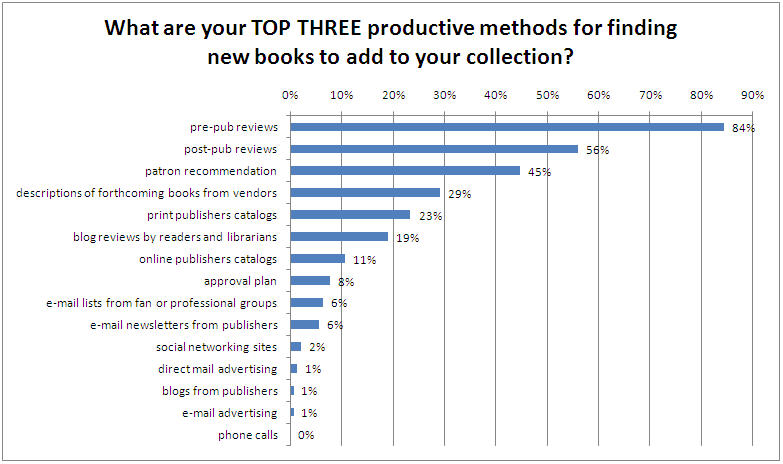
    I love libraries for this very reason. And because there’s no way I could purchase all the books I read. No way in heck. So how do they find the books for their collections? I mentioned above that they used reviews. But I didn’t know how much until I saw the data. Holy schnitzel (click on the graphic to see it full size).

    HowLibrariesSelectBooks.

    This only makes sense. Study after study has shown that buyers don’t want unlimited choice. Readers use prior experience and recommendations from people they know to manage the chaos. Libraries use reviews and then patron recommendations. Of course, this use of reviews has other implications as shown below.

    I get a lot of requests from self-published authors asking me to buy their books, and I have to explain that with limited resources and only so much space on the shelves, we have to go with books that are reviewed, that have been professionally edited. With nearly half a million books published each year—maybe half of them self-published, and most of those pretty awful—I just don’t have time to go beyond trusted sources. This usually doesn’t go over well.

    About 9 months ago I wrote about how cumulative advantage can drive product popularity–products that get early positive notice tend to get more notice. It appears that cumulative advantage is at work again. It’s just that with libraries the method isn’t a download counter. The article’s author concludes, “the best way to reach the library market is indirectly: by publishing books that people want to read and having them assessed objectively in reviews.”

    So what are the major sources for pre-publication book reviews? The article lists five big ones:

    • Booklist
    • Kirkus Reviews
    • Library Journal
    • Publishers Weekly
    • School Library Journal

    But what can an author do with this information? Authors can’t control reviews. Heck, according to the article the Library Journal itself only reviews about 10% of the books they receive.

    We all know the answer. Authors can control one thing: they can strive to write the best holy freaking heck book in their power. After all, what’s a review but a recommendation? Besides, patron recommendations were #3 on the librians’ list anyway. Nevertheless, it DOES help to have a publisher who sends your book out to the reviewers and their catalogs out to libraries. It helps to have a team that’s connected with librarians.

    The article ends by saying publishers and libraries are actually working together. I liked how the author summed it up.

    What publishers offer:

    • Discovery of talent
    • Shaping and refining books
    • Design, distribution, marketing, and promotion

     What librarians offer:

    • Discovery of books
    • Nurturing of diverse reading communities
    • Selection, distribution, marketing, and promotion

    Here’s to libraries! (And good reviews. And grandmas. And the little house trolls that give writers fabulous ideas.)

    Share

3 Comments

  1. Came to say the same thing about the Pomodoro Technique. 25 minutes of hard work, 5 minute break, and after every 4 pomodoros, then you take a longer break. I wonder if 25 minutes is long enough to get a lot done when writing, though. 45/15 might be better for that.

Comments are closed.