Thank you for putting your lives on the line
To our soldiers, law enforcement officers, and firemen. What an awesome song and video for this Memorial Day.
To our soldiers, law enforcement officers, and firemen. What an awesome song and video for this Memorial Day.
One of the things I enjoy about being an author are the emails I receive from readers. A few months ago I received one from Mr. Edward Bear. He’d purchased Servant and, as he was reading, found an unclosed dialogue quote.
Mr. Bear could have simply noted it and read on. But he did not. Mr. Bear is a proofreader. And so he practiced a bit of wizardry, found that I had a handful of quote goofs, and emailed them to me.
Many of them ended up being weird smart quote issues Word introduced into the text when I broke a line of dialogue with an action like this: “You will not”–he scratched his nose angrily–“share another pair of my panty hose with that woman!”
You’d think that would be enough for a doughty reader. But Mr. Bear didn’t just notify me of the errors. Oh, no. He also included the page from his proofreader’s grimoire that allowed him to find those quote issues in a matter of minutes in the first place.
As soon as I had the time, I tested the spell on Bad Penny, and, voila, in a matter of a few minutes found a couple of issues in that text. I was delighted.
But Mr. Bear wasn’t satisfied with mere delight. He then sent me another page from that grimoire to help with spelling. We luvs wizardly readers, Precious.
Copy editing and proofreading require patience, painstaking reading, and a knowledge of what to look for. You have to know not only the mechanics of the written word (capitalization, spelling grammar, syntax, punctuation, abbreviations, usage, etc.) but also, if you’re reading for a printed edition, interior formatting (widows, orphans, word or hyphen stacks, headers, and so forth). There’s a lot to it. And anything that speeds up the process and minimizes errors is welcome.
If you’re contracting your proofreading out, a cleaner copy can also translate into lower rates. Knowing that many of you who visit this website are writers, and because your host’s generosity knows no bounds, I asked Mr. Bear if he might be willing to share his wizardry with you. The wizard responded with a yes.
By Edward Bear I’m Ed Bear. I work, both professionally and otherwise, as a proofreader. I’ve gone over books for my publisher and I’ve done scan/OCR/check against paper books for republication, both electronic and back-to-treeware. When I mentioned some of the “ancillary tools” I have for aiding the work, John offered me this guest post slot in his blog. Feel free to pass this stuff around. I’ve found these techniques invaluable in getting the job done faster, and with better quality.
First, though, I need to tell you about the tools themselves. The biggest component is the software for electronic text editing. However, I’m NOT talking Word or anything like that. I’m talking about an editing program which can a: work with plain text and b: handle Regular Expressions. (What are those, some of you ask? I’ll get to that.)
Since I’m a windows user, I have two such programs available. My favorite is a program called TextPad (www.textpad.com). I’ve used it for years and it’s become invaluable to my work. They currently charge $28 for a single user license, but IMO, the program’s so useful that, even though upgrades are free, I buy another license every time they bring out a new major release. The other program is free. It’s called NotePad++ (http://notepad-plus-plus.org/) I’ve tested it and it can handle the methods I use, but I haven’t used it much, since TextPad and I are long-time buddies. If anybody out there knows a program for the Macintosh which will do these jobs, please mention it in the comments.
You don’t have to be a wizard to use them. The tutorial over at http://www.regular-expressions.info/tutorial.html describes them elegantly: “Basically, a regular expression is a pattern describing a certain amount of text.” They are also called a regexp or regex, and I’ll be including the regexes I use in this post.
I have a small library of regexes, and two of them are critical to aiding the proofreading process. One of them allows checking dialogue quotemarks, to insure that speech is properly closed off, and the other makes it possible to generate a word list of each unique word in the book. I’ll be walking through the usage, including screenshots.
One of the challenges of checking dialogue passages is that, with one exception, every opening quote (“) needs to have its matching closing quote (”). The exception, of course, is when the same character is speaking in the next paragraph. This can lead to a heavy false positive load if the characters are loquacious.
The first time I tried this stunt, I found 73 paragraphs with unbalanced quotes. Only 6 of them were errors. But being able to find them quickly so they could be fixed in minutes instead of hours? That paid for the effort.
The process itself is simple: You take the document and convert it to plain text. If it’s an RTF or Word document, you simply select ALL, hit copy, and paste it into Textpad. The result will look something like this:
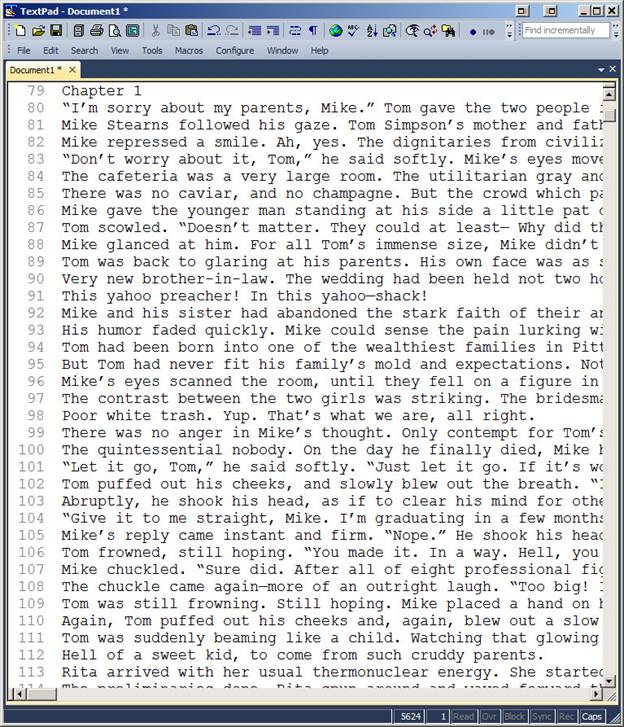
What I normally do is turn on word wrap, so I can see the whole paragraphs as I go. So it looks like this:
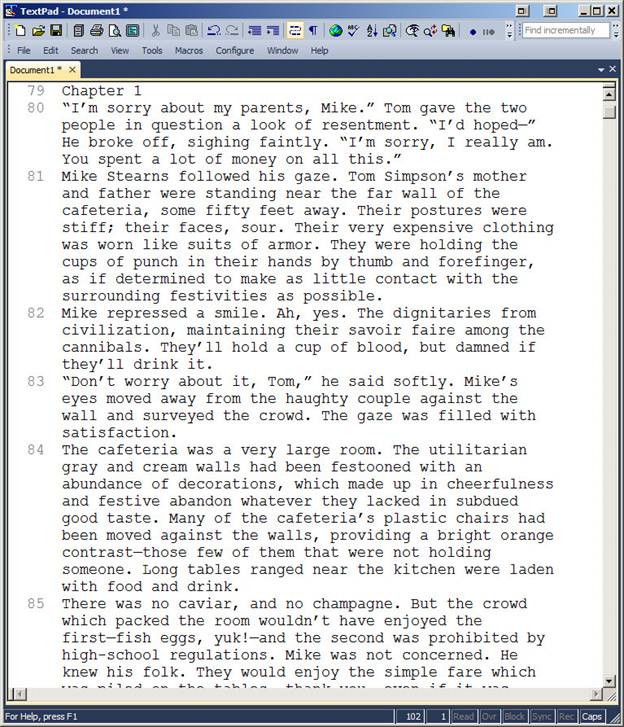
Now, we go hunting. The next step is to set up the search pattern using a regex. The one I use for this is the following: (?!^([^“”\r\n]++|“[^“”\r\n]*”)*$)^.+ Complicated little brute, isn’t it. I didn’t write it, but I knew who to ask if he could write one, and the above is the result. FYI, there’s also one for straight quotes: (?!^([^”\r\n]++|”[^”\r\n]*”)*$)^.+ You use it the same way. So go into find, and put the regex into the “Find what:” box:
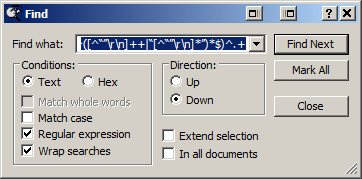
Notice that the “Regular expression” box is checked. I also “Wrap searches” just in case I miss something and want to loop around. Click “Find Next” and:
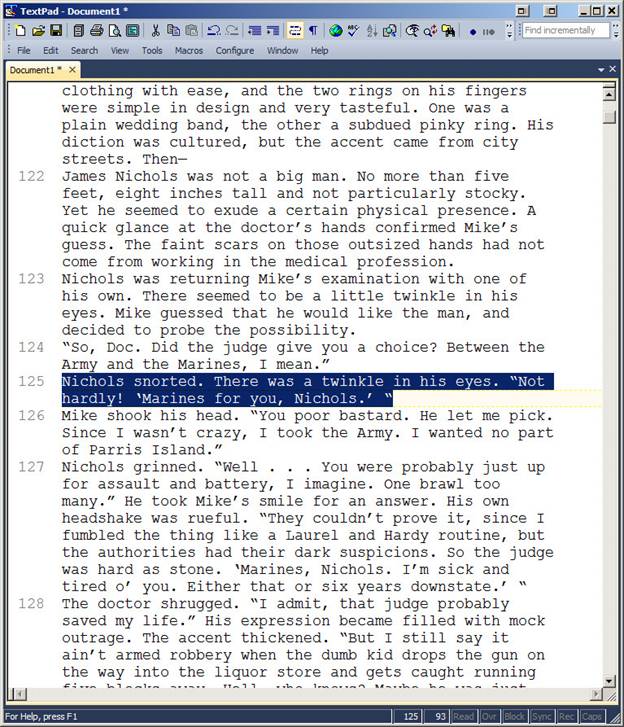
The paragraph highlighted has two opening quotes, one at the beginning and one at the end. Word assumes that a quote preceded by a space is an opening quote, so you need to correct it in your RTF/DOC. Wash, rinse, repeat. You keep doing “find next” all the way through, checking for situations like the following:

As I said, same speaker, next paragraph, so this one is good. This post is getting a little long for a blog entry, what with illustrations, so I’ll break off here. Stay tuned for part two: checking spelling and spelling consistency. In the meantime, here are the RegEx tool commands plus a few bonus goodies: RegExToolCommands.
From Russell Blake.
This does not represent the only way to do things, but it’s my way, and is the synthesis of everything I’ve learned over the last 23 months of self-publishing:
1) Pick one genre that’s popular and with which you are extremely familiar, and then write in that genre. Stick to it. Don’t hop around. It confuses your potential readers and muddies who you are in their minds, and will hurt your sales. If you want to write different genres, use a pseudonym, and if you like, let your readers know that moniker is you. But stick to one name, one genre, because you’re building your brand, and brand building is a function of clarity – clearly communicating what you do, and what your product is.
2) Write a series. Why? Because readers like series, and you want to give readers what they like. Or you won’t sell as much. You can try stand-alone – I have – but my series outsell my stand-alone books 4 to 1. Once you have at least three books in the series, make the first one free. Earn your income from the rest, but give readers a whole novel to decide whether they like you or not.
3) Write a lot. By that I mean try to write at least 3 novels a year. Don’t bother with short stories or novellas (40K or under) if you’re writing fiction – erotica, romance and non-fiction reportedly to do better with short form, but I don’t know from personal experience. Write 60-90K installments in your series, and release them AT MINIMUM every four months. Every three months would be better. Every two, better still. Momentum breeds success, and readers have short memories. The current market is a hungry animal, and you need to feed it, or risk being forgotten by the time your next one releases. Sorry. It’s the truth. And don’t start whining about how X famous author only puts out one book every Y years. If you’re Dan Brown and you sell tens of millions of novels each whack, then do whatever the hell you like. If you aren’t, listen up, or chock your strategy up to, “Become the next Dan Brown” and stop reading this drivel.
. . . .
5) Allocate time every day to write, and be disciplined. I suggest minimum one hour per day, or 1000 words. I actually ignore that and shoot for 5000-7000 a day when writing a novel, but that’s just my approach, and it’s not for everyone. My point is that you must be disciplined about your writing and develop that muscle. If you don’t make it a habit, you won’t write enough to put out one novel every four months, and you’ll already be way behind the curve.
6) Allocate time every day to market. I recommend a 75%/25% writing to marketing mix. So spend an hour writing every day, and fifteen-twenty minutes marketing (social media, blogging, interviews, message boards like this). Two hours writing, half hour to forty minutes marketing. And so on.
. . . .
13) Price competitively and intelligently. Look at your genre. Where are most books priced? Are you undervaluing/underpricing your work? Price to sell, but don’t go cheap, no matter what Locke or Hocking did years ago. Use low prices occasionally to move product, as promotional pricing. But price your product consistently with the rest of your peers. Over time, you can increase prices, if your product warrants it and your readership is willing to pay it. My advice here is don’t price too low, or too high.
. . . .
19) Have realistic goals. Look at what the average person does in their first year, and their second. That’s average. It ain’t pretty. If you want to be different than average in a good way, you need to do something better/different, and you need to make your own luck. Don’t get bummed because you haven’t been an overnight sensation. I sold $300 of novels in November, 2011, after six months of 15 hour days and seven releases. In December, 2011, I released five novels I’d been working on for months, to create a massive Xmas surge. I leaped to $1450. With a dozen books out. That’s not exactly a ton for the big Xmas season. But I continued writing as though my work was in hot demand. And I kept investing in my product, losing money, until it turned the corner and I started making decent money in Jan of 2012.
20) Book selling is a retail business, and retail businesses are promotions intense. You’re only going to be as good as your last, and next, promotion. Promotions are a necessary fact of life in retail. You have to generate noise – the product won’t do it by itself. There are millions of books out there. Yours are just more books. Figure out how to get some visibility. I won’t advise you on how – there are plenty of ‘experts’ that will charge you $5 for a book on what worked two years ago. Simply put, it’s constantly changing, so you need to experiment and push the envelope, share information with others and stay ahead of the curve. But if you aren’t promoting, you’re stalling. In business you’re either shrinking, or growing. If you aren’t promoting, chances are you aren’t growing.
There are 28 tips in all at “How to Sell Loads of Books.”
From Russell Blake.
I get a lot of emails from authors who are just starting out, or who are on the road but frustrated at the level of success they’ve seen thus far. I wish I had more time to correspond with everyone, but the truth is I’m usually slammed with writing/publishing related tasks, and don’t have a lot of opportunity to do more than offer a brief sentence or two.
But the last few missives I received got me thinking about what I wish someone had explained to me before I started self-publishing in June, 2011. So here’s my top 10 list, such as it is:
1) There are lots of talented writers out there. Lots. And it seems like everyone’s now got a book, or books, on Amazon. Being good isn’t enough to guarantee you anything but satisfaction for a job well done. It should, but it doesn’t. Don’t take it personally.
2) There are lots of crap writers out there. Lots. And while many sink to the bottom of the swamp with nary a whimper, some sell well, and some even become bestsellers. This is because the world’s unfair and, depending upon the genre, oftentimes readers don’t care much whether they suck or not, as long as the story entertains or reaffirms some conviction or bias the readers have. These authors succeed in spite of their abilities, rather than because of them. Don’t take it personally.
3) The internet is filled with gurus who know nothing. It’s hard to turn around without bumping into a writing or self-publishing expert. Most of them are completely full of shit, and don’t sell many books – but that doesn’t stop them from trying to get you to part with your money to hear them tell you what you need to do to sell well. Whenever you hear advice, consider the source. If it’s a million selling author, that means more than from someone whose work ranks slightly lower on Amazon than the collected love poems of Adolf Hitler in original German. Seems like everybody but me is selling seminars, courses, or how to books that promise much and deliver nothing. Must be a good business there, but I prefer labeling my fiction as such and putting in a car chase or gunfight rather than trying to trick the dim or desperate out of a few bucks.
4) You need to be able to put out books at a decent clip. Sure, you might hit huge off one, but probably not. You’ll be building your readership the hard way, which means one reader at a time, and the more quality books you have on your virtual bookshelf the more likely one will catch someone’s eye. This doesn’t appeal to a lot of authors’ wish that they could write a book every year or two and have a nice living. Sorry. I have yet to see that happen. But it’s a seductive siren song, so lots of newbies listen to it like it’s still a viable way to go. In self-publishing, not so much.
More at “10 Things I Wish I’d Been Told”.
I know, I know. Stop making blog posts, John, and finish CURSE.
The top two factors driving book sales both stem from having a loyal customer base. Building that base is the goal as it is in any business that depends on repeat customers. In a previous post I outlined these parts to building that base.
In this post I’m going to share some thoughts on #3.
So how do you entice someone new to give you a try? There are a lot of things I see that play into that: a great cover, description, sample chapters, and reviews that all say quality and scream genre. But there’s another huge factor to making something enticing. And that is price. Or rather price vs. perceived value.
I’m looking at Mark Corkers reports from Smashwords.
I’m looking at slides 65-69. I know many of us have seen them.
If the patterns are similar at Amazon, which sells more ebooks than anyone else, then a price of $3.99 on average will sell more than double the copies of $6.99.
$3.99 means MORE readers who might develop some level of loyalty, MORE word of mouth, and it means MORE revenue than at other price levels.
It means more than double the chances of getting your stuff in front on an influencer.
More than double the chances for luck to come into play.
And those odds grow exponentially.
And, again, all along the way that price earns you more than if you were pricing at $6.99 or $9.99 because you sell more books.
Of course, these are averages, which means folks are winning at prices above and below this. Furthermore, it’s not the same across genres. For example, it appears romance tends to sell better towards the lower end of the range Corker shows. But it clearly shows that price is an important part of enticing a reader to give you a try.
And when I look at the indies who are selling huge numbers and have built their customer base, the vast majority of them seem to have gotten there by tapping into the market forces Corker shows on these slides.
That doesn’t mean they price all their books the same. Some are doing very well using a loss-leader/sample strategy where they offer the first book in a series for 99 cents or free. This also doesn’t mean they set their price and forget. it. They seem to do just the opposite, experimenting with different prices. I noticed the Joe Konrath, who became a mega-seller at $2.99, raised his prices to $5.99 recently. He’s dropped them back down to $2.99 and $3.99. But he was clearly testing something. In an interview earlier this year with Simon Duringer, Russell Blake who is doing very well in the thriller category recently said this.
Probably the most effective thing I did over the last two years other than Select, which came and went in terms of usefulness, was making the first book in my JET and my Assassin series free. That lowered the barrier to giving my work a whirl to nil, and my readership exploded from there. About a month and a half ago I stopped doing that because I saw my conversion rates were averaging about 12-13% from the first to the second book, and I questioned whether, with, say, 500 downloads a day, and seeing 60 sales of book two, it might not be more desirable to get 70 paid sales of book one, and seeing that same 60 on the conversion (because if someone pays for your first book, they’re probably going to read it, and soon, whereas if they get it free, it could take years, or more likely, never happen). So far so good.
Clearly the folks who are doing well with this are experimenting with price to see which levels maximize revenue and loyal customers. And I think that’s the key. They are looking at what seems to be working for others, experimenting, and basing decisions on results.