Edward Bear Shares His Proofreading Secrets

One of the things I enjoy about being an author are the emails I receive from readers. A few months ago I received one from Mr. Edward Bear. He’d purchased Servant and, as he was reading, found an unclosed dialogue quote.

Mr. Bear could have simply noted it and read on. But he did not. Mr. Bear is a proofreader. And so he practiced a bit of wizardry, found that I had a handful of quote goofs, and emailed them to me.

Many of them ended up being weird smart quote issues Word introduced into the text when I broke a line of dialogue with an action like this: “You will not”–he scratched his nose angrily–“share another pair of my panty hose with that woman!”

You’d think that would be enough for a doughty reader. But Mr. Bear didn’t just notify me of the errors. Oh, no. He also included the page from his proofreader’s grimoire that allowed him to find those quote issues in a matter of minutes in the first place.

As soon as I had the time, I tested the spell on Bad Penny, and, voila, in a matter of a few minutes found a couple of issues in that text. I was delighted.

But Mr. Bear wasn’t satisfied with mere delight. He then sent me another page from that grimoire to help with spelling. We luvs wizardly readers, Precious.

Copy editing and proofreading require patience, painstaking reading, and a knowledge of what to look for. You have to know not only the mechanics of the written word (capitalization, spelling grammar, syntax, punctuation, abbreviations, usage, etc.) but also, if you’re reading for a printed edition, interior formatting (widows, orphans, word or hyphen stacks, headers, and so forth). There’s a lot to it. And anything that speeds up the process and minimizes errors is welcome.

If you’re contracting your proofreading out, a cleaner copy can also translate into lower rates. Knowing that many of you who visit this website are writers, and because your host’s generosity knows no bounds, I asked Mr. Bear if he might be willing to share his wizardry with you. The wizard responded with a yes.

Augmented Proofreading 1

By Edward Bear I’m Ed Bear. I work, both professionally and otherwise, as a proofreader. I’ve gone over books for my publisher and I’ve done scan/OCR/check against paper books for republication, both electronic and back-to-treeware. When I mentioned some of the “ancillary tools” I have for aiding the work, John offered me this guest post slot in his blog. Feel free to pass this stuff around. I’ve found these techniques invaluable in getting the job done faster, and with better quality.

First, though, I need to tell you about the tools themselves. The biggest component is the software for electronic text editing. However, I’m NOT talking Word or anything like that. I’m talking about an editing program which can a: work with plain text and b: handle Regular Expressions. (What are those, some of you ask? I’ll get to that.)

Since I’m a windows user, I have two such programs available. My favorite is a program called TextPad (www.textpad.com).  I’ve used it for years and it’s become invaluable to my work. They currently charge $28 for a single user license, but IMO, the program’s so useful that, even though upgrades are free, I buy another license every time they bring out a new major release. The other program is free. It’s called NotePad++ (http://notepad-plus-plus.org/) I’ve tested it and it can handle the methods I use, but I haven’t used it much, since TextPad and I are long-time buddies. If anybody out there knows a program for the Macintosh which will do these jobs, please mention it in the comments.

Regular Expressions

You don’t have to be a wizard to use them. The tutorial over at http://www.regular-expressions.info/tutorial.html describes them elegantly:  “Basically, a regular expression is a pattern describing a certain amount of text.”  They are also called a regexp or regex, and I’ll be including the regexes I use in this post.

I have a small library of regexes, and two of them are critical to aiding the proofreading process. One of them allows checking dialogue quotemarks, to insure that speech is properly closed off, and the other makes it possible to generate a word list of each unique word in the  book. I’ll be walking through the usage, including screenshots.

Quote Checking

One of the challenges of checking dialogue passages is that, with one exception, every opening quote (“) needs to have its matching closing quote (”). The exception, of course, is when the same character is speaking in the next paragraph. This can lead to a heavy false positive load if the characters are loquacious.

The first time I tried this stunt, I found  73 paragraphs with unbalanced quotes. Only 6 of them were errors. But being able to find them quickly so they could be fixed in minutes instead of hours? That paid for the effort.

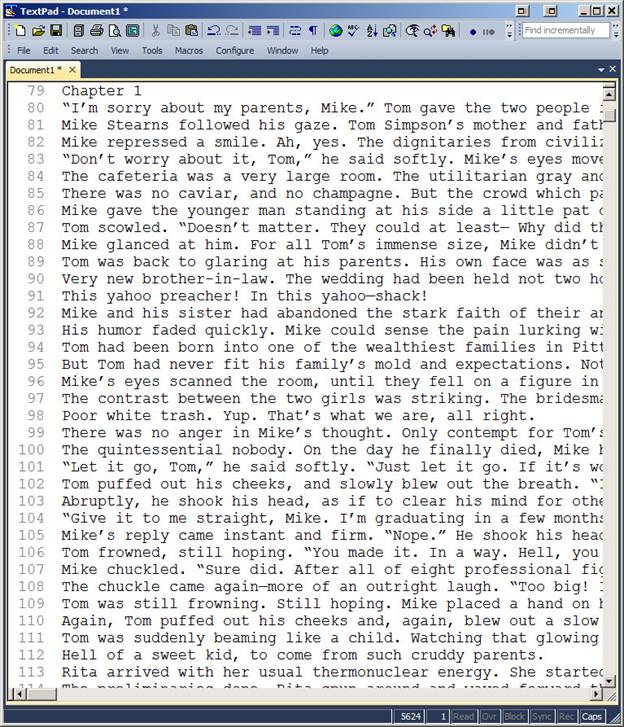
The process itself is simple: You take the document and convert it to plain text. If it’s an RTF or Word document, you simply select ALL, hit copy, and paste it into Textpad.  The result will look something like this:

image001

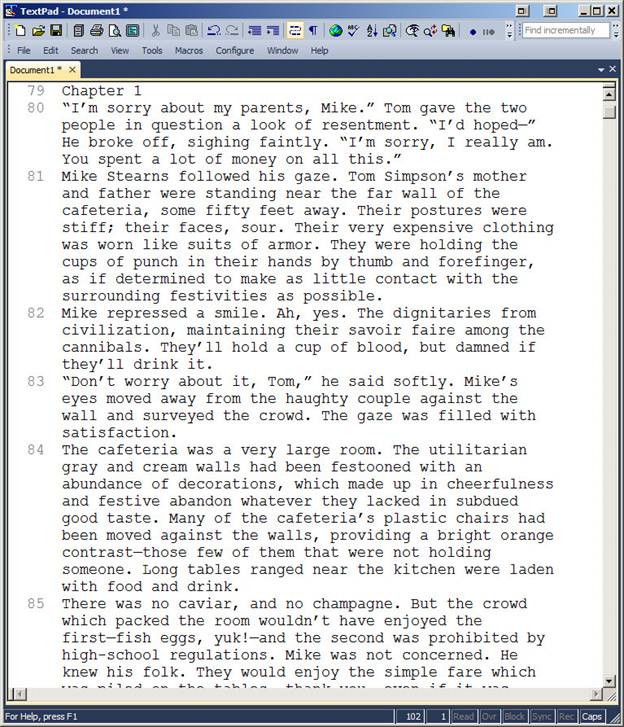
What I normally do is turn on word wrap, so I can see the whole paragraphs as I go. So it looks like this:

image002

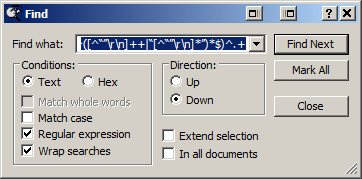
Now, we go hunting. The next step is to set up the search pattern using a regex. The one I use for this is the following: (?!^([^“”\r\n]++|“[^“”\r\n]*”)*$)^.+ Complicated little brute, isn’t it. I didn’t write it, but I knew who to ask if he could write one, and the above is the result. FYI, there’s also one for straight quotes: (?!^([^”\r\n]++|”[^”\r\n]*”)*$)^.+ You use it the same way. So go into find, and put the regex into the “Find what:” box:

image003

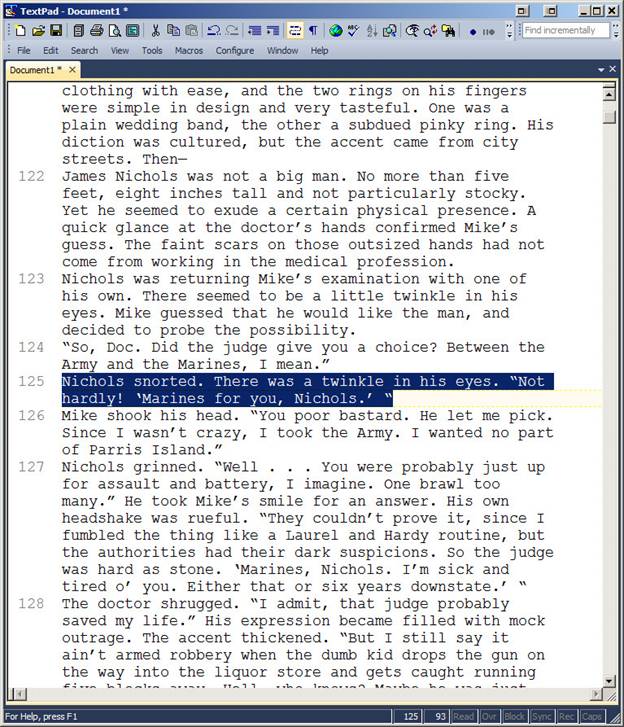
Notice that the “Regular expression” box is checked. I also “Wrap searches” just in case I miss something and want to loop around. Click “Find Next” and:

image004

The paragraph highlighted has two opening quotes, one at the beginning and one at the end. Word assumes that a quote preceded by a space is an opening quote, so you need to correct it in your RTF/DOC. Wash, rinse, repeat. You keep doing “find next” all the way through, checking for situations like the following:

image005

As I said, same speaker, next paragraph, so this one is good. This post is getting a little long for a blog entry, what with illustrations, so I’ll break off here. Stay tuned for part two: checking spelling and spelling consistency. In the meantime, here are the RegEx tool commands plus a few bonus goodies: RegExToolCommands.

Share

Similar Posts

  • Generating Story 5: Hunt Zing

    Even after you choose a genre, you still need to develop ideas for character, setting, problem, plot, and text.

    What do you do? How do you develop those ideas?

    The first thing you do is hunt zing.

    Feeding the beast

    Zing is any idea that turns you on, sparks your imagination, or stokes your desire. Zing tingles your cool meter. Dude, yes, ah, oh baby, man-o-man, great oogily boogily–these are all common responses when you come across these types of ideas.

    Most zings are small tingles. Sometimes they’re zaps. Rarer still are the freaking gigawatt monsters that shake you about and leave you breathless. But I’ve found I can’t wait for those. Or maybe I should say that they often come only after I’ve caught smaller prey.

    Your imagination is a beast. Feed it and it will get up and terrorize the neighborhood on its own accord. Starve it and it will lie there like a gigantic dust mop and gather flies.

    Nothing in, nothing out.

    YOU MUST FEED YOUR IMAGINATION!

    Some of us might feel we don’t have much to feed our imagination. Most of us are not Ann Franks or CIA agents or little old ladies caught in terrorist plots. But we don’t have to be.

    I once taught teen writers workshop where we met one day each week for three weeks. During the first class I introduced zing and told the students they were to hunt for 10 zings each day.

    They were dismayed. They groaned. Ten? Was that possible?

    The next week all of the students came back bubbling about all the things they’d found. One of them said it had changed things for her: her world which had been relatively hum-drum was suddenly filled with the cool. The other students agreed.

    We all are limited by what we can perceive and focus on. Our working memories are so small. And so it’s easy to focus on so many mundane business-of-life things and miss the wonderful show of lights that goes on around us.

    This is what hunting for zing does for you. It quite literally changes your world.

    Be a hunter.

    Capture the zing.

    This is the first step. You have to gather interesting material. Lots of it. Which means you must turn your zing sensors on.

    What do I mean by this?

    Open your eyes and ears and heart. Be on the look out. When something cool comes along, capture it. Use scratch paper, the back of a receipt, get a notebook, a folder file, a camera, a sketchbook. Just capture it when it comes. And it will come.

    Most of the ideas are never used, but unless you capture them, i.e. notice them, you won’t get the ones that do develop into something special. For many of us writing them down is the way to really give them the attention they need. I promise you: these little scraps and snippets have a way of combining at the oddest moments, and suddenly you have more than an itty-bitty old zing, you have a freaking power plant!

    The Drag Net

    Having your sensors on is like deploying a drag net—it catches whatever swims into it. One of the benefits of this is that you get ideas you’d never in a million years come up with on your own. Here are some random things I caught in my drag net.

    Some people actually raise chickens in their apartment (from a book I happened to pick up while browsing a section of the library).

    Hum, what if my character’s neighbor does that? What if it’s his kooky sister? Maybe his wife decides they need to be more self-sufficient. Or maybe she’s told a neighbor she’d take care of her chickens.

    A girl was sold to cover her father’s debts (while reading an article about ancient history)

    Could that happen today? How would that work? What if it was someone else kidnapping a girl to pay off debts?

    “The monkey, which costs $15,000, is what Truelove envisions as the ultimate SWAT reconnaissance tool. Since 1979, capuchin monkeys have been trained to be companions for people who are quadriplegics by performing daily tasks, such as serving food, opening and closing doors, turning lights on and off, retrieving objects and brushing hair. Truelove hopes the same training could prepare a monkey for special-ops intelligence.” (From an online newspaper that’s sent to me each week)

    A SWAT monkey? Come on! Could this primate be put to nefarious purposes? What if he stole something incredibly valuable? What if a major thief uses them? What if it’s a boy in the neighborhood?

    There’s a guy who lets his toenails grow to horrible lengths; they look like claws. It’s incredibly disgusting (Something a friend said about one of his friends in an email)

    Does your main character have a partner? Someone they work with in the office? A mate in their medieval army squad?

    GARDEN GROVE (CBS) — An Albertson’s supermarket on Harbor Boulevard was evacuated Monday after a burglary suspect fell through the ceiling to the ground near a cash register.

    What if that’s your main character? What was he doing stealing copper? Maybe he was forced to?

    Headline in Daily Mail Reporter: Ghurka kills 30 Taliban. ‘I thought I was going to die… so I tried to kill as many as I could’: Hero Gurkha receives bravery medal from the Queen. Corporal Dipprasad Pun defeated more than 30 Taliban fighters single-handedly.  Used the tripod of his machine gun to beat away a militant after running out of ammunition.

    Could this be used as a scene in the story? What about the tripod business?
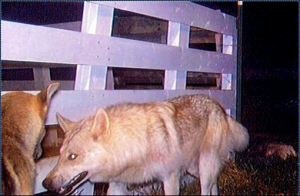
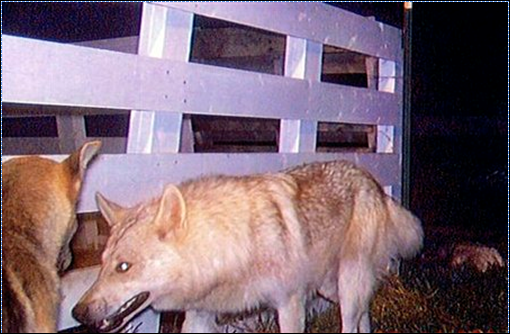
    In this May 2011 security camera frame grab provided by the Stevens County Sheriff’s Office, dogs are seen at the home of a resident near Deer Park, Wash. A pack of dogs has killed about 100 animals in the past three months while eluding law enforcement and volunteers in northeastern Washington state. The killings are happening in a wide area of mountains and valleys west of Deer Park, a small town about 40 miles north of Spokane, authorities said. (AP Photo/Courtesy of the Stevens County Sheriff’s Office)

    What if these guys are roaming the neighborhood where your character lives? What if it’s a fantasy story and these are not just dogs? Are they bewitched? Trolls? Something come in from the woods?

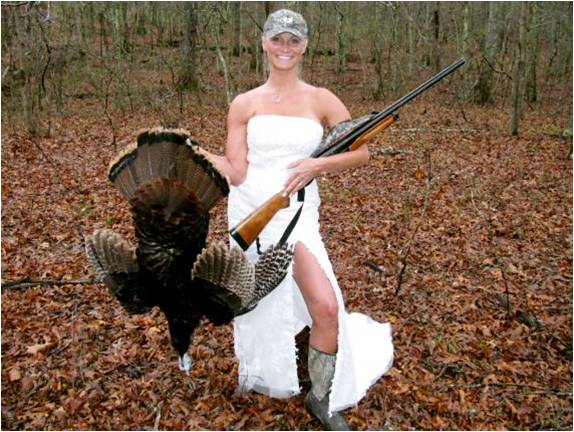
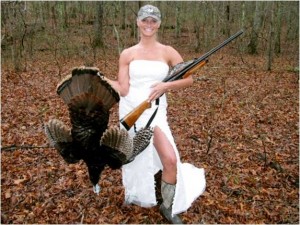
    As far as pictures go. How about this gal? Would she fit in a romantic comedy? A murder mystery? What if she went missing? What if someone kidnapped her son?
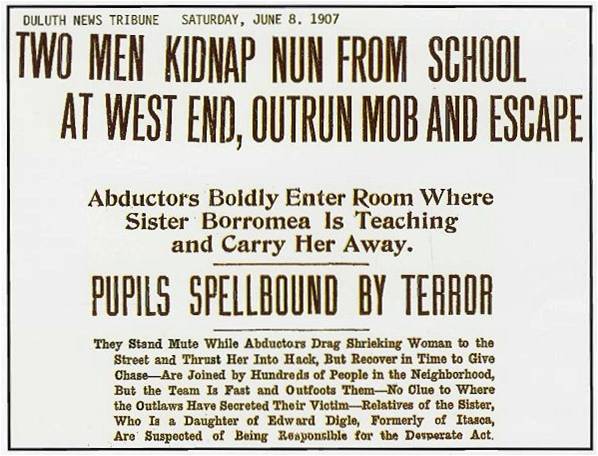
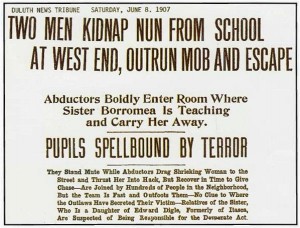
    What about this newspaper clipping? Click on the image and read the fine print.
    All you have to do is start asking questions of these zings and they can’t help but produce character, setting, problem, and plot.

    Deploy your drag net.

    Do it now.

    Hunting With A Purpose

    Even though your drag net is out, you cannot rely on it to deliver all the ideas you need. Very often you need to go hunting with a purpose. In fact, whenever you have development objectives, you’ll be on the lookout for that thing you need to develop.

    Let’s say you want a funny and new fight scene in your story. Look at the stuff above.

    • A fight including that gal in the wedding dress?
    • One in the space the copper thief fell from?
    • How about one in a chicken apartment?

    Maybe you need a new love interest.

    • What if she’s the copper thief?
    • What if she’s out hunting the wild dogs?
    • Maybe he’s the guy who kidnapped the nun?

    Do you see? When you have a purpose, you look at the things you come across with a different lens.

    But you might need to be a bit more active in your hunt. You might need to do some things to find what you’re looking for. I’m talking about directed research.

    An Example

    I attended Orson Card’s literary boot camp. He had us take a day and develop five story ideas (or seeds) which we were to write down on ONE side of a 3×5 card (hum, sounds a bit like the story setup we talked about in the previous blog).

    2 of the cards were for story ideas we developed from research conducted at Barnes & Noble or in a library

    2 were for ideas developed from a drag net of events or curious things I saw that day

    1 card was for an idea developed from an interview with someone.

    The assignment was to look at things as a writer, to exploit what I see as a writer. On the card we were to tell a story. The fundamental idea–what happens and why. Just the idea and some events. The space limint on a 3×5 card forces you to think of story and NOT the writing.

    Oh, and the research was supposed to be for something we didn’t find interesting, which meant we didn’t know squat about it.

    I researched Iroquois Indians, women who did crazy things like going over Niagra Falls in a barrel, and some other crap I can’t remember. I also read a bit about an American Indian in 1614 who was stolen as a slave, taken to Spain, got his freedom, went to England and then back home.

    I interviewed two women in a music box shop and worker in a Thomas Kindcade art gallery. The gallery gal was blonde and rode Harleys. Had tattoos. What in the world was she doing in a THOMAS KINCADE gallery?

    I used the Elizabeth Smart poster (abducted girl) and an empty music box as my curious things.

    I worked from 5PM until 9PM on the ideas and never really got anything. Went up on a hike up Rock Canyon still thinking about it. Saw a cave; evening came; the canyon was beautiful. Marvelous. Almost stepped in a snake. Worked and worked on the music box idea and the kidnapping idea. More on the music box.

    No ideas really pulled me.

    Next morning I woke at 6 AM and started thinking. Decided I had no time AND I WOULD HAVE TO FOLLOW NELLIE’S [my wife] ADVICE and simply go with what I had. I made a decision and go with it even though I didn’t really feel it inside.

    During class, someone else talked about bone magic. It was cool! I stole the bone magic idea and crossed it with the Iroquois stuff I’d looked at and suddenly started liking my story a whole lot more. Decided the tribe that lost their only bone breaker (that’s how the magic was obtained) in a raid (he was sold to the French as a slave) and sent out a woman who knew French and a warrior to retrieve him.

    The next day I was supposed to write the story. I found I didn’t really want to write that one. Spent all day at the library reading juveniles and encyclopedias on Iroquois and Eastern Indians. Read for 5 hours then began to try to write.

    Now, let me stop here.

    Through my directed research I had collected gobs of zing. There were Indian names like “Handsome Lake” and “He Who Keeps Them Awake,” the fact that the Iroquois had a peace sachem (leader) and a war leader. The peace leader was a woman and chose the male war leader. I had stories about abducted Whites and Indians being sold into slavery and escaping. I read about men purchasing Indian wives. I added tidbits I knew from the Netherlands and Bible. It went on and on and on.

    I had TONS of cool material to work with because I’d actively gone on the hunt for it.

    If you look back as the example I shared about the golem story in the previous post, you’ll see I researched golems and Croatia and found TONS of cool material. I added to that other tidbits I already had. And the result was massive zing.

    So what happened with that Iroquois story?

    Well, I finished it, and it went on to sell multiple times. It’s called “Bright Waters”. Here’s how it starts. But the thing to remember is that it all started with the directed hunting for zing.

    Bright Waters

    In the spring of 1718 Jan van Doorn returned to his log house with a load of molasses, flour, and a fine green dress for his new wife. He found she had run out on him and taken half of his goods with her.

    She was the second wife he’d bought. And the second one to run away before a season was out.

    Her name was Woman With Turtle Eyes, an older Huron of 23 years. He had thought an older woman would be more stable than the girl he purchased the first time. Besides, she said she wanted him to buy her.

    Jan didn’t understand how the men in the settlements courted and kept their women. And it couldn’t be because he was ugly. He’d seen plenty of ugly men marry. The only ones that seemed to have any interest in him were the whores at Fort Montreal, and when he’d given in to his urges that one cursed time, they took far more from him than his money.

    There was nothing to do about Woman With Turtle Eyes. If he hunted her down, she’d just run away again. He could beat her, but she’d run nevertheless. Besides, her theft meant he’d have to start working his old claim, and there were precious few weeks before the beavers began to shed their winter coats. No, there was nothing to do but fold up the dress and put it in the cedar chest.

    He looked down upon the dress for a few moments admiring the fine, shimmering cloth. Then he closed the lid.

    That night Jan cooked himself a meal of kale and old potatoes. When he finished, he rubbed deer urine onto his traps to prepare them for the morrow. Then he went to bed.

    Remember: zings are almost always small. Don’t be looking for the ONE killer idea. Usually the killer story is made up of a bunch of smaller zings.

    “What generally happens is that I’ll be reading up on some topic just for entertainment — spies, pirates, the Romantic poets, mountain-climbing — and I’ll notice a few indications that the situation might do as the basis for a novel. At that point I declare that this isn’t recreation anymore, it’s research. So I start reading lots of books and articles on the subject, even if they’re not entertaining. And I follow any side-paths that show up — for one book, Tarot led to Poker which led to Las Vegas which led to famous gangsters. And while I’m reading all this, I’m looking for bits that are “too cool not to use.” When I’ve got a dozen or so things that are too cool not to use, then I’ve got — obviously — a dozen elements of the eventual novel.” ~ Tim Powers

    Your Zing, Not Mine

    Again, you don’t want any old idea. You want good ones. So how do you recognize a good idea?

    YOU FEEL IT!

    Good ideas carry current, they spark your interest, they tug your heart strings, they turn you on. This is what I’ve learned: a good idea is like an electric jolt. Sometimes it’s very small, sometimes it’s overpowering. It’s the feeling of “cool,” “whoa,” or “oh, boy, this has possibilities.”

    But notice I said they spark your interest.

    You’re not looking for what turns me on. For you to write a story, you have to follow your zing, not mine or your friend’s or your mentor’s.

    The trick is finding your zing and then sharing your zing with people who have similar tastes.

    Where to find zing

    There are a few places where I seem to find TONS of zing. Maybe they’ll be productive for you.

    Source 1: Other stories

    I get an unlimited supply of ideas from other stories. Here are a number of sources.

    • The news
    • History
    • Friends and acquaintances
    • My past
    • Strangers
    • Scripture
    • Gossip
    • Fairy tales
    • Poems
    • Movies
    • TV programs (fiction and non-fiction)
    • Summaries of actual court cases
    • Novels
    • Magazines
    • Biography
    • Interviewing a relative or friend for their life story

    Source 2: Snippets of life

    Every week I run across interesting conversations, lines, facts, events, images, and people. These things aren’t stories but they can be used to enhance or generate one. In fact, part of the joy of writing is finding ways to incorporate the cool things I encounter into the current story. There are many places where I find these snippets of life:

    • People I know or talk to
    • Science
    • History
    • Poetry
    • The Discovery Channel and its many cousins
    • How-to books, videos, tapes
    • Current or historical issues
    • Books on how people used to live
    • Photographs of other lands and cultures
    • People I see (The hero of my Writer’s of the Future story was based on a transient I picked up one night who lived in a storage space at the town’s used bicycle shop)
    • Learning about other people’s professions
    • Trying new things

    Source 3: Research

    This is just another way of coming across stories, facts, events, people, and trying new things, but it’s more directed.

    • Do it
    • Visit it
    • Talk to those who have done it or been there
    • Watch movies about it
    • Read about it, starting with Juveniles & Encyclopedias and then moving to thicker texts

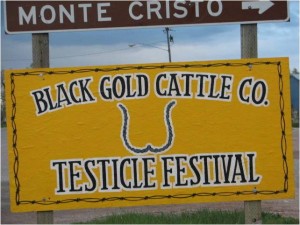
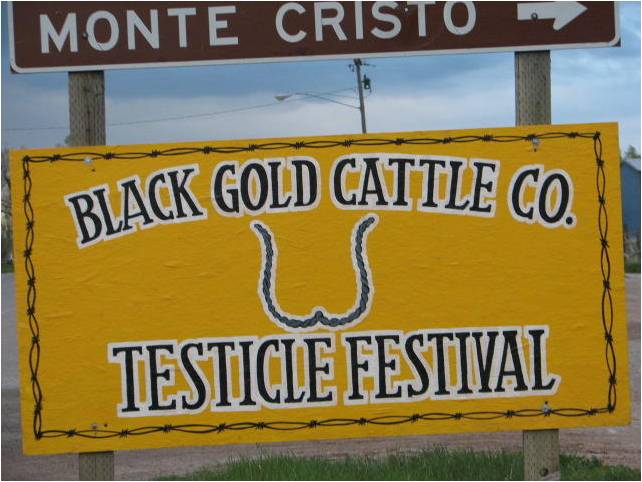
    When I moved up into the hinterlands of Utah, I found out they had an annual local testical festival. As a regular joe I might have gagged and moved on. As a zing hunter, I couldn’t afford to do that.

    No, they do not taste like chicken.

    They do taste like something many people find delicious. But I’ll let you identify what that is with a little research of your own.

    When you get a chance to try something new–try it. You get marvelous details, wonderful ideas. And you just might find you enjoy life a little bit more. Or at least be grateful you’re not trapped in a coffin.

    I was writing a scene for one of my books, where a secondary character accidentally locks himself in a casket. Not having experienced such a tragedy, I began winging that thread on imagination alone. But the scene simply wouldn’t jell. When I finally finished the first draft and read it, it felt two-dimensional. So I wrote it again. It still stank. By the third draft my frustration level had peaked, and I shoved my chair away from the computer, knowing there was only one solution to this two-dimensional problem. I would have to experience it. Now you would think a logical person would take into consideration that the number of readers who’d actually been trapped in a casket was minimal enough to make the whole issue moot. Then again, we’re talking about a rational person…I’ll tell you, I’ve pulled some crazy stunts before, all in the name of research, but this one ranks in the top three.  ~Deborah LeBlanc

    Nobody can copyright an idea or technique

    Don’t worry about stealing ideas from someone else or using a technique you find in another story. Don’t worry that something’s already been done. What you want to avoid is copying the writing. But take any idea or technique and run with it–in your own direction. Remember: The Terminator & Back to the Future have the same premise but are two totally different stories. So go wild.

    Be a hunter.

    Capture the zing.

    Start gathering your writing material today.

    For more in this series, see How to Get and Develop Story Ideas
    Share
  • Generating Story 2: No Clue, No Solution

    I want you to think about Ed Smylie, who helped save the Apollo 13 astronauts with his duct tape contraption. What if the authorities had come to Ed, but instead of saying, “Look, we need to fit the round CO2 scrubbers into the holes for the square ones,” they’d said, “We want you to do something; it involves thinking.”

    Ed would have blinked. Waited.  “Yeah?”

    “That’s it. Something. A lot is riding on this.” And then maybe they urged him on with a significant wave of their hands.

    Can you see Ed at this point?

    “Sure.” He’d say. “I’ll get right on that.” Then he’d wonder who put these guys up to this practical joke.

    Do you see how impossible it is when you frame things that way?

    To come up with solutions, you have to have a clue about what it is you’re trying to do. Even if it’s just a rough idea. It doesn’t matter if you’re trying to fix a space ship, roast hotdogs, or write a story.

    Once we have a rough idea of what we want to accomplish, the mind automatically kicks into gear to perform its wonders. Until we do that, we’re going to be like Ed in the example above—staring at a blank wall, wondering if our superiors aren’t a bit cuckoo.

    So what are we trying to do?

    Think about your reader. Is it a woman? A teen? A crazy dude? Do you remember my book tour with Larry Correia in 2009 and the guy who, during a booksigning / doughnut party at a Phoenix Barnes & Noble, proclaimed my book to be true?  Aliens really were eating our souls and enslaving humanity. They were lizards living in the hollow portion of the earth.

    The point is: what are your readers hoping your story provides them? In fact, since you’re the first audience, what do YOU want from your stories? Why do you read?

    I want you to write down five stories you really like. Movies, TV shows, novels, short stories, plays—I don’t care the genre or type. Just write down five. Do it now. Here are five random stories I like.

    • The Incredibles
    • The Good Guy by Dean Koontz
    • Hunger Games by Suzanne Collins
    • The Sound of Music
    • Runelords by David Farland

    This is going to be a powerful exercise for you. It was for me the first time I did it in a class on interior design.

    A few years ago, Lovely Wife and I were building a house. We wanted to make our living space sing. We wanted our surroundings to make us happy, but we didn’t quite know how to go about doing that. So we took a class on interior design, hoping to learn the principles involved.

    Except when we showed up in the first session and saw the many different design styles, it overwhelmed us. Some styles were ethnic (Southwestern, Asian, French, Gothic, Pygmy), some philosophical or religious (Zen, Feng Shui), many were artistic (Modern, Arts & Craft, Minimalist, Art Deco, College Room Mate ), a lot were mixtures. Some were about making statements and creating moods, some about practicality (here’s a taste of those styles).  How in the world were we going to learn this?

    Luckily, we had a very perceptive teacher. She knew that most of us were there, not to learn all the styles, but to decorate our own houses. So in our second session, she brought dozens of home magazines. She spread them out on the tables we were sitting at and told us we would go through the magazines. When we found a picture or image we liked, we were to rip that page out and put it in our personal stack. So for about 45 minutes we looked and ripped and looked and ripped. Lovely Wife and I each ended up with a pile of a few dozen pictures.

    Then the teacher told us to spread our pictures out in front of us and look for things that the images had in common. Colors, features, design elements.

    I spread my pictures out. Lovely Wife spread out hers. And it was like magic. Boom! Right there in front of us. I loved arches and eyebrow windows. Loved dark blues and purples mixed with creams and whites. Loved the color of blond wheat and a navy blue sky. I loved wood. Loved Arts & Craft with a few tweaks.

    Lovely Wife’s pile was equally revealing.

    The teacher then said, “This is your personal style. This is what’s going to make you happy.” She told us that when designing the rooms in our house, that we should think about their function and merge them with these elements. And if any of us were to work with clients, we’d do something similar with them and find out their wants and likes.

    With our styles now beginning to be fleshed out, Lovely Wife and I went to work. Some of her elements and colors overlapped mine. Some didn’t, like her idea of sleeping bliss: a bed with sheer red drapes hanging from some lamp shade contraption in the middle.

    I told her I didn’t know if I could keep my man card and sleep in that bed. She decided I should keep my man card, but said she couldn’t sleep in a plain-walled zen room. We compromised. She got textured red on the walls. I got a bed without too many frills. We came up with designs for our spaces that did what we wanted them to do.

    But we couldn’t have done this if we hadn’t identified what we were after.

    So I’ve adapted that visual art technique used in the design class for our purposes. It’s just as powerful with literary arts. Which is why I want you to write down five stories.

    I want you to take a moment and identify what you’re after, in a big picture general way.

    I can’t do this for you.

    You and I are different. Just like Lovely Wife and I are different. While our tastes may overlap in some places, they’re going to diverge. You don’t want to write my stories. You want to write YOURS.

    So write down five stories. Then write down what you really enjoyed, over all, about each of those five stories. You might do this on five pieces of paper. What did you enjoy with each of the main story elements—character, setting, problem, plot, and text? What kind of an experience did they give you? What drew you to them in the first place?

    You don’t need to go all crazy detailed on me with this and do a twenty page report. Just hit the highlights. The stuff that will fit on one page without writing in four point font.

    When you finish that, step back and look at all five pieces of paper side by side. What common elements do you see? Circle them.

    This is your style. This is what, in general, you’re going for.

    If you found the exercise insightful, do five more stories. Ten is such a nice number.

    I’m going to predict that 99% of the things you identify have to do with what the story did to you. The stories made you laugh, smile, scream, want to fall in love again. They made you curious or jealous or feel some type of desire (be a Ninja king, strong, beautiful). Maybe they gave you insight. Maybe they affected you so profoundly that it changed, if even in a small way, how you decided to live your life.

    Stories–the ones people pay money for; the ones people stay up until four a.m. reading with a flashlight; the ones people tell their friends about–make people feel things.

    A while back I wrote about this in three parts. I believe the things you’ll read in those short posts, if you don’t know them already, will change how you think about stories. They did for me. And it all begins with lipstick.

    1. Lipstick
    2. Getting specific
    3. My big draws

    Okay, I hope at this point you are getting a general idea of why readers pay money to read the stories we create. Why YOU pay money and spend countless hours reading what others write.

    This is the first step in being able to produce on purpose, not on accident. This is the first step to becoming the Ed Smylie of fiction—understanding what you, as a writer, are trying to do.

    This week, keep your eyes open. Notice what stories do to you. Notice how you feel about different characters and plots. If you feel like taking it farther, notice the effect of different beginnings and ends of novels, chapters, or scenes. Notice the effect of different ways authors describe characters, places, and actions.

    Of course, while knowing these general objectives is critical, it’s not enough. You need to know what you’re reaching for with the current story, the current characters, the current plot. How do you translate all this general stuff to the specifics of the story in front of you? Do you have to define everything up front? And what if you don’t know what you want in the current project anyway? What if you are clueless and have nothing but a handful of random ideas that for some reason are generating electrical sparks? What do you do then?

    In the next post, I’ll talk more about those questions and where the how-to’s fit into all of this, and then we’ll get into the principles of invention.

    For more in this series, see How to Get and Develop Story Ideas
    Share
  • Indie Thoughts: It’s a business

    Complaining is not a business strategy ~ Jeff Bezos

    I love that quote.

    That doesn’t mean folks should never express dismay, fear, or frustration. It can sometimes be very helpful to voice it.

    Name it.

    Pin it to the wall.

    And then move forward.

    So Amazon changed how they approach paying authors with Kindle Unlimited (KU). I think the move is fantastic. It rewards value provided to the reader. If you’re in the business of selling value to the reader, that’s a no-brainer.

    I also think this whole KU 2.0 thing illustrates why Author Earnings is so important.

    It reminds us that we are NOT Amazon.

    It reminds us that we are NOT the publishers.

    It reminds us that we are NOT the agents.

    We are a totally different group.

    Amazon is simply a partner. A great partner right now, but they are NOT us.

    Which means we’re responsible to make our own way. How do you do that? The only way I can imagine is to own the idea that you’re a business. And then think like a business.

    How?

    I haven’t run any better way than the lean startup approach.  I’ll be sharing some posts over the next few weeks that explains just what that means.

    Happy 4th of July! May God bless America and the disruptive freedom-loving form of government she introduced.

    Share
  • |

    Wowser sequence in Life season 1 episode 3

    I just started watching Life, the NBC series. I’ve enjoyed the first four episodes. In fact, episode three has one of the most brilliant sequences I’ve ever seen.

    Here’s the setup. Charlie Crews is a detective who was sent to jail for a murder he didn’t commit. Being a cop in prison made him a target for many many beatings. Eleven years later they found none of the DNA at the murder site was his. So they released him, and, as settlement for damages, gave him a bunch of money, and allowed him to be a cop again. He’s been partnered up with Dani Reese. Nobody really wanted him, but she’s had problems of her own and got stuck with him. Crews had a car in the first episode, geeked out about GPS and handsoff telephone (stuff his missed in prison), but the ex-con lawyer Crews has put up in his mansion ran it over with a tractor. He’s been riding the bus. In this sequence, Crews and Reese are looking for a guy named Manny Umaga who carjacked a man and his wife then shot the wife. In this sequence they go find where he is and then go get him.

    Watch it and then read my comments below. It runs from minute 15:49 to 21:15.

    1. Surprise. You walk into a dangerous car shop. What are you expecting? You know you’re going to meet hard characters. They’re not going to want to talk to you. There’s some danger and so a bit of suspense. So we meet some hard characters. I was still surprised by the particulars of Buscando Maldito–his neck tattoos and hat. Wonderful and new (at least to me). But before we can have a confrontation–surprise–Crews sees the car of his dreams. Then we get that wonderful exchange between him and Maldito and El Repitito. Total humor. Totally unexpected. Then Maldito suggests a posse? Not only is he willing to talk, but he suggests he goes with them? When going to get Umaga, more surprises. Flash bangs? Big honking Samoan running? Busts down the door? Takes Crews by the neck? Crews pulls his own knife? Surprise after surprise after surprise.

    2. Characters. Loads of interest factors (see my post on character). Maldito and Repitito have fabulous eccentricities. Crews displays his own interesting reaction to the car. Surprising, but logical (BTW, in a later scene you see him driving the car!) Then we see his prison background coming up with the knife. Love his backstory. And did you notice how strong Reese is, taking none of Maldito’s crap?

    3. Dialogue. Did you notice how the first few times Reese says anything to Maldito he doesn’t respond to her question? Total avoidance of on-the-nose dialogue, talking cross-purpose.

    4. Soundtrack. The way they bridged the two scenes with that music was fabulous. And the music itself. Wow. BTW, that’s “No Nadie” by Edgard Jaude, Rafael Torres, & Andres Ayrado.

    5. Conflict. Between the Maldito and Crews about the car, between Maldito and Reese, between Umaga and Crews. Then Crews and Reese (with the knife).

    I think I watched this a dozen times. Loved it.

    Share
  • Generating Story 14: Freewriting from Inquiry to Outline to Scene to Draft with Author Maya Lassiter

    Maya Lassiter is an unschooling mom, a yogini, a goat keeper, a yurt dweller, and a pantsy fantasy writer. Or should I say very likely soon to be less pantsy and more of a juggernaut? We shall see.  The initial results of her attempt to go from writing by the seat-of-your-pants to doing more pre-draft development seems to be paying off big time in less stress and higher word counts in each writing session.  I asked Maya to share her method with us. Here’s what she had to say.

    Maya

    At one hundred pages in on my eighth novel, I ran aground and could not seem to move forward an inch.  This was totally normal.  As a pantser, I pretty much always ran aground at some point, usually many times per novel, and then had to go back and rewrite, revise, redraft, finding the point I had gone off the rails and fixing things until finally I could get the train drafting moving once again.  Of course, even after all that, I would still go back to the beginning again, once I had hit then end, for revisions were where I found the book out of the mass of stuff I had gotten down by the seat of my writerly pants.  It was usually for four or five more drafts.  Grueling, exhausting work. 

    This time, however, staring at the choked up, broken manuscript before me, I had had enough.  I decided I wanted to be one of those people who planned their book: to heck with this pantsing crap. I wanted to write a draft that hung together the first time through.  I wanted this whole novel writing thing to be easier.

    In deciding this, however, I realized I had no idea how to proceed.  It’s one thing to say, “I want an entirely new way to do this,” and quite another to actually know what that new way is.  So, I did what any avid reader does when trying to figure anything out: I went to the library.  I checked out a giant stack of books–anything about writing fiction, or writers talking about their work, or editors talking about their writers.  I read it all. 

    In the process, I might have figured out how those outliners do it.

    Pantsing, for me anyway, involves figuring everything out in the draft.  Following your nose, your characters, your muse, your whim, and learning about your story as you go, often right along with your protagonist.  I had previously given up on outlining (multiple times) because, how can you outline what you don’t know, and how can you know if you haven’t written it yet?

    I found one solution to this in Alan Watts’s The 90 Day Novel.  In a word, free-writing.  In fact, 30 days of his 90 are spent just making stuff up, fooling around, free-writing without intending to keep a word of it, all using Watt’s copious question prompts about your story, your protagonist, or your antagonist, whenever you need to, to prime the pump.

    So I tried it.  And after 30 days, I knew a ton about my story I hadn’t already figured out—even though I had already written 100 pages of a draft.  (A draft that was riddled with problems, and now I could see what the pieces were.)  Basically, inquiring into the story and characters, and fooling around in longhand to find answers, brought many insights, including flashes of scenes, scraps of dialogue, the voices of the characters coming to life, new ideas….

    At some point I started listing these flashes out.  That is, any time I actually saw a scene-let from my novel spring to life in my head, I wrote it down.  I got an out-of-order laundry list this way of bits and pieces of the book-to-be, and I kept adding to it as the 30 days progressed.  Until one day I realized that two or three of those scene-lets could come together and become a true scene.  And that this bit ought to go in front of that bit–the beginnings of a plot!  Basically, the list started organizing itself as I figured out more about the story through those free-writes.  Magic.

    Watts also makes use of a three-act structure and slotting my proto-scenes and full scenes (as I found them) into his structure helped me see where there were holes…which brought more questions and more inquiry, which brought more free-writing, free-wheeling, answers.  I think any structure could work for this step: a romance structure, a puzzle structure, a plot-coupon epic, a coming of age story, whatever you know and love and want to use. 

    So, the laundry list, the scene list sequence, and then playing with that scene list within a structure template, these were the three steps that took me from a mass of free-written, stream of consciousness stuff, to a pretty clear idea of the arc of the story, beginning, middle, and end.  With lots of information along the way.

    At this point, I was at the end of Watts’s 30 days, the point at which he starts to draft in earnest….but I still wanted more than a laundry list of scenes, even an organized one.  I wanted a tighter sense of the thing.  I wanted less WORK and flailing about as I wrote.  So I took a page from Holly Lisle’s technique–a very similar one, I have learned, to a technique in Victoria Schmidt’s book, Book in a Month, that she supposedly got from Nora Roberts, and on it goes.  What you do is you take an index card for each scene and write a single sentence on it that sums up that scene.  The sentence includes five parts: [A protagonist with a need][in conflict with][an antagonist with a need][in an interesting setting][with a twist].  If you’ve got all five of those parts for each and every scene, you’re going to have tight scenes that move the story along, with no dangling bits or wandering (re: getting lost). 

    I took the “twist” part of that formula and read it to be similar to a central idea in Robert McKee’s book, Story, something he calls the Turn.  Basically, your character walks into a scene expecting X and the general energy charge of the scene is either postive + ish, or negative – ish.  Then something happens, or something is revealed, that changes all that, turns those expectations upside down.  That’s the Turn.  Whatever the charge was to begin with, it is now very different, either much further than it was (really + or really -) or the opposite charge altogether.  If a scene doesn’t have a Turn, it isn’t a scene.  If the charge doesn’t change, you get a monotony in your manuscript.

    All right.  I took my scene list and converted it into Sentence-per-Scenes on index cards, making sure each sentence had all 5 components, more or less, especially including the Turn.  Surprise, there were 28 scenes in this novel.  How about that?

    If I wrote 28 cards-worth of material, I’d have a complete novel draft.  It seems so doable, when it’s put like that.

    But I wasn’t done yet.  I remembered a blog post I had read a while back about increase productivity–and remember, this whole experiment was to see if I could make novel writing an easier, more streamlined process.  Maybe I would fail, maybe writing novels for me was always going to be guts and angst, but I wanted to see what was possible.  I mean, why not, right?  So I went and found that post, a post on Rachel Aaron’s blog, called How I Went from Writing 2000 Words a Day to 10000 Words a Day.  (http://thisblogisaploy.blogspot.ca/2011/06/how-i-went-from-writing-2000-words-day.html  )  One of her primary tricks was to figure out what you were going to write for five or ten minutes–just fool around long hand on a page or two, before you start drafting until the scene is clear in your mind before you start drafting.  It was sort of like Alan Watts’s 30 days of free-writing, in miniature. 

    I also remembered another writer, Laurel Amberdine, talking about her trick of priming the pump for a scene with a sort of cheat sheet she had invented, a list of things she wanted to be sure to hit in each scene–not as a checklist, but as more writing prompts to help her find the details of the scene before drafting.  I went looking for that in our writer’s group threads, merged it with John Brown’s take on that same list, and then added on some questions from McKee’s Story, and I came up with my own prompt-sheet, designed for 10-15 minutes of pre-writing before starting each of my 28 scene cards.  Here it is:

    One Sentence Description:

    Problem:  What does the main character want in this scene?

    What persons or forces stand in the way?  What do they want?

    Value:  What is the value at stake?

    Describe the charge, positive or negative, for the main character as the scene opens.
    Described the value charge as the scene closes.

    Turning Point:  When does a gap open between expectation and result?  Describe it.

    Beat Pattern:  Comment on any of the action/reaction exchanges that may occur.

    WHERE ARE WE?
    – Fun, cool, weird, odd, particular details, surprises for reader
    – Time, weather, etc.
    – Background or world building details?

    WHO IS HERE?
    – What’s the situation for each character?
    – Who is driving this scene?
    – What is his/her concrete objective?
    – What does each of the others want (motive)?
    – Fun & cool stuff?  Surprises for reader?

    WHAT STORY LINES WILL HAVE BEATS HERE?
    – Progress or trouble?
    – Points of conflict?
    – Obstacles?
    -TURN

    Opening/transition:
    Current Situation:
    Setting, and significant details:
    Next big crisis:
    Turn:
    Background/worldbuilding details:
    Desired effect in reader:
    Events:
    Emotions:
    Character’s unique reactions:
    Ending hook:

    Print one of these out, read my scene card, and start fooling around with the prompts.  By the time the page was filled up, the scene was clear in my mind, often with dialogue written, emotional beats I wanted to hit, and most importantly, the Point of it all, that Turn.  Not to mention foreshadowing, setting goodies, backstory bits I needed to get in, all of it on a single, handy page.

    Of course, at this point I had about a half-dozen different writer’s processes rolled together into a giant mash-up that was sure to do me in with sheer weight and complexity.  But so what–this was in the name of Science!  Throw everything against the wall and see what sticks!

    With card #1, built off the bones of my 30 days of free-writing, and my filled up, front and back, worksheet (took about fifteen minutes), I banged out the first scene chapter, 6000 words, in about 3 hours.  That’s double my usual top speed of 1000 words an hour, but who’s counting?  The main thing: it was perfectly painless.

    My scene card #2 was written similarly in record time, the words flowing easily, no staring into space or getting lost, just smooth, lovely writing.

    Plus, I wasn’t at all having the feared, “why write it if you know what’s going to happen?” thing that so many pantsers cite as their reason for not outlining.  On the contrary, I was very excited about each scene because I knew just what was so cool about it, where the juice was coming and why, and I was psyched to get in there and make it as awesome as I knew it could be. 

    In other words, I could focus on the HOW because the WHAT had already been determined.

    I won’t know, of course, until I finish card #28 whether the process will really work. And I REALLY won’t know until I do a revision pass on the complete draft to see if what I’ve got is any good.  So think of this post as a progress report from the trenches.  I’m up to scene card 6 so far, 16,000 words in, and its still going well, easy writing sessions at double my usual speed and no flailing. 

    Too soon to tell, but tentative conclusion…maybe a pantser really can become a plotter?

    John Sez

    Isn’t that absolutely fantastic?

    By simply taking some time to freewrite, which is just another term for sketching, she has been able (so far) to take out a ton of pain AND increase her word count. And increase it dramatically. So let’s see again how she does it.

    Step 1: Sketch the story using questions as prompts

    1. Sketched using inquiry and freewriting a la Alan Watt’s The 90-Day Novel. Among many other things, that pre-draft development generated a number of scenes and scene snippets. (Hum, “inquiry” and “freewriting”; why, they’re just another form of creative Q&A. That dang creative Q&A is popping up everywhere!)
    2. Kept a list of the scenes she saw.
    3. Sequenced the list in a this-before-that order.

    Step 2: Create a working outline

    1. Maya compared what she had to a structure pattern that and tried to fill in any gaps using more inquiry and freewrite.
    2. (I’m a big believer in patterns, not formulas.)

    Step 3: Sketch the scenes

    1. Next, she sketched out each scene on her list using her own version of the Holly Lisle/Victoria Schmidt/Nora Roberts technique. 
    2. Her sketches had 5 parts: [A protagonist with a need][in conflict with][an antagonist with a need][in an interesting setting][with a twist]

    Step 4: Draft

    1. She was now ready to begin drafting, but does one more sketch before she writes each scene.  She uses her own version of the Amberdine “Template,” which I call the “Scene Primer” and Maya calls a “prompt-sheet,” which helps her (a la Rachel Aaron) to envision the scene more clearly.  So does this for about 15 minutes at the beginning of her drafting session.  
    2. She starts to draft, full of excitement, and feeling free to focus on the how instead of so much on the what.

    Note all of the sketching. Note the creative Q&A. Note the developing in iterations. Did you also see her comments on the helpfulness of using a plot pattern?

    I remember when I first started doing this and feeling the same way–I can focus on the how! It’s so liberating! The writing became more of a pleasure. And I never stopped inventing. Because even though I’ve sketched a lot out, things change when you do the next take. It always does.

    I cannot wait to see how this experiment of hers turns out. I think she’ll run into a few snags but find it’s a much more productive method. We shall see.

    We shall also see if I can’t improve my productivity and pleasure because while this is generally how I work, I haven’t used the Lisle card prompts. Nor have I read Watt’s book. Which means it looks like I’m going to be performing an expirement of my own. And it couldn’t come at a better time. I’ll be done with BAD PENNY here in just a few weeks. And it will be time to start another novel. I can’t wait to try these new tools.

    For more in this series, see How to Get and Develop Story Ideas
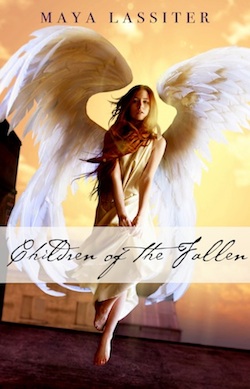
    P.S. Look at the cover of Maya’s latest novel. I think it’s gorgeous.

    Share

5 Comments

  1. One thing I forgot to mention. The Swiss Army Chainsaw called a regex still doesn’t replace actually reading the copy you’re working on. The above technique will show you what ISN’T there but maybe should. It won’t find something like the following:

    The captain turned his head, “Tactical Officer!”

    “Fire!”

    Something that is there, the quotemark after Officer! shouldn’t be there, because the captain clearly continues speaking. 🙂

    Finding that sort of thing is still the province of the Mark 1 eyeball.

  2. (?!^([^“”\r\n]++|“[^“”\r\n]*”)*$)^.+

    Nice regex!

    By the way, for anyone who knows regexes and is trying to parse that, here is a rough translation into English:

    Except for lines with no quotation marks or lines with balanced pairs of opening and closing quotation marks, match all lines.

    The “++” is a little unusual. For those who are unfamiliar with it, it is the “possessive” version of the + quantifier, meaning to not “give back” or backtrack to look for other possible matches.

    Thank you for the guest blog post.

  3. This is a great tool I never knew existed. Seems reasonable too. Thank you to both of you for sharing.

  4. TextWrangler is the best free text editor for Mac that I’m aware of. You can also get gedit to run on OSX, but I’ve found it to sometimes be unstable. There are also a host of paid text editors available. One of the more popular is TextMate (which is developed by the same company that created TextWrangler).

  5. @WHM: Thank you. If TextWrangler or TextMate can handle Perl-format regular expressions, the above techniques should work fine.

Comments are closed.