Indie Thoughts: Enticing with price

The top two factors driving book sales both stem from having a loyal customer base. Building that base is the goal as it is in any business that depends on repeat customers. In a previous post I outlined these parts to building that base.

  1. Create a product (a book in this case) that’s likely to delight a certain set of consumers (readers).
  2. Let those consumers (readers) know about it.
  3. Make it enticing for them to give it a try.
  4. Make it easy for those who liked it to know when they can get another; and make it easy to get.
  5. Get more product (another book that’s similar to the last) out the door so your repeat customers can come back for more.

In this post I’m going to share some thoughts on #3.

So how do you entice someone new to give you a try? There are a lot of things I see that play into that:  a great cover, description, sample chapters, and reviews that all say quality and scream genre. But there’s another huge factor to making something enticing. And that is price. Or rather price vs. perceived value.

I’m looking at Mark Corkers reports from Smashwords.

I’m looking at slides 65-69. I know many of us have seen them.

If the patterns are similar at Amazon, which sells more ebooks than anyone else, then a price of $3.99 on average will sell more than double the copies of $6.99.

$3.99 means MORE readers who might develop some level of loyalty, MORE word of mouth, and it means MORE revenue than at other price levels.

It means more than double the chances of getting your stuff in front on an influencer.

More than double the chances for luck to come into play.

And those odds grow exponentially.

And, again, all along the way that price earns you more than if you were pricing at $6.99 or $9.99 because you sell more books.

Of course, these are averages, which means folks are winning at prices above and below this. Furthermore, it’s not the same across genres. For example, it appears romance tends to sell better towards the lower end of the range Corker shows.  But it clearly shows that price is an important part of enticing a reader to give you a try.

And when I look at the indies who are selling huge numbers and have built their customer base, the vast majority of them seem to have gotten there by tapping into the market forces Corker shows on these slides.

That doesn’t mean they price all their books the same. Some are doing very well using a loss-leader/sample strategy where they offer the first book in a series for 99 cents or free. This also doesn’t mean they set their price and forget. it. They seem to do just the opposite, experimenting with different prices.  I noticed the Joe Konrath, who became a mega-seller at $2.99, raised his prices to $5.99 recently. He’s dropped them back down to $2.99 and $3.99. But he was clearly testing something. In an interview earlier this year with Simon Duringer, Russell Blake who is doing very well in the thriller category recently said this.

Probably the most effective thing I did over the last two years other than Select, which came and went in terms of usefulness, was making the first book in my JET and my Assassin series free. That lowered the barrier to giving my work a whirl to nil, and my readership exploded from there. About a month and a half ago I stopped doing that because I saw my conversion rates were averaging about 12-13% from the first to the second book, and I questioned whether, with, say, 500 downloads a day, and seeing 60 sales of book two, it might not be more desirable to get 70 paid sales of book one, and seeing that same 60 on the conversion (because if someone pays for your first book, they’re probably going to read it, and soon, whereas if they get it free, it could take years, or more likely, never happen). So far so good.

Clearly the folks who are doing well with this are experimenting with price to see which levels maximize revenue and loyal customers. And I think that’s the key. They are looking at what seems to be working for others, experimenting, and basing decisions on results.


Share

Similar Posts

  • |

    Become A Story Idea Machine

    Now’s your chance

    Apply to take the next Novel Writers Academy course: How to Create Story Ideas That Beg To Be Written.

    • Six-weeks
    • Starts: Jan 2, 2022
    • Ends: Feb 21, 2022
    • Gobs of hands on practice
    • One-on-one guidance from me

    At the end of the six weeks you will be a story idea machine.

    I will be working with only a small set of people. And so you need to apply to get in.

    The deadline for applications is midnight, December 11th. So contact me now to get the application instructions.


    A cracking good story idea requires five critical elements.

    Until you have all five, you’ll struggle to plot. You’ll write a few scenes and run out of gas. You’ll feel like the story just isn’t going anywhere.

    And that’s because it isn’t. It can’t. A story isn’t a story without all five elements.

    However, once you develop these five things, your story will suddenly roar to life. There are a few other elements that are important as well, but these five things form the core of the story setup. 

    In this course you’re not going to merely learn about all of those story elements. You’re going to go deep and learn what can only be learned by actually doing the work and developing story idea after story idea with personal one-on-one feedback from someone who knows what they’re doing.   

    When you finish, you won’t just know story theory. You will be a story idea machine. And you will be that because you have put in the work. The right work.  

    Again, this is not a course full of lectures and videos. This is a course where you’re going to work. And develop the insights and skills that only come from doing the work.

    You’re actually going to:

    • Come up with story setup after story setup after story setup
    • And improve them with one-on-one feedback. 

    It’s going to:

    • Eliminate years of you wandering about in the story wilderness trying to figure things out on your own. 
    • Put you miles ahead of other writers who have no idea what’s really at the core of story. 

    You are going to learn how to develop killer story ideas on purpose instead of on accident. Which means you’ll be able to do again and again. Reliably. Like clockwork. 

    Course details

    The focus of the class is not on learning about story, although you will do that. The majority of your time will be spent on developing stories. 

    You can’t become a carpenter by watching videos and reading books about it.

    You have to get out on the work site, cut wood, and pound nails. You have to make the mistakes all beginning carpenters make, get feedback, and improve.

    The same goes for writing.

    And you’re going to work in this class. You develop 21 story setups. In fact, you develop more because the 21 are just the ones you turn into me. And with each one your skills, insights, and abilities grow.  

    In the beginning, your setups will be bare bones. By the end, they’ll be fully developed setups that beg to be written. Setups you can use to immediately write the first draft  of your novel, whether that’s in outline or chapter form. 

    Here’s what you do each week. 

    Week 1.

    • Uncover the secrets of what’s really at the heart of story and how to generate ideas. 
    • Define your genre requirements
    • Create story setups 1-3

    Week 2.

    • Uncover the secrets to compelling characters 
    • Create character sketches
    • Create story setups 4-7 

    Week 3.

    • Uncover the secrets to formidable obstacles
    • Create story setups 8-11 

    Week 4.

    • Uncover the secrets to interesting casts
    • Create story setups 12-15

    Week 5.

    • Uncover the secrets to managing multiple storylines and series
    • Create story setups 16-19 

    Week 6.

    • Create story setups 20-21. These are your capstone projects where you apply everything you’ve learned and take it to the next level

    In this class you develop story idea after story idea after story idea. You are going to be marinated in the work of developing characters, THOMs, goals, obstacles, settings, casts, and more. And because of that, each week will not only bring an explosion of insights, but new skills and abilities.

    Every week you get two private, one-on-one, live sessions with me where you get encouragement and feedback on what you’ve developed. And you’ll have access to a private Facebook group where you can apply the principles to brainstorm even MORE ideas for each other’s stories. 

    At first you might feel a bit shy and worried about your ideas and abilities. But you’ll soon get over that. By the end of the course you’ll be one of those people that can generate terrific ideas easily. And you’ll be able to do that because you will have put in the work to become a different writer.  

    What’s the price?

    Hours of one-on-one instruction from a professional editor or author costs thousands of dollars. An MFA program can cost $25,000 to $30,000 or more!

    But this course won’t cost anywhere close to that.

    Plus you’re going to learn things here you’ll never get in an MFA program (I know. I was accepted into a top-ranked program).

    The cost of this course is $799. And I personally guarantee your results. You’ll be totally oh-my-gosh-I’m-so-happy-I-took-that-class satisfied, or I’ll give you your money back. No questions asked.

    Now’s your chance to stop spinning your wheels. I can’t tell you how much I wish I’d had something like this when I’d started:

    • The secrets about the true core of story.
    • The secrets about how to come up with ideas. 
    • Actual work with personal one-on-one feedback. 
    • Laser focused on what actually matters, not a bunch of ridiculous writing rules. 

    When you finish, you will be a story idea machine. 

    You won’t know plotting. That’s a different course and set of skills. You won’t know how to write chapters. But you’ll know how to create the engine that powers all the rest of that. You’ll know how to create the core that makes awesome plots and chapters possible. 

    If you want to take this course, click the button below and contact me. I will tell you exactly how to apply.

    I’m not going to be able to accept everyone who wants to take the class. I have a very strict limit on the number of students I can work with. So you need to get your application in before the deadline of midnight, December 11th.

    Don’t wait!

    Contact me now to get application instructions.

    Share
  • |

    Workshop: The 3 Things You Must Learn to Write Killer Stories

    Where: Salt Lake City at CONduit 

    Date: Saturday, May 24, 2008

    Time: 2 PM – 4 PM

    I had tons of great feedback from the last workshop. It seemed to be helpful to quite a few people. There are a number of other good workshops for writers going on before and after mine that you’ll want to look into as well.

    For more information go to the CONduit website.

    Share
  • Can you write for love AND money?

    Many artists think you can’t. And not simply because they envy those who are selling hundreds of thousands of copies.

    The reason they think this is for the simple fact that the creative process is fueled by following the zing. It’s ruled by passion. You have to care about AND believe in what you’re writing. You have to because if you think it’s boring or unbelivable, then it’s likely everyone else will as well. 

    For example, let’s say you are deeply bored by vampires, but see that vampire love stories are making piles of cash and decide to write about one with smoldering eyes and a bad habit of chewing tobacco even though it leads to dental problems with the fangs (hey, why would her man-toy care?), then you’re substituting passion (that which springs up from within) for graphs and plots about marektability (stuff that’s imposed from without).

    And so many folks think that there’s a continuum. On one end is writing for passion. On the other is writing for money. And the two don’t cross. But this is a false dichotomy. The truth is that money and passion are independent factors.

    Lon Prater, a writer friend, recently expressed it this way.

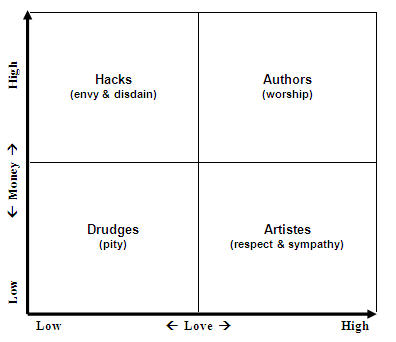
    Not a dichotomy, but rather an X and Y axis, the way I see it.

    There’s:

    low love, low money (SEO writing?)

    low love, high money (For me, this would be tech writing, or media tie-in to a universe I didn’t care about)

    high love, low money (unfortunately too much of my writing!)

    high love, high money. (Loftiest of goals) 🙂

    You can find datapoints for every quadrant, and of course “love” is highly subjective and individualized, as are what counts as low and high for each writer.

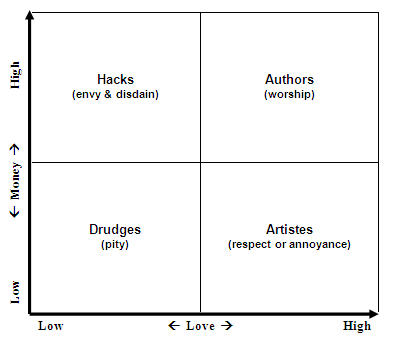
    If we put labels to the quadrants, we get something like this, along with common emotions they tend to evoke in other writers. (Although I will say that envy seems to want to run amok in the author quadrant as well.) 

    writer-love-and-money-quadrants2

    Share
  • |

    Writing update: 5/16/11 – outlines & writing vividly

    Finished chapter 5 of CURSE last Saturday. Huzzah!

    The writing is a blast, even though it still requires work. Along those lines, I’ve been meaning for some time to write up the techniques and principles I use when drafting.  So I think I’m going to do a semi-regular post on a weekly basis where I share these tidbits as I run into them. It will be kind of like director commentary, although I’ll have to be careful not to toss out any spoilers.

    This week I’ll talk about using chapter outlines and writing vividly. 

    Bullet Outlines & Chapter Outlines

    Up to this draft, what I’ve done is work from a bullet outline.  Each bullet is a short statement of what needs to occur.  Sometimes it’s very general about the story arc–presentation of the problem, struggle, and resolution.  Sometimes it’s a very specific step.  Sometimes it includes cryptic notes.  For example, here are some bullets for SERVANT:

    1. Talen goes to village, they suspect him
    2. Talen runs, sabin catches him by his hair and pulls him back, field stone size of liver. Plant idea of him catching Hatchlings
    3. Woods back home, freaked
    4. Father is not as concerned, strange, sends him out to field–Talen starts to think about catching the Hatchlings himself

    As you can see, it gives me a roadmap (which often changes) so I’m not starting from nothing when I open up my chapter document.  But it’s very general.  When using this, I often have to use a number of takes to get the scene written because those first takes are me imagining the scene. In fact, my first take is usually a sketch of the scene with me blocking out my goals for the scene and how I expect the events to occur. However, in this last go at CURSE I wrote a chapter outline.  It took me about 25 hours, and the outline for CURSE ran 32 pages. I’ve pasted the first two chapters below.  You can see they’re still mostly in summary, but they represent the initial sketch of what’s going to happen.   

    1.               The Village of Plum – TALEN

    It’s past midnight, behind enemy lines. A thin moon hangs in the sky. Talen, Sugar, River, and five of Shim’s best soldiers crouch in the black shadows of the tree line running along the road to the village of Plum (Sugar’s former village), watching for soldiers or a village guard.

    Talen jokes with Sugar, telling her he wanted a dance tonight, not a sneak behind enemy lines, even if it was in the dark. He’s more than half serious. As they’ve worked together over the last three months since the battle in the cave, he’s become attracted to her.

    Also during those three months, the clans of the New Lands split into two factions. Five clans, led by the Fir-Noy, believed Shim, the leader of the Shoka clan, was being controlled by sleth. The remaining four clans followed Shim. The Fir-Noy faction immediately took up arms, initially to protect themselves, but they soon began talking about ridding the land of the sleth curse. Tensions rose, and in a series of altercations a number of people on both sides were killed. Now both factions have mobilized forces to establish pickets and patrols along a border between them.

    A few days ago, Argoth received word from his spies that something was afoot in the Fir-Noy clan, as if they were preparing for a strike. Futhermore, they’ve decided to excavate the grounds about Sugar’s old house. Argoth knows Purity had her own cache of weaves under the hearth of her old home, the location of which she revealed to Sugar just before she died. Argoth has begun to train up an army of dreadmen for Shim. But he’s stretched thin. He needs all the lore he can get. So he’s sent Sugar and the others to retrieve the items before they’re lost. They’ve come on the evening of the annual apple dance festival, hoping the Fir-Noy would be less vigilant. So far, they’ve been right. In fact, Talen begins to feel like it’s been a little too easy.

    As Talen and the others prepare to move forward, Sugar puts her hand on Talen’s arm. He can feel Sugar’s Fire and soul, and her touch only enflames his desire for both. He’s alarmed by this intensity, and finds it hard to focus, so he moves his arm away.

    “You’re going to give me a boost up,” she says.

    Up ahead in front of the Fir-Noy village stands a thick timber pole probably 11 feet high. Fastened to the top of that pole is what looks to be a skull.

    “You brought us round the wrong side,” Talen says. Their objective was the ash ruins of Sugar’s burned out house, not this pole. 

    “You can’t think we’d come all this way, and I’d leave without it.”

    It’s her father’s skull. The only thing of his that remains. Talen, not wanting contact, motions at one of the taller soldiers with them. “He’d be taller.”

    “Come on,” Sugar says and moves forward in a crouch. They move out of the shadows and into the moonlight, watching the village. Sugar climbs up on Talen’s shoulders and cuts loose the bonds holding her father’s skull. The whole time Talen’s desires make the experience uncomfortable.

    Once Sugar has the skull safely in her sack, the group keeps to the deeper night shadows of the tree line and moves around the edges of the village fields until they come to a ditch. Along the way, one of the soldiers touches Talen, and he feels that same overpowering desire. Something is not right inside of him. He knows it. But there’s nothing to do about it now as they follow the ditch to the ash ruins of Sugar’s house.

    Sugar and Talen sneak over to the hearth of the burned out home. River and the five Shoka soldiers take up watch. Soon Sugar finds the secret cache, but as she’s removing the items, they hear a sound come from one of the surrounding houses. Talen and the others stop and listen. Suddenly Fir-Noy soldiers burst out of the door. They overwhelm one of Shim’s soldiers and rush straight for the others.

    Talen and the others turn to run, but Fir-Noy soldiers begin to pour out of four other houses. Then a Fir-Noy dreadman emerges and shouts it’s the boy that’s wanted. They can slaughter all the rest. It’s clear these soldiers were waiting for them, but there’s no way they could have know Talen and the others were coming, unless they were betrayed. 

    2.               Hue & Cry – SUGAR

    Sugar stuffs the last item in the secret cache into her sack and rises. The Fir-Noy are shouting, but River charges a gap in the quickly forming mob. She fights ferociously. The others race after her, Sugar and another soldier bringing up the rear. Sugar and the others are multiplied, but they’re not fast enough to avoid the soldiers completely, and Sugar is forced to fight and kick to break her way through. When she finally does break past the men, she finds she and the last soldier have been separated from the others and there’s no way to immediately join back up.

    Sugar and the soldier run, but he’s wounded. He tells Sugar to run on without him. She refuses, then a company of Fir-Noy round the corner of a house. The soldier turns to face them and tells her once again to run. In her mind’s eye, Sugar sees the same situation unfolding before her as when the mob came after her mother and da. She ran then and regretted watching her father get butchered. She isn’t going to run now. Besides, she’s multiplied. So instead of running, she rushes over to the soldier and, with lore-given strength, picks him up, puts him over her shoulders, and, despite his protests, speeds away.

    Sugar knows she won’t be able to outdistance her pursuers like this, but she also knows the villager Stout keeps a horse in the barn just ahead. She turns the corner on the barn, puts the soldier down, and tells him to get the horse. Then she darts back out into view of the soldiers following and leads them away. She glances back and sees the soldier slip into the barn. It’s the best she could do for him. If he can get on Stout’s horse, he’ll have a chance to escape.

    Sugar looks to see how she might join back up with Talen and the others, but it’s impossible now. And while most of the Fir-Noy soldiers chased after Talen and the others, a good number are chasing her. Furthermore, others in the village are coming out of their homes. She speeds past them. All over the village dogs begin to bark, but she hears one cluster that sends fear down her spine. The villager Solem keeps a pack of prize-winning sight hounds. He emerges from a barn with his pack on a leash.

    “There!” a man shouts. The barking of Solem’s dogs rises in pitch.

    Sugar increases her speed then hears Solem. “Stu, boys! Take her. Get the wretch!”

    The dogs shoot out after her.

    So how has it worked?

    So far it’s worked very well. Having that initial sketch done means I take a lot less time finishing each chapter.  However, it doesn’t change the general drafting process for me:

    1. The chapters still change as I write. I find cooler ways to accomplish what I need. I also run into things I haven’t imagined yet and have to invent them. For example, on chapter 2 when Sugar is having issues, I realized I didn’t know exactly where the houses lay in the village, so I had to sketch that. It presented opportunities and images.  For example, I thought about the Fir-Noy bowmen being on the roofs. I hadn’t imagined that before, but it was so cool to me, I had to put it in.  Then I felt I wanted Talen and her to huddle together at first. I had to run through a few options about how that played out before I found one that felt right.  
    2. I still find I need to sketch out my goals for the chapters and an initial blocking of what happens. This is much shorter than it’s been on previous drafts, but I still find it helpful. Blocking scenes helps.  This is me just figuring out where everyone is and how they move. Sketching this first helps me write faster.
    3. I still have to do takes, although I move through them more quickly.  

     As you can see, I find the sketch/draft method incredibly helpful.  Just like a painter, I sketch out what I’m thinking of painting. That might require a few sketches where I add in more details.  Then I switch over and begin to paint.


    Writing Vividly

    On another note, I read “Stories are made out of scenes; Scenes are made out of nouns” by author James Maxey again. I really like this essay. Everyone is always talking about verbs, but nouns are such powerhouses.

    Speaking of which, here is the opening to Maxey’s “To The East, A Bright Star” which was published in Asimov’s.  It has one of my favorite beginnings. And part of the reason is what Maxey talks about with nouns.

    TO THE EAST, A BRIGHT STAR

    There was a shark in the kitchen. The shark wasn’t huge, maybe four feet long, gliding across the linoleum toward the refrigerator. Tony stood motionless in the knee-deep water of the dining room. The Wolfman said that the only sharks that came in this far were bull sharks, which were highly aggressive. Tony leaned forward cautiously and shut the door to the kitchen. He’d known the exact time and date of his death for most of his adult life. With only hours to go, he wasn’t about to let the shark do something ironic.  

    Tony waded back to the living room. Here in the coolest part of the house, always shaded, he kept his most valuable possession in an ice-chest stashed beneath the stairs. He pulled away the wooden panel and retrieved the red plastic cooler. Inside was his cigar box, wrapped in plastic bags. He took the box, grabbed one of the jugs of rainwater cooling in the corner, and headed up the stairs to the bathroom. He climbed out the window above the tub onto the low sloping roof over the back porch.

    This all reminds me of Swain’s thoughts on bringing the material to life, which I thought Maxey did so well in those paragraphs.

    Few of us read voluntarily about the primer-level doings of Dick and Jane.  Simplicity is a virtue in writing, true; but never the primary virtue.

    What is?

    Vividness.

    How about brevity?

    It’s important too.  Within reason.

    Within reason?

    Who, just learning this business, knows where or when or how to be brief? In the wrong place, brevity can destroy you.

    So?

    As in the case of simplicity, brevity is never the heart of the issue. Vividness is.

    How do you write vividly?

    You present the story in terms of things that can be verified by sensory perception. Sight, hearing, smell, taste, touch–these are the common denominators of human experience; these are the evidence that men believe.

    Describe them precisely, put them forth in terms of action and of movement, and you’re in business.

    Your two key tools are nouns and verbs.

    (p25 Techniques of the Selling Writer)

    Of course, there’s more–the telling detail, metaphor, working memory overload, details from the point of view. But it all plays into being vivid.


    Share