Advice to new writers

Recently a fellow writer brought up this post by author Kameron Hurley. He has a lot of interesting things to say (and some cool covers in his sidebar). A Steve Martin quote features prominently: “Be so good they can’t ignore you.”

That sounds like excellent advice, doesn’t it?

Until you start to think about it.

Are there authors out there who strive to be just okay? That set goals to be mediocre?

“Marge, keep the kids away! Bring me no lunch. Because today, do or die, I am determined to write a middling tale about lukewarm characters with a so-so plot!”

!?

I believe our writer of measley aspirations just might just be a strawman.

Be good enough they can’t ignore you, Martin says.

Wow, sounds good. Except let’s test it out. Let’s take some of the least-ignored authors of our day.

For millions of readers J. K. Rowling is NOT a great writer. And neither is Harper Lee. Or Steven King. Or Orson Card. Or Brandon Sanderson. Or Lee Child. Or Nora Roberts. Or whomever. Insert whom you will–the vast majority of the reading public ignores or eschews them.

The vast majority of the reading public is not moved by them in the least.

Stephenie Meyer is a great writer for some. She gave them such a moving experience they dress up and relive it all at balls. She’s a horrible writer for others. Most people haven’t read her or gone to see her movies.

The Bible is THE most life-changing, most moving book that millions have read. For others it’s a piece of trash.

It seems that following Martin’s advice is a really good way to lose a lot of time galavanting after shrubberies only to then have your throat ripped out by the Rabbit of Caerbannog.

Woe is me, for I should have stayed home with my lovely wench and lovely children and eaten more peas and read about sparrows. Zounds, but the blood my mother gavest me, at nine-month cost, now flows silently onto the sterile rocks. . .

You can create great product, stuff made with extraordinary skill, and still not be Great because you’re earth-shattering stuff speaks to and shatters only a small portion of readers.

I say forget greatness!

Just sing. And revel in the singing. And the new songs your voice can carry as your skill grows. And share that reveling with all who enjoy such singing.

Because it’s not about greatness. It’s about the song.

And then go home and enjoy the laughter and coversation of the woman/man at your hearth, the children/cats at your feet, and the lovely taste of the fresh green peas.

(Dear me, I believe I just equated children with cats. And yet, does it not sound just right?)

John, you ask, what about goals? What about being all you can be? Are you saying it’s okay to schlub your way through life and writing?

You must choose your own path. But I would never say don’t have goals. Nor would I say don’t try to write the best book possible . . . for the particular type of story you’re trying to tell.

I think we all benefit by singing our types of songs to the very best of our ability and then trying to enlarge that ability as much as we can.

That generates more joy in the giver and the receiver.

But the quest to be Great so some amorphous “they” (who is they?) can’t ignore you seems foolish. It disregards the idea that it’s impossible to write great books for all audiences. But that’s not its only problem. It also seems to be all about the writer, and not the sharing. Me-me-me is, ultimately, such a hollow prize.

It seems to me that it’s so much better to quest after singing, not to be noticed, but to deliver a service that I and the reciever can both rejoice in together. And then to increase that joy.

What changed in the author’s cut of SERVANT?

Because a number of folks have emailed or posted asking this question, I figured I should address it in a post.

This edit of SERVANT was signficant, but it involved mostly line edits, copy edits, resequencing, and one important adjustment and addition.

Line edits are things that make individual sentences or paragraphs read more clearly. I made line edits to almost every page. I think most readers won’t notice these. But then that’s the point.

Copy edits catch small things like typos and misspellings. There were a number of maddening copy issues that were introduced into the manuscript in the publisher’s version and others that weren’t flagged. I fixed a number of these and then had two copy editors read over the manuscript to find more. No book is perfect. I’m sure there are still some gremlins lurking in the text. But we caught a lot of the little buggers. 

Resequencing is moving chapters or sections around and does affect the experience. The biggest resequence was switching the first eight chapters back to the original order I intended. This is an important change and will have a large effect on the reader for the first quarter of the book. Then there were three other smaller sections inside the story that needed to be moved around to make the chronology clearer and improve the suspense.

The line, copy, and resequencing edits make up the bulk of the edits. But I did adjust and add a short section to the ending immediately after the climax to clarify a few things that should have been revealed in the first version and that lead into book two.

What does this all mean?

It means that while this is a superior version of the tale, the base story remains the same. I care about the stories of Sugar, Talen, Argoth, Hunger, and the dilemmas they face. So I did not change their tales. However, I did significantly change the experience of those tales for the reader.

If you have already read SERVANT, you know everything that happens. However, you will want to get a hold of a copy of the new version to review the updated ending for the new information it includes.  To avoid spoilers and confusion, I will not be releasing the ending in a separate document. But if you sign up for my release notification, I’ll let you know when I have my release sale so you can get it cheap. 

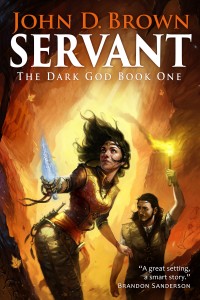
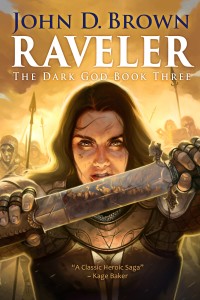
One final note. Because I feel this is a superior version of the story, and because I do not want readers to be confused about which version to read, I’m releasing it with a different title and different cover art. It will be called “Servant” and include the series label “The Dark God Book 1.” 

I think readers are going to be very pleased with this version. I know I am. And then we can move on to “Curse,” the next in the series, followed by “Glory.”

Harry Reid’s Chickens

Are we all wearing Coke bottle glasses with this government shut down?

First, it seems silly to me when reporters ask Americans who is causing the shut down. It’s like, duh, if either party just gave into the other party’s demands, we wouldn’t have the issue. Which means that BOTH parties are causing the shut down.

Second, it seems a lot of folks have forgotten that this is precisely what should happen.

What?

Yes, our government is designed to allow these types of things.

But, John, isn’t that just asinine?

No. It’s not an oversight. I think it’s smart. Even if it causes some pain.

Let me explain what it seems some in the media and elsewhere are forgetting.

This is not a nation that belongs to a government. It’s not a nation owned by some lord or entity. This is a nation of individuals who decided to band together because we thought that banding together would allow us to protect our lives, liberty, and pursuit of happiness better than if we stood alone individually.

This is a nation of individuals who said, you know, we think we can figure things out better together ourselves than having someone dictating to us what we’re going to do. We’ll get together and talk. We’ll argue. We’ll persuade. We’ll try to convince each other of our individual ways of thinking. And when enough of us are convinced that we should do something, we’ll act.

We’ll set up a process for talking and making decisions that ensures everyone can be heard. It would be great if we could get 100% agreement on everything, but we know that’s not realistic. At the same time, we don’t like the idea of forcing our will on others. So we’ll make a compromise; we’ll set up the rules for making decisions so it requires that a good majority of us are in agreement before we can take action, especially on matters that are important to a lot of us.

Finally, we’ll make sure no individual or group can take control and deprive us of this way of living. We did the monarch thing, and we’re done with that. We will not bow to any king ever again. We’re going to be very careful about this one item because a lot of bad things begin to happen when any one person or group gets too much power.

So we set up the rules and started working together this way. And the basic premise under all of this is that we would respect each other’s free will. We’re a land of liberty. We’re a land where we get together and agree on a course of action. Not one where we impose our will on others.

One of the main methods we used to ensure that no individual or group could take control of the rest of us and that a good majority of us must agree before taking a course of governmental action was to distribute the power to make and enforce rules. We did this in a wide variety of ways. We did this because power’s a slippery thing and easily abused. Furthermore, because we knew no system is perfect, we also set up a system of checks and balances so that if one person or group abused their power, we could stop them and force them to remember to respect the freewill that the rest of us have.

So what has caused this shutdown?

It’s very simple.

A lot of Americans do not agree with Obamacare. By most polls, it’s a majority of Americans. They were not listened to when it was being developed. They were not listened to when it was made law. They feel it was passed, not with open discussion, but a lot of chicanery. They feel it’s not some minor regulation, but a very big thing that will infringe on their rights to live how they want to live.

Now, it might be that all their fears are unfounded. It might be that Obamacare is going to usher in utopia. Many signs suggest it’s not going to do anything of the sort. But let’s just say it is the finest piece of legislation ever. Let’s say is a celestial piece of governing.

That isn’t enough.

It’s not nearly enough.

Because this is not a nation that belongs to any group. We are a nation of individuals who have banded together, agreeing that we will talk things out amongst ourselves and only act when a good majority of us agree on a course of action. This is a nation that tries to tread lightly on each other’s liberty.

But many of the folks in Washington back in 2009-2010 forgot this and forced this thing called Obamacare upon the rest of us; in doing so, they violated one of the basic agreements of our compact. If they had followed the underlying intent of our union, they would not have done what they did. They would have crafted legislation that a good majority of us could get behind.

In 2010, those of us who protested this use of power voted in new folks into the House of Representatives to deal with the matter. In fact, when given the chance, Americans (both Republican and Democrat) in the heavily Democratic state of Massachusetts voted Republican Scott Brown into office, hoping to stop this legislation in the Senate before it became law. But Harry Reid didn’t listen. He didn’t care. He and Pelosi and Obama weren’t interested in allowing a full national discussion. He and the others were more concerned with getting their way. And so he used a parliamentary trick to force it through.

This shut down is about one group of people forcing their will on the rest of us. It’s about using the checks and balances designed into the system to correct such errors. It’s about the chickens of some poor decisions coming home to roost.

I know the shut down has caused issues. It’s a partial shutdown; 13% of the government. I think 87% is still funded and running. Still, I know it’s causing some pain.

But none of that pain needs to occur. Everyone wants to fund cancer research. Everyone wants to help poor single mothers. Those things aren’t the issue. The issue is that not everyone agrees with Obamacare.

If you’re a supporter of Obamacare, let me ask you this: if the tables were turned, what would you do?

Would you not stare at the folks trying to force their will on you and say, hey, come on. We’re adults here. We all agreed that we wouldn’t do anything unless a good majority of us were convinced it was the right course of action. Let’s get together and come up with something a good majority of us can get behind.

If you’re an opponent of Obamacare, you too should recognize that a good portion of your fellow citizens are clamoring to change the way things are. They’ve been clamoring for some time. Should you force your will on them? Or should you sit down and listen and try to come up with something that addresses the points we can agree on?

I don’t know if the folks many of us voted to go to Washington will stick to their guns and correct this. I hope they do. And I hope that those on both sides who have forgotten one of the basic tenets of our social compact will wake up and remember we are banded together, not to game the system to get what we want, but to act on only what a good majority of us want.

Passed the 75% mark on the final draft of BAD PENNY

Working on the copy edits of BAD PENNY today and passed the 75% mark to general rejoicing.

You normal folks may now go back to work. For you passionate grammarians, my fab copy editor marked a hundred uses of “then” in my manuscript.

No, I wasn’t having issues with the then/than confusion.  

I was having issues when using “then” when tying two clauses together. The question: did I always have to use “and” with “then”?

EXAMPLE 1: “Frank backed out of the parking stall then rumbled out onto Dewar Drive.”

Was “then” naked without an accompanying “and”? Should I make it read as “Frank backed out of the parking stall and then rumbled onto Dewar Drive”?

And if it doesn’t need the full “and,” does it need at least a comma for a miniskirt so it reads “parking stall, then rumbled out onto . . .”?

EXAMPLE 2: “The tension ratcheted up, then Senor Zombie’s eyes slid to the side.”

Can you use “then” as a coordinating conjunction? Or must it always be used with “and,” as in “the tension ratcheted up, and then Senor Zombie’s slid to the side.”

I looked in the Chicago Manual of Style. I looked in Garner’s Modern American Usage. I could not find the answer. So I emailed Annette Lyon, author of There, Their, and They’re: A No-Tears Guide to Grammar From The Word Nerd.

Saint Annette’s response:

Your first example is correct as is, with no AND: “Frank backed out of the parking stall then rumbled out onto Dewar Drive.”

The only time you grammatically need AND before THEN is if we’re connecting two independent clauses, because THEN isn’t one of the conjunctions that can do that. You’ll find those in a text box in the book, and they include AND, OR, FOR, NOR, YET, BUT, SO.

The only issue in the above sentence is whether to use a comma before THEN. The current stylistic trend is to leave out the comma, so you can leave it just like you have it above. Some people balk at that and want the comma for the pause it provides. Depending on the house style guide, that may be something you can argue, or maybe it won’t be. Neither is really grammatically more correct; the comma before THEN is more of a style issue. 

In the next example, we do need AND or some other conjunction from the list, because both sides of the sentence are independent clauses. So this would be wrong: “The tension ratcheted up, then Senor Zombie’s eyes slid to the side.”

But this would work: “The tension ratcheted up, and then Senor Zombie’s eyes slid to the side.”

To avoid the issue altogether, we can rephrase it. A couple of variations:

-The tension ratcheted up when Senor Zombie’s eyes slid to the side.

-Senor Zombie’s eyes slid to the side; the tension ratcheted up. (Semicolons replace conjunction + comma)

Rules of thumb:

-If you’ve got 2 independent clauses, don’t use THEN as the conjunction. Add AND or another one.

-It the sentence has just 1 independent clause, THEN is enough by itself.

Thank you, Annette.

And wouldn’t you know, I opened A Wanted Man by Lee Child, and what did I see? A bunch of then’s illustrating exactly what Ms. Lyon suggested.

“Reacher heard the roar of the shot, quieter than some, but still deafening in a closed room, and simultaneously he heard the wallboard explode above and behind his head, and then he hit the floor, knees first, then his hip, then his side, sprawling, down low behind the counter, out of sight.” (159)

I think all I’m going to see while reading for the next while are the then’s.