What changed in the author’s cut of SERVANT?

Because a number of folks have emailed or posted asking this question, I figured I should address it in a post.

This edit of SERVANT was signficant, but it involved mostly line edits, copy edits, resequencing, and one important adjustment and addition.

Line edits are things that make individual sentences or paragraphs read more clearly. I made line edits to almost every page. I think most readers won’t notice these. But then that’s the point.

Copy edits catch small things like typos and misspellings. There were a number of maddening copy issues that were introduced into the manuscript in the publisher’s version and others that weren’t flagged. I fixed a number of these and then had two copy editors read over the manuscript to find more. No book is perfect. I’m sure there are still some gremlins lurking in the text. But we caught a lot of the little buggers. 

Resequencing is moving chapters or sections around and does affect the experience. The biggest resequence was switching the first eight chapters back to the original order I intended. This is an important change and will have a large effect on the reader for the first quarter of the book. Then there were three other smaller sections inside the story that needed to be moved around to make the chronology clearer and improve the suspense.

The line, copy, and resequencing edits make up the bulk of the edits. But I did adjust and add a short section to the ending immediately after the climax to clarify a few things that should have been revealed in the first version and that lead into book two.

What does this all mean?

It means that while this is a superior version of the tale, the base story remains the same. I care about the stories of Sugar, Talen, Argoth, Hunger, and the dilemmas they face. So I did not change their tales. However, I did significantly change the experience of those tales for the reader.

If you have already read SERVANT, you know everything that happens. However, you will want to get a hold of a copy of the new version to review the updated ending for the new information it includes.  To avoid spoilers and confusion, I will not be releasing the ending in a separate document. But if you sign up for my release notification, I’ll let you know when I have my release sale so you can get it cheap. 

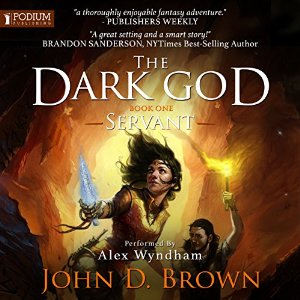
One final note. Because I feel this is a superior version of the story, and because I do not want readers to be confused about which version to read, I’m releasing it with a different title and different cover art. It will be called “Servant” and include the series label “The Dark God Book 1.” 

I think readers are going to be very pleased with this version. I know I am. And then we can move on to “Curse,” the next in the series, followed by “Glory.”

Share

Similar Posts

  • Lord of Bones Update

    So I’m up to 20,000 words on the next novel. The working title used to be Lord of Bones, but that doesn’t fit it right now. So the title has now changed to The Drovers. It may change again. This is the first book in an epic fantasy series that has the potential for many, many novels.

    It about a retired, deadly mercenary named Borros who is trying to live the good life as a man of cattle, and smuggling blackmeal (a forbidden magic substance) on the side. A war with Osson, the kingdom across the sea, is imminent. And Borros has contracted with the king’s agent to deliver 250 head of cattle to the capitol city to help supply the king’s army. But then the crew he hires turns on him and tries to kill him and steal the herd. He and the camp cook defeat them, but there’s no way he can drive the cattle by himself, not where he’s going. He goes to the next village to hire a new crew, but the men refuse. And he has no choice but to hire a crew of boys. A week into the journey, far beyond any place they could get help, something begins to stalk them. And he and the boys are going to have to use all their wits and skills to survive.

    Share
  • Dark God Update! Audio book narrator has been cast

    Alex-Wyndham-headshot-200x300I’m very pleased to announce that Podium Publishing, the folks producing the audio versions of the Dark God books, has cast Alex Wyndham as the narrator for the Dark God series. Production is scheduled to take place in March and April.

    Wyndham is an actor from the UK who has played television and film roles and narrated a number of audio books. Wyndham is the real deal. Just give the samples below a listen.

    You can listen to other samples on Audible by clicking on his name or by going to his Bee Audio profile.

    Folks, I cannot wait to see what he does with the books.

    The Dark God is rising…


    Share
  • |

    You’re invited to join the novel writing workshop pilot

    I am developing an online novel writing course and am looking for folks to pilot it with me and give me feedback. I’m thinking I want to limit it to 10-12 folks.

    It’s free and will probably take two or three months to complete. If you join, your job will be to do the work. And there will be work. I’m thinking 10-15 hours of work per week. Please don’t ask to join if you don’t want to make this commitment. I only want folks who are serious and ready to give this a shot. In addition to the work, you’ll need to report your experience with the course as we go, sharing with me where you get stuck, what’s confusing, what’s helpful, what does and doesn’t advance your skill. In fact, if at some point the course just isn’t providing you any value, you are welcome to drop. That’s good feedback too.

    It’s going to be a blended format that includes self-paced work and some type of weekly online meeting. I will be guiding the class. At the very least, we’ll meet and chat at my site. I don’t know if we’ll do a live meeting or not. Still working that out.

    I struggled for many years, trying to figure this stuff out, then had a number of epiphanies during Orson Card’s boot camp and continued from there. Of course I still have lots to learn. But I want to share what I have.

    I love teaching and have been teaching in one form or another for the last 20 years. I’m currently an education program manager at a large software firm. What this is all means is that I’m trying to build a course that guides folks through a process that will help them learn to WRITE novels. Not just talk about them.

    So this is not a series of lectures with quizzes that test your ability to recall, although I will quiz you.

    It’s not a course with an end goal of teaching you what I’ve learned about the concepts and principles of plot, character, and setting, although you will need to learn that.

    This is about increasing your ability to get ideas, develop them, and then write.

    It’s about doing the work. It’s about production. It’s about finishing product. And having a good time doing it.

    If you already feel comfortable with your ability to finish novels, this is NOT the course for you.

    You can learn more about the course here by clicking The Path in the On Writing menu.

    Probably the only other thing you need to know is that the class is a PG-13’ish class. While the stories can deal with intense and adult themes, as the teacher, I’m not interested in working with stories with explicit or detailed sex or lots of language of the sort that would earn a movie rating more restrictive than PG-13.

    Remember, this is a pilot. Even though I’ve taught about writing for a number of years to various audiences, there might be some rough spots. We might find we need to change the work requirements or activities or any number of things.

    If you’re interested, click on the Contact link on the menu of my site, and shoot me an email.

    Edit 1/30/15: I’m getting a number of excellent questions about the time commitment and schedule. Let me answer them here.

    The gap I’m trying to fill

    First, you have to understand that I am not interested in talking about novels and writing novels. I’m interested in helping folks finish novels. That’s a big gap I see in most writing instruction. It’s the gap I had. There was nobody to help me move from the theory to the writing, and writing all the way to the end. So this isn’t a class about novels. It’s a class where I hope to help you learn a number of techniques for developing and finishing one. And to learn those techniques, you have to actually use them. Which means you have to develop and finish a novel 🙂

    So why 10 hours as a minimum?

    If you’re a slower writer, it’s going to take you around 50 hours to develop and write a novel of 25,000 words. That’s the size of one of Louis L’Amour’s smaller novels (which we call sometimes call “novellas” today). It’s the size of some smaller romances. A lot of indies are writing serials around this size. If you want to write a 50k book, it’s probably 100 hours, maybe more. A 75k novel? 150-200 hours. The development and first draft of a 100k novel? 200-300 hours.

    These are not exact times. Some writers are faster. But you get the picture. Writing a novel is a big project. And I’ve found that it’s just too hard to get any traction on less than 10 hours per week. When you spend much less time than that, you spend most of your time just trying to remember what the story is about. I’ve found it’s best to keep your writing engine hot, or at least warm.

    So will these 10 hours be in meetings?

    No. I don’t want to have a lot of meetings. That’s the beauty of online. We will have deadlines. But you should be able to complete you work during the times that suit you best.

    What’s the course schedule?

    I can’t give you an exact schedule. I haven’t timed everything. Figuring that out is part of what we’re doing in this course. But I do know what I want you to learn and how I hope to help you learn it. We’ll just have to see how far we get with each weekly 10-hour chunk.

    Share
  • Passed the 75% mark on the final draft of BAD PENNY

    Working on the copy edits of BAD PENNY today and passed the 75% mark to general rejoicing.

    You normal folks may now go back to work. For you passionate grammarians, my fab copy editor marked a hundred uses of “then” in my manuscript.

    No, I wasn’t having issues with the then/than confusion.  

    I was having issues when using “then” when tying two clauses together. The question: did I always have to use “and” with “then”?

    EXAMPLE 1: “Frank backed out of the parking stall then rumbled out onto Dewar Drive.”

    Was “then” naked without an accompanying “and”? Should I make it read as “Frank backed out of the parking stall and then rumbled onto Dewar Drive”?

    And if it doesn’t need the full “and,” does it need at least a comma for a miniskirt so it reads “parking stall, then rumbled out onto . . .”?

    EXAMPLE 2: “The tension ratcheted up, then Senor Zombie’s eyes slid to the side.”

    Can you use “then” as a coordinating conjunction? Or must it always be used with “and,” as in “the tension ratcheted up, and then Senor Zombie’s slid to the side.”

    I looked in the Chicago Manual of Style. I looked in Garner’s Modern American Usage. I could not find the answer. So I emailed Annette Lyon, author of There, Their, and They’re: A No-Tears Guide to Grammar From The Word Nerd.

    Saint Annette’s response:

    Your first example is correct as is, with no AND: “Frank backed out of the parking stall then rumbled out onto Dewar Drive.”

    The only time you grammatically need AND before THEN is if we’re connecting two independent clauses, because THEN isn’t one of the conjunctions that can do that. You’ll find those in a text box in the book, and they include AND, OR, FOR, NOR, YET, BUT, SO.

    The only issue in the above sentence is whether to use a comma before THEN. The current stylistic trend is to leave out the comma, so you can leave it just like you have it above. Some people balk at that and want the comma for the pause it provides. Depending on the house style guide, that may be something you can argue, or maybe it won’t be. Neither is really grammatically more correct; the comma before THEN is more of a style issue. 

    In the next example, we do need AND or some other conjunction from the list, because both sides of the sentence are independent clauses. So this would be wrong: “The tension ratcheted up, then Senor Zombie’s eyes slid to the side.”

    But this would work: “The tension ratcheted up, and then Senor Zombie’s eyes slid to the side.”

    To avoid the issue altogether, we can rephrase it. A couple of variations:

    -The tension ratcheted up when Senor Zombie’s eyes slid to the side.

    -Senor Zombie’s eyes slid to the side; the tension ratcheted up. (Semicolons replace conjunction + comma)

    Rules of thumb:

    -If you’ve got 2 independent clauses, don’t use THEN as the conjunction. Add AND or another one.

    -It the sentence has just 1 independent clause, THEN is enough by itself.

    Thank you, Annette.

    And wouldn’t you know, I opened A Wanted Man by Lee Child, and what did I see? A bunch of then’s illustrating exactly what Ms. Lyon suggested.

    “Reacher heard the roar of the shot, quieter than some, but still deafening in a closed room, and simultaneously he heard the wallboard explode above and behind his head, and then he hit the floor, knees first, then his hip, then his side, sprawling, down low behind the counter, out of sight.” (159)

    I think all I’m going to see while reading for the next while are the then’s.

    Share
  • Life, The Universe, & Everything 2010 Schedule

    If you’re a writer, you’ll find Life, The Universe, & Everything (LTUE) an excellent convention. Yes, it’s focused on science fiction and fantasy, but the principles of writing discussed apply generally and there are a lot of authors who will be there that write in different genres–YA, romance, etc. In fact, there will be a LOT of published authors there, period–including two that have recently been on the NY Times best seller list and others who have just broken in.

    If I were an aspiring author, I’d be making sure I had arrangements to attend at least part of the convention. Follow the link above and look at the list of panel topics. And remember: it’s open to all and FREE of charge.

    Dates: Feb 11-13, 2010
    Wilkinson Center
    Brigham Young University
    Provo, UT 84602
    (801) 422-4636 (BYU information line)

    I’ll be doing the following. Hope to see you there!

    BTW, Stephen Nelson has graciously offered to film the workshop. If the recording and class pass muster, we’ll post it for your viewing enjoyment!

    Thursday, Feb 11

    5 – 7 PM: Writing workshop: “How to Write a Story That Rocks” (John Brown, Larry Correia)

    Friday, Feb 12

    9 AM: Panel: “Paths to publishing: When is traditional best and when should you try an alternative” (Stacy Whitman, John Brown, Dan Willis, Eric Swedin, Sandra Tayler)

    Noon: I will be attending Dan Well’s Pacing and Story Structure presentation.

    1 PM: Panel: “Killer Openings – How to write a gripping, engaging and interesting opening paragraph” (Dr. Steven C. Walker, John Brown, Mette Harrison, Heather Horrocks)

    Saturday, Feb 13

    9 AM: Panel: “A Guys Take on Writing Romance (Male Panelists)” (L. E. Modesitt, Jr., Clint Johnson, Aleta Clegg, Dan Willis, John Brown)

    Noon: Panel: “Building different cultures….” (L. E. Modesitt, Jr., Roger White, John Brown, Brandon Mull, Marty Brenneis)

    1 PM: Signing. (Wish very much I could go to Eric James Stone’s reading at the same time. I’ve gone to 2 or 3 of his and have never been disappointed)

    2 PM: Reading from CURSE OF A DARK GOD.

    Share

5 Comments

  1. I just reread your Calendar section, and it has this line:

    “CURSE (The Dark God book 2) – Late November, 2013 (I’d like to make it Halloween for the fun of it, but we’ll see)”

    Am I correct to assume that Halloween comment no longer applies? There is almost a one-month gap between Halloween and “Late November”.

  2. Yes, Halloween no longer applies. Thanks for the catch. And the CURSE edit is indeed at 2%.

  3. CURSE is now at 15% I see progress! (I’ve been waiting a long, long time for that book…)

    By the way, at one time (a long time ago) you posted that CURSE was done, but then you were told you needed to shorten it and I guess you worked on that.

    Which version are you working on now that you are self-publishing? Is it closer to the first, longer version (I hope)?

  4. John,

    So glad to hear you’re chomping at the bit 🙂

    The edit is at 22% now.

    Three versions of CURSE were written. The first two were 230k and 245k words long. This version is currently 185k long and will probably end up being closer to 190-195k. For reference, SERVANT is 184k. Normal novels are anywhere from 80k-120k. So it’s still a BIG book.

    The neat thing now is that after book 3, if I want, we can still explore more in this world.

Comments are closed.