
Similar Posts
Awful Intent Update: Climax Finished
The first draft of the novel is essentially finished. I have two chapters left–one that confirms the resolution of the A story, and one that wraps things up in the B story. I am so excited to let this sit for a week or two, then come back to it with fresh eyes and get the second draft written. That draft will go out to my beta readers. And while they’re reading, I will be developing the idea of the next novel.
These last two weeks, I have been applying the techniques used by sports psychologists to enhance professional- and olympic-level sports performance to my writing sessions. I’ve noticed the difference. And it’s been very good. I’ll be describing what that is in a future post.
Passed the 75% mark on the final draft of BAD PENNY
Working on the copy edits of BAD PENNY today and passed the 75% mark to general rejoicing.
You normal folks may now go back to work. For you passionate grammarians, my fab copy editor marked a hundred uses of “then” in my manuscript.
No, I wasn’t having issues with the then/than confusion.
I was having issues when using “then” when tying two clauses together. The question: did I always have to use “and” with “then”?
EXAMPLE 1: “Frank backed out of the parking stall then rumbled out onto Dewar Drive.”
Was “then” naked without an accompanying “and”? Should I make it read as “Frank backed out of the parking stall and then rumbled onto Dewar Drive”?
And if it doesn’t need the full “and,” does it need at least a comma for a miniskirt so it reads “parking stall, then rumbled out onto . . .”?
EXAMPLE 2: “The tension ratcheted up, then Senor Zombie’s eyes slid to the side.”
Can you use “then” as a coordinating conjunction? Or must it always be used with “and,” as in “the tension ratcheted up, and then Senor Zombie’s slid to the side.”
I looked in the Chicago Manual of Style. I looked in Garner’s Modern American Usage. I could not find the answer. So I emailed Annette Lyon, author of There, Their, and They’re: A No-Tears Guide to Grammar From The Word Nerd.
Saint Annette’s response:
Your first example is correct as is, with no AND: “Frank backed out of the parking stall then rumbled out onto Dewar Drive.”
The only time you grammatically need AND before THEN is if we’re connecting two independent clauses, because THEN isn’t one of the conjunctions that can do that. You’ll find those in a text box in the book, and they include AND, OR, FOR, NOR, YET, BUT, SO.
The only issue in the above sentence is whether to use a comma before THEN. The current stylistic trend is to leave out the comma, so you can leave it just like you have it above. Some people balk at that and want the comma for the pause it provides. Depending on the house style guide, that may be something you can argue, or maybe it won’t be. Neither is really grammatically more correct; the comma before THEN is more of a style issue.
In the next example, we do need AND or some other conjunction from the list, because both sides of the sentence are independent clauses. So this would be wrong: “The tension ratcheted up, then Senor Zombie’s eyes slid to the side.”
But this would work: “The tension ratcheted up, and then Senor Zombie’s eyes slid to the side.”
To avoid the issue altogether, we can rephrase it. A couple of variations:
-The tension ratcheted up when Senor Zombie’s eyes slid to the side.
-Senor Zombie’s eyes slid to the side; the tension ratcheted up. (Semicolons replace conjunction + comma)
Rules of thumb:
-If you’ve got 2 independent clauses, don’t use THEN as the conjunction. Add AND or another one.
-It the sentence has just 1 independent clause, THEN is enough by itself.
Thank you, Annette.
And wouldn’t you know, I opened A Wanted Man by Lee Child, and what did I see? A bunch of then’s illustrating exactly what Ms. Lyon suggested.
“Reacher heard the roar of the shot, quieter than some, but still deafening in a closed room, and simultaneously he heard the wallboard explode above and behind his head, and then he hit the floor, knees first, then his hip, then his side, sprawling, down low behind the counter, out of sight.” (159)
I think all I’m going to see while reading for the next while are the then’s.
How to Write a Story that Rocks
Folks, a huge thanks goes to Stephen Nelson for putting all this together. You may kiss his hand when you see him.
This is a recording of “How to Write a Story that Rocks,” a two-hour seminar Larry Correia and I just put on at the annual BYU’s Life, The Universe, & Everything symposium. I think we had 130-140 people attend. This symposium is focused on writing fiction. And while the panels and presentations do include things specific to the science fiction, horror, and fantasy genres (both adult and young adult), a lot of time is also spent on story writing fundamentals that apply to ALL genres. So when I developed this workshop, I made sure I took the fundamental approach.
The two-hour seminar has been broken down into 12 segments. To switch between the segments:
- Hover your mouse pointer over the YouTube below
- Click the forward and back arrows that appear on the right and left sides to move to the next or previous segment, OR
- Scroll through all 12 segments and select the one you want using the playlist control at the bottom
If you prefer, you can watch all 12 on the How to Write a Story that Rocks YouTube playlist page.
I’ve found whenever I develop any presentation or training that it takes a few iterations and revisions before it’s the best it can be. This is the first iteration of this seminar. And so below this video I’ve provided additional comments on each segment explaining key concepts, principles, and techniques that we might have failed to discuss or convey as clearly as we’d hoped. Enjoy!
Handout
How to Write a Story That Rocks – Handout
Segment 1
It’s documented–right-wing gun nut Larry Correia sang “Kumbaya.” What’s next? The hugging of small trees? Oh, Larry, the disilluion. The disillusion.
The reason why I had Larry sing was not for his mellifluous performance, but to demonstrate the difference in reactions between him and our happy volunteer (“Country Road” by John Denver–this really was a love fest). The volunteer balked because he hadn’t taken any thought to know what to sing before he was commanded to do so. On the other hand, Larry and I had spoken before the seminar. So Larry had something to sing BEFORE he sang it. It’s a simple demonstration, but it illustrates a principle a lot of new writers forget. Writing is a performance. It helps to know what it is you’re going to perform before you perform it.
It’s one thing for you to tell yourself to write. It’s much easier to tell yourself to write the scene where the rancher finds out one of his illegal ranch hands has been kidnapped.
Now this doesn’t mean that you have to know everything. Or that you can’t write exploratory drafts to figure out what it is you want to write. But it does illustrate that whatever techniques you use, you’ll be a lot more effective in your writing when you have something to say first.
But what do you develop? What are the things that bring the story to life? How do you go about getting those things to say? That’s precisely what I wanted to address in the seminar. In the segments that follow, I try to:
- Explain what I’ve found are the most important things to develop, the things that define the essence of story, that make the story come alive in the writer’s mind–the things that really matter
- Demonstrate techniques to develop those things so you have something to say
Segment 2
I think this segment went fairly well. What rocks will different from person to person, even though there will often be a huge overlap between people. So it’s important for authors to seek to develop the kinds of stories that rouse their passion. Watch this interview with best seller Debbie Macomber to see what I mean. So I can’t tell you what to write about. Or if whath you think rocks will resonate with a large number of people. However, what I can do is share the techniques I use that have been most productive in helping me develop initial ideas into something that has much more power.
You can use the techniques to juice up any of the four parts of story. However, I will say that I find that the most productive, the most important parts, are character and problem. Plot and setting are important. I love them and work to juice them up. But when I get a good character and problem, that’s when the writing seems to flow the easiest.
And no, I don’t list theme as a part of story. Everyone talks about theme, but when I read what they have to say or press them for examples, it seems that it always either boils down to (1) a story element or topic that’s repeated, (2) a story problem/issue stated in an abstract manner, or (3) some moral situation. Les Miserables is about the “theme” of mercy versus justice. But saying justice versus mercy is just an abstraction of the story problem and dilemmas the story deals with. So, no theme.
Segment 3
Loved this bit about scenes from David Mamet: http://www.slashfilm.com/2010/03/23/a-letter-from-david-mamet-to-the-writers-of-the-unit/
Segment 4
I’ll be adding my comments to the rest of these segments over the next few days.
Segment 5
Segment 6
Segment 7
Segment 8
Segment 9
Segment 10
Segment 11
Segment 12
Dan Wells on Story Structure
Check it out: Dan Wells on How to Build a Story (story structure). I find Dan’s “start with the ending” technique helpful as well as thinking about a worst fears realized moment. Watch the videos and see if there isn’t something there that can help you develop your story idea.
You can get the PowerPoint of How to Build a Story on Dan’s site.
If you find this approach useful, you might want to check out what novelist Larry Brooks has written about the same material on StoryFix.com.
Bad Penny – working title
I’ve decided to tentatively call the first book in my Frank Shaw series “Bad Penny.” This is the thriller I’ve been talking about. It’s a working title, so it may change.
As for progress, I’m close to 14,000 words. Huzzah! And I’m having a blast writing it. Every day I look forward to my writing time.
For those curious, the book takes place in Rock Springs, Wyoming. The plot will move it across eastern part of the state and then down into Colorado.
Frank Moses Shaw, ex-con . . .
Ah, folks. I’m just loving it.
I’m also generating options for a pen name. Althought I know there’s overlap between readers of epic fantasy and thrillers (hey, look at me!), I still think the genres are too different to try to spread a brand name across both. I read about Tess Gerritsen, who started in romance, using the same name for her thrillers, which is all I think she writes now. She reports that she had a number of the thriller readers pick up her romances and vice versa, and then get frustrated because her brand meant one thing to them, but they got another.
If I was writing thrillerish SF, like Card’s Ender’s Game, or thrillerish fantasy, like Correia’s Monster Hunter, then maybe the stretch wouldn’t be so far. For those of you who are thriller readers, I’ll be posting some possible names in the near future. I’d like your reactions on the options, so keep a look out.
As for CURSE OF A DARK GOD, no word yet from ye Editors. I’m expecting a reply March or April. Yeah, I turned it into my agent end of November. She submitted it to Tor in December. No, I don’t like these lead times any better than you do. But it is what it is. My job is to produce. My target this year is two novels–DARK GOD’S GLORY (book 3 in the series) and BAD PENNY. My stretch goal is to finish the working outline for the second Frank Shaw book (already have the premise) and actually start on it before the end of the year. We’ll see what happens.
Yo, John and Larry do Colorado this Saturday!
Larry and I will be in Lone Tree (South Denver) and Loveland Saturday, December 5th. Drop by and say hello, buy one of our books as a gift, or just show up with your Klingon outfit and gun.
John Brown events at Barnes & Noble
Saturday,
December 5
1 pm – 3 pmMeet public, discuss book, signing–Brown & Correia Loveland, CO Barnes & Noble
The Promenade Shops at Centerra
5835 Sky Pond Drive
Loveland, CO 80537
(970) 663-9473Saturday,
December 5
5 pm – 7 pmMeet public, discuss book, signing–Brown & Correia Denver (Lone Tree), CO Barnes & Noble
Barnes & Noble Booksellers
8374 South Willow Street
Lone Tree, CO 80124
(303) 706-9660Holy Mackrel, My First Cover Illustration
And, Dude! Will ya look at this thing.
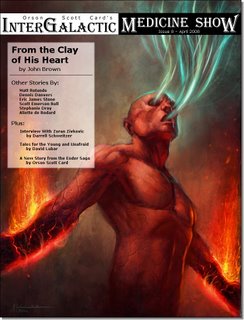
Read FROM THE CLAY OF HIS HEART at Orson Scott Card’s Intergalatic Medicine Show.
Read the story behind the story on Side-Show Freaks in the coming month.
Then read more about Scott Altmann, the marvelous illustrator.
Born on Long Island, New York, Scott was never far from a drawing tool and a surface to make a mark. The early years consisted of funny-looking beasts and asymmetrical faces. Years later Scott attended the School of Visual Arts in Manhattan and graduated from the Illustration Department with his BFA.
He enjoys sushi, cerebral spelunking, playing guitar and painting in oils. He draws to escape, and tries to escape to draw. All other times he can be found with his wife and son, in Long Island, New York — laughing uncontrollably and causing mischief.
6 Comments
Comments are closed.
Aw 🙁 Oh well, we’ll cope.
Look how strong you are!
Any update on the release window?
Still trying to nail down dates with artist. This is the last piece of the puzzle. As soon as I have that, I’ll announce! Thanks for checking and asking.
Hi Jon
Can you remind me what’s going on with this new version of SERVANT – is it a re-edit, a ‘Director’s cut’, an overhaul…?
I have the original Tor version so just wondering what the differences are between the two? Will you be releasing any notes (maybe a blog post) comparing them? It would certainly help me decide whether to pick up the new version before CURSE comes out.
Also, can you recommend where would be the best place to order your new books in the UK?
Thanks
Tim F
Tim,
You betcha. This was a signficant edit, but it involved mostly line edits and resequencing and one important addition, so the base story remains the same.
Line edits are things that make individual sentences or paragraphs read more clearly.
Resequencing is moving chapters or sections around and does affect the experience. The biggest resequence was switching the first 8 chapters back to the original order I intended. Then there were two or three other sections that needed to be moved around inside the story.
Those are the bulk of the edits.
I did add a short section to the ending to clarify a few things that should have been revealed in the first version and that lead into book 2.
You will be able to get the books on Amazon in the UK in paper and electronic format. And I’ll be holding a sale in the first week or so of the release so previous readers like you can get either format as cheaply as possible.
Does that help?