Harry Reid’s Chickens

Are we all wearing Coke bottle glasses with this government shut down?

First, it seems silly to me when reporters ask Americans who is causing the shut down. It’s like, duh, if either party just gave into the other party’s demands, we wouldn’t have the issue. Which means that BOTH parties are causing the shut down.

Second, it seems a lot of folks have forgotten that this is precisely what should happen.

What?

Yes, our government is designed to allow these types of things.

But, John, isn’t that just asinine?

No. It’s not an oversight. I think it’s smart. Even if it causes some pain.

Let me explain what it seems some in the media and elsewhere are forgetting.

This is not a nation that belongs to a government. It’s not a nation owned by some lord or entity. This is a nation of individuals who decided to band together because we thought that banding together would allow us to protect our lives, liberty, and pursuit of happiness better than if we stood alone individually.

This is a nation of individuals who said, you know, we think we can figure things out better together ourselves than having someone dictating to us what we’re going to do. We’ll get together and talk. We’ll argue. We’ll persuade. We’ll try to convince each other of our individual ways of thinking. And when enough of us are convinced that we should do something, we’ll act.

We’ll set up a process for talking and making decisions that ensures everyone can be heard. It would be great if we could get 100% agreement on everything, but we know that’s not realistic. At the same time, we don’t like the idea of forcing our will on others. So we’ll make a compromise; we’ll set up the rules for making decisions so it requires that a good majority of us are in agreement before we can take action, especially on matters that are important to a lot of us.

Finally, we’ll make sure no individual or group can take control and deprive us of this way of living. We did the monarch thing, and we’re done with that. We will not bow to any king ever again. We’re going to be very careful about this one item because a lot of bad things begin to happen when any one person or group gets too much power.

So we set up the rules and started working together this way. And the basic premise under all of this is that we would respect each other’s free will. We’re a land of liberty. We’re a land where we get together and agree on a course of action. Not one where we impose our will on others.

One of the main methods we used to ensure that no individual or group could take control of the rest of us and that a good majority of us must agree before taking a course of governmental action was to distribute the power to make and enforce rules. We did this in a wide variety of ways. We did this because power’s a slippery thing and easily abused. Furthermore, because we knew no system is perfect, we also set up a system of checks and balances so that if one person or group abused their power, we could stop them and force them to remember to respect the freewill that the rest of us have.

So what has caused this shutdown?

It’s very simple.

A lot of Americans do not agree with Obamacare. By most polls, it’s a majority of Americans. They were not listened to when it was being developed. They were not listened to when it was made law. They feel it was passed, not with open discussion, but a lot of chicanery. They feel it’s not some minor regulation, but a very big thing that will infringe on their rights to live how they want to live.

Now, it might be that all their fears are unfounded. It might be that Obamacare is going to usher in utopia. Many signs suggest it’s not going to do anything of the sort. But let’s just say it is the finest piece of legislation ever. Let’s say is a celestial piece of governing.

That isn’t enough.

It’s not nearly enough.

Because this is not a nation that belongs to any group. We are a nation of individuals who have banded together, agreeing that we will talk things out amongst ourselves and only act when a good majority of us agree on a course of action. This is a nation that tries to tread lightly on each other’s liberty.

But many of the folks in Washington back in 2009-2010 forgot this and forced this thing called Obamacare upon the rest of us; in doing so, they violated one of the basic agreements of our compact. If they had followed the underlying intent of our union, they would not have done what they did. They would have crafted legislation that a good majority of us could get behind.

In 2010, those of us who protested this use of power voted in new folks into the House of Representatives to deal with the matter. In fact, when given the chance, Americans (both Republican and Democrat) in the heavily Democratic state of Massachusetts voted Republican Scott Brown into office, hoping to stop this legislation in the Senate before it became law. But Harry Reid didn’t listen. He didn’t care. He and Pelosi and Obama weren’t interested in allowing a full national discussion. He and the others were more concerned with getting their way. And so he used a parliamentary trick to force it through.

This shut down is about one group of people forcing their will on the rest of us. It’s about using the checks and balances designed into the system to correct such errors. It’s about the chickens of some poor decisions coming home to roost.

I know the shut down has caused issues. It’s a partial shutdown; 13% of the government. I think 87% is still funded and running. Still, I know it’s causing some pain.

But none of that pain needs to occur. Everyone wants to fund cancer research. Everyone wants to help poor single mothers. Those things aren’t the issue. The issue is that not everyone agrees with Obamacare.

If you’re a supporter of Obamacare, let me ask you this: if the tables were turned, what would you do?

Would you not stare at the folks trying to force their will on you and say, hey, come on. We’re adults here. We all agreed that we wouldn’t do anything unless a good majority of us were convinced it was the right course of action. Let’s get together and come up with something a good majority of us can get behind.

If you’re an opponent of Obamacare, you too should recognize that a good portion of your fellow citizens are clamoring to change the way things are. They’ve been clamoring for some time. Should you force your will on them? Or should you sit down and listen and try to come up with something that addresses the points we can agree on?

I don’t know if the folks many of us voted to go to Washington will stick to their guns and correct this. I hope they do. And I hope that those on both sides who have forgotten one of the basic tenets of our social compact will wake up and remember we are banded together, not to game the system to get what we want, but to act on only what a good majority of us want.

Share

Similar Posts

  • The First Step to Being an Entertaining Storyteller

    What’s the first step to becoming an entertaining storyteller?

    In a recent ZOE Nutrition podcast, James Clear, author of Atomic Habits, suggests the key to starting a new behavior, like telling entertaining stories, is doing four things:

    • Make the cue to the behavior OBVIOUS.
    • Make the behavior more ATTRACTIVE.
    • Make the behavior EASY.
    • Make the behavior SATISFYING.

    But what’s the FIRST step?

    It’s mastering the art of showing up.

    That’s it.

    What does that look like?

    He shared an interesting story in the section where they were talking about making the behavior easy.

    START

    Let me give you two examples that’ll probably help clarify. So the first one this is just a really simple tactic, a very actionable thing, that you can use for building better habits. I call it the two-minute rule, and it just says take whatever habit you’re trying to build and you scale it down to something that takes 2 minutes or less to do.

    So read 30 books a year becomes read one page. Do yoga four days a week becomes take out my yoga mat.

    Now sometimes people resist that a little bit because they’re like, okay buddy, you know I know the real goal is not to just take my yoga mat out. I know I’m actually trying to do the workout, so this is some kind of trick, and if I know it’s a trick, then why would I fall for it?

    I have this reader his name is Mitch. I mentioned him in Atomic Habits. He lost over 100 pounds. So what is that? 40 or 50 kilos? And he kept it off for more than a decade. And he had this strange little rule for himself where he first started going to the gym, and for the first like 6 weeks he wasn’t allowed to stay for longer than 5 minutes.

    So he would get in the car, drive to the gym, get out, do half an exercise, get back in the car, and drive home, and it sounds ridiculous. You know? It sounds silly. It’s obviously not going to get the guy the results that he wants, but what you realize is that he was mastering the art of showing up.

    He was becoming the type of person that went to the gym four days a week even if it was only for 5 minutes, and this is a pretty deep truth about habits. Which is that a habit must be established before it can be improved. It has to become the standard in your life before you can scale it up and turn it into something more. You need to standardize before you optimize.

    And so the two-minute rule kind of helps push back against that perfectionist tendency that we have sometimes, or against that tendency to try to do too much, and encourages you to master the art of just showing up.

    END

    That’s the answer!

    If we want to be entertaining storytellers, the first, most powerful identity we can adopt is being the creative who shows up every day to work on his or her entertainment. Or maybe it’s five days a week. Or six days, four days, whatever your number is.

    The first identity is that I’m the kind of creative that shows up to work. This awesome work of entertainment.

    So what’s a two-minute behavior that might go along with that?

    Here’s mine. After I come back from weighing myself in the morning, I set my writing session timer, open my writing document, read a bit of what I wrote in the previous session, and identify the task for this session.

    That’s it. Nothing more.

    That’s showing up.

    If I show up and do that, I’ve shown up.

    If, for some reason, I miss showing up. I identify the next slot in that day to get it done.

    I can master all the other parts of writing entertainment later. But I must master the art of SHOWING UP first.

    So tell yourself you’re the kind of creative who shows up to write entertainment every day.

    Make that your identity. You can expand that identity later. But let’s start here.

    Write your two-minute behavior. Get specific on the time and action.

    Then be like Mitch. Show up and celebrate showing up.

    And if, like Mitch, it takes you six weeks to master the art of showing up, then it takes six weeks. Big whoop.

    Writing fiction is a long-haul game. That means the name of this game is playing the game until you win the game. And to do that you first have to master the art of showing up.

    This is the key. When you master this, everything else is possible.

    “I am the kind of creative who shows up every day to create.”

    Tell yourself that. Repeat it when brushing your teeth. Make that your identity. Be that guy.

    If you have a two-minute action for showing up, share it.

    If you don’t have one yet, identify one and share it. And if your action doesn’t work? No biggie. Act like a scientist and tweak it until it does.

    NOTES

    ZOE Nutrition podcast with James Clear. https://www.youtube.com/watch?v=mcdzK8BOfBY or https://zoe.com/learn/podcast-how-to-master-healthy-eating

    Share
  • Good Stuff! Two fun family and party games

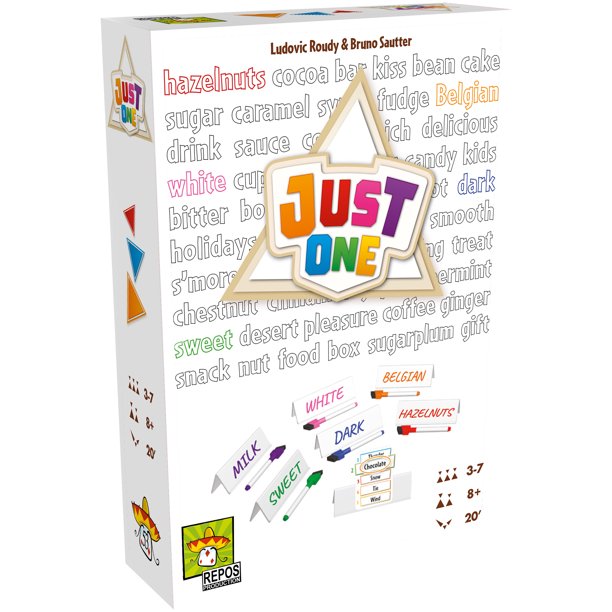
    There’s nothing quite like the laughter and fun a good family or party game creates. And we discovered two games this summer that have brought hours of pleasure.

    The first is Just One. It’s for 3 to 7 players and takes about 20 minutes to finish.

    Now, I was skeptical of this game at first because it’s a cooperative party game.

    I mean, come on. Cooperation?

    No teams?

    No competition?

    What were we going to do—hold hands and sing Kumbaya?

    I was fully expecting to be bored out of my mind. Boy, was I wrong. There was suspense, laughter, and loads of fun.

    There are 13 rounds in each game. In each round, one player blindly selects the number of a word on one of the game cards. The other players each write a one word clue to help that player guess the word. However, if two or more players write down the same word, they have to remove that clue.

    So you’re trying to come up with one-word clues the others won’t that still help the guessing player. Some clues lead the guessing player off onto funny tangents. Others are just funny. And then there’s the suspense of whether someone else wrote your word and whether the player will be able to guess it from the clues that are left.

    Your goal is to guess all 13 words selected. And there’s a little score card that ranks what it means if you get 13, 12, 11, etc.

    As an aside, it’s crazy to me that the score card provided motivation. But it did. It was a delightful little brain hack.

    One Word is a quick, fun game. We’ve played it with a few as 3 and as many 8 players and had a ball each time. We are so happy to have it in the family game closet.

    The next is Fish Bowl. It’s for 4+ players. What this game does is take favorites like Taboo, One Word, and charades and mixes them together in a competitive game between two teams.

    Here’s how you play it. Each person writes up 5 to 7 different words or phrases on separate slips of paper, folds the papers, and puts them in a bowl. Then you do 3 rounds.

    Round 1 is like Taboo, where you can describe, but can’t say or act out the word or phrase on the paper. You select a team to go first. One person on the team selects the papers from the bowl and then tries to describe the word or phrase. The team has 30-45 seconds (you decide) to guess as many of the words as possible. When the time is up, it’s the other team’s turn. Back and forth you go, selecting a new team member each turn to give the clues, until there are no more slips of paper in the bowl. Then you count the number of slips each team got and move to round 2.

    In round two, you put all of the slips of paper back into the bowl. The team that went second in the first round starts this one. This time the person giving clues gets to share one word. That’s it. And the team has to guess it. Again, the team has 30-45 seconds to guess as many as they can.  Then it goes to the next team. And you switch back and forth just like you did in round 1, and when the slips of paper are gone, each team counts up their score.

    In round 3, you put all of the slips of paper back into the bowl. The time the person giving the clues has to act them out. No words allowed. You run this round just like you did the first two with  30-45  second turns, switching back and forth between the teams until all the papers are gone. At that point, the teams  total their scores for this round and then for all 3 rounds together to see which team won.

    If you don’t want to use paper, you can play a version online.

    Either way, it’s another fast, fun game. In fact, we played it last night. And laughed and laughed when one daughter was trying to get the other to guess “sling” and nailed her teammate in the head trying to act out a rock hitting Goliath.   Movies are great. But sometimes what you need is some delightful game fun. And I’m betting you’ll love these.

    Share
  • Good Stuff! The political book for our times

    I just finished the most important book on politics I’ve read in years.

    Years.

    In fact, I’ll go so far as to say it is the book for our current political times.

    I say this because America isn’t facing the threat of Communism, Nazism, poverty, illiteracy, or disease. ISIS and the terrorists are on the run. We’re beginning to figure out a better way of treating our LGBT brother and sisters. And we’re not poisoning ourselves with the broad-based racism or sexism of the past. Yes, there are lots of areas where we can improve. But these are not the main problems of our current time.

    In my opinion, the main problem of our current time is a burgeoning contempt between left and right.

    Political scientists find our nation is more polarized than at any time since the Civil War. People in positions of power and influence on both sides of the spectrum, and everywhere in between, are setting us against each other. They tell us our neighbors who are on the other side are evil, corrupt, or stupid. And must be utterly vanquished. And many of us perpetuate the message, very frequently on social media.

    By some measures the divide between right and left in America is beginning to approach the size and feeling of the one between the Israelis and Palestinians.

    Is that really where we want to go?

    I think most people will agree with me that it is not. So what do we do about it?

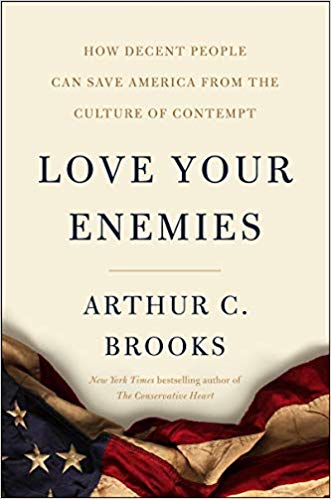
    May I suggest we start by reading this terrific book by Arthur C. Brooks called Love Your Enemies: How Decent People Can Save America from the Culture of Contempt.

    With that title you might think Brooks is suggesting that the solution to the divisions in our country is to start a national program for the singing of “Kum Ba Yah.” If so, you would be wrong.

    Brooks doesn’t claim we need less disagreement. He thinks we need more disagreement. Yes, you read that right. More. He’s calling for more, strong disagreement. It’s just that we need to disagree in a better way. A different way.

    At this point you might be wondering how it’s possible to disagree, and in greater amounts, and not run the nation off the cliff in flames.

    I was wondering that too. And Brooks provides the research, the thinking, and a number of practical methods in his book. Brooks will make you think about how we interact in a totally different way. And he does it with his trademark good humor. You’ll laugh, you’ll think, and you’ll come away seeing a better path.

    If a good portion of us disagree the way Brooks is suggesting, it will change our country. All we need is a core of us willing to try.

    If you’re interested in politics, if you are getting tired of the insults on social media and the news, if you’re tired of the way the parties are not working with each other in Washington, I think you’ll love this book.

    If you want a taste of what Brooks is talking about, watch his eleven-minute commencement speech at BYU this last April. Find it here. If you want another taste, watch his TED talk.

    Share
  • Gun Runner submitted!

    Gun Runner, the action-packed, science fiction novel Larry Correia and I have been working on, has been delivered to Toni Weisskopf at Baen Books.

    It was a blast to write.

    This song was played, as was appropriate, in celebration.

    The seed came from Larry’s eleven-year-old son. When we sat down to develop an idea for a sci-fi con presentation a number of years ago, Larry asked: “Joe, what’s cool?”

    The answer: “Giant robots, bandits, and murderers.”

    We looked at each other and said, “That IS cool.”

    And thus was a story born.

    The current description Baen has goes like this.

    “Once, Jackson Rook was a war hero. Raised from boyhood to pilot an exosuit mech, he’d fought gallantly for the rebellion against the Collectivists. But that was a long time ago, on a world very far away.

    Now, Jackson Rook is a criminal, a smuggler on board the Multipurpose Supply Vehicle Tar Heel. His latest mission: steal a top-of-the-line mech called the Citadel and deliver it to the far-flung planet Swindle, a world so hostile even the air will kill you. The client: a man known only as the Warlord. Rook has been in the smuggling business long enough to know that it’s best to take the money and not ask questions. But Rook cannot stand by and watch as the Warlord runs roughshod over the citizens of Swindle, the way the Collectivists did on his homeworld. For all his mercenary ways, Rook is not a pirate. And deep within the smuggler, the heart of a warrior still beats.”

    The book should be available February, 2021.

    Share
  • LTUE 2024 Writing Presentations

    Yesterday, I gave two presentations at Life, The Universe, and Everything, a SFF writers conference in Provo, Utah. A number of the attendees wanted copies of the presentations. I’ve linked to them below.

    There are two types of plots that power almost all successful commercial fiction. Are you using them in your stories? Do you know how they work? In this class, you learn both plot types, their key beats, the 3 big mistakes writers make, how to generate scenes, and much, much more. Come learn how to make plotting easier and deliver the ride your readers are looking for.

    My lecture notes.

    The #1 thing that slays more writing dreams than anything else is the writer’s own head games. In 2005 I fiddled with death. Cognitive therapy (and God and a good counselor) saved me. And gave me an explosion of insights about writing stories and the distortions that sabotage so many of us writers. In this class, you learn the distortions, the truth, and a tried-and-true technique for removing the distortions that anyone can follow. You don’t need to struggle anymore. Banish your writer’s block, fear, imposter’s syndrome, comparisonitis, and more. Come learn how to unleash your awesome creativity and have a blast writing.

    PDF of presentation slides.

    Share