If you feel a bit lost or anxious about how to teach narrative for the new core, especially stories, I think I can help.
I’m an educator in the private sector and an award-winning novelist and short story writer. I’ve been teaching authors in various venues how to write for the last five years. I’ve been on writing podcasts with thousands of listeners, taught at a number of writers conventions, and had a series of articles published by the national Science Fiction and Fantasy Writers of America organization, an organization for professional authors. I’ve also been helping Nellie, my wonderful wife, teach her 7th and 8th grade language arts students the unit on short stories during that same period. We’ve taught it to twenty different classes and picked up a number of important insights along the way.
This last year I couldn’t help but examine all the materials Nellie brought home during the district’s writing program adoption investigations. Some programs looked very promising; others not so much. Some got some things about writing flat out wrong. Most of the programs had gaps.
Furthermore, because I work with so many people wanting to write, I know that it’s difficult to teach if you really don’t understand what stories really are and how they work. For lots of people, the subject matter can seem impenetrable. And yet writing stories is such a wonderful way to teach writing, especially because so many kids love it. You won’t find a kid who will spend extra hours writing a business letter or poem analysis, but you will find quite a few who will go crazy writing stories. And the whole time they’re practicing their writing skills.
The question is how DO you write a story?
What is a story?
How can you tell if it’s good?
How do you come up with ideas?
Where do you start?
And what the heck is this chart? Do writers really use this? (Not many that I know.)
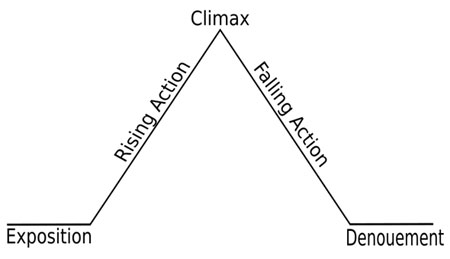
And does anyone think changing the diagram to look like Aspen, Colorado actually helps?
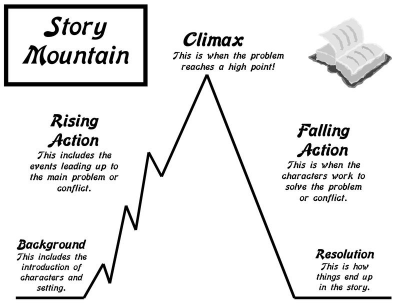
Hey, students—please make your story look like Aspen, Colorado! (Yeah, that’s going to be effective.)
And yet it’s not as difficult as it appears. Nellie and I have seen a lot of kids really get into writing stories. We’ve seen kids WILLINGLY going way beyond the assignment to write stories that are eight, twelve, twenty-five plus pages. And as they’re writing, they’re practicing grammar, spelling, structure, vocabulary, etc. without knowing it and having a great time. I know that if you enable your students, many of them will write, write, write. Especially in grade school. But also in the higher grades.
Stories can be a blast. The assignments can connect to many students. And the results can be wonderful. I’ve laughed out loud at some of the stories coming out of Nellie’s class. Others have been enjoyable on other levels.
But for this to work in your class, you need to know some key things. You need to understand the core of story and the story development process. You need a lesson plan that details everything step-by-step so your students don’t flounder. And you need to know some fundamental tips (secrets?) about teaching this content.
So I’m going to hold this day-long class for you. A full eight hours. And share everything Nellie and I have learned. This class will be for teachers at ALL levels (I’ll show you some ways to scale the complexity of what you’re doing). There will be NO cost. The only thing you have to bring is a pencil, paper, whatever program materials you have, and a willingness to have a good time.
When we finish, you will know how to write a simple story like the ones your students will write because, ta-dum, you will write one! AND you’ll have a step-by-step lesson plan that builds on whatever materials you have—an official program or one of your own. AND you’ll understand story better than 99% of the population. AND you’ll have a bundle of techniques to help your students. AND you’ll solve both world peace and maybe the lost sock conundrum.
Truly, I think that instead of feeling stress, you’ll actually be looking forward to teaching and writing stories with your students. If not, you may bring tomatoes and huck them at me, but please be aware that I will not stand still; to find satisfaction, you will have to be able to hit a moving target.
If you’re interested, just click the Contact John link under my photo in the left sidebar and send me an email letting me know.
Hope to see you in class!
GET READY FOR A FUN DAY OF LEARNING!
Topic: Teaching writing (narrative & the common core)
Who: Teachers (and writers at least 18 years old), seats are limited
When: Monday, July 29th, 8:15 AM – 5:00 PM
Where: Rich Middle School, 54 E 100 S Laketown, UT 84038
Materials you need to bring:
- Pencil
- Paper
- The writing program you’ll be using this year
- Kooky socks, for those who cannot resist the urge
- A lunch or a way to get one
AGENDA
8:15 AM Arrive
8:30 AM – 9:20 AM
- Can you create a redneck crapper?
- The 1st secret to teaching writing: Attributes & techniques
- The 5 parts of story
- Thieves prosper – using existing patterns
- A car, a beggar, and an idiot — basic pattern 1
9:30 AM – 10:20 AM
- The 2nd secret to teaching writing: Do it with them
- Technique: Sketch then draft
- Workshop 1: Zombies and kisses
- Technique: Zing hunting
- Workshop 2: Hunt zing
10:30 – 11:20
- What makes a story big or small
- Workshop 3: Select a right-sized THOM and character
- Workshop 4: Select a Goal
- Workshop 5: Make character sympathetic
- Workshop 6: 3 tries
- Workshop 7: Resolution
LUNCH
12:00 – 12:50
- The 3rd secret to teaching writing: Cognitive modeling and the 6-step process
- The 4th secret to teaching writing: Our tiny brains
- Writing is telling: Narrative & description
- Technique: Yes, SiR
- Technique: Broad-brush + 1
- Technique: The Pause
1:00 – 1:50
- The 5th secret to teaching writing: Have fun
- Workshop 8: Write your story
2:00 – 2:50
- How the pros revise—concept, line, & copy
- Workshop 9: Content edit
- The 6th secret to teaching writing: Our brains are still tiny
- Workshop 10: Line edit
3:00 – 3:50
- The 7th secret to teaching writing: The 3 grunts (responding to a story and grading)
- Share stories
- What the heck did we just do?
4:00 – 4:50
- How to adjust for grade level
- Common core
- Your program and lesson plan
- Identify black holes
- Wrap up & next steps

Thank you, John, for presenting your dynamic and enlightening, “Lessons On Story From The Hunger Games.” When I watched your presentation last winter at LTUE I had an “Ah ha” moment. Given the opportunity to pick and choose over the workshops at the URWA conference, I decided that your presentation was one of the most important I’ve ever seen. Sometimes people giving you bullet points about elements, conflict, beats and turning points isn’t as effective as demonstrating where, when and why the emotion hits you/sucks you into the story.
You are a fantastic and engaging speaker, and I cannot thank you enough for agreeing to come to our conference.
PS. Thanks you the Lesli thing, I wish I’d been there to see it. Note to self: Do not make declarations of love over the internet. Someone is always watching…
Lisa, you make me blush. So happy to hear you found it useful. I really had a good time 🙂
Okay, now, I’m really hoping SOMEBODY will take pity on me and clue me in on exactly what happened with the sweet dream telegram. I really think I deserve a few details! You know how to reach me….
Lesli introduced me. In her introduction she said that “this is the man I said I’d leave my husband for.” Then she read a bit of my bio, saying why: I’d been raised a florist and pugilist. Loving flowers and a good fight. Then she revealed she’d been a florist. But then she indicated how embarassed she was because she had no idea I’d bring my wife along to the conference.
Oh, Lesli, how little you knew at the time. . .
I started my presentation. At the part where I pointed out that the three romance covers were using the same dark-haired chest waxer, I deepened my voice and revealed that I was thinking about getting my own chest waxed. The audience laughed. Then I said, “Lesli Lytle.” There was a small uproar. “Lesli Lytle,”–still in the deep voice–“Are you here?”
Her friends all shouted. “Here, here!”
Lesli’s eyes went wide. Her face reddened.
I paused. “Lesli,” I asked, “you know what your name means in ancient Gaelic, don’t you?”
She shook her head.
“Oh, yeah,” I said meaningfully, fanning my face.
The audience laughed. Lesli at this point had very good blood flow to her face. I think she tried to duck under the table.
“Lesli,” I said. “I have it upon good authority that you perform”–I paused a beat for effect–“acts of waxing upon select men.”
The audience hooted. Lesli told me later that she was so embarassed at this point she lost her hearing.
“Is this true?” I asked.
She couldn’t speak. “Yes,” a woman said. “She does!”
But Lesli shook her head.
“Alas,” I said. “In such a way, over cheesy potatoes, are a man’s hopes dashed upon the rocks.” I made my voice throaty. “I hunger, Lesli,” I said. “I”–pause–“hunger.”
The audience hooted and roared.
“And that,” I said, “is your sweet dreams telegram, wishing you a happy Friday, with love, from Sherry Lewis Brown.”
The audience awwwed. Lesli was beet-red, shaking her head in that “oh, I’m going to get her” manner. And then I got on with the presentation.
Lesli was such a good sport. And it was perfect for the audience.
ROFL. Okay, not true. Sitting in my chair laughing — out loud. That’s too, too funny! Thanks for the laugh. I definitely needed one this morning!