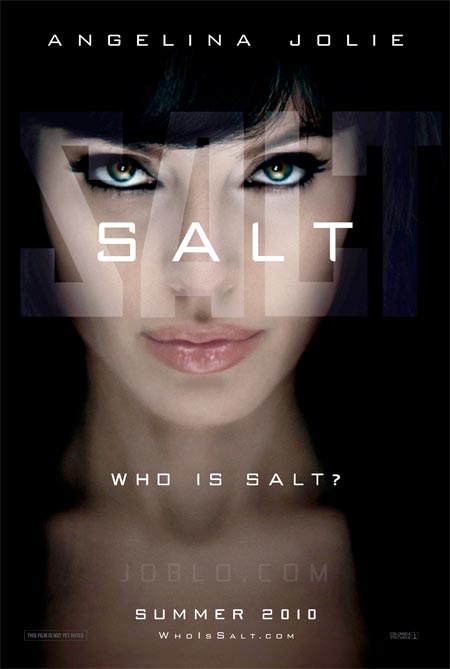
 Last week I went and saw Salt. Wow. The movie started with a bang and was off to the races with lots of great action. Unlike many action films where the characters perform stunts which are simply too hokey for me to buy into, I found myself believing in all but two of Salt’s. So I was wowed most of the time instead of thinking about whether they were using wires or what or that it was all so wrong and geeze don’t these guys have consultants? They weren’t as stunning as the opening of Casino Royale, but what is?
But it wasn’t just action. The premise and acting were all great as well (yes, I recant, I slammed Jolie a while back as an actress cast only for her face value; and while you know that’s one of the reasons why she was here, she still was convincing in her role). Furthermore, the story had a lot of great reversals and reveals. But this was also its ultimate downfall.
When I got to the ending, I did not feel a climax release. No catharsis. No afterglow. It just ended and left me feeling empty. It’s an awful feeling. Totally unsatisfactory. Such a maddening cut off.
But why? It was all so good up to that point.
*** SPOILERS ***
As I was talking it over with Nellie I believe I indentified the answer: in their effort to be surprising, the director and writers removed everything that would have built suspense. So instead of getting a Sixth Sense ending where the surprise adds to the climax and gives it a wonderful texture, we got a slap of surpise and then nothing.
For me to feel relief, triumph, and the desire to stand up and cheer–all those great climax emotions–I have to be worried about a character. Stressed, thinking they’re going to fail. They need to fight courageously against insurmountable odds and actually come to a point where it appears all is lost. Where I groan inside. All this creates massive pent up worry and anxiety for them. And at that point, the character snatches victory from the jaws of defeat.
Boom! The climax floods me and it’s delight, relief, cheer, joy.
It’s just like a football game where we bite our nails until the very end. Where our non-ranked team is playing the #3 team in the nation. Maybe we jump ahead in the second quarter, but in the third we fall behind. We make some great plays but can’t catch up. And when we do put points on the board, the other team immediately responds. There are three seconds left. We’ve stalled at the twenty yard line. We have one more play. From the moment it starts it appears to be broken, our QB is going down, and then . . . he passes to a running back who has made some space. Who is standing open in the end zone! Yeeeeeaaaaaaahhhhhh!
In order to feel a release a climax, something has to build up. The thing that builds is worry, fret, desperate hope. This is what we mean when we talk about suspense. We know the team’s goal, see their predicament, see the overwhelming odds. See them about to lose it all. The dread of defeat and what will be lost rises.
But in Salt the director and writers went for the effect of surprise instead of suspense and triumph. The moment Salt starts in on the Russian president I thought she was the bad guy. Yes, there was the bit about the spider that had me wondering. Yes, I knew she felt anguish about her husband being killed (that smart little reveal in her expression). I knew all of that. But the movie kept me busy thinking she was the bad guy up until almost the very end. Everything in the film lead me to believe this. Not because I didn’t get it. I got it precisely. It’s exactly what the director wanted. It was the setup for the big surprise/reversal at the end.
But when they went for surprise by not letting the audience know what Salt was really up to, the immediately removed the possibility of suspense. So I didn’t feel any suspense at her infiltrating the old group of spies. No relief at her killing them–that was just her revenge. No suspsense when she went to the White House. Nothing when she chased the president down the elevator shaft. The whole time I was thinking, crap, they really did indoctrinate her. She’s bad.
More importantly, there was no rooting, no worry building to release proportions.
Not until the very end do we realize what she’s been trying to do. Oh, the role reversal with her and Ted Winter (btw, like Liev Schreiber who plays the part) was all a big surprise, as it was designed to be. But the surprise faded and there was . . . nothing to replace it. That’s how surprise works. It’s a relatively short effect.
Yes, she kills Winter. Yes, he was a threat at the end with his scissors, but I didn’t care that much. I hadn’t been whipped into a fever pitch. Not like I was in Gladiator with the emperor and the lead in the coliseum. There was no pressurized worry ready to burst. There wasn’t any because we hadn’t had any time for it to build and because by that time nothing for Salt was really at stake. The one meaningful thing she stood to loose–her relationship with her husband–was taken away from us in an earlier scene when he was shot dead. So what was at stake? A big old nuclear war. Well, who cares about that? Nobody. It’s too generalized. We cared about Salt and her husband.
The result was that the director and writers traded climax for surprise. Alas.
So here’s my conclusion. Surprise is a relatively easy effect to create. You simply have something unexpected but logical occur. Relief, triumph, climax needs something much different. And surprise can be a part of it. But in our effort to build surprise we must not remove the conditions necessary for please-dear-mother suspense. Suspense requires we root for and worry about a character for a significant period, our unease growing until it’s drawn taut, straining. All the time something significant has to be at stake. Something we can sympathize with. Something personal to the person we care about. Only then can we feel the climactic release. Only then will we stand up and cheer in holy-crap-no-way relief and delight.
 How would you like to listen to a master story teller for almost an hour? You can. Radio West recently interviewed Pete Docter who directed Pixar’s recent motion picture Up.