We all know about the placebo effect. Well, here’s its ugly brother.
nocebo (no-SEE-bo) noun: A substance producing harmful effects in someone because it is believed to be harmful, but which in reality is harmless. [From Latin nocebo (I will harm), from nocere (to harm). Modeled after placebo (I will please).]
Both groups who received nocebos showed elevated levels of the stress hormone cortisol in their blood.” James Morgan; Is Your Pain a Trick of the Mind? The Herald (Glasgow, UK); Jan 12, 2007.
An article with many interesting examples of nocebo effect.
One of the most basic way of coming up with story ideas is to take a familiar story or thing, list out what’s commonly associated with it, then start changing some of those elements.
For example, you list out all the normal things for vampires–the coffins, black, bats, sucking blood, etc.–then you begin to twist. What if the vampire wears, instead of black, some styling plaid? What if it isn’t a person but a rabbit (whoops, that one’s been done)? What if instead of gothic places like catherals you find him in a trailer park? What if instead of being dangerously suave, he’s a drunk?
Do you see? You can do this with anything.
In this interview, Matthew Sturges talks about how he did just that with the movie The Dirty Dozen and ended up with with Midwinter, a novel about prisoners given another chance. According to Sturges, “In the case of Midwinter, the beginning of the story was, ‘What is prison like in Faery?'”
Read the whole interview. I think you’ll find it enlightening.
I have read few books more interesting than Temple Grandin’s Animals in Translation: Using the Mysteries of Autism to Decode AnimalBehavior.
In it she describes her world of autism and how it helped her a perspective into animals unlike any other expert in the field. She can literally see what we block out. It’s part of what helped her make a huge impact on the meat packing industry.
And it’s had an impact on her. When she was visiting her grandparents once in Arizona, she saw a squeeze chute in operation on a ranch. She saw the cattle calm, for the most part, in the chute. “Watching those cattle calm down,” she says, “I knew I needed a squeeze chute of my own.” So when she got back home she built a human-sized one with the help of her teacher. “I got through my teenage years thanks to my squeeze machine and my horses.”
Grandin is not a vegetarian activitst (she eats meat herself) or a brutal slayer. She has taken the middle ground between the fantatics that want to prevent the consumption of all meat, on one hand, or totally disregard the life of animals on the other. She writes, she says, “because I wish animals could have more than just a low-stress life and a quick, painless death. I wish animals could have a good life, too, with something useful to do. I think we owe them that.”
Temple has dozens and dozens of insights into animals, which she shares here. You’ll learn about rapist roosters and the problem of one-trait breeding, whether prediators find it “fun to kill a groundhog” (yes, she says, they do), whether animals have true cognition, and so many other things it’s impossible to list them here. I was fascinated on every page. If you have anything to do with animals, you’re going to LOVE this book.
Get the book. Read it. In the meantime, watch a 27 minute interview of Temple by Doug Fabrizio on Utah NOW. I caught this on TV flipping through the channels and couldn’t look away. This is a fascinating interview of a fascinating woman.
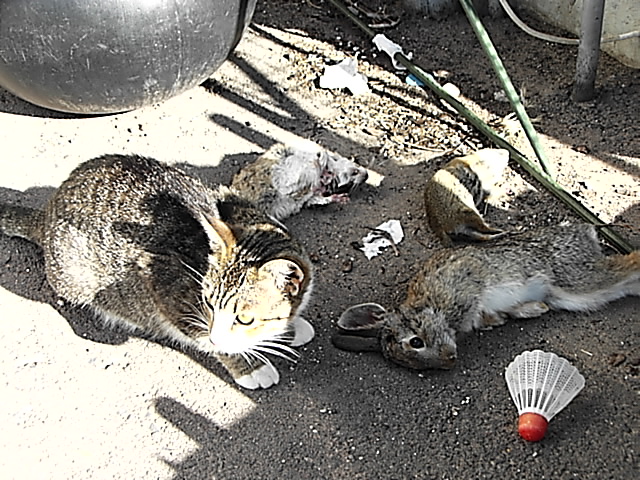
I figured regular readers would want a break from all the book release news, as fascinating as it is. And so I present to you my photograph, “Mumma, Cat of Death.” (I need a new camera. The quality of this piece of junk is so stellar.)
Mumma was a stray that showed up in our garage one day, freaked many of the long-timers, and then got pregnant. Up here in the ranch lands there are no such thing as spaying and neutering. There are a number of Toms, and, well, we were too slow with our communist population control program. So she had five cute kittens. Up until that time she was satisfied with catfood and an occasional bird or mouse. After that, she became Mumma, Cat of Death.
What you see above is only PART of the catch of ONE day: a packrat, a ground squirrel, a bird (she ate it, what you see on that piece of white paper is what she left–one leg), and a rabbit. Notice, she’s looking away from her catches. I think she was eying a visitor’s toddler at that moment, deciding if she could take him down. Every day she hunted up a few meals. And these were not for show, not nice gifts left on the doorstep for the master. No, she’d bring them up from the fields, let them ripen a bit, and then start in at the head. But she wouldn’t always eat the whole thing. Sometimes she’d leave it for the kittens. Sometimes, she’d just leave it for the next day. She turned our garage into a scene of blood and carnage.
On your left you may observe King Charles the 1st of England, the man who mandated the collection of urine. It was a patriotic thing.
Dude.
I love, LOVE, finding out how they used to make things. And it seems that making gunpowder back in the day spawned all sorts of jobs that beg to be put into a novel.
You’ve heard of tanners, bakers, tailors–how about a peterman, as in a collector of saltpeter?
QUOTE 1: “By the end of the 1500s, the standard formula for military-grade gunpowder was saltpeter, sulfur, and charcoal dust in the ratio 6:1:1.
At this time, the only source of potassium nitrate was from rotting organic matter, especially rotting meat and urine. The saltpeter supplier would send out teams of collectors who would locate promising places to dig (abandoned privies and dungheaps) by tasting the soil before digging it out and carting it off to be boiled, strained and evaporated to produce saltpeter of the required purity. It is said that throughout Europe no privy, stable, or dovecote was safe from saltpeter collectors or ‘petermen’.”
QUOTE 2: “In 1626, King Charles I ordered “his loving subjects [to] carefully and constantly keep and preserve in some convenient vessels or receptacles fit for the purpose, all the urine of man during the whole year, and all the stale of beasts which they can save and gather together whilst their beasts are in their stables and stalls, and that they be careful to use the best means of gathering together and preserving the urine and stale, without mixture of water or other thing put therein. Which our commandment and royal pleasure, being easy to observe, and so necessary for the public service of us and our people, that if any person do be remiss thereof we shall esteem all such persons contemptuous and ill affected both to our person and estate, and are resolved to proceed to the punishment of that offender with what severity we may.”
There are more interesting facts in the short article. In fact, a number of the pages at that site yield up some gems like this Rudyard Kipling poem:
Gold is for the mistress, silver for the maid
Copper for the craftsman cunning at his trade
“Good!” said the Baron, sitting in his hall
“But Iron–cold iron–is master of them all.”
I know that discussing genetic factors of intelligence is something many do not want to do because such notions have been used horribly in the past. And because there are groups who would like to continue such horrible abuses today.
However, it makes no sense to me to avoid such discussions. There are so many things, from mental illness to physical strength, that have genetic factors that it’s just stupid to ignore data that suggest intelligence also has such factors.
And so I offer you this paper from three folks at the University of Utah which “elaborates the hypothesis that the unique demography and sociology of Ashkenazim in medieval Europe [Jews descended from the medieval Jewish communities of the Rhineland in the west of Germany] selected for intelligence.”
It may turn out the hypothesis of these researchers is wrong. But you’ll never know even what they’re proposing without giving it a gander.
Not many people understand creativity. Dewitt Jones, a National Geographic photographer, does. And this video on the creative process, HOLY COW, it’s so good I had to buy it so I could watch it whenever the yearning took me.
But this isn’t just for artists. The principles of creativity apply to any creative endeavor–from writing and drawing to building microchips and parenting.
Go here. Watch the brief clip. Then watch the whole Clear Vision video. Tell me what you think.
Capture the zing!
One Comment
Well, that is really interesting! I’ll have to remember that.
Actually, I have a question (favor?) to ask of you, which is how I found my way over here in the first place. I couldn’t find your email address on the site, so I figured I’d just post in the comments here. I recently read about your book in Publisher’s Lunch Weekly, and I had something to ask you regarding that. If it’s not too much trouble, could you email me? I understand if you can’t, but I would really appreciate it. Thanks!

 One of the most basic way of coming up with story ideas is to take a familiar story or thing, list out what’s commonly associated with it, then start changing some of those elements.




Well, that is really interesting! I’ll have to remember that.
Actually, I have a question (favor?) to ask of you, which is how I found my way over here in the first place. I couldn’t find your email address on the site, so I figured I’d just post in the comments here. I recently read about your book in Publisher’s Lunch Weekly, and I had something to ask you regarding that. If it’s not too much trouble, could you email me? I understand if you can’t, but I would really appreciate it. Thanks!