The Drowned Cities by Paolo Bacigalupi
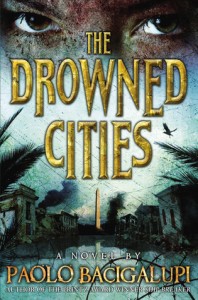
The Drowned Cities by Paolo BacigalupiI just finished The Drowned Cities by Paolo Bacigalupi, and, holy cow, folks—this story rocked.

It’s set in the future in the area around Washington D.C. which is the titular drowned cities. They’re drowned because the climate has gotten warmer, the seas have risen, and D.C. is half under water, permananetly flooded. It’s more like Georgia or Florida—gators, kudzu, the works. But this is not another dumb book about global warming. If it were, I wouldn’t be writing this.

No, the United States has fallen apart. Up north there’s some alliance with money and power and the ability to keep those in the Drowned Cities out. South, who knows? West? Don’t know. But right around D.C. everything has gone to hell.

It’s like Mogadishu, Somalia in the 1990’s (Blackhawk Down) with warlords fighting each other, tearing the place apart.

It’s like Sierra Leone at the end of that decade with different factions butchering locals and forcing kids to fight as soldiers.

Except instead of the U.S. or Europe or the U-freaking-N sending in peacekeepers to stabilize the situation, it’s China. And just like the U.S. in Somalia, the warlords send the Chinese peacekeepers packing. And so now it’s just chaos.

Talk about a setting for a story. But Bacigalupi doesn’t stop there. He adds in genetically modified creatures. He starts the book with one named Tool. A creature that’s got the DNA of humans, mastiffs, tigers, reptiles and who knows what else all combined to make him smarter and stronger than humans ever could be—a monster that’s the ultimate killer, the ultimate soldier, the ultimate war machine. One that was bred to submit to a master, but something went wrong with Tool. And he was able to break free of that bond.

Tool is trying to escape prison and death. But as mighty as he is, he’s weak and injured. And then two kids from a village run into him while in the jungle. He knows they’re going to reveal his whereabouts to the warlord searching for him. In his weakened state, Tool is only able to grab the small boy named Mouse.

Mahlia, the girl, promises to bring medicine if Tool will only spare the boy. He knows she’s lying.

And so starts a rich tale of the monster, the boy, and the girl: a tale that is filled with friendship, triumph, loss, heroism, cowardice, and earthy sci-fi coolness all set in the midst of a guerilla war. The beginning sucks you in. The ending leaves you breathless. Along the way you get to see into the character of all three plus some of the bad guys. In the end you get a story about sacrifice and love.

If you liked A Long Way Gone, Ishmael Beah’s memoir of his time as a child solider in Africa; if you liked The Hunger Games, and not primarily for the romance; if you like person in jeopardy fiction or war flicks where a small group has to fight for its life, I think you will love this book.

This is the second book set in the same world. The first was Ship Breaker. Tool, one of the most interesting characters I’ve come across, is in that one too. But you don’t need to read that to enjoy this. And I wouldn’t put this read off to do so. Go give The Drowned Cities a try. Three or four pages in, I suspect you’ll be completely lost in the wondrous tale.

Share

Similar Posts

  • The Sing-Off, Sam’s Salmon, The Englishman Who Went Up A Hill

    One of the best TV programs this fall

    American Idol was good until the judges became irrelevant and annoying. Or maybe I was just tired of the format. I didn’t think I’d watch another singing show. But I tuned into the opener for The Sing-Off on NBC last week, and holy harmonies, Batman–it was wonderful.

    Ten of the best a’capella groups in the country compete for a $100,000 prize and a recording contract with Sony Music. Unlike American Idol, the groups represent a wide range of ages—from kids in high school to older adults—and backgrounds. They don’t use any instruments, just their voices, to sing incredible arrangements of modern songs with percussion, bass, and lovely vocals. This ain’t no choir music. And unlike American Idol, the judges actually have interesting and useful things to say. Also unlike American Idol, the judges eliminate the groups until three are left. Only then do the rest of get to call in and vote.

    We were glued to the TV watching each episode. The programs are all two hours long, but move like lightening. Our favorite groups at this point are Committed and The Backbeats.

    This whole show runs a total of three weeks, one episode each on Monday and Wednesday. It started last week, continues this, and finishes next week. Some of you might be depressed, feeling you’ve already missed it.

    Not so! You can watch all of the full episodes online at www.nbc.com/sing-off/ (with fewer commercials). Then tune in for the grand finale. I can’t wait. 

    Are you kidding? From a can?

    Canned tuna fish is one of those un-meats. It doesn’t taste like fish. It doesn’t taste like chicken. I guess the all-white albacore is okay. But tuna’s not one of those spectacular foods I crave.

    So you’d think, as I strolled the isles of Sam’s Club, that I would have passed up the canned Member’s Mark Atlantic Salmon. But one of my wild culinary urges, the ones that rarely pan out, overtook me.

    I purchased a pack of five, seven-ounce cans for $11.88. I brought the pack home put it on the shelf and didn’t dare open it. What was I thinking?

    Canned salmon? Canned meat?! When was the last time you had a steak out of a can?

    It couldn’t be good.

    Of course, my sensible hesitations only last so long. I broke down one afternoon when the cupboards were bare. I saw the salmon and thought that it might go well with a salad and baked potato.

    I opened the can. It was pink, like the trout I used to catch and immediately fry when I went camping as a boy. I tasted it. And it tasted like .  .  . fish. Real fish. The light delicious taste of those trout I caught so many years ago.

    I enjoyed a wonderful meal that day and have had several repeats since. Boneless, skinless filets in water, packed with omega-3 fats, all grown on fish farms in Chile. 

    Great movie set in Wales

    I enjoy Hugh Grant as an actor. I loved him in Sense & Sensibility with Emma Thompson, one of my most favorite movies ever. And so I was curious about another movie with Grant that received two thumbs up from Siskel and Ebert. It’s called The Englishman Who Went Up A Hill And Came Down A Mountain.

    The setup is unusual. In 1917, with the war still raging in Europe, two English cartographers visit the small South Wales village to measure what is claimed to be the “first mountain inside of Wales.” The villagers are proud of their “mountain,” but become alarmed when the Englishmen measure it and find it’s not a mountain but a hill. The villagers are determined not to lose their status. Especially not to two Englishmen. What follows is good humor, drama, and a bit of romantic comedy. I think you’ll fall in love with the characters. It’s a wonderful tale. And it’s on DVD.

    As a little bonus, here are the opening lines, given to us by two narrators.

    “Narrator: For some odd reason, lost in the mists of time, there’s an extraordinary shortage of last names in Wales. Almost everyone seems to be a Williams, a Jones, or an Evans. To avoid widespread confusion, Welsh people often add an occupation to a name. For example, there was Williams the Petroleum, and Williams the Death. There was Jones the Bottle, and Jones the Prize Cabbage… which described his hobby and his personality. Evans the Bacon, and Evans the End of the World. But one man’s name was a puzzle, and it wasn’t until I was 10 years old that I asked my grandfather about the man with the longest and most enigmatic name of all.

    “Grandfather: The Englishman Who Went Up a Hill but Came Down a Mountain? Now there’s a long name for you. And a long story. You are not going to fidget, are you? For this is a story… an epic story. Yes, epic.”

    Share
  • The 2009 BBC version of Austen’s Emma

    Emma BBC Romola GaraiYou read some reviewers because they regularly set you back in your chair with keen insight. You read others because their phrasing and voice are so delightful that you find yourself unable not to read, even when they venture forth into exciting areas like soup cans and lug nuts. I, alas, fear I cannot occupy either role when I tell you about the BBC’s 2009 mini-series production of Jane Austen’s Emma.

    I cannot because have no keen insight into acting or film-making or film adaptations. I am not an expert on the late 18th and early 19th century England.  I am not an Austen junkie (although you can be sure I intend to become one shortly).

    Surely, as a writer, I could come up with some kind of amazing assessment. But I cannot because I am speechless. I am filled with a fine joy. I have spent nearly four hours with my wife and two of my lovely daughters watching a delightful tale unfold about the fates of a number of characters–some foolish, some arrogant, some quirky, but most of them splendidly human and noble.

    This. THIS is what I go to story for. To be transported. To laugh. To cry. To hope and fear and feel suspense for another.  To spend time with wonderful characters.  To have lived just a little more while under the story’s sway.

    Gush, gush, gush.

    Such an unmanly thing to do. But to hell with that. I am a man who loves Jane Austen and shoot ’em up thrillers both.

    And if you enjoy Cranford or Pride & Prejudice or Downton Abbey, then you will love this production of Emma too. You will want to own it.

    Romola Garai plays the star role of Emma. I enjoyed every minute she was on the screen. I didn’t know who she was, but it appears she was in the 2006 Amazing Grace with Ioan Gruffudd. I might have to watch that one again just to see more of her work. Mr. Knightly, Emma’s lifelong friend, is played by Jonny Lee Miller who starred in Eli Stone, one of my favorite TV series. I loved watching every minute with him equally as well. There were some other familiar British actors; and more I hadn’t seen before. I thought they all did an excellent job.

    As for the story, it’s about Emma, who believes she has an amazing ability at match making and prognosticating and very soon runs into to trouble because of it. It’s also about kindness, and generosity, and, most of all, love. Of so many varieties.

    If you’re wondering what to watch this next week, order this one now.

    Share
  • “Clockwork Chickadee” by Mary Robinette Kowal

    Mary Robinette Kowal is a professional puppeteer and a dang good story teller. I ran across her “Clockwork Chickadee” this last summer and forgot to blog about it. Then she won the Campbell Award. And I thought to blog it again. Now it’s November and you see what it means to run on “Brown time.” But however belated my review, this story is marvelous. The images have stuck in my mind since that first reading. And the chickadee, well, let me share the beginning with you.

    The clockwork chickadee was not as pretty as the nightingale. But she did not mind. She pecked the floor when she was wound, looking for invisible bugs. And when she was not wound, she cocked her head and glared at the sparrow, whom she loathed with every tooth on every gear in her pressed-tin body.

    The sparrow could fly.

    He took no pains to conceal his contempt for those who could not. 

    I am an impatient reader: if the story doesn’t grab me within the first few lines, I usually pass. I’m trying very hard not to be so demanding and extend this to two pages (no, I do not have the fortitude some readers do to extend this to twenty, forty, or sixty pages). But sometimes I slip back into my old ways. However, with Clockwork Chickadee I didn’t need to remember to be patient. I just read and read and read some more.  

    For those who care about story, you’ll notice it doesn’t run on the normal fuel of sympathy and suspense. This is a curiosity story. And Kowal does it so well.

    Here’s the text version. But if you have no time to read, that’s no problem. Listen to the audio version right now or download it to your iPod or MP3 player and listen while you’re out and about.

    Enjoy!

    Share
  • Witchbreaker by Author James Maxey

    I’m supposed to do this tag thing where one author tells about his or her latest project and then tags other authors to tell about theirs and so on and so on until we turn into some weird internet author borg and eat your brains out. 

    Heck with that.

    I want to simply share something cool with you instead. James Maxey (who tagged me in the borg fest) writes stories with lots of action, fun, and character that also make you think. They always start with a bang and never let up. For example, look at how GREATSHADOW, his last book, starts.

    When Infidel grabbed me by the seat of my pants and charged toward the window, I didn’t protest. Partly this was due to the speed of her action, but mostly due to my inebriation from the sacramental wine we’d stolen.

    If an opening like that isn’t going to make you want to read more, I don’t know what will. Especially when the wine was stolen from a lava-pygmy temple carved into the sheer cliff face of a volcano.  I’m not alone in my appreciation of Maxey’s writing. Orson Card wrote this glowing review of GREATSHADOW earlier this year.

    Here is the opening to Maxey’s “To The East, A Bright Star” which was published in Asimov’s.  It has one of my favorite beginnings.

    There was a shark in the kitchen. The shark wasn’t huge, maybe four feet long, gliding across the linoleum toward the refrigerator. Tony stood motionless in the knee-deep water of the dining room. The Wolfman said that the only sharks that came in this far were bull sharks, which were highly aggressive. Tony leaned forward cautiously and shut the door to the kitchen. He’d known the exact time and date of his death for most of his adult life. With only hours to go, he wasn’t about to let the shark do something ironic.  

    Which brings us to the fact that Maxey has another book out called WITCHBREAKER. That’s such a cool title I wish I could off Maxey and steal it for myself. The book has, as you have seen to the right, a fabulous cover as well. About 5000% better than the horrid thing Solaris put on GREATSHADOW.

    Maxey talks about what inspired WITCHBREAKER in this blog post, which I recommend you read in full. But just in case you’re a lazy son-of-a-gun like me, here’s the meat of the thing. WITCHBREAKER is about a woman named Sorrow. Says Maxey:

    Her father was a judge who hung his own mother after she was accused of being a witch. Sorrow rebelled by becoming a witch herself, but her hatred isn’t directed directly at her father, it’s directed at the religious and political institutions that empowered him. So, Sorrow’s life mission is to overthrow that system. She’s one woman against the world, fighting to make it a better place even though everyone she meets keeps insisting that the world isn’t so bad. I’ve got a soft spot in my heart for characters locked into a lifelong battle against forces more powerful than they will ever be.

    Blast that dang Maxey and his character genius. I’m not envious at all. No, sir. Which is why I suggest you give Maxey a go. Maybe you’ll appreciate him as much as thousands of other readers do. Read the first few pages of WITCHBREAKER here with Amazon’s look inside.

    Share
  • |

    Jolie, Salt, & trading suspsense for surprise

    Last week I went and saw Salt. Wow. The movie started with a bang and was off to the races with lots of great action. Unlike many action films where the characters perform stunts which are simply too hokey for me to buy into, I found myself believing in all but two of Salt’s. So I was wowed most of the time instead of thinking about whether they were using wires or what or that it was all so wrong and geeze don’t these guys have consultants? They weren’t as stunning as the opening of Casino Royale, but what is? 

    But it wasn’t just action. The premise and acting were all great as well (yes, I recant, I slammed Jolie a while back as an actress cast only for her face value; and while you know that’s one of the reasons why she was here, she still was convincing in her role). Furthermore, the story had a lot of great reversals and reveals. But this was also its ultimate downfall.

    When I got to the ending, I did not feel a climax release. No catharsis. No afterglow. It just ended and left me feeling empty. It’s an awful feeling. Totally unsatisfactory. Such a maddening cut off. 

    But why? It was all so good up to that point.

    *** SPOILERS ***

    As I was talking it over with Nellie I believe I indentified the answer: in their effort to be surprising, the director and writers removed everything that would have built suspense. So instead of getting a Sixth Sense ending where the surprise adds to the climax and gives it a wonderful texture, we got a slap of surpise and then nothing.

    For me to feel relief, triumph, and the desire to stand up and cheer–all those great climax emotions–I have to be worried about a character. Stressed, thinking they’re going to fail. They need to fight courageously against insurmountable odds and actually come to a point where it appears all is lost. Where I groan inside. All this creates massive pent up worry and anxiety for them. And at that point, the character snatches victory from the jaws of defeat.

    Boom! The climax floods me and it’s delight, relief, cheer, joy.

    It’s just like a football game where we bite our nails until the very end. Where our non-ranked team is playing the #3 team in the nation. Maybe we jump ahead in the second quarter, but in the third we fall behind. We make some great plays but can’t catch up. And when we do put points on the board, the other team immediately responds. There are three seconds left. We’ve stalled at the twenty yard line. We have one more play. From the moment it starts it appears to be broken, our QB is going down, and then . . . he passes to a running back who has made some space. Who is standing open in the end zone! Yeeeeeaaaaaaahhhhhh!

    In order to feel a release a climax, something has to build up. The thing that builds is worry, fret, desperate hope. This is what we mean when we talk about suspense. We know the team’s goal, see their predicament, see the overwhelming odds. See them about to lose it all. The dread of defeat and what will be lost rises.

    But in Salt the director and writers went for the effect of surprise instead of suspense and triumph. The moment Salt starts in on the Russian president I thought she was the bad guy. Yes, there was the bit about the spider that had me wondering. Yes, I knew she felt anguish about her husband being killed (that smart little reveal in her expression). I knew all of that. But the movie kept me busy thinking she was the bad guy up until almost the very end. Everything in the film lead me to believe this. Not because I didn’t get it. I got it precisely. It’s exactly what the director wanted. It was the setup for the big surprise/reversal at the end.

    But when they went for surprise by not letting the audience know what Salt was really up to, the immediately removed the possibility of suspense. So I didn’t feel any suspense at her infiltrating the old group of spies. No relief at her killing them–that was just her revenge. No suspsense when she went to the White House. Nothing when she chased the president down the elevator shaft. The whole time I was thinking, crap, they really did indoctrinate her. She’s bad.

    More importantly, there was no rooting, no worry building to release proportions.

    Not until the very end do we realize what she’s been trying to do. Oh, the role reversal with her and Ted Winter (btw, like Liev Schreiber who plays the part) was all a big surprise, as it was designed to be. But the surprise faded and there was . . . nothing to replace it. That’s how surprise works. It’s a relatively short effect. 

    Yes, she kills Winter. Yes, he was a threat at the end with his scissors, but I didn’t care that much. I hadn’t been whipped into a fever pitch. Not like I was in Gladiator with the emperor and the lead in the coliseum. There was no pressurized worry ready to burst. There wasn’t any because we hadn’t had any time for it to build and because by that time nothing for Salt was really at stake. The one meaningful thing she stood to loose–her relationship with her husband–was taken away from us in an earlier scene when he was shot dead. So what was at stake? A big old nuclear war. Well, who cares about that? Nobody. It’s too generalized. We cared about Salt and her husband.

    The result was that the director and writers traded climax for surprise. Alas.

    So here’s my conclusion. Surprise is a relatively easy effect to create. You simply have something unexpected but logical occur. Relief, triumph, climax needs something much different. And surprise can be a part of it. But in our effort to build surprise we must not remove the conditions necessary for please-dear-mother suspense. Suspense requires we root for and worry about a character for a significant period, our unease growing until it’s drawn taut, straining. All the time something significant has to be at stake. Something we can sympathize with. Something personal to the person we care about. Only then can we feel the climactic release. Only then will we stand up and cheer in holy-crap-no-way relief and delight.

    Share
  • The Harry Potter Book of Mormon Hello

    For those who haven’t been tracking the Broadway scene, South Park creators Trey Parker and Matt Stone launched the production of The Book of Mormon musical last year in New York. It won 9 Tony Awards, including best muscial, delighted many critics, and is something I will never see, alas. It’s simply too vulgar for this Mo. However, the show’s cast album did something that hasn’t happened in over 40 years: It hit the top ten on Billboard’s pop charts. While I couldn’t listen to all the songs (yeah, I tried but was almost struck by lightning), “Hello,” the first, is great. But it doesn’t stop there. Oh, no. Tessa Netting, a 20-year-old Broadway actress, recently had the brilliant idea to combine the characters of Harry Potter with the song. I think you’ll be delighted with both.

    “Hello” from the musical

    “Hello – Harry Potter Book of Mormon Parody” which you can get on iTunes.

    You might want to listen to an interesting All Things Considered NRP interview where Stone and Parker talk about the music.

    Share