You’re name is Mitch Rafferty. You’re a gardener. You have no past as a cop, spy, or Navy SEAL–you’re just a plain old petunias and begonias guy. You’re working in someone’s yard when you get a call on your cell phone. You answer. And the guy on the other end has your wife.
He tells you that you will get him two million dollars or you’ll never see her again.
You’re lost. This has to be a sick prank. You’re just a gardener. You know peat moss and mulch. You don’t have two million. Heck, you have, at the most, $11,000 in the bank. You tell him this. He tells you he knows.
Then your wife screams over the phone. The wife who you love, who makes you whole. They let her talk. It’s not just one man. And then, just to show you that they’re serious, they kill a complete stranger who is walking a dog across the road. They shoot him in the head. You know they’re watching you. You look around and can’t see where the sniper is hiding.
You’re a gardener. They have your wife. If you go to the cops, they kill her. If you don’t deliver, they kill her. What do you do?
That’s the premise of Dean Koontz’s The Husband. I listened to this on audio book, read by Holter Graham, and, folks, I don’t think a book has gripped me like this in a very long time. And that despite some quirks in the reader’s presentation. I’m coming to respect Koontz as a writer more and more. I can’t recommend this book highly enough. Go get it. Read it. Do it before they make the movie.
I used to move along the salad bars, looking at the mushrooms, and think: they’re vegetable Styrofoam! Who ever thought eating mushrooms was a good idea? My answer, of course, was it must have been some starving dude lost in the woods who found they were easier to chew on than bark.
Such were the days of my ignorance. Because while raw mushrooms are fairly bland, sautéed or grilled mushrooms are worthy of a passionate, say it slowly, “oh my freaking heck” (hey, I live in Utah).
I now love mushrooms. And I’ve found they very easily replace tasty meats. Probably because they have loads of the fifth basic taste—umami (you-MOM-ee)—just as meats do. I know some of you are thinking, “hold on, didn’t I learn that the tongue can only taste four things?” That’s indeed what you learned. But you were wrong. In 1985 scientists discovered we have a fifth taste, popularly referred to as savoriness, that’s been sitting on the tongue with the sweet, sour, bitter, and salty all along. In fact, humans get their first experience with it in momma’s milk.
But cooked mushrooms not only taste good, they are also actually good for you. They help safeguard against cancer, boost the immune system, supply hard to get nutrients, and can help you cut calories and saturated fats by, as I said before, moving some of the meat off the plate.
With all this goodness it’s hard not to see new opportunities for consumption. And indeed I found one. I love a good BLT (bacon-lettuce-tomato sandwich, for any troglodytes who read this column), especially when the bacon is crispy and the tomatoes have some sass or a little feta cheese to accompany them. But one day while partaking of some of my fungus friends, my mind was expanded, and I thought: why not replace the bacon with some sautéed mushrooms? Why not, indeed?
I replaced. I partook. And rejoiced. Then I ate my MT (mushroom-tomato) for lunch three more days in a row (I also found if you must have crispiness, two Sun Chips added to the top of the sandwich do the trick nicely).
Do not disdain the fungus. Cook the little guys up and devour them with some well placed oohs and aahs on an open-faced MT.
“To A Dying Girl”
Clinton F. Larson was a poet who taught at BYU. I remember him coming in to read during one of my classes, but he soon retired, and I was never able to take any of his classes. How sad I am that I could not learn from him because he had much to teach, as evidenced by some of his poems. Here’s one of my favorites.
To a Dying Girl
How quickly must she go?
She calls dark swans from mirrors everywhere:
From halls and porticos, from pools of air.
How quickly must she know?
They wander through the fathoms of her eye,
Waning southerly until their cry
Is gone where she must go.
How quickly does the cloudfire streak the sky,
Tremble on the peaks, then cool and die?
She moves like evening into night,
Forgetful as swans forget their flight
Or spring the fragile snow,
So quickly she must go.
-Clinton F. Larson
The first reading fills the mind with vivid images and a sense of beauty and sorrow. Subsequent readings deepen the feeling. Especially when we reflect a bit on the three images he evokes of passing from life into death. First, the black swans arise to fly south for winter: graceful, beautiful, and dark as death. They’re the girl’s own harbingers, maybe her guides, coming from mirrors, reflecting in the depths of her eye. The second image presents fleeting grandeur and beauty with the stunning cloudfire that often awes us as the sun sets. Isn’t death the time we most value life? The time when, like cloudfire, it burns in glory and beauty and then is gone? The last image presents another image of passing, but not one of loss. It’s not a transition to blackness or cold or bitter loneliness, but of winter passing to spring. Of a fecund beginning.
Of course, there are other things the lines and images evoke. This isn’t a poem to be wrapped up in a tidy bow. Poetry is meant to be felt, not dissected like a dead animal. In the end, that’s what Larson delivers: sorrow, loss, and hope all wraped in the music of his rhythm and words. Beautiful.
A Great Read
Sometimes a book’s beginning is so good you can’t not purchase it. Here’s one that forced my hand.
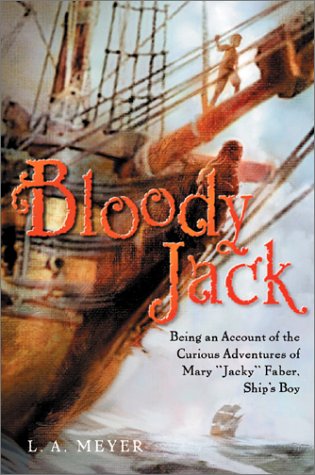
“My name is Jacky Faber and in London I was born, but, no, I wasn’t born with that name. Well, the faber part, yes, the Jacky part, no, but they call me Jacky now and it’s fine with me. They also call me Jack-0 and Jock and the Jackeroe, too, and, aye, it’s true I’ve been called Bloody Jack a few times, but that wasn’t all my fault. Mostly, though, they just call me Jacky.
“That wasn’t my name, though, back on That Dark Day when my poor dad died of the pestilence and the men dragged him out of our rooms and down the stairs, his poor head hanging between his shoulders and his poor feet bouncin’ on the stairs, and me all sobbin’ and blubberin’ and mum no help, she bein’ sick, too, and my little sister, as well.
“Back then my name was Mary.”
The book is a historical novel by L. A. Meyer called Bloody Jack. It tells the tale of Mary Faber, who is orphaned in London in the early 19th century and survives only by joining a street gang and then, posing as a boy, the crew of a ship. On board, she has to hide who she is and avoid the many perils of ship life.
The book is delightful, transporting the reader to the time and place with excellent details and a style that evokes the speech and times. There’s humor, danger, adventure, and an interesting cast of characters. I recommend it highly. If you end up loving it as I do, you’ll then be happy to know this is only Jack’s first adventure.
When you live where we do, you cannot hope to landscape likes folks in a warm suburb. First of all, at 6,000 feet with a min temp of -30 Fahrenheit you can’t grow a lot of warmer climate plants. Second, the deer seem to eat everything else you do grow. So we’ve been looking and I think I’ve found a tree to add.
I actually found it earlier when I was biking around the beautiful Round Valley and had to stop and go back to revel in the delicious fragrance. But I didn’t know what it was at the time. I do now.
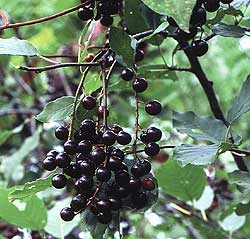
It’s the black chokecherry.
It grows naturally up here. Has beautiful fragrant blossoms in the spring. And it produces fruit that can be made into a delicious syrup. Oh, the raccoons like it as well.
Now when you eat the raw berry, unless you eat it late in the fall, you’re in for an astringent, alum after-punch. But we picked the berries up a canyon behind our town after the first frosts. In fact, many of our berries were wrinkled. They just fine raw. Even Lilia, my pickiest eater, enjoyed them.
We picked about 1.25 gallon ice cream buckets of the stuff. Then we followed this recepie and made about 4 quarts of syrup.
(I’ve heard some folks add 1/4 teaspoon almond extract for a stronger cherry taste)
Wash chokecherries, place in a large kettle, barely cover with water and cook, covered, for about 30 minutes till the cherries are soft.Mash gently and strain the chokecherry juice through a sieve or cheesecloth.
Do the same with the apples.
Pour the juice into a large kettle; stir in the sugar.
Cook on high, stirring constantly.
Boil hard for 1 minute.
Remove from heat and skim foam.
To can: Pour hot syrup into sterilized hot jars to within 1/8th inch from top.
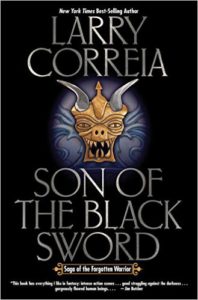
I just finished reading Larry Correia’s Son of the Black Sword, and enjoyed it immensely.
It takes memes from King Arthur’s sword, Moses, the Shaolin monks, special operations forces, ancient India, prophets, and freedom and mixes them into an epic fantasy that’s simply tremendous.
It has all the action and entertainment you expect from a Correia production. There are monsters. There are battles and wonderful scenes of sword fighting. There are magic and wizards, but it’s not the magic and wizards you’ve seen before (magic from demon body parts?!) And unlike many fantasies, which revolve around the magic—discovering how it works and some chosen person growing in its power—this story revolves around matters of justice and mercy and law and truth.
This isn’t a story about magic. It’s a story about a man in terrible conflict.
The main character, Ashok, is not just a Lord Protector, one trained in battle to kill demons and administer death to those who break the law, he’s the most fearsome of them all. And the most pure in his devotion to the law. There’s just one problem—he finds out that he himself is a terrible affront to the law.
Discovering why that is and how it occurred is part of the enjoyment, so I won’t give it away. But along with that and all the action, you’ll be transported to a new world based on the old Indian caste system with a number of twists. You’ll encounter the court intrigue found in so many fantasies. But probably what was most delicious to me was a central mystery shrouded in the ancient past and a whole cast of wonderful characters. There’s Ashok, but we also get a courageous librarian/legal assistant, a tough female boat captain, a funny black market smuggler, and a veteran soldier who wants to restore the honor that was unjustly taken from him.
As a reader, I was delighted. As an author, I found many things to admire (and some to be envious of), including the fact that when you’re in the point of view of a character, you’re with that character, caring about what they care about and seeing the world through their eyes.
Son of the Black Sword is a book chock-full of delights. If you like fantasy and action, I think you’ll love it. As for me, I can’t wait for the second in the series.
The Pew Research Center has just published their findings on reading in America. It’s called “The Rise of E-reading“. There’s a LOT of fascinating information in the report. Here’s a taste:
Americans 18 and older read on average 17 books each year. 19% say they don’t read any books at all. Only 5% say they read more than 50.
Fewer Americans are reading books now than in 1978.
64% of respondents said they find the books they read from recommendations from family members, friends, or co-workers.
The average reader of e-books read 24 books (the mean number) in the past 12 months; the average non-e-book consumer read an average of 15.
Building an Audience
I also want to recommend this week’s post by Kris Rusch on Audience. She has a number of interesting things to say about the dream of being a best seller and building an audience. The money quote comes as she refers to a post by Tracy Hickman:
“The point here is that you do not have to feel as though you are in competition with the entire world. You don’t NEED the entire world to be a successful writer. What you need is an audience—just enough of an audience, mind you—who reads your words, is changed by them and wants to come back for more.”
An audience. More importantly, an audience that reads and “is changed by” your words. Not an audience who loves them, not even an audience who likes them. An audience who is changed by them, and because of that experience, “wants to come back for more.”
Simple. Important. Usually forgotten.
She talks about lots more. Read the whole thing.
My thoughts?
First, there’s no need for authors or readers to worry about wading through “crap.”
According to Pew, readers only read 15 or 24 books a year on average. That’s not a lot of books.
More importantly, it takes about 3 seconds to get a lead for a good book. You hear something from a friend or family member, you look at the USA Today best sellers list, you browse a few books at a store or online, you read a blog and suddenly you’ve found a book.
Readers fill up their book reading slots much more quickly than they can ever empty them. That’s why we all have years of reading in our queues.
It doesn’t matter that there are millions of other books out there, a good majority of which might have been written by monkeys. There’s no need for authors to worry that readers will have to wade through a mountain of crap to find a good book. They don’t need to because they have leads for good books coming out their ears.
Second, people purchase books that friends, family, and co-workers love.
Which means that when you deliver a great experience to one person, it’s going to ripple out. It’s probably not going to be linear. It’s probably going to ripple out like viruses do into different population pockets. Or seeds do into different environments. It will run through one pocket, make a jump to one or more others, or it may not jump at all. Some pockets are big, some are small.
The way to keep a virus going is to release it in a lot of places where it’s likely to thrive or in places that a lot of people travel through. And as Kris points out, writing is all about repeat business–making sure you have a stream of good product (something I hope to rectify with my own writing this year).
Bottom line: the best way to build your writing business is to simply write the best book you can, and keep them coming.
Third, the market is BIG.
If you read Rusch’s and Hickman’s articles, you’ll see that even the mega sellers only reach a fraction of those who read. This is reinforced by the statement made by Thomas McCormack, former CEO of St. Martin’s that you can read here. So just because 100,000 people read one book doesn’t mean 100,000 others won’t read mine.
Moreover, e-books and online shopping are broadening distribution. Brick and mortar stores only have so many slots for books. Every 8-12 weeks they rotate the old books out (like 12 weeks is old) and replace them with the new ones, unless, of course, your book is selling very well and gets “modeled” at the store. The point is: when you only display a few books at a time, those books will get bigger sales numbers. This happens because there isn’t anything else to purchase.
But you don’t have that limitation with e-books and online shopping. Nothing rotates out of the store. Sure, things rotate on and off the best seller lists. But the books are always there. With an ever growing selection, there won’t be as many mega sellers. Publishers Weekly discusses this trend in their 2011 Facts & Figures articles, which list best-seller numbers (make sure you click through to the Trade Paperback article as well). The same thing has happened with TV station viewership with the explosion of channels, DVDs, and online streaming. Same thing happened with music.
What this means is each author has a better chance of getting his or her books to those who will love them. We’ll still have best-sellers. But we’ll also have a lot more medium sellers as well. And that’s great for authors everywhere.
The joy of music. Pure, unadulterated joy–this is what I recently stumbled across on YouTube.
I was watching the The Piano Guys and thought I saw something new from them. I clicked, but it wasn’t The Piano Guys. It was Simply Three doing a cover version of the popular “Wake Me Up” by Avicii.
For those unfamiliar with the term, a “cover” or “cover version” is a reworking, updating, or interpretation of an existing song. And this cover simply blew me away.
Simply Three is an electrifying trio made up of cellist Zack Clark, bassist Nicholas Villalobos, and violinist Glen McDaniel, although they have switched in other violinists, including Alex Weill and Olivia Lemmelin. But don’t let the instruments fool you–this isn’t some stuffy classical music gig. And it’s not muzak in the elevator. Not even close.
They are doing what Lindsey Stirling and The Piano Guys are doing: taking modern songs in wonderful new directions and, in the process, making these classical instruments cool again.
I went on to watch a number of their other covers, and then I had to purchase the songs because I simply had to be able to listen to their great beats and interpretations on the road.
Here’s their cover of “Wake Me Up.” The joy Zack Clark (the cellist) exhibits sells the whole thing for me.
Here is their cover of “Demons” by Imagine Dragons.
And finally their cover of “Counting Stars” by OneRepublic.
If you like them, you can get each of these on Amazon for less than a buck with these links:
Buying them not only supports the artists, but it lets them know there’s a demand for it and encourages them to make more. And I hope they make more.
***
By the way, “Counting Stars” has some interesting lyrics. Ryan Tedder, the songwriter, is a professed Christian. He grew up in a Charismatic household and graduated from Oral Roberts University.
However, you might look at some of the lyrics and think he’s given all that faith up.
I feel something so right
Doing the wrong thing
I feel something so wrong
Doing the right thing
I could lie, could lie, could lie
Everything that kills me makes me feel alive
But you need to look at the lyrics in context of the rest of the song and the artist’s statements about the song to see he’s singing about something totally different.
Some poets, and songwriters are poets (song is where poetry lives these days), think being obscure is cool. Tedder follows that more obscure approach in this song, which is unlike the immediate clarity he put into the lyrics of the fantastic “Halo,” performed by Beyonce, or his own OneRepublic’s “Apologize.”
Sometimes the artist writing gnomic lyrics doesn’t want to pin down a message for the listener—they think it’s cool for each person to make up their own message (I prefer clarity). Other times they do have a message, but they want the listener to work for it, and so they try to be subtle. Or sometimes they simply goof and don’t realize their lyrics are being so vague.
I have no idea which path Tedder was trying to take with these lyrics, but I do know that he’s made statements about the song. And these statements give us a guide.
In an interview with 5280, the Denver magazine (Denver is where Tedder lives) we get the first glimpse.
At 15, he began writing his own songs. “I obsessed over music and just loved it,” Tedder says. “But I never considered it as a career. Where I grew up you go to high school, you go to college, you find a wife in college, you get married, you have 2.3 kids, and if that hasn’t all happened by the time you’re 24, some people think there’s something wrong with you—or the assumption is that maybe you’re not into the opposite sex.”
But he couldn’t keep away.
Back in Oklahoma, at Oral Roberts University, the largest charismatic Christian university in the world, Tedder majored in public relations and advertising. At least that’s what his diploma says. Based on the time he put into sneaking into the Timko-Barton Performance Hall’s piano rooms, he probably could have been a double major. He spent hours on the piano and the guitar deconstructing his favorite albums—like Eric Clapton and B.B. King’s Riding with the King—figuring out the chords and then trying to write new songs using those same chords. He was skipping classes—even meals—to write songs.
No one knew. Not friends. Not his roommate. He sang in secret. He was in the school choir, but his friends always thought it was odd that a person who didn’t seem overly musically inclined would be taking a singing class. When he was in one of the piano rooms he would tape a piece of notebook paper over the small window in the door so that no one could see him.
Tedder says there were two reasons he hid his passion. The first was that he believed there were so many bad singers and bad songs in the world that he didn’t want to add to the noise. He wanted to be certain he would be successful before he revealed himself. The second reason was more deep-seated: Being raised in a religious home, Tedder had been taught that there was a purpose for his life, and that because God had ordained that purpose, he should live the life expected of him—one that was pious and humble. “Deciding you want to go into the music business is about the most narcissistic thing in the world,” Tedder says. “I had this constant battle—and to some degree I still do.”
So Tedder felt “wrong” about songwriting. But he eventually began to see it as his gift to share.
Billboard: Given “Counting Stars”‘ uplifting, faith-based message, it must be gratifying to be connecting with such a meaningful song.
Tedder: I think it’s our responsibility as a band, and what separates us from everyone else. I took that from being a fan of U2 for two decades now, since “Achtung Baby.” To this day, they might be the only band on that level who sings about things other than just boy-girl troubles or the kind of selfish, “I’m a badass” stuff. I’ve spoken with Bono about this when we toured with him, and he said the same thing. I felt a responsibility to actually write and sing about things that have a level of human gravity to them. If everybody else sings about sex and love and lust and money, then somebody’s gotta be singing about life and faith and hope and things of that nature.
So if “Counting Stars” isn’t about sex, lust, and money, what’s it about?
In another interview with Radio.com, he indicated that the whole counting stars bit was for anyone who loses sleep wondering how they’re going to be able to afford their rent or provide for their family. When he was first starting out, things were rough.
“A lot of time I just lay in bed awake, stressing out,” Tedder said. “Everybody does it. And I just thought, I can’t wait until I’m counting stars and not counting dollars anymore. Things will be so much better.”
To me, it’s clear that Tedder is singing about his story. And he’s singing for people like him who have a passion, but society says it’s not the practical thing to follow or dedicate your life to. Songwriting is what makes him feel alive. Furthermore, he had flashing signs indicating that if he sought, he would find—in other words, it was the thing God wanted him to do. And he just had to have hope, a four-letter word for those who are practical- and money-minded, and follow that passion.
We can argue the merits of that follow-your-passion message, but I think we’re all happy Tedder followed his.
***
And while we’re talking about the joy of music, how about this baritone saxophone and drum.
I don’t have time to watch, but I found myself getting sucked in this week. And here’s something I realized as I watched Simon, Paula, Randy, Ryan, & the contenstants–the show is using story principles.
Duh, I know: of course, it is. But it does it so well. It reminds me of a research article I read about sportscasters and audience enjoyment of sports competitions. They found that if they could inject story elements–suspense, rivalry, etc.–people enjoyed the games more. Next time you watch a college football game, notice what the color commentators say to make it a contest. It’s not just about reporting what #45 did out in the flat.
Anyway, back to Idol. Look at these elements.
What draws us to characters?
Beauty, threats, quirkiness, larger-than-life situation or skills, source of viewer wish-fulfillment.
Humm, let’s look at the cast of performers. Don’t we see all of that? How many of us wouldn’t love to be able to sing like they do? Have a shot at becoming a recording artist? Or just goggle at someone getting this chance?
What factors generate suspense?
Threats to characters we like or marvelous opportunities for them, turns in the situation, a prolonged resolution.
Humm. Our sympathy is engaged because these folks are normal folks, many of them underdogs. Many viewers identify strongly with one or two because of the contestant’s various social groups and because, heck, the auditions are for people like you and me. It could be us up there in front of the world! You’ve got the threat of peformance fright, but also the overriding opportunity to make a dream real. You’ve got a wonderful career, if not millions of dollars, on the line. You’ve got Simon who is honest, but also plays his part. Isn’t that the moment of most suspense with each performance? You’ve even got a little subplot going on between Simon and Seacrest. There’s no villain here. But there are plenty of obstacles. Weekly threats.
What does Idol give us that Survivor never could?
It’s all REAL, even if the producers let their selection of performers be influenced by things other than vocal talent. And because it’s real, we believe it. Which means we can more easily feel sympathy and root for the various performers.
It’s a simple but brilliant concept. And I just wasted 4 hours watching it. And I’m likely to do it again.
 You’re name is Mitch Rafferty. You’re a gardener. You have no past as a cop, spy, or Navy SEAL–you’re just a plain old petunias and begonias guy. You’re working in someone’s yard when you get a call on your cell phone. You answer. And the guy on the other end has your wife.



 I just finished reading Larry Correia’s