|

Writing Update: Curse, trebuchets, CONduit, book industry, & Robinson Wells
As of 5 PM this last Saturday I have finished 15,000 words of the climax of Curse of a Dark God. I think I have another 10,000 to go and the book will be done. I’m so close to the end of this draft! So don’t let the progress bars fool you. The ending is coming together fabulously–lots of spectacle, big reveals, and major heroics. At least, I think so.

While working on this, I had to spend a number of hours finding out how strong a wind must be to pick up humans and stones. I also needed to know the destructive forces of various classes of tornados and hurricanes. Why would I need to know such things? I write fantasy, for Leroy’s sake!

(Yes, that’s good English; I’m a writer, and one of my prerogatives is to make up silly versions of common expletives using the names of friends and enemies.)

Here’s why: I just can’t write if I don’t believe in what I’m writing. And when I’ve got monsters (skir) that can generate winds that will be used in a siege, well, I had to know the terminal velocities of what these creatures could throw, and what that might mean for fortress defense. I had to know the limitations and ramifications.

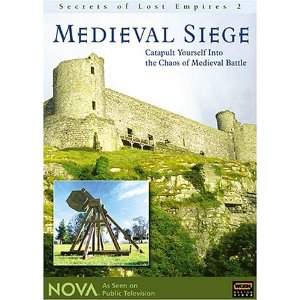
I won’t rehearse all the fascinating details (and it WAS fascinating), but all that research did lead me to a wonderful documentary. It’s called Secrets of Lost Empires 2: Medieval Siege and was produced by Nova in 2000. You can get it on Netflix or Amazon.  In the film, fifty carpenters worked day and night to create and test what they dubbed “the fourteenth century version of the atom bomb”–the trebuchet (tre-byou-SHAY). The trebuchet as the most popular throwing machine in Europe during the middle ages. If you love the history of medieval war, you’ll love this film. You might want to add to it a reading of the excellent Ancient and Medieval Siege Weapons by Konstantin Nossov, which you can get via the inter-library loan program.

I’ll share two cool factoids for you history fans. “Catapult” means “shield-breaker,” “cata” meaning break or penetrate and “pelta” being the name of the shield used by the Greek light infantry. The original catapults were NOT big spoons–they sped arrows and balls along a track like a crossbow. However, instead of using the spring force of a bow, they used torsion-springs, which is what you get when you twist fibers that want to be straight. In the case of catapults the fibers were ropes made out of animal sinews or hair (horse or human, a woman’s hair being considered the best) and soaked in oil. Click on the image to see a larger picture. 
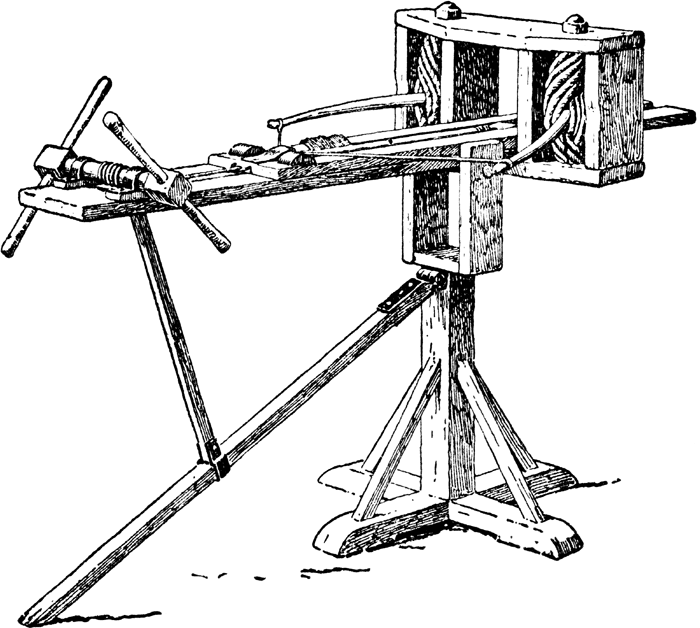
A modern example of a torsion-spring are those balsa wood airplanes with propellers attached to a rubber band that’s hooked to the belly of the plane. To fly them, you rotate the propeller round and round, twisting the rubber band. Then you let the propeller go. Because the rubber wants to be straight, it reverses the twist, spinning the propeller the opposite way you twisted it. 

You might think these torsion-spring engines were weak. But one catapult was reported as being powerful enough that an arrow shot from it broke through a shield, and the armored warrior standing behind it, at a distance of 400 yards! Hence, the name.

The other factoid is that “trebuchet” comes from the French term meaning to overthrow. If you saw Return of the King, you’ll recognize them as the engines used on the towers of Minas Tirith. Trebuchets are simply an evolution of the staff sling. When it came to breaking castle walls, there was nothing more effective until the cannon appeared. Of course, in my book I use them a bit differently. You’ll see.

One funny thing. I watched the movie with my oldest who was just as fascinated with the engines as I was. When she was telling my wife about the film, she kept referring to trech-uh-butts. Which, I guess, is as fair an attempt at “trebuchet” as any. However, my wife kept picturing buttocks and couldn’t figure out what the heck my daughter was talking about–“You were watching what with your father?!”

The French make things so hard . . .

***

The Monday after CONduit I left for work in Mexico and then Vegas. I didn’t get back until this week. So I just wanted to say I had a great time at the con. Loved chatting with all the folks there.

It was great to see the Larry Correia, Paul Genesse, Jessica Day George, Isaac Stewart (and his brother Dan), Mette Harrison, Eric James Stone, Darren Egget, Julie Frost, Sandra Tayler, LE Modesitt, Josh Perkey, Nicole (whose husband is an Orem cop and I lost his number), Daniel Who-I-Sacrificed-to-My-Editor, and the Dungeon Crawlers Radio guys.

It was also nice to speak with Julie Wright who was one of the initial judges for the Whitney Awards. She’s always nice to chat with, but this time it was especially nice since she said reading Servant of a Dark God was like eating chocolate. I’ll take chocolate praise any day.

I also met new author Janci Patterson who just sold a YA with a great premise. It’s called SKIP and is about a young girl whose parents are divorced. The girl has to go stay with her dad who lives in a trailer and is a bounty hunter. I’m a sucker for bounty hunter stories. Especially this one, because she goes out with him and falls in love with one of the guys her dad has to haul in. I’ve slaughtered the pitch, but I got that good old writer’s envy when she told me about it. Can’t wait to read it.

I also got to see Barbara Hambly. I was at LTUE when she was there like 20 years ago. We loved her stuff. She suddenly dropped out of the writing scene in the early 90’s and now I know why–it appears Del Rey dropped all their midlist authors except for Anne McCaffery and someone else. Hambly was one of the causalities.

***

After Hambly’s main address, I sat with a few authors and had a brief discussion about the book industry where it was suggested the industry was shrinking–fewer readers, fewer sales, doom, doom, doom. But that is exactly opposite all the data I’ve seen.

  1. Book sales have an annual average growth over the last seven years of 1.1%, adult paperbacks are growing 2.9% http://www.publishers.org/main/IndustryStats/indStats_02.htm or http://www.publishers.org/main/IndustryStats/documents/S12009Final.pdf . Now, this doesn’t show units sold. So it could be that they sold fewer units for more money per unit. Still, it shows at the very least that $$$ aren’t shrinking.
  2. The New Book Titles report here shows an increase in the number of titles: http://www.bowker.com/index.php/book-industry-statistics — 80% increase from 2002 to 2009.
  3. Reading rates are actually on the rise: http://johndbrown.com/2009/03/literary-reading-rates-on-the-rise/
  4. Finally, I contacted Bookscan for their numbers for an ALA conference I did last summer. This is just juvenile fiction, but the numbers are in units. Now, I don’t know if they added more sources to their database and so that caused a rise, but I explained to them what I was trying to do—see trends over time—and this is the data they provided. According to their numbers, more juvenile books are being sold now than in 2004. Click on the graphic below. This means we have more and more readers rising up through the ranks! One author asked how much of that was Rowling and Meyer. During that period books by those authors accounted for an average of 7-10% of all juvenile fiction. Bookscan categorizes “juvenile” as everything for kids. That means from Go, Dog Go up through what we consider Young Adult. R&M accounted for an average of 33-36% of what Bookscan categorizes as science fiction, fantasy, or magic within the juvenile mega-category. What all that means is the growth is across the whole category, not just with their books.

So I’m very sanguine about the book industry’s prospects. Today’s youth seem to be able to play computer games AND read in great quantities.

***

Finally, one last bit of news. Robinson Wells was the one of the main ones to start the Whitney Academy and the Whitney Awards. Well, he just got some fabulous news. Here’s the announcement from Publishers Marketplace: “Robison Wells’ YA debut dystopian thriller VARIANT, a modern-day LORD OF THE FLIES, set at a boarding school where not everything is as it seems and every day is a fight for survival, in a significant deal, in a three-book deal, to Erica Sussman at Harper Children’s.”

For those of you who don’t know, here are the PM deal categories.

  • “nice deal” $1 – $49,000
  • “very nice deal” $50,000 – $99,000
  • “good deal” $100,000 – $250,000
  • “significant deal” $251,000 – $499,000
  • “major deal” $500,000 and up

Oh, baby. Someday. Someday. Of course, I’m nothing but happy for Mr. Wells!

Links

Share

Similar Posts

  • Signing on Saturday in Eagle Mt, Utah

    BOOK SIGNING SATURDAY!

    Saturday, November 20, 2010: 5 pm – 7 pm

    It’s fantasy night at Dragons & Fairy Tales bookstore. I’ll be there with NY Times best-selling author Larry Correia, mega-popular comic strip writer Howard Tayler, ”I Am Not A Serial Killer” author Dan Wells, and others.

    3535 E Ranches Parkway Suite A
    Eagle Mountain, UT 84005
    801-789-5014
    Click here for store details

    Share
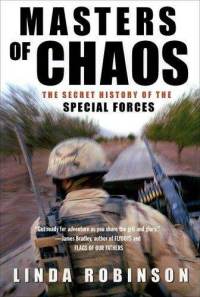
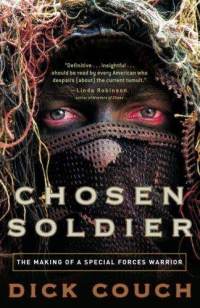
  • Masters of Chaos, Chosen Soldier, and Teenage Boys

    US Army Special Forces

    Nobody can stand up to the US Military’s conventional fighting force using conventional tactics.  Yes, Russia and China have significant militaries and a fight with them would be bloody.  But it’s not likely we’re going to go to war with them.  Instead, as we’ve seen since the 1990’s, we’re likely to fight much smaller groups—Somali warlords, genocidal brutes in the Balkans, terrorist-supporting regimes like the Taliban, unstable dictators like Saddam Hussein, or Islamic extremists who aren’t associated with any nation. 

    Those who do try to fight us conventionally get wiped out.  We saw that very clearly with Saddam Hussein.  Which is why the fight went underground.  In this type of war, when the bad guys are hiding among the good, we can’t just rush in and bomb the place to the stone age.  If we do, the local population will soon come to hate our presence and work against us.  And when that happens, we set ourselves up for defeat.

    The best way to fight against insurgents is to ally ourselves with friendly portions of the populace who can identify who the insurgents are, which doors to kick in, and can actually kick those doors in themselves, if only they get some support and training. 

    Because of this, a strong argument can be made that the US Army’s Special Forces are the most effective tool we have in winning the types of wars we’re likely to fight in the near future.

    The US military has a number of special operations forces.  Those you’re probably most familiar with are the Navy SEALs, Delta Force, Rangers, Marine Force Recon, and the Army’s Special Forces (commonly known as Green Berets).  There are other groups like the Air Force’s Combat Control Team, the Army’s 4th Psychological Operations Group, and other black op units that the military doesn’t officially recognize. There is some overlap in the types of things these forces do.  However, each has its own focus, the thing it’s best suited for. The reason why the Army’s Special Forces are so valuable in our current environment is that one of their main missions, the thing they do better than anyone else, is conducting and fighting unconventional wars.

    Along with all the other cool stuff that goes along with special operations work, Special Forces troops have to learn how to build rapport and trust because unconventional war is conducted through and by the indigenous population.  Special Forces troops not only have to know how to conduct high-risk missions, they have to be able to train others to do the same, which is why they are all required to learn a second language.  All this people work requires a more mature soldier.  And it shows: the average age of the SF operators is thirty-two, while the average age of a US Marine is nineteen.

    I just read two fabulous books on the Army’s Special Forces.  The first is Masters of Chaos by Linda Robinson. Robinson was given unprecedented access.  She traveled with them to the front lines and was allowed to interview and report as no other had been allowed up to that point.  She starts with a brief history of the SF and their training; she then details missions the Special Forces carried out from 1989 – 2003, including their work in Panama, El Salvador, Kuwait, Somalia, the Balkans, Afghanistan, and the second gulf war.  My eyes were opened to the significant role they’ve played in all these conflicts.  It was absolutely fascinating.

    The second book is Chosen Soldier by Dick Couch. Couch, a former Navy SEAL and CIA case officer, is the only writer ever given the privilege to attend the many months of Special Forces pre-selection, preparation, selection, and qualification training from start to finish.  He was given “full access to all training, venues, students, and training cadres.”  Couch did not merely interview.  He and his wife moved to one of the few residential structures on base at Camp Mackall in North Carolina.  Couch went out with the SF candidates to observe first hand exactly what they did, and, in a number of instances, do it with them.

    One of the things I loved about this book are the personal bios given about the backgrounds of the various candidates.  They are not at all what you’d expect—everything from bouncers to engineers to one fellow who had a degree in and a passion for Russian literature.  I also enjoyed the details he gave about the training.  There are about 1.2 million people in the US Army.  Only about 5,000 of them are in the Special Forces.  When you finish, you have a good feel for the types of things they learn and why about 80% of those who volunteer for training wash out.

    I couldn’t put either of these books down.  If you decide to read them, let me also recommend you download and read Army Field Manual 3-05.20 Army Special Forces Operations as well, which is the Army’s “keystone manual for Special Forces (SF) doctrine” that “describes SF roles, missions, capabilities, organization, command and control, employment, and sustainment operations across the operational continuum.”  You can find it here: http://tinyurl.com/3ryt3o3.  For those who just want an overview of these forces, the Army has provided a great site here: http://www.goarmy.com/special-forces.html. 

    The Boys of Laketown and Round Valley

    Every school morning my wife and two oldest girls hunt.  They eat their breakfast perched high on a hill and watch for the quarry.  When it appears, a shout is raised, and the trio races to the car.  They blast out of the garage, perform an expert three-point turn, then Monte Carlo down the winding hill road.  Next, they attempt to set a land speed record on the straight shot into town, all in an effort to catch the big yellow school bus. 

    Most days they make it.  The bus makes a few stops in town.  Sometimes they’re not so speedy and can only manage to catch the bus at its last stop.  Sometimes I join in on the hunt.  Most of the time I catch the bus at its last stop in town.  But this week I was quick enough to get them to the third stop in front of the middle school where most of the teens board the bus.  And I had the privilege to witness a class act.

    The first time I arrived with my payload, all but two teen boys had already boarded.  We raced up to the bus, my daughters flew out of the car, and the two teenage boys from Round Valley stopped.  They did not get on.  They waited for my girls to hustle the length of the bus.  My girls got on, and the boys followed them in.

    Odd.

    The next day we got there a little bit earlier.  This time I witnessed ALL of the boys from Laketown and Round Valley stand and wait for all the girls to get on first.

    What was this? 

    I asked my girls about it.  They confirmed—it wasn’t a fluke.  While first initiated by the bus driver, the boys have the class to show this courtesy every day. 

    Teenagers . . .

    Bravo, Gentlemen.  Bravo.

    Share
  • Donald Rumsfeld, The King’s Speech, Aquatic Ancestor Apes & Talking Bacteria

    Donald Rumsfeld

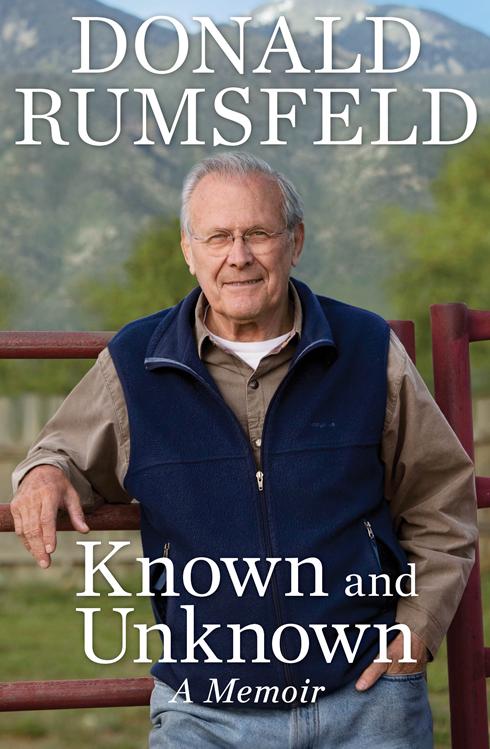
    I just finished Known and Unknown, a fat memoir by Donald Rumsfeld, and enjoyed every page.  Rumsfeld served as the Secretary of Defense under George W. Bush.  But Rumsfeld’s service didn’t start there. He was a Navy pilot, an assistant to a congressman during the Eisenhower days, and, in the early 60’s, a four-term congressman from Illinois.  He held various positions in the Nixon White House in the late 60’s and early 70’s, including ambassador to NATO.  He was Chief of Staff and Secretary of Defense when Ford took over from Nixon.  Reagan tapped him to be a special envoy to both the Middle East after the Beirut bombing and to the Law of the Sea treaty discussions.  He was the president of Searle, a pharmaceutical, as well as General Instrument, the company that pioneered HDTV.  Only after all that, did George W. Bush bring him on as Secretary of Defense.

    When writing novels, I try to create characters worth knowing, either because of their interesting personality or skills or because of the events they take part in. Donald Rumsfeld is just such a character, except he’s no fiction.

    In his memoir he shares insider information on everything from Watergate to 9/11 to the war in Iraq. What emerges is a fascinating look into many of the most important events in the last forty years.  You’ll get insight into some of the issues experienced in various White House administrations and see what really was going on with waterboarding, Guantanamo, Abu Ghraib, hurricane Katrina and many other of the hot button issues in the Bush years. There are some laugh out loud moments where his understated humor shines through. There are also parts where he reveals some of his differences with others that worked with him in the various administrations, including issues with Nelson Rockerfeller, Colin Powell and Andy Card. But in everything he writes he’s fair and restrained and attempts to present the facts accurately. This is no attempt to settle scores.  Just a wonderful read.

    If you are interested in politics at all, I think you’ll enjoy this book. Moreover, I think you’ll come out a little wiser, maybe a little better person, for having spent a few hours with Donald Rumsfeld.  

    The King’s Speech

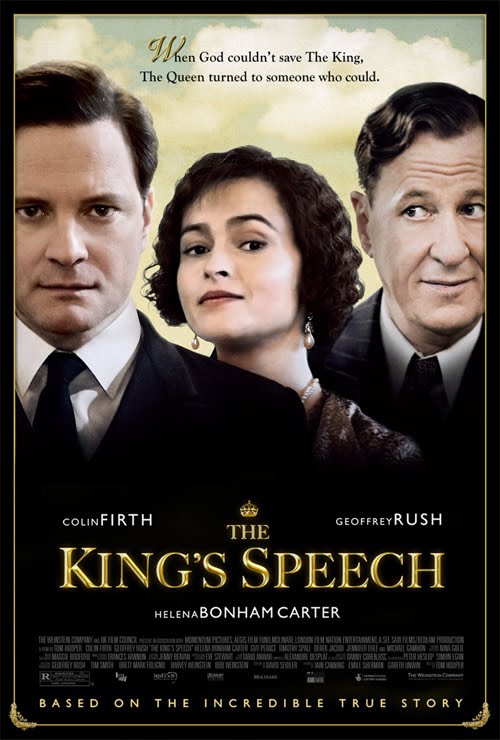
    I do not watch many r-rated movies.  They are usually too vulgar or pornographic for my prissy tastes. However, I did my research on The King’s Speech, and having heard so many glowing reviews, Nellie and I rented it.

    It was wonderful.

    The movie tells the story of prince Albert Frederick Arthur George of Britain who did not ever expect to inherit the throne and did not want to, in part because of his stammer. Can you imagine having to be a public figure like a king and have to deal with something like that? Most of us dread the thought of public speaking. Can you imagine having to try with a stammer?

    But Albert’s lot was not to live the sheltered life. He became king when his brother abdicated the throne because of improprieties in his personal life. The day before the abdication, Albert went to London to see his mother, Queen Mary. He wrote in his diary, “When I told her what had happened, I broke down and sobbed like a child.” That is not the entry of a power-hungry man.

    He assumed the throne in 1936, when England ruled over almost a quarter of the world’s population. Three years later in 1939 WW2 broke out and Britain’s king needed to be able to address the people.

    In the movie, Colin Firth plays Price Albert. Geoffery Rush (Captain Barbossa in Pirates of the Caribbean) plays Lionel Logue, the unorthodox Australian speech therapist to whom Albert’s wife turns for help. The script is wonderful and the star-studded cast is spot on. There are moments of humor and poignancy and triumph. I was caught up in this movie as much as any I’ve seen.

    If you like English dramas, you’ll enjoy this one. And the profanity, the reason for the r-rating, is not there to depict casual vulgarity. It was part of a technique used by the therapist. In the end, you’ll overlook it and find yourself on pins and needles, rooting for this fine man.

    Aquatic Ancestor Apes & Talking Bacteria

    I’ve written about TED before. The annual TED (technology, entertainment, design) conferences, in Long Beach/Palm Springs and Edinburgh, bring together the world’s most fascinating thinkers and doers, who are challenged to give the talk of their lives (in 18 minutes or less). The folks at TED record these speeches and put them up for free on their site for the rest of us to watch. And I just watched two dandies.

    The first is by Elaine Morgan who says we evolved from aquatic apes (sigh, just when you think you’ve found grandpa Eddy hanging out in the trees, you learn he’s an imposter). Morgan is a Welsh writer for television and also the author of several books on evolutionary anthropology. In the speech she describes the reasons why it makes sense that humans had aquatic ancestors. Along the way, she illustrates key principles of science, including why science by consensus is no science at all. Her manner is so delightful and engaging I think I could listen to her for hours, preferably around the dinner table. Watch her right now. She just might convince you.

    The second speech was given by Bonnie Bassler, an American molecular biologist, who has been part of the team that discovered key insights into how bacteria talk. It appears that bacteria do not invade a host and start doing damage. No, they wait until their numbers are sufficient that they have a chance of surviving. They coordinate defense and mount attacks as a group. Who would have thought? Knowing how this works is not only interesting all by itself, but it has stunning implications for medicine and fighting infection. Bassler is a fascinating and enthusiastic presenter. Among other things, you’ll end up seeing that humans are more bacteria than you could imagine. Watch her.

    Share
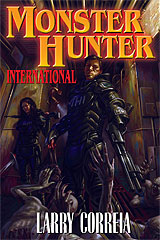
  • Monster Hunter International by Larry Correia

    MonsterHunterInternational_LarryCorreiaThere’s a joke that all horror movies would be over in two minutes if you just made the hero smart and gave him a gun.

    Well, Correia gives his likeable hero a gun, but not just any old thing. If you’re going to kill a vampire, why not use a rocket propelled grenade or a flame thrower? In fact, if there were enough monster outbreaks, you might have a government agency. You might also find that agency was willing to outsource some of the monster hunting to private contractors (ala Blackwater). And you can bet they won’t be hunting with pea shooters. They’ll be doing it right, with brains and firepower. Correia, someone who loves guns (used to own a gun shop and shoot competitively in rifle, shotgun, and pistol) and monsters, wrote a story that does just that.

    The idea of Larry Correia’s Monster Hunter International might remind you a bit of X-Files or Men in Black, but it’s neither. However, it is as  good as or better than both. Correia tells the story of Owen Pitt, a big lug of an accountant, who, as he was working late one evening, gets called into the office of his boss. No big deal, right? Except the fat man is naked, transforming into a werewolf, and vows to eat Pitt’s heart. It’s not quite how you want to end your day tallying debits and credits. Pitt almost dies in the encounter, but manages to “live the American dream” and throw his incompetent jerk of a boss from the fourteenth-story window and splatter him on a double-parked Lincoln Navigator below.

    Good work for a bean counter. When Pitt finally recovers, he gets an offer he can’t refuse (mostly because of the alluring agent that comes to recruit him), and he joins Monster Hunter International (MHI), the private contractor who sends out special force teams to use any means at their disposal to kill monsters. Unlucikly for Pitt, one of the baddest monsters around is just about to ruin the world forever, and Pitt finds himself in the middle of the fight.

    Correia fills the book with enough action for any red-blooded male, a variety of bad mamba jamba monsters, and wonderful characters. There’s romance and heroism (I got a lump in my throat at one part toward the end), but his signature is his humor. I laughed again and again.

    Part of that humor stems from the fact that Correia has an ear for good lines. Part stems from his delight in taking common tropes and stereotypes and twisting them. And this is another one of the things that I enjoyed immensely about the book. For example, the team of newbie hunters that Pitt joins is not made up of square-jawed males and females with Navy SEAL backgrounds, although some in the company do have that. Nope, Correia puts together an accountant, librarian, school teacher, and stripper (all people who faced some kind of monster and are ready for payback), and he makes them believable hunters. 

    This tongue-in-cheek tweaking is everywhere. There are elves in this book unlike any you have ever seen. But he also makes it personal. Owen is not your typical accountant. Even a number of the minor characters get this treatment. For example, one of the people on the team is a Black guy with Rasta hair. But Correia doesn’t choose from what Correia calls one of the four Hollywood stereotypes. Nope, this guy plays against those types. He isn’t the comic relief, the gangsta, the sports dude, or scary male. He’s his own man, a shy virgin with a good heart. Correia also gives his characters interesting backstories. And one of the delights is discovering them.

    I encountered a few minor flaws in the presentation, but these are easily overlooked. Easily. There’s also quite a bit of profanity (and so those who wish to avoid it are forewarned). However, when I turned the last page Friday night, I looked up at Larry who was lying on his bed in our La Quinta hotel room in Denver, his concealed .45 and 9mm guns on the floor beside him, and said, “Wow. WOW.” And then I think I said, “Dude, what a marvelous read” or maybe it was “Oh, great lord of zombie destruction tales do not smite me,” but I’m not sure because I was still thinking about the perfect last line of the perfect last scene of the last chapter.

    Now, those exclamations of satisfaction and delight had nothing to do with the guns on the floor, that Larry’s a deadly shot, or that he’s a big 6’3″ Portugese. It has nothing to do with the fact that he and I were on a book tour together. I don’t read books that don’t grab me. End of story. I stopped doing that long ago. I don’t care who wrote them. And I don’t give false praise. False praise irks me to no end and does nobody any good, especially not the receiver. The truth is that Larry’s book was simply too good to put down. It pulled me in with the opening quote and kept delivering the goods until the end. And if you don’t believe me, you read the quote that both inspiried and opens the book and tell me you don’t want to turn the next page.

    “You know what the difference between me and you really is? You look out there and see a horde of evil, brain-eating zombines. I look out there and see a target-rich environment.” ~Dillis D. Freeman Jr.

    Yeah, it got ya, didn’t it. The ride is waiting folks. Just go on over to Amazon. Correia is going to be a writer to watch.

    Share
  • |

    Camille Paglia, Word Ninja

    I think I must disagree with half of everything Paglia says (I’m a Republican, she’s a Democrat). But when you can write like a kung fu master, you have to be read:

    Advanced whack-a-mole is clearly needed for that yammering smarty-pants Newt Gingrich, who is always so very, very pleased with himself but has yet to produce a single enduring thought.

    Holy schnitzel, that’s what words are for. I’m still laughing and nodding my head. Can I be Camille for a while?

    The fact is while Paglia is clearly liberal, she’s not a party lemming. This is one of the things that is so refreshing about her. She’s not afraid to call ’em as she sees them, even if that means roasting her own party or praising the other.

    More here: Too late for Obama to turn it around? Plus: The left’s visionaries lost their bearings on drugs — but the GOP is led by losers

    And here: Paglia page.

    Share

2 Comments

  1. It’s pretty amazing what weaponry they were able to come up with in those days. I think of the movie Timeline when I hear trebuchet (it was the first time I heard of it). Impressive stuff.
    Glad to hear that the juvenile market is doing well, especially in the fantasy/sci-fi genre.

Comments are closed.