During the podcast I talked about my practice of debriefing after every writing project. A reader just asked what that was, and so I thought I’d explain it here.
The debrief is a simple thing. I learned it back when I worked as a business consultant. It always provides great insights. Sometimes it provides massive insights. The principle is to pull back and look at the big picture every once in a while. So here’s what I do. When I finish a project, I sit down and simply list out what I struggled with, what went well, and anything I learned. I list out things I’d do again that worked particularly well and things I’d do differently. This might be about craft or process. Sometimes I might take some time to reflect on the nature of story and read a favorite book about the craft or perform a story analysis on another movie or book. Then I write up my insights in a form that I can read later and know what the heck I’m talking about. This can take a few hours or a few days. This last debrief after draft 3 of CURSE coincided with my preparation for a day-long workshop I had agreed to give on story, and so the insights came thick and fast. I recommend the practice highly.
A cracking good story idea requires five critical elements.
Until you have all five, you’ll struggle to plot. You’ll write a few scenes and run out of gas. You’ll feel like the story just isn’t going anywhere.
And that’s because it isn’t. It can’t. A story isn’t a story without all five elements.
However, once you develop these five things, your story will suddenly roar to life. There are a few other elements that are important as well, but these five things form the core of the story setup.
In this course you’re not going to merely learn about all of those story elements. You’re going to go deep and learn what can only be learned by actually doing the work and developing story idea after story idea with personal one-on-one feedback from someone who knows what they’re doing.
When you finish, you won’t just know story theory. You will be a story idea machine. And you will be that because you have put in the work. The right work.
Again, this is not a course full of lectures and videos. This is a course where you’re going to work. And develop the insights and skills that only come from doing the work.
You’re actually going to:
Come up with story setup after story setup after story setup
And improve them with one-on-one feedback.
It’s going to:
Eliminate years of you wandering about in the story wilderness trying to figure things out on your own.
Put you miles ahead of other writers who have no idea what’s really at the core of story.
You are going to learn how to develop killer story ideas on purpose instead of on accident. Which means you’ll be able to do again and again. Reliably. Like clockwork.
Course details
The focus of the class is not on learning about story, although you will do that. The majority of your time will be spent on developing stories.
You can’t become a carpenter by watching videos and reading books about it.
You have to get out on the work site, cut wood, and pound nails. You have to make the mistakes all beginning carpenters make, get feedback, and improve.
The same goes for writing.
And you’re going to work in this class. You develop 21 story setups. In fact, you develop more because the 21 are just the ones you turn into me. And with each one your skills, insights, and abilities grow.
In the beginning, your setups will be bare bones. By the end, they’ll be fully developed setups that beg to be written. Setups you can use to immediately write the first draft of your novel, whether that’s in outline or chapter form.
Here’s what you do each week.
Week 1.
Uncover the secrets of what’s really at the heart of story and how to generate ideas.
Define your genre requirements
Create story setups 1-3
Week 2.
Uncover the secrets to compelling characters
Create character sketches
Create story setups 4-7
Week 3.
Uncover the secrets to formidable obstacles
Create story setups 8-11
Week 4.
Uncover the secrets to interesting casts
Create story setups 12-15
Week 5.
Uncover the secrets to managing multiple storylines and series
Create story setups 16-19
Week 6.
Create story setups 20-21. These are your capstone projects where you apply everything you’ve learned and take it to the next level
In this class you develop story idea after story idea after story idea. You are going to be marinated in the work of developing characters, THOMs, goals, obstacles, settings, casts, and more. And because of that, each week will not only bring an explosion of insights, but new skills and abilities.
Every week you get two private, one-on-one, live sessions with me where you get encouragement and feedback on what you’ve developed. And you’ll have access to a private Facebook group where you can apply the principles to brainstorm even MORE ideas for each other’s stories.
At first you might feel a bit shy and worried about your ideas and abilities. But you’ll soon get over that. By the end of the course you’ll be one of those people that can generate terrific ideas easily. And you’ll be able to do that because you will have put in the work to become a different writer.
What’s the price?
Hours of one-on-one instruction from a professional editor or author costs thousands of dollars. An MFA program can cost $25,000 to $30,000 or more!
But this course won’t cost anywhere close to that.
Plus you’re going to learn things here you’ll never get in an MFA program (I know. I was accepted into a top-ranked program).
The cost of this course is $799. And I personally guarantee your results. You’ll be totally oh-my-gosh-I’m-so-happy-I-took-that-class satisfied, or I’ll give you your money back. No questions asked.
Now’s your chance to stop spinning your wheels. I can’t tell you how much I wish I’d had something like this when I’d started:
The secrets about the true core of story.
The secrets about how to come up with ideas.
Actual work with personal one-on-one feedback.
Laser focused on what actually matters, not a bunch of ridiculous writing rules.
When you finish, you will be a story idea machine.
You won’t know plotting. That’s a different course and set of skills. You won’t know how to write chapters. But you’ll know how to create the engine that powers all the rest of that. You’ll know how to create the core that makes awesome plots and chapters possible.
If you want to take this course, click the button below and contact me. I will tell you exactly how to apply.
I’m not going to be able to accept everyone who wants to take the class. I have a very strict limit on the number of students I can work with. So you need to get your application in before the deadline of midnight, December 11th.
Folks, the first tentative schedule for Life, The Universe, & Everything (LTUE)has been set. For the past few years I’ve been teaching a 2-3 hour workshop called “The 3 Things You Must Learn To Write Killer Stories.” I think I must have taught it over 15 times in different venues. Hundreds have attended and said they loved it.
However, this year I’m going to be doing something different. I’m developing a new two-hour workshop called “How to Write a Story that Rocks.”
I’ll be teaching it Thursday evening, February 11th from 5 PM – 7 PM at LTUE at BYU. It’s FREE and open to all.
What I found was that a lot of new aspiring authors get lost in mountains of rules. But great storytelling isn’t about rules. They try to form stories with word counts, chapters, and weird plot diagrams. But stories aren’t about those things. They have a hard time knowing what to write next because they don’t understand how story works. In fact, some don’t know how to start at all. They just flounder in their piles of zing. Finally, even if they can get a bullet outline, they have a hard time turning that into a scene.
So what we’re going to do in this workshop is this.
I’m going to bring in some ideas for character, setting, and problem. We’re not going to generate from scratch as we’ve done in the past because I want to get to the next steps.
Then I’m going to teach you how to go from idea to outline–we’re going to do it together, and you’re going to learn exactly how to know what comes next
Then we’ll go from outline step to scene sketch.
Then from scene sketch to draft.
At every step I’ll be pointing out key story development concepts and principles
When we finish, you should be able to:
Identify the essential story objectives and story development questions–get these right and the rest doesn’t really matter. This will include the HANDFUL of key things you need to worry about and develop with character and plot.
Develop more likeable and interesting characters
Develop more powerful story concepts (call it premise, problem, situation, whatever). Once you get this the story writes a lot of itself.
Explain the real Story Cycle. Not Campbell’s mumbo-jumbo hero’s journey. Not the three, five, seven, nine acts. Not Freytag’s diagram. Story.
Explain what it means to “move a story forward,” “increase the stakes and tension,” “complicate the plot,” “complicate the motive” and how that’s done using surprise, conflict, motive, and problem. Included in this are “turns,” “rugpulls,” and “reversals.”
Use the Story Cycle concepts to generate a story bullet outline and take a bullet step idea and turn it into a scene.
Explain the creative principles that help you generate stories more easily.
Larry Correia will be there as well. So I’m expecting this to be a very helpful workshop. I’m going to do all I can to make it as good or better than the first.
On Saturday, gun nut (and author of Monster Hunter International) Larry Correia had a group of his buddies show up to the signing. They explained the explosive target business to me. Larry read the book over the weekend and then held forth in this review.
Today was awesome for writing. First, I got five hours in, and I was in flow the whole time. When you’re in flow, you’re in the scene, seeing it, smelling it, experiencing it. It’s awesome.
Second, during my review of the first draft, I came to the final battle scene and realized I’d made it much too convoluted. Way too convoluted. When I wrote it, I thought it was great, but coming to it fresh, it was just too much. So I drew a big red line through all those pages and made a note to rewrite it. Today I got to rewrite that section plus a bunch before and after it.
I have to say I love sheriff Hood, the female character who is teamed up with Frank. The woman is spectacular. And I love this fight scene. I don’t think I’ve ever seen or read a thriller fight scene like this one. Sorry, won’t tell you what it is (no spoilers), but I can tell you I can’t wait to get this out to readers. I’m as pleased with this as I was the snow mobile sequence in Bad Penny.
A while ago the Writing Excuses team asked me to record with them, and last Friday I got to do it and had a blast.
We recorded three episodes. In the first podcast we talk about putting and not putting ourselves in our writing and making characters who don’t all sound like the author. As usual, the guys had some great insights. Check it out: The Anti-Mary Sue Episode.
Check it out. “The Clan Lands of Whitecliff” by Isaac Stewart. I think he’s done a great job. Here’s the full PDF. BTW, this is not the map that will appear in the book. That one’s being done by another artist selected by Tor. This is one I commissioned when I got my book contract.
3 Comments
John;
I loved the last couple of WE episodes you were on. I have even forgiven you for making me read Jude The Obscure, though I am still scarred for life from it.
I am still eagerly awaiting YOUR second book. Why must the publishing industry torture us with such slow release dates?
Jon (the other one)
Wow. They must have been reeeeeel good 🙂
I’m eagerly awaiting my second book as well. Alas, later this week I’m going to make a post that’s not going to make anyone happy.
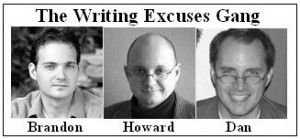 After a cancerous death, I appeared on Writing Excuses this week to groan and hold forth with the guys on writing second novels and second books in a series.
 Folks, the first tentative schedule for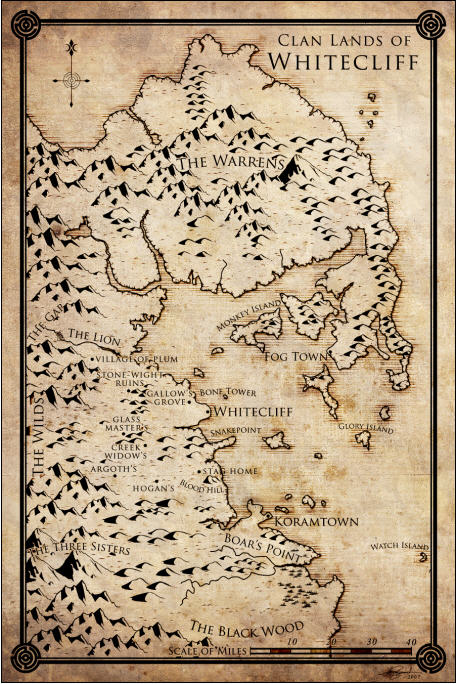
John;
I loved the last couple of WE episodes you were on. I have even forgiven you for making me read Jude The Obscure, though I am still scarred for life from it.
I am still eagerly awaiting YOUR second book. Why must the publishing industry torture us with such slow release dates?
Jon (the other one)
Wow. They must have been reeeeeel good 🙂
I’m eagerly awaiting my second book as well. Alas, later this week I’m going to make a post that’s not going to make anyone happy.