Great news! Laser Books has just purchased rights to print Servant of a Dark God in Czech for their Masters of Modern Fantasy imprint (click on the link to see other authors being published by them). The Czech Republic has just won a special place in my heart, seeing it’s the location of my first foreign sale, ever. We luvs the Czech Republic, Precious.
Here’s a photo of Prague, their capitol city.
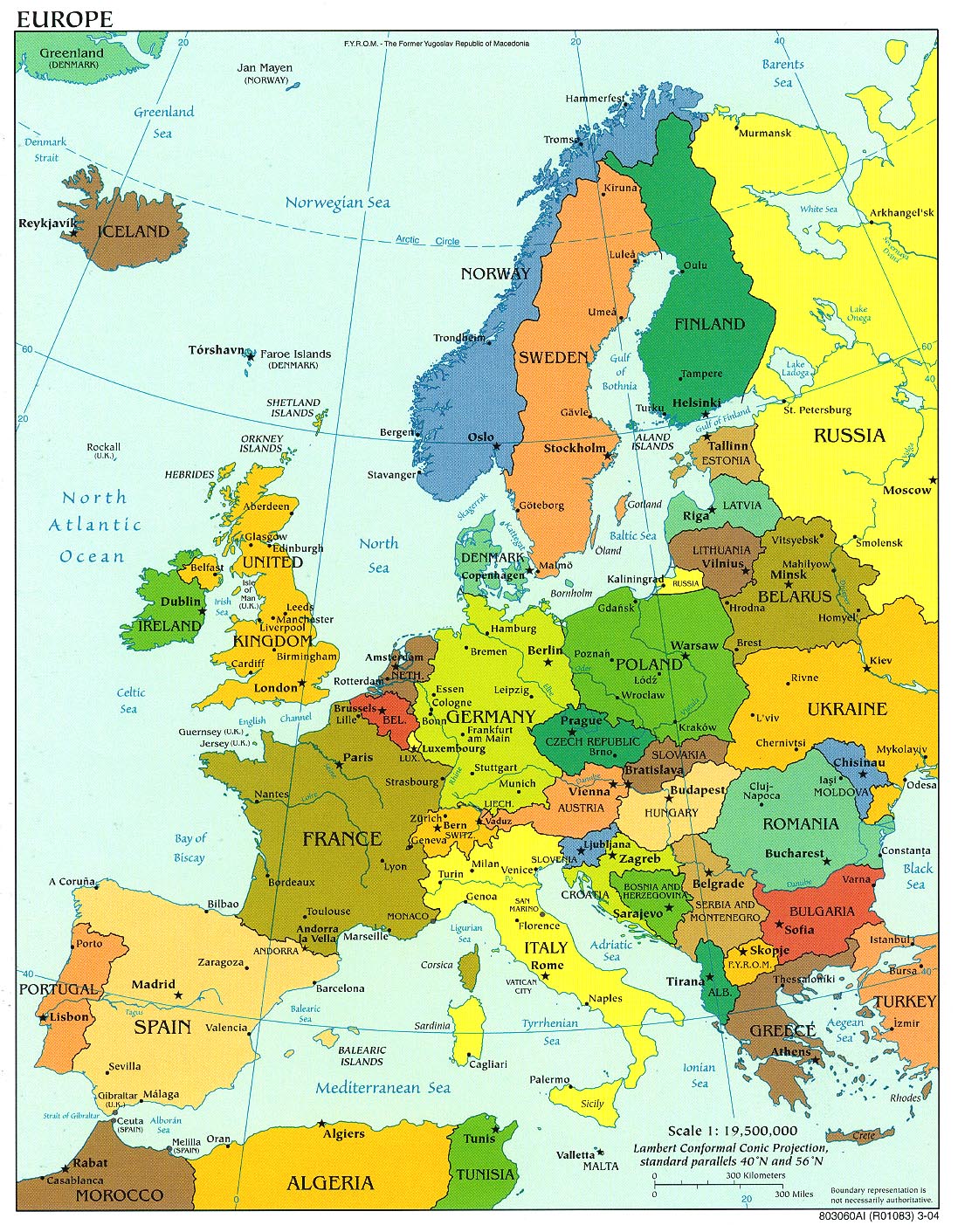
More lovely and interesting photos here. For those who need a little bit of help with their geography, click on the map below. The Czech Republic is right in the middle of Europe.
Just got word from the programming organizer that my killer workshop is a go for MountainCon this year. The bonus is that Brandon Sanderson will be teaching it with me. You do NOT want to miss this one.
WHAT: Writing Killer Stories: This is a hands-on workshop conducted by two professional
authors (Brandon Sanderson, John Brown).
When you finish, you will know:
The 3 keys to writing killer fiction
4 parts of story & how they relate to the key
The creation process
7 principles of creativity
Critical guidelines on suspense, plotting, setting, and character building
WHEN: Saturday, September 20th, 7:30-10:00 PM, Panel Room 1
Folks, a huge thanks goes to Stephen Nelson for putting all this together. You may kiss his hand when you see him.
This is a recording of “How to Write a Story that Rocks,” a two-hour seminar Larry Correia and I just put on at the annual BYU’s Life, The Universe, & Everything symposium. I think we had 130-140 people attend. This symposium is focused on writing fiction. And while the panels and presentations do include things specific to the science fiction, horror, and fantasy genres (both adult and young adult), a lot of time is also spent on story writing fundamentals that apply to ALL genres. So when I developed this workshop, I made sure I took the fundamental approach.
The two-hour seminar has been broken down into 12 segments. To switch between the segments:
Hover your mouse pointer over the YouTube below
Click the forward and back arrows that appear on the right and left sides to move to the next or previous segment, OR
Scroll through all 12 segments and select the one you want using the playlist control at the bottom
I’ve found whenever I develop any presentation or training that it takes a few iterations and revisions before it’s the best it can be. This is the first iteration of this seminar. And so below this video I’ve provided additional comments on each segment explaining key concepts, principles, and techniques that we might have failed to discuss or convey as clearly as we’d hoped. Enjoy!
It’s documented–right-wing gun nut Larry Correia sang “Kumbaya.” What’s next? The hugging of small trees? Oh, Larry, the disilluion. The disillusion.
The reason why I had Larry sing was not for his mellifluous performance, but to demonstrate the difference in reactions between him and our happy volunteer (“Country Road” by John Denver–this really was a love fest). The volunteer balked because he hadn’t taken any thought to know what to sing before he was commanded to do so. On the other hand, Larry and I had spoken before the seminar. So Larry had something to sing BEFORE he sang it. It’s a simple demonstration, but it illustrates a principle a lot of new writers forget. Writing is a performance. It helps to know what it is you’re going to perform before you perform it.
It’s one thing for you to tell yourself to write. It’s much easier to tell yourself to write the scene where the rancher finds out one of his illegal ranch hands has been kidnapped.
Now this doesn’t mean that you have to know everything. Or that you can’t write exploratory drafts to figure out what it is you want to write. But it does illustrate that whatever techniques you use, you’ll be a lot more effective in your writing when you have something to say first.
But what do you develop? What are the things that bring the story to life? How do you go about getting those things to say? That’s precisely what I wanted to address in the seminar. In the segments that follow, I try to:
Explain what I’ve found are the most important things to develop, the things that define the essence of story, that make the story come alive in the writer’s mind–the things that really matter
Demonstrate techniques to develop those things so you have something to say
Segment 2
I think this segment went fairly well. What rocks will different from person to person, even though there will often be a huge overlap between people. So it’s important for authors to seek to develop the kinds of stories that rouse their passion. Watch this interview with best seller Debbie Macomber to see what I mean. So I can’t tell you what to write about. Or if whath you think rocks will resonate with a large number of people. However, what I can do is share the techniques I use that have been most productive in helping me develop initial ideas into something that has much more power.
You can use the techniques to juice up any of the four parts of story. However, I will say that I find that the most productive, the most important parts, are character and problem. Plot and setting are important. I love them and work to juice them up. But when I get a good character and problem, that’s when the writing seems to flow the easiest.
And no, I don’t list theme as a part of story. Everyone talks about theme, but when I read what they have to say or press them for examples, it seems that it always either boils down to (1) a story element or topic that’s repeated, (2) a story problem/issue stated in an abstract manner, or (3) some moral situation. Les Miserables is about the “theme” of mercy versus justice. But saying justice versus mercy is just an abstraction of the story problem and dilemmas the story deals with. So, no theme.
I’ll be adding my comments to the rest of these segments over the next few days.
Segment 5
Segment 6
Segment 7
Segment 8
Segment 9
Segment 10
Segment 11
Segment 12
Dan Wells on Story Structure
Check it out: Dan Wells on How to Build a Story (story structure). I find Dan’s “start with the ending” technique helpful as well as thinking about a worst fears realized moment. Watch the videos and see if there isn’t something there that can help you develop your story idea.
Yes, you read that right. Valerie Moore, an Arizonan bead maker, read the book and loved it. After coming to the Poisoned Pen signing, she was inspired with a new bead design that she calls “The Grove,” after the Grove of Hismayas.
She says, “I like when other people’s work speaks to me and I can release it in my form of art (which happens often enough through books or music). . . The Grove is a design, inspired by your work, made from polymer clay and 22k gold. The colors and design evoke a sense of depth, much like The Grove in Servant of A Dark God. It runs deep and true; like a network of roots. Earthy, deep and calm is what they “feel” like to me. The gold glints out like the sparkling of a soul, pure and shining and as yet untarnished. And in a way, think of the dragonfly “zinging” around. 😉 It must have gotten some funny cookies to eat.”
I say “hear, hear!” to funny cookies! I’m so stoked my story inspired her. I think the beads look great. More importantly, so do my girls, who are true bead heads (we dropped $50 on Black Friday at a bead shop, ack!). Check it out. If you want some for yourself, you can get them online.
Maya has one of the most quirky goat-loving blogs around. I dare you to read just one of her blogs. You can’t do it. You’ll find yourself going back to read another. And another. Anyway, she’s been doing a series called “How Writers Do What They Do” where she interviews authors on the creative process. Mine’s the latest, but there are a lot of other interviews in the series you will want to read. Enjoy!
Folks, I just finished the first draft of my working outline for AWFUL INTENT. I’m stoked. Lots of research and lots fun and sometimes maddening work to get to this point. Here’s the current version of the summary, which will change.
Southeastern Utah. 30,000 square miles of red-rock desert and wilderness. One of the least populated places in the United States. The perfect place to hide just about anything.
Frank Shaw is just passing through. He was once an elite soldier, trained to see what others want to hide. Then he made some terrible mistakes and fell from grace. Except the old skills never went away: they were only heightened during his time behind bars. Which is why Frank notices the fearful woman in the McDonalds and the killer watching her.
Frank could move on. He’s got a life to put together and a sandwich to buy. But some things are more important than a Big Mac. Frank follows the man who follows the woman, and that one decision leads Frank to a ranch that isn’t a ranch and into a plot of awful proportions.
When Frank and the strong female Sheriff from the small town a number of miles away discover the truth, they try to get back and call for help, but the rancher is on to them and sends a private army out to hunt them down in the wilderness. Frank and the Sheriff will need to use all their combined skills to survive. Because time is running out, and thousands of lives are at stake.
My agent got back to me on BAD PENNY. I will be focusing on some tweaks over the next two or three weeks. Then we need to get that moving forward.
Finally, I know some of you are wondering about the DARK GOD series. And why wouldn’t you be with my earlier post? Things haven’t been finalized. Soon, Grasshopper. Soon.
3 Comments
Czech it out! (That’s the title I would’ve used for the blog post.) =P
Congrats on your first foreign sale! That’s got to be a cool feeling.
That would have been great. Alas, my mind takes days to think such things up.



 Yes, you read that right.
Czech it out! (That’s the title I would’ve used for the blog post.) =P
Congrats on your first foreign sale! That’s got to be a cool feeling.
That would have been great. Alas, my mind takes days to think such things up.