
Similar Posts
TED
I LOVE TED.
No, I’m not coming out of any closet. I’m talking the annual Technology, Entertainment, Design (TED) forum. It started out (in 1984) as a conference bringing together people from those three worlds. Since then its scope has become ever broader.The annual conference now brings together the world’s most fascinating thinkers and doers, who are challenged to give the talk of their lives (in 18 minutes).
For example, here’s Richard Dawkins’ “Queerer than we can suppose: the strangeness of science.”
Or here’s Hans Rosling’s “Debunking third-world myths with the best stats you’ve ever seen” and his New insights on poverty and life around the world.
Or how about Howard Rheingold’s “Way-new collaboration”There is, if done well, very few things as stimulating as an excellent speech. Thank you TED for providing a way to revive this marvelous genre by sharing it on the internet.
Go to TED. But beware: you may end up unable to stop listening to one fascinating idea after another.
Are Squirrels Smarter Than We Think?
I miss the squirrels we had at the old homestead. No, that’s not hyperbole. Until two years ago the six of us lived in a 900 sf home my wife’s grandmother homesteaded for. But that’s beside the point. We had squirrels there. They chittered, ran about, tossed apples down at my girls when they tried to inhabit the hammock.
For those of you not from Utah, you might be wondering why this is such a big deal. If you’re from the East you might be thinking I’m nuts. But out West trees are few and far between, which means so are the squirrels. So we loved our squirrels, but then they got into our neighbor’s fifth wheel and he promptly killed them all.
Alas.
But here, for your pleasure, are squirrels using their god-given intelligence to do what they were bred to do–steal and eat.
Of course, they are squirrels. Not quite geniuses yet.
One of my stories either needs a squirrel who steals candy bars or a character who is constantly setting up obstacle courses for the varmits.
Anti Monkey Butt
Sometimes words fail me…
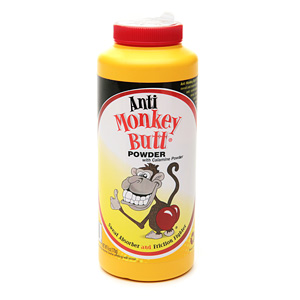
With Calamine Powder
Sweat Absorber and Friction Fighter
Anti Monkey Butt® Powder is specially formulated to absorb sweat and minimize frictional skin discomfort. Helps to keep you dry and comfortable. Ideal for butt busting activities such as motorcycling, bicycling, horseback riding, truck driving, hiking, hockey, football, and baseball.
Indoors or outdoors, work or play, or on occasions when you sit on your butt all day. Don’t let your buns get red. Use Anti Monkey Butt ® Powder instead!
Rufus Hussey: The Bean Shooter Man
It’s been a while since I posted pure zing, but here’s one that I just ran across and love. I want Rufus in one of my stories. These kind of things make life great.
According to Remembering Randolph County, North Carolina, Rufus appeared on the Johnny Carson show. If anyone has links to that video, please post. In the meantime, get zinged, Baby.
I want to be Scott Westerfield
Laura Miller at Salon.com has it all wrong when she says promoting books with movie-style trailers is a silly idea.
Here, watch this book trailer for Scott Westerfield’s Leviathan.
Yeah, I know you want to–go ahead, watch it again.
Miller looks at book trailers, sees that the vast majority of them are lame, lame, lame (actually, this is the FIRST I’ve seen that’s any good). Sees that they reach no markets and then concludes that all trailers are silly. It’s true: lame trailers ARE a waste of time and money. But ANY advertisement (print, video, audio, whatever) that’s lame is a waste of time and money. Making killer trailers that nobody sees is an even bigger waste of time and money. But that’s true of ANY killer advertisement that nobody sees.
Look. I’ve never read Westerfield. Don’t know much about him or his books. But I saw that clip and now want to read that book. Hum, trailer worked for me. I AM a reptoid mutant, but I suspect there are others out there like me. I mean, come on. Good gravy, woman–“Do you oil your war machines? Or do you feed them?” Killer!
Movie trailers, book trailers–any advertisement–isn’t about delivering what the person is going to experience on the spot. If that were the case, then you’d never show a print ad of a meal at Olive Garden because it doesn’t deliver the goods right there on page 10 of Woman’s Day. Nope, all you’d do is go around giving out samples in places with Italian mood.
Miller’s error is not understanding the difference between making an offer and delivering on one. What an ad is supposed to do is make the offer. Let you know this thing is available. Because you’re not delivering the actual experience, you can make the offer via all sorts of media. Now, if you can give them a taste, that’s great. But you don’t need to deliver the full deal right there.
So what do you need in an offer? You need the offer to say, “Hey, I’ll deliver this type of experience.” It needs to call to some action, either directly or by implication–“buy this” or “be here.” You also need it to say, “You can trust this will be worth it” and make the consumer believe that’s likely to be true. It communicates this last bit by being a quality piece of work.
Making an offer is exactly what book covers do–they make the offer and give the consumer a little taste. And book covers matter. This has been proven over and over. Just like most people, when I see a cool cover, I pick up the book and check it out. When I see a lame one, or one that offers something I’m not interested in, you’re going to have to threaten me to pick that book up. Or it better dang well have some righteous word of mouth. It’s that simple. We all judge books by their covers because the cover is making an offer. And lame offers don’t get very many takers.
Book trailers are nothing more than deluxe book covers. The cool thing about them is the cool thing about movie trailers–you can make the offer by providing a little taste. You do that by giving the audience the story situation, the pitch. You do it by communicating the feel of the experience and raising curiosity. You do it by making it a pro job. The good ones make you laugh, say cool!, or raise curiosity and expectation.
And that Westerfield trailer does that.
Dang, “Do you oil your machines? Or do you feed them?”
Run that on TV. Run it on the radio. Put it up on sites where people are likely to see and click. Confirm it in print. Make the offer to real people. Get it infront of young readers. I’ll stake my eyebrows that ad can sell as many books as a good movie trailer can sell movie tickets.
Crimeny, now I want to be Scott Westerfield.
Edit, I lied
I have seen another book trailer that’s as good as Westerfield’s. Do you remember this: http://thesecret.tv/movie/trailer.html ?
Very effective advertising for the book. I think the content of the book is crap, but that trailer made me pick it up just to see what it was all about.
Do you notice that this one and the Westerfield one combine extreme professionalism AND they make the pitch in a clear and grabbing way? The pitch for both was what the book was about. For fiction it’s the concept. For non-fiction how to it’s the promise.
So many of the book trailers lack one or more of those things. For example, look at the book award finalist for THE FALLEN: http://www.youtube.com/watch?v=vsLE6bNaIrk. I don’t know what the heck the book is even about after a long 2 minutes. They’re trying to make a movie.
Something else. On both of these you have a voice over PITCHING the book to you just as someone might do it in person or to an editor. It’s a powerful method, I think.
Notice also how short the Westerfield one is. Just over a minute. Westerfield’s really is like a query pitch or cover copy–in just a few lines tell me what your story is about. We get genre, setting, character, and the story problem or concept.
Animals in Translation by Temple Grandin + Interview
I have read few books more interesting than Temple Grandin’s Animals in Translation: Using the Mysteries of Autism to Decode Animal Behavior.
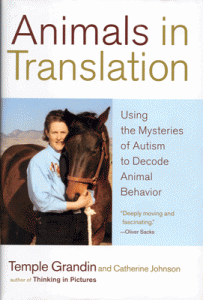
In it she describes her world of autism and how it helped her a perspective into animals unlike any other expert in the field. She can literally see what we block out. It’s part of what helped her make a huge impact on the meat packing industry.
And it’s had an impact on her. When she was visiting her grandparents once in Arizona, she saw a squeeze chute in operation on a ranch. She saw the cattle calm, for the most part, in the chute. “Watching those cattle calm down,” she says, “I knew I needed a squeeze chute of my own.” So when she got back home she built a human-sized one with the help of her teacher. “I got through my teenage years thanks to my squeeze machine and my horses.”
Grandin is not a vegetarian activitst (she eats meat herself) or a brutal slayer. She has taken the middle ground between the fantatics that want to prevent the consumption of all meat, on one hand, or totally disregard the life of animals on the other. She writes, she says, “because I wish animals could have more than just a low-stress life and a quick, painless death. I wish animals could have a good life, too, with something useful to do. I think we owe them that.”
Temple has dozens and dozens of insights into animals, which she shares here. You’ll learn about rapist roosters and the problem of one-trait breeding, whether prediators find it “fun to kill a groundhog” (yes, she says, they do), whether animals have true cognition, and so many other things it’s impossible to list them here. I was fascinated on every page. If you have anything to do with animals, you’re going to LOVE this book.
Get the book. Read it. In the meantime, watch a 27 minute interview of Temple by Doug Fabrizio on Utah NOW. I caught this on TV flipping through the channels and couldn’t look away. This is a fascinating interview of a fascinating woman.
Source:Temple Grandin on Utah NOW
