Are you ready for a story that’s heroic and inspirational? And poignant. And action-packed. And all true.
I just finished Fearless: The Undaunted Courage and Ultimate Sacrifice of Navy SEAL Team SIX Operator Adam Brown by Eric Blehm. And wow. I can’t tell you how happy I am to have read this book.
It tells the story of Adam Brown who was killed while on assignment in 2010. But this book isn’t about a special operations battle in Afghanistan, although the battle is detailed. It’s not a war book. Although it tells about many episodes in the life of a Navy SEAL operator. No, this book starts when Adam was a kid.
It like the story of Louis Zamperini that’s told in Unbroken by Laurel Hillenbrand (and, yes,the film adaptation missed so much of the story, including the most important part,that if you haven’t read that book, you are missing out on an absolute treat). In this one, Brown starts out as a boy with bright promise, but after he graduates from high school, he makes a number of bad choices and drives his life right off a cliff.
You’ll be flipping the pages to see what helps him turn it around and whether he can make the change permanent, or if he’ll lose everything, including the love of his wife and kids. You’ll also be amazed at his grit. It’s a tremendous read. If you can listen to it on audio, you’ll enjoy the narration by Paul Michael. Either way, if you like stories about redemption and triumph amidst struggle, if you like books about special operations forces and elite soldiers, then you’re going to love this book. Highly recommended.
*
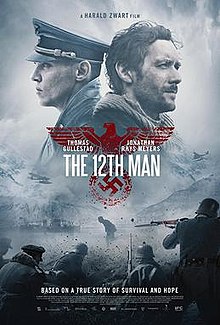
The 12th Man is a 2017 World War 2 historical drama based on the true story of Jan Baalsrud. He and eleven other Norwegian resistance fighters set off from the UK on board a fishing boat with six to seven tons of TNT to sabotage some German military facilities.
However, their mission falls apart soon after reaching Norway. A German warship attacks. The resistance fighters set fire to the TNT on their boat and jumped into the water just off shore. Eleven of the fighters are caught by the Germans. The twelfth, Jan Baalsrud, gets shot in the toe, but still runs across land and manages to elude immediate capture by swimming across the fjord, in the dark, in the freezing, winter water.
Yeah, and that’s just the beginning. The story is about his attempt to get to the safety of Sweden, a neutral country. I watched this with my teenage daughter, and we were riveted with the suspense and action. And we were amazed at what this guy endured.
You will have to read English subtitles during a large parts, but we found that after a few minutes, we really didn’t notice it. It was a great date night. If you like war movies and action, I think you’ll love this movie.
*
Tonight I ate a dish that instantly became one of my favorites. My oldest daughter and her husband found it. They love it and shared it with Nellie. And since it was her night to cook, she decided to give it a try. My first bite was wow.
It’s a baked casserole, a cross between lasagna and spaghetti, called “MillionDollar Spaghetti” from tastesbetterfromscratch.com. Just click on the link the get the recipe.
Now, here’s the thing: you can use spaghetti pasta, or you can make it totally low carb by replacing the pasta with cooked spaghetti squash like we did. The low carb version was awesome. I can’t wait to heat up the leftovers tomorrow.
By the way, here’s a quick way to cook spaghetti squash.
First, cut the squash in half lengthwise. The easiest and safest way I’ve found to do this is to place the uncooked squash on a cutting board. Next, get a big knife and set it along the line you want to cut. Finally, rap the spine of the blade smartly with a thick stick or long block of wood until the knife cuts through all the way. Using a knife this way is called batoning because you’re using a baton, a stick. It’s a slick and safe way to cut a hard squash.
Once you have cut the squash in half, scrape out the seeds with a large spoon.
Next, pour about a quarter cup of water into the hollow of the squash, and then turn the squash hollow-side down on a plate or microwave dish. Microwave the half on high for five to six minutes. It’s done when you can easily pierce the outside with a fork.
Remove the plate with hot pads and use a fork to scrape out the cooked squash. Voila! Cooked spaghetti squash in less than 10 minutes.
You can also just bake the halves in the oven for 40 minutes on 375 degrees. Baking gives the squash a slightly richer flavor. In this method, you brush the halves with olive oil and sprinkle with salt and pepper then put the sides face-down on a baking sheet. Again, it’s done when you can easily pierce the outside with a fork.
*
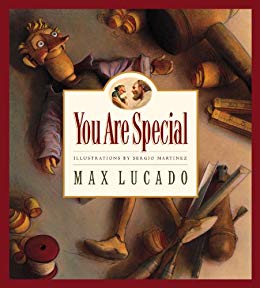
And here’s one more because it’s Christmas. I attended a young women’s meeting for my local congregation not too long ago. As part of the program, one of the leaders read a picture book called You Are Special by Max Lucado.
It’s about these small wooden people called Wemmicks who stick gold stars or gray dots on one another. The pretty or talented ones always get stars. The others, like Punchinello, get the ugly gray dots. And then one day Punchinello finds a happy Wemmick that has no dots at all. In fact, no dots stick to her. How does she manage it?
It’s a great little tale with an important insight. After hearing it, I knew I needed a copy of the book to read to all my grown up kids.
Homicide rates are down in America, but school shootings are up. What’s going on? What’s driving this?
Some say it’s guns.
I have an hunch that I think deserves some study.
Back in the 1970s we had 30 school shootings with a population of about 216 million.
Today we have a population of 320 million. If we had the same ratio of shootings to population today, we’d have 44 shootings total in the decade between 2010 and 2020. But from 2000 – 2010, we had 60. And since 2010 (if my data is correct, and it appears that’s a big if–see Edit 2 at bottom) we’ve had 146. That’s a 300% increase!
If we want to solve the school shooting problem in the long term, we need to figure out what’s fueling it. One way to get at this is to ask what’s changed since the 1970s and 80s when the rates were lower.
Are we killing at a higher rate in general? Is that what’s changed?
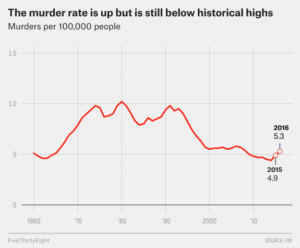
No. FiveThirtyEight reports homicide rates have dropped. Here’s their chart.
We’re down.
But school shootings are up. Way up!
Clearly, what’s driving school shootings doesn’t seem to be the same thing that’s driving general homicide rates. Otherwise, the rates would be moving in the same direction, but they’re not.
Is it gun ownership rates?
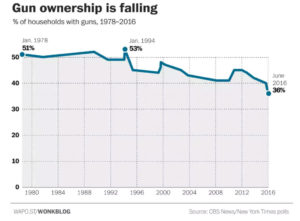
According to the Washington Post, ownership rates are at their lowest in quite some time. Here’s their chart.
This means that if general gun ownership rates were a major factor, then we’d be seeing school shooting rates fall. We’re not.
Furthermore, some of the US states with the highest gun ownership rates have the lowest murder and school shooting rates. (For those wanting to know more about guns, magazines, the definition of an assault rifle, gun control, etc. see Larry Correia’s informational post below.)
Now, it could be that while overall gun ownership rates have fallen, ownership in certain population segments has risen. That’s something to look at. But when looking at the overall ownership rate, we don’t find an answer.
Is there anything else to study? Anything else that might be different now?
Here’s my hunch–it’s the internet. My hunch is that an unintended consequence of social media and the ease of finding certain types of content have facilitated the development of the mindset and ability of certain youth to commit these crimes.
We do things when we are prompted to take a specific action and we have both the ability and desire necessary to take that action. So action requires three things:
A prompt
The ability
The desire
If the rates are going up, then one or more of those things have changed. Either more kids are being prompted to take this specific action, we’ve made it easier for them to do it, or we’ve increased their desire to do it. Or some combination of those three.
Let’s see if the internet might be a factor.
First, from what I’ve read, it seems a lot of these kids feel like outcasts and seem to be seeking some kind of revenge. Does social media foster and facilitate more bullying and isolation and, therefore, more resentment? Has it increased the desire to conduct such attacks?
Second, it is dramatically easier for kids to learn how to do all sorts of stuff now. Back in the 70s and 80s, it was hard to learn about the methods and tactics of crime, firearms, etc. Now, if you want to learn how to shoot, scope a place out, plan an attack, do all sorts of things, you can watch YouTube videos on it. Has the easy accessibility of how-to instruction facilitated the ability to plan and carry out these attacks?
Third, back in the 70s and 80s you had limited programming. Gilligan’s Island, Brady Bunch, The Love Boat, The Donny and Marie Show, Lawrence Welk, etc. They all fostered good-citizen values. Today, kids have easy access to all sorts of crap. Violent rape porn. Evil games like Blue Whale that give challenges to the player, and the last is to kill yourself. Are there certain types of programming on the internet that foster a violent mindset? That prompt these very actions and makes them seem like a good alternative?
Fourth, look at how well political conversations go on Facebook. Chat rooms, blogs, etc.–we all know they foster more incivility than when you talk in person. Does our social media, by its very structure, anonymity, etc. foster a more anger-filled approach to disagreements? Has it prompted, even trained, more kids to behave this way?
Is one of the unintended consequences of the internet and social media a rise in school shootings?
I’m not saying it’s the only part of the puzzle. But I do think it’s worth studying. We need a long-term solution.
At the same time, we need something now while that long-term solution is being researched and implemented. One of the best ideas I’ve seen so far to stop the killings is the one mentioned here.
Such people are screened, trained, and on-site. They can respond immediately. Plus it’s voluntary. If you’re a teacher that doesn’t want to do this, you don’t have to. Plus this doesn’t add security guards to schools. Nothing changes at the school until the shooter shows up, and suddenly there are half a dozen, dozen, two dozen deputies immediately there.
I think at our tiny 1A middle school, there are probably 6-8 people who would do this, including my wife. The teachers know the kids, know where other teachers are likely to be, know the place like the back of their hands. We know security deters threats. I can’t see anything but positives.
I don’t like the fact that we have to contemplate this. I want to go back to my youth in Bountiful, Utah where this never happened. Maybe we can get back to that type of a society. Until then we need an immediate, practical, and effective solution. This seems like a good part of a multi-approach solution.
But what’s the long-term solution?
I wonder if has to do with the internet.
Is any organization seriously studying this?
Do you see anything else that might have increased the prompts for this specific action, the ability to plan and conduct attacks, or the motivation to do so?
Edit 1 – gun retention
On Facebook today, a former deputy sheriff I know and respect was asked “Should teachers carry guns?” His answer: “No. Weapon retention is never even considered when politicians and others come up with that. Imagine some big, unfriendly student disarming a teacher during some classroom issue. Instant problem.”
This is a good point to raise.
I didn’t think of it. It’s clear none of the teacher defense plans are complete without it.
But is it a show stopper?
First of all, how big a risk is this? How many student-teacher scuffles do we have in grades 1-6 where the teacher is overpowered by a third-grader? How about in middle school? I’m sure the risk is higher in high school.
But just because there’s a risk doesn’t always mean you shouldn’t do something. Male and female agents and officers are trained in retention. My question is whether such retention training is ineffective? Should officers not carry guns because of this?
If it is effective, then it seems to me that if you’re trained, you’re trained. A big senior boy has just as much chance to disarm a trained cop as a trained non-cop of the same size and strength.
This is another reason I like the suggestion of the sheriff above. It’s not just any teacher that would do this. They need to be screened and trained. They’re deputized. I could see them doing training on a frequent basis. Something goes down at at school, and you immediately have 6-8 trained deputies on site. Maybe a dozen or more. Is that not a game changer?
It’s good to identify risks. But what would reduce the risks identified? Could we reduce them to acceptable levels? It’s a question that needs answering.
Edit 2 – is the “rise” due to bad data?
Just saw this. Is the “rise in school shootings” even real? Or is it bad data? Here’s an opinion on USA Today, suggesting it might not be as bad as we think. One of the things that’s maddening about all of this is what seems to be a lack of good data!
Wikipedia on murder rates by country–however, it appears how the data is reported by country and what’s counted, even between countries like the UK and USA, make is almost impossible to get apples to apples.
On February 28th, Operation Underground Railroad freed 20 kids from slavery and brought 5 slavers to justice. They are continually running operations.
Oskar Schindler didn’t stop the killing of all Jews. But he did what he could. One of the most poignant moments of Schindler’s List was when he pulled out his pen and realized he could have saved someone with his pen. We all have a pen opportunity in front of us. Join me and my family. Become an abolitionist.
We’ve set up a monthly amount, but even a one-time donation puts you on the team.
I know you want more information. Here’s an awesome video where the founder explains what’s happening and what they’re doing.
In this one, Glenn Beck interviews Cliff Graham about the organization. It’s a must-see interview.
I always enjoy presenting at the Life, the Universe and Everything writers conference. This year they asked me to present the following.
The 3 Little Secrets that Make Plotting So Much Easier
No, the secrets don’t have anything to do with the hero’s journey; 3, 7, 8, or 9 acts; Lester Dent; or cat-saving beats. An average novel has around 40 to 70 scenes. If you’re like me, those abstract plot structures spark an idea or three, then dump you in front of a blank wall. So where in the heck do all the other scenes come from? Well, a whole heap of them stand up and present themselves when you use these 3 little secrets. If you struggle with plotting, this is your chance to put that behind you for good and start generating fun and exciting plots with ease. Come learn the 3 little secrets that make plotting so much easier.
Despite the oft-repeated 11th commandment for writers—show, don’t tell—writers never show. They can’t. It’s all tell, tell, tell. The trick is to tell in a way that helps your readers imagine with such vividness and clarity that your story triggers an emotional response. In this session learn the five critical prose techniques that help you do just that.
Are we all wearing Coke bottle glasses with this government shut down?
First, it seems silly to me when reporters ask Americans who is causing the shut down. It’s like, duh, if either party just gave into the other party’s demands, we wouldn’t have the issue. Which means that BOTH parties are causing the shut down.
Second, it seems a lot of folks have forgotten that this is precisely what should happen.
What?
Yes, our government is designed to allow these types of things.
But, John, isn’t that just asinine?
No. It’s not an oversight. I think it’s smart. Even if it causes some pain.
Let me explain what it seems some in the media and elsewhere are forgetting.
This is not a nation that belongs to a government. It’s not a nation owned by some lord or entity. This is a nation of individuals who decided to band together because we thought that banding together would allow us to protect our lives, liberty, and pursuit of happiness better than if we stood alone individually.
This is a nation of individuals who said, you know, we think we can figure things out better together ourselves than having someone dictating to us what we’re going to do. We’ll get together and talk. We’ll argue. We’ll persuade. We’ll try to convince each other of our individual ways of thinking. And when enough of us are convinced that we should do something, we’ll act.
We’ll set up a process for talking and making decisions that ensures everyone can be heard. It would be great if we could get 100% agreement on everything, but we know that’s not realistic. At the same time, we don’t like the idea of forcing our will on others. So we’ll make a compromise; we’ll set up the rules for making decisions so it requires that a good majority of us are in agreement before we can take action, especially on matters that are important to a lot of us.
Finally, we’ll make sure no individual or group can take control and deprive us of this way of living. We did the monarch thing, and we’re done with that. We will not bow to any king ever again. We’re going to be very careful about this one item because a lot of bad things begin to happen when any one person or group gets too much power.
So we set up the rules and started working together this way. And the basic premise under all of this is that we would respect each other’s free will. We’re a land of liberty. We’re a land where we get together and agree on a course of action. Not one where we impose our will on others.
One of the main methods we used to ensure that no individual or group could take control of the rest of us and that a good majority of us must agree before taking a course of governmental action was to distribute the power to make and enforce rules. We did this in a wide variety of ways. We did this because power’s a slippery thing and easily abused. Furthermore, because we knew no system is perfect, we also set up a system of checks and balances so that if one person or group abused their power, we could stop them and force them to remember to respect the freewill that the rest of us have.
So what has caused this shutdown?
It’s very simple.
A lot of Americans do not agree with Obamacare. By most polls, it’s a majority of Americans. They were not listened to when it was being developed. They were not listened to when it was made law. They feel it was passed, not with open discussion, but a lot of chicanery. They feel it’s not some minor regulation, but a very big thing that will infringe on their rights to live how they want to live.
Now, it might be that all their fears are unfounded. It might be that Obamacare is going to usher in utopia. Many signs suggest it’s not going to do anything of the sort. But let’s just say it is the finest piece of legislation ever. Let’s say is a celestial piece of governing.
That isn’t enough.
It’s not nearly enough.
Because this is not a nation that belongs to any group. We are a nation of individuals who have banded together, agreeing that we will talk things out amongst ourselves and only act when a good majority of us agree on a course of action. This is a nation that tries to tread lightly on each other’s liberty.
But many of the folks in Washington back in 2009-2010 forgot this and forced this thing called Obamacare upon the rest of us; in doing so, they violated one of the basic agreements of our compact. If they had followed the underlying intent of our union, they would not have done what they did. They would have crafted legislation that a good majority of us could get behind.
In 2010, those of us who protested this use of power voted in new folks into the House of Representatives to deal with the matter. In fact, when given the chance, Americans (both Republican and Democrat) in the heavily Democratic state of Massachusetts voted Republican Scott Brown into office, hoping to stop this legislation in the Senate before it became law. But Harry Reid didn’t listen. He didn’t care. He and Pelosi and Obama weren’t interested in allowing a full national discussion. He and the others were more concerned with getting their way. And so he used a parliamentary trick to force it through.
This shut down is about one group of people forcing their will on the rest of us. It’s about using the checks and balances designed into the system to correct such errors. It’s about the chickens of some poor decisions coming home to roost.
I know the shut down has caused issues. It’s a partial shutdown; 13% of the government. I think 87% is still funded and running. Still, I know it’s causing some pain.
But none of that pain needs to occur. Everyone wants to fund cancer research. Everyone wants to help poor single mothers. Those things aren’t the issue. The issue is that not everyone agrees with Obamacare.
If you’re a supporter of Obamacare, let me ask you this: if the tables were turned, what would you do?
Would you not stare at the folks trying to force their will on you and say, hey, come on. We’re adults here. We all agreed that we wouldn’t do anything unless a good majority of us were convinced it was the right course of action. Let’s get together and come up with something a good majority of us can get behind.
If you’re an opponent of Obamacare, you too should recognize that a good portion of your fellow citizens are clamoring to change the way things are. They’ve been clamoring for some time. Should you force your will on them? Or should you sit down and listen and try to come up with something that addresses the points we can agree on?
I don’t know if the folks many of us voted to go to Washington will stick to their guns and correct this. I hope they do. And I hope that those on both sides who have forgotten one of the basic tenets of our social compact will wake up and remember we are banded together, not to game the system to get what we want, but to act on only what a good majority of us want.
Last week, I was booted out of Codex Writers, a private, online writer’s group that I’d been a member of for somewhere around fifteen years. I’m not broken up about it, but the reason for said booting is interesting, unexpected, and worth a post.
Over the years, writers moved in and out of the group, but there were usually somewhere around fifty to a hundred members active on the boards. We discussed the writing craft and business. We held writing contests. We provided critiques. People shared interesting things about their lives.
The group has moderators. And the moderators got together last week and decided John Brown had to go.
Why?
What, of all the sins one may commit online, triggered this?
Was it refusing to stop posting pictures of cats?
Using too many emoticons?
Infecting everyone’s pages with Russian spam bots?
Nope. Nope. Nope.
I know what you’re thinking. Surely, John, you must have
been posting in a belligerent, arrogant, and strident way. You must have been a
jerk.
That’s what you’d think.
I assumed that’s what the problem was too. I invited those
who were angry and hurt to come to my personal thread and explain what it was
that was making them so hurt and angry. A number took me up on the offer. And,
to my great surprise, one of their criticisms was that I was too polite.
One person posted that my politeness made her think I was sealioning (a new term to me). Other’s agreed.
Another person said that my polite manner surely indicated I wasn’t sincere. Other’s agreed.
In fact, one of the moderators stated that being polite was part of the insidious problem that was John Brown. She said that my politeness had suckered folks in to letting my awful behavior go on too long.
I was offensive, and I was too dang polite about it.
So what was I doing?
Well, I was asking for evidence.
Don’t ask for evidence
My sin was suggesting that some claims being made about a
certain topic seemed to be premature. My sin was in looking at the evidence
being offered to support some of these claims and firmly stating that I
couldn’t see how it supported the conclusions.
On every topic on the forum, we could question claims and
discuss evidence in an effort to figure things out. But there was one topic, as
I learned, for which a number of the active members and the moderators decided
that was forbidden.
The topic was systemic or “institutionalized” discrimination.
On the forum, most of the discussion was how it related to publishing.
They explained to me that it was offensive for me to want to
see if the evidence actually supported the claims. It was offensive to post when
I couldn’t see that it did.
You might wonder how in the world can that be offensive.
After all, evidence is one of the first things we ask for when people make
claims.
If Billy Joe comes up to you and says, “Son, aliens done landed in my yard last night. I swear it on a stack of Bibles.” Most of us would want some additional evidence.
We’d want to see the video he took and look at the burn mark
in his lawn and the broken branches he said were made when their ship landed.
And we’d want to see the report showing that the residue collected off the
swing set was a substance unknown to mankind.
But it isn’t just claims about aliens that we do this with.
Historians do it about history.
Scientists do it about science.
Courts require it for reaching verdicts.
Heck, we even do it when we look at movie reviews—we use
those reviews as evidence that the movie is going to probably be good or bad.
Evidence.
We’re always looking for evidence to see if our guesses are
right. But on this topic, wanting evidence was offensive. I was told it was
“hurtful” and “damaging.”
The logic of micro-aggressionism
How could folks get to the point where wanting and
challenging evidence for claims was a bad thing?
Well, quite easily. And they aren’t the first to do it.
And lest you think this unfortunate logic is found only in
obscure writers groups, you need to know it has spread to many American university campuses.
That means it’s eventually coming to an organization near you. And that means
chances are good that you or someone close to you will have to face, at some
time or another, online or elsewhere, an angry mob (or moblet, as the case may
be).
So let’s examine the logic so that when you do, you’ll be
able to see the response for what it is, name it, and bring its tenets out into
the light and show them for what they are.
Here’s their logic.
ONE, each of us
has our individual prejudices, biases, and beliefs about the world.
I’m sure you agree with this. It seems pretty obvious. One guy might think soccer is for wimps, and another might think football is for lumbering meatheads. Of course, it’s not just about sports. We also hold views about people from other groups. Depending on your experience, the media you’ve been exposed to, and the statements and behavior of those around you, you might have unconsciously picked up certain beliefs about Asians, Blacks, Hispanics, Germans, Swedes, Whites, engineers, clowns, etc.
TWO, it’s likely there are others out there with the same prejudices and biases. Some of those ideas will be held in common by smaller percentages of the population. Others will be held in common by larger percentages of the populations.
I’m sure you agree with this too. A lot of Americans like football, but some don’t. A lot of Europeans like soccer, but there are some who don’t. We can see this with our beliefs about various groups. For example, ask anyone in the USA what they think about Nazis, hippies, or hockey players, and you’ll find a handful of common responses.
THREE, various prejudices
and biases can get perpetuated in the society. This is what the
micro-aggressionists call systemic discrimination.
I’m sure you’re nodding along here as well. Americans have
loved football for generations. Europeans have loved soccer too. Views are passed
on from parents to children. They’re passed on via the media. There’s a
systemic introduction to and reinforcement of those likes, dislikes, and
beliefs.
I think we’ll all together here.
However, this is the point where the micro-aggressionists diverge.
When those who have bought into the micro-aggressionist
views see any disparity between groups they focus on (ethnic minorities, women,
and minority genders), they claim, FOUR,
that the disparity between the two groups MUST be because of systemic discrimination.
Nothing else could be the cause.
I was told it wasn’t up for question. Furthermore, I was told that you can’t prove such things anyway. It’s “like ecology.” And so I shouldn’t ask. I was also told that questioning simply proved that I was lazy and ignorant, because if I’d done any amount of thinking or study, I’d agree with them.
But it didn’t stop there. They claim, FIVE, that if you question their default answer, you’re not only an ignoramus, but you are also hurting others. Literally hurting them.
The very act of asking for evidence, they say, is a micro aggression,
a micro threat, a micro attack. It’s a tiny assault. And those tiny assaults
perpetuate the discrimination. So if you disagree, you’re bullying and hurting.
If you question, challenge, or want evidence, you’re damaging people’s lives.
And this all leads them to their final conclusion—SIX, if you won’t voluntarily stop, you
must be made to stop. You must be silenced. And if you can’t be silenced, then
you must be banished.
Did you see where they went off the rails?
Multiple factors
The fact is that there are a LOT of factors that could cause differences in the situations between two people. And commonly held prejudices or biases is ONLY ONE of them. And until you’ve really dug into it, there’s no way to tell how large a factor it is, or if it’s a factor at all.
Here are just a few of the factors that have been shown to
have significant effects on a person’s success:
Birth order
Beliefs about self-efficacy
Grit
Work ethic
Whether you were born and raised in a single-parent family
How wealthy your family was
Self-control
Whether you graduated from high school
Certain pollutants in the environment
Where you lived
Your height
Your level of attractiveness (and it’s different attributes for men versus women)
Your age
Learning disabilities
Reading ability
Level of activity in a religion
General health
Notice that none of them have anything to do with ethnicity,
skin color, or gender. To ignore these as contributing factors in any given
situation is not only simplistic and wrong-headed, it can be harmful.
For example, why do Blacks have such high murder rates in
some of our biggest cities?
Micro-aggressionism would ignore all the many factors above
and assume that it must be some form of systemic racism. It would demand you
accept that explanation. And tell you you’re ultimately contributing to a
perpetuation of high murder rates if you question it.
Luckily, there are others who are looking into that issue. One strong correlation is with high out-of-wedlock birthrates. Another, with the spike in the late ’70s, is with unleaded gasoline. Or was it simply the boom in males aged 15-24? Or is it possible that murder rates are caused by different mixtures of factors at different times? Look at the graphs here.
What if a major factor is out-of-wedlock births? That has nothing to do with discrimination. It has everything to do with a life choice. And if that is indeed one of the main causes, then we can help save thousands of lives by figuring out a way to help the kids in those cities make better life choices and avoid getting pregnant outside of marriage. What if a pollutant is a compounding factor? Working on fuzzy claims of racism isn’t going to take lead out of the air.
But those under the sway of micro-aggressionism gloss over all of that. They are like doctors who diagnose every symptom as a sign of a broken leg.
Your chest hurts?
It must be a broken leg.
You’re bleeding from the head?
It must be a broken leg.
Your belly is distended?
Dang, another broken leg.
Criminalizing disagreement
The second error the micro-aggressionist philosophy makes is
in thinking disagreement is bad.
Yes, it can be uncomfortable when people disagree with you.
Yes, disagreement, even when polite, can stress you, raise
your anxiety level, or make you lose sleep.
But if you forbid disagreement, then you lose all of the
good things disagreement and the challenging of ideas brings.
Things like science and the search for truth.
Things like votes for women.
Things like civil rights.
The progress of our society has only been possible because
we’ve been able to disagree. When we begin to think disagreement is bad, we
start down a road that ultimately leads to a tragic end. One we’ve seen over
and over.
It’s the road of the Taliban and ISIS. The road of the Inquisition.
The road of the KKK. It’s one of the main roads that leads to oppression.
In the last century, Joseph Stalin, the champion of
socialism, the champion of the common man, the one who wanted to wipe out
inequity, killed an estimated 9-20 million non-combatants. Compare that to the estimated
11-12 million Hitler and his Nazi regime killed. What was Stalin’s view on
disagreement? “Ideas are far more powerful than guns,” he said. “We don’t let
our people have guns. Why should we let them have ideas?”
Indeed.
To Stalin, disagreement with his socialist ideas was
hurtful. It was damaging. It perpetuated inequality. Those that expressed even
a whiff of it were either shot or shipped off to the Gulag, the wonderful
forced-labor prison camps where people died in droves.
Mao, Pol Pot, and others all felt the same way about their
programs.
But the micro-aggressionist philosophy blindly ignores that. It ignores they all started with the righteous cause of equality.
Sure, in the beginning, it might feel like the yellow brick
road, but that path doesn’t lead to Oz. It doesn’t even lead to the witch’s
place. That road leads to Mordor.
If you go there and raise that regime, you’d better hope two
little fellows show up who have the courage to disagree.
The truth is that disagreement is like the tension and stress you feel when you workout and build muscles. It leads to a healthy, vibrant, and strong society.
Banning disagreement is like banning exercise. The result is a dramatic loss of health. A society of couch potato, Ding Dong hunchbacks.
What now
The writer’s group I got kicked out of is filled with good and interesting people. I wish them no ill will. And, again, I’m not broken up about being thrown out. Oh sure, there were good conversations and helpful insights. But, ultimately, it means one less distraction. And that’s good for me getting books out the door.
However, the ideology that some there hold is simplistic, unhelpful, and wrong. It’s not going to take them where they want to go. We know because we’ve seen how that movie ends.
And it appears it hasn’t run its course yet in our society. Which means at some point in the future, you’re probably going to meet folks who have, out of the goodness of their hearts, fallen for this logical trap.
I hope you find opportunity to speak up.
When you do, I hope you treat them politely and with good humor.
And I hope you clearly and unfailingly disagree.
Extras
If you want to know more, here are some great reads and
interviews to get you started.
How we pick up unconscious biases
“The Hidden Brain”. This is a Radio West interview of Shankar Vedantam. Nobody conducts interviews better than Doug Fabrizio. In this one Vedantam shares fascinating insights about how we pick up our unconscious biases.
Thinking,
Fast and Slow by Daniel Khaneman. A good-humored and groundbreaking
tour of the two systems in the mind that drive the way we think and the
resulting cognitive biases.
“What
exactly is a microaggression?” By Jenee Desmond-Harris. Another article
from Vox that explains what microaggressions are from the point of view of
someone who agrees with that philosophy.
The First Amendment by the Cornell Law School. An overview of what speech is currently protected and what isn’t.
An example of civic dialogue between a classical liberal and someone who disagrees.
Well, from what people have been posting, he seemed like the devil. But I know how the internet can be. Mitt Romney at one time was the devil. Now, I think he’s been degraded in those quarters to janitor of the hot place. Yeah, that one Romney who is out raising tons of money to help fix blindness among the poorest of the poor, that evil son-of-a-gun.
So when I saw there was a new head honcho in town, I decided to see what he was all about.
I did try reading various posts on the internet, but after a dozen or so of those, I realized it would just be easier to go to the source. And so I went to Vox Day’s website and clicked the contact link, which popped up an email.
I asked Day if he’d mind answering a few questions.
He agreed.
What you will read below is our conversation, arranged for easy reading.
Why am I doing this?
Well, who doesn’t want to scoop the devil? But beyond that, I agree with George R. R. Martin: internet conversations that are not moderated to maintain a tone of respectful disagreement are a bane upon us all. Actually, Martin said they were part of the devil’s alimentary canal, but I didn’t want to confuse the topic.
So I’d read a number of posts that Day had made and others folks had made about Day and saw all the bad juju going back and forth. And I wanted to know what this guy actually believed. Once I understood that, if I disagreed, then I could disagree in a way that I think is actually productive.
We talked about some of his views on two subjects—race and women. Are his ideas provocative? Well, you need to know what they are before you decide.
Conversation
Brown
Vox,
I’m following the conversation about the Hugos. Many of the conversations claim you are a racist and misogynist. Knowing how labels and slurs can magically become fact, I wanted to go to the source and understand what it is you truly believe. I’ve done some reading on your site. I’ve seen attack pieces such as this http://rationalwiki.org/wiki/Theodore_Beale#cite_note-real-ass-13.
But it’s all so scattershot and snippets out of context. I’m wondering if you might answer some questions. If so, my first questions are about your views on race.
Do you believe Black Africans have, in general, less genetic potential for intelligence than White Europeans?
Do you believe the same for the darker Asians like those from India or Indonesia?
Which genetic group has the highest genetic potential for intelligence at this time?
My response to those who claim I am racist or misogynist is simple: why do you reject science, history, and logic? It is not hateful to be scientifically literate, historically aware, and logically correct.
Pure Homo sapiens sapiens lack Homo neanderthalus and Homo denisova genes which appear to have modestly increased the base genetic potential for intelligence. These genetic differences may explain the observed IQ gap between various human population groups as well as various differences in average brain weights and skull sizes.
Yes, East Asians have been observed to have considerably higher IQs than Southeast Asians.
The Chinese. Their average IQ is higher than the Ashkenazi Jews, who are genetically a refined group of Semitic-Italian crosses. To be more specific, the highest average IQ is found in Singapore.
No, the genetic groups are the Homo sapiens sapiens/Homo neanderthalus crosses, the Homo sapiens sapiens/Homo neanderthalus/Homo denisova crosses, and the pure Homo sapiens sapiens. These broadly align with Europe, Asia, and Africa, but not exactly.
Let me see if I’ve captured your overall approach. You feel it’s important to examine and conduct science without regard to political correctness. For example, if Vanhanen and Lynn say IQ is genetic, you feel the most appropriate thing to do is not attack them for being racists, but simply examine their data and conclusions dispassionately. It’s important to question it. Argue with it. Try to falsify, as we do with any other scientific claim. But not dismiss it simply on the basis that it doesn’t agree with our what we feel is morally right. Correct?
Day
Yes. Science and history and logic exist regardless of whether we are happy about them or not. We have to take them into account.
Brown
It appears the Lynn & Vanhanen book suggests the genetic IQ differences were caused, not by Homo crosses, but by natural selection operating in colder climates over long periods of time. Can you provide another reference that discusses the DNA tracing and IQ correlation of the various crosses?
Day
There are many articles on the Internet about DNA and IQ, I suggest you simply search them out and read a few. The data is conclusive, the rationale explaining the data is not.
Brown
I’m not sure I understand what you mean when you said the rationale explaining the data is not conclusive. What do you mean by that?
Day
Regarding rationale, the data is beyond dispute. But we cannot explain why the data is the way that it is, we can only construct various explanatory hypotheses. Historical explanations are, for the most part, scientific fairy tales, literal science fiction.
Brown
I read your comment to Jemisin about African exposure to Greco-Roman culture. It seems you’re suggesting societies can’t make large change their culture (values and beliefs) over a few generations, or within one generation. Is that what you’re claiming? It doesn’t seem like you’re making a genetic-intelligence argument since 1,000-2,000 years seems too short for any type of significant evolution. Of course, if it’s a cultural argument, then I don’t see how it’s possible to say it’s impossible for a bunch of Jemisons to accomplish this since she was raised with the Western culture. Confused on your base point here.
Day
Yes, I am claiming that societies are incapable of moving from full primitivism to full civilization within the time frame that primitive African societies have been in contact with what we consider to be civilization. It is a genetic argument. It takes that long to kill off or otherwise suppress the breeding of the excessively violent and short-time preferenced. African-American men are 500 times more likely to possess a gene variant that is linked to violence and aggression than white American men.
Brown
Two more questions. It doesn’t sound like you’re against immigration per se. You just think that if a society wants to continue, they need to breed. Right?
Day
I am against large-scale immigration, particularly population-replacement immigration. Limited immigration, no problem.
Brown
I suspect someone is going to wonder if your ideas on race and IQ and violence mean you favor some type of eugenics program. So let me ask you: do you believe in selective breeding or sterilization? If so, would that be to promote the Homo crosses you think are better? Or just any trait from any group you think is superior?
Day
No, I am not a eugenicist. I oppose forced selective breeding and sterilization. However, I also oppose dysgenic and dyscivic social policies, which is presently what we have across most of the West.
Brown
As much as I want to ask more about what you consider dysgenic and dyscivic policies, I think it would just lead to another topic, which would lead to another. Let’s talk about your views on women. Here are my initial questions.
Do you believe a country is better off when women cannot vote?
Do you believe a country is better off when women are not afforded equal education opportunities as men?
What are the top topics of education do you think would be beneficial for women?
I’ve read this post http://voxday.blogspot.ca/2012/06/scientist-beats-up-pz.html. It sounds like you think the main objective of a country or culture with regards to women should be to reduce female promiscuity (not necessarily male promiscuity) and increase the number of children each female bears. Is that correct?
Referring to that same post, are you saying that genital mutilation and acid burnings are legitimate ways to treat women? Or are you saying that they are bad things, but that the societies that do such things have lower female promiscuity rates and higher fertility rates, and so it’s a small price to pay?
Day
Yes, in a representative democracy. However, note that I favor universal direct democracy and the jury is out there.
It depends. It increasingly appears that a society is improved by widespread female education through high school, and harmed by it beyond that level. If you look at the demographics, a society that sends its women to college stops breeding. How this is supposed to benefit a society, I do not understand.
Again, it depends. If a society is demographically dying, then yes, it had better do something to get its birth rate up or it will cease to exist. This isn’t rocket science. If a society is stable or growing demographically, it has no need to concern itself with such policies.
You appear to have misread the post. PZ Myers claimed that there was no rational case to be made for the Taliban’s activities. I responded by demonstrating that the Taliban’s behavior is entirely rational, it is merely the consequence of different objectives and ruthlessness in pursuing them. But the mere fact that I am capable of observing a logical syllogism does not mean I share the assumptions involved or advocate the conclusion. Considering that the Taliban defeated the Soviets and appear to have outlasted NATO, I think it is remarkably stupid to dismiss them as irrational simply because they are willing to defend their way of life.
Brown
Even though it appears I misread the exchange with PZ Myers, your answers to 2 and 3 suggest you prioritize fertility rates as the main goal a society should have towards women. As long as the population is stable or growing, you feel a society can examine other goals or objectives. But only if those goals or policies do not negatively impact the population rate. Correct?
Day
Yes. The NATIVE population rate. Immigration is used to cover up demographic decline, but it changes the nation.
Brown
Okay, what’s the reason you feel women shouldn’t vote in a representative democracy? And do you think only certain types of males should vote?
Day
The reason women shouldn’t vote in a representative democracy is they are significantly inclined to vote for whomever they would rather f***. Hence the studies about height and hair being relevant to US presidential politics. That’s why women’s suffrage was pushed by the Communists and why it is the first plank of the Fascist Manifesto.
In a representative system, yes, only certain types of males should vote. And before you leap to any silly conclusions, please keep in mind that I have lived most of my life in political systems where I am not allowed to vote. Voting does not equal maximizing freedom and liberty.
Brown
First, what types of males do you think should vote in a representative government and what’s the main reason why?
Second, do you believe large numbers of males will vote based on sexual attractiveness as well when females are running for office?
Day
Men who demonstrate sufficient long-term orientation and a willingness to put the national interest above self-interest.
No, men aren’t wired the same way.
Brown
How would you identify the types of men you mention? Military or law enforcement service? How would you determine who had a long-term view of things?
Day
I have never given any thought to how such men would be identified. Every method is bound to fail in time.
Personally, I’d like to see direct democracy tried. We now have the technology, and it would be MUCH harder to corrupt than representative democracy. At least we don’t know exactly HOW it would fail.
Brown
Vox,
This has been really helpful to me. I think it would be helpful to others wanting to understand you. Agreeing, of course, is a different matter. But that’s a different subject. Would you be okay with me posting this conversation on my site?
Day
Sure, do as you see fit. The usual suspects will have their own hissy fits, but that’s of no concern to me. I find it amusing when people tell me they disagree with some of these things. Do they not understand that it is not me with whom they are disagreeing, but reality? Why people can understand that if pandas don’t breed, they will go extinct, but fail to grasp the same thing is true of nations is beyond me.
Comments
You will notice I wasn’t trying to challenge his ideas. Does that mean I agree with them lock, stock, and barrel?
No. I’m very skeptical about a lot of them.
But as I stated above, before I agree or disagree with someone, I need to understand them. And the best way to understand someone is to ask questions, listen, and verify I’ve understood accurately. The worst way to understand is to start with an attack.
In this stage, the goal is not to trick someone. It’s not to convince them that they’ve contradicted themselves. It’s not to prove any point.
It’s to hear them out. And if there are things that don’t make sense, to ask questions of clarification.
But what do I think about his ideas?
Well, let’s look at them.
Scientific Inquiry
I have to agree with his idea that we should try to look at science dispassionately. I think it’s dumb to reject someone’s science simply because the results offend our sensibilities.
We reject science because there are issues with the data, or the experiments, or conclusions. We reject it because it doesn’t fit with the observations. Or because we can’t replicate the results, or because it fails to predict as it claimed it could. But we only hurt ourselves when we reject it because it doesn’t fit our current political beliefs.
Okay, fine. But what about his views on race and women?
The Rhetoric of Offense
Well, they’re bound to rile feathers. And Day sometimes seems to go out of his way to state them in a way he knows is offensive. I didn’t feel he did that with me. But if you read the links above, you can see he does employ it with others.
Here’s my take on this. The rhetoric of offense is different than the rhetoric of explication. The latter is meant to explain. The former’s goal is to cause injury. It has no interest in sharing ideas. It only has interest in injuring someone, either to try to gain relief from an attack or to beat someone into submission, or because seeing folks get all riled up provides amusement.
A good portion of Day’s posts that I’ve read, admitting it’s nowhere near exhaustive, seem to contain a lot of the rhetoric of offense. And I think this dramatically undermines his ability to get others to consider his ideas, let alone believe them.
Sure, the attacks might bring like-minded folks to his side. But, for the most part, it does not provide the ground in which insight grows. Offense closes both parties off to challenges, biases, and ideas. It closes them off to new information. And new information is such an integral part of learning.
Some people say that tone shouldn’t matter. For example, you may lace the fact that the earth revolves around the sun with expletives, or say it to me sweetly, but the fact remains that the earth revolves around the sun. So asking for a more respectful tone is an ad hominine attack, a logical fallacy. It has nothing to do with the argument.
But here’s where I believe the anti-tone folks go wrong. Offense changes the message. When you call me a jackass, you’ve selected to promote one message over another. It doesn’t matter if you’ve couched your attack in a well-reasoned point because you have decided to no longer communicate your point. You’ve decided to communicate the offense instead.
Can’t we do both?
Not really. It’s like playing a country western tune of reason softly in the background while shoving a 110 decibel speaker blasting an annoying alarm in my face.
It’s like taking the statement “the cow jumped over the moon” and saying “the the the the the the the the the the the the the the” followed by a barely audible statement of the rest. All the receiver hears is “the”. And that’s what they respond to.
This means there’s no fallacy at play because there is no argument being communicated. Instead, you’ve communicated an attack. And invited a response to precisely the same.
If the speaker wants someone to consider his ideas, then he needs to speak in a way that invites consideration. I know, you can do that, and the receiver may still go into what sometimes feels like “a hissy fit.” We see this all the time, don’t we? Communication is indeed a two-way street. However, if the guy who was trying to explain decides to switch and respond with an attack, that’s his choice. But don’t call it explication or reason or conversation.
Day was perfectly polite to me. And I know it’s incredibly difficult sometimes to not attack when being attacked. I know his ideas, even when stated reasonably, will rile some folks. But it’s also true that he sometimes loads his communications with things he knows will offend. Things meant to injure and ridicule. Things which show little regard for others. I find it counterproductive. I think it’s wrong. But I also condemn the same tactic from the other side. And, yes, there is probably a time to use the rhetoric of offense, but that’s for another post.
Okay, but what about his beliefs, John?
Votes for Women
Do you agree it would be better for our nation if women didn’t vote?
No.
I’m not convinced men aren’t affected by charisma. What? When males get in a group, all are equally popular? Or popular only because of their ideas, not their looks, money, power, physical prowess, etc? Nor am I convinced that women can’t be long-term thinkers. I haven’t seen any science that supports that idea. And my personal experience has been just the opposite. The women I know think a lot about the future. Furthermore, when I include women in councils, we usually come up with much better ideas.
Now Day might suggest there’s science to look at. That’s his prerogative. I’m incredibly skeptical. But I think the most productive thing to do in reaction to his claim is to gauge whether you think it merits serious consideration. If it does, or if you’re curious, examine the evidence and report your results. If it doesn’t, just say you haven’t seen anything to suggest its worth looking into further.
Education for Women
What about his idea that the most important thing for a society is to maintain the population, which means the most important thing for a woman is to have babies, and that education undermines this and therefore should be avoided?
In one way, he’s right. If you want to maintain a certain population, you do indeed have to breed.
But if that’s your goal, I don’t see education in general as the determining factor. Mormon women have, as a group, much more education than the average female in the United States AND they have more babies. Lots more. I don’t think it’s education per se. I think it’s the values and beliefs some education fosters.
There are some groups that are taller on average than others, some that are shorter. On the face of it, I don’t see why some groups might not have a genetic disposition to more of one kind of intelligence and other groups less. I haven’t looked into this much. I don’t know anything about Homo sapiens sapiens, Homo neanderthalus, Homo denisova, and the various crosses.
However, I do question if IQ isn’t more about nutrition and early learning. I wonder if IQ tests really measure intelligence or just one type of problem solving. And I’m skeptical that it’s really that big of a difference. Maybe it is. I admit my ignorance and curiosity on this topic openly.
Race and National Success
What about his claim that Homo sapiens sapiens, which he claims are what we find in Sub-Saharan Africa ancestry, have more genes for violence than we do up north and so can’t at the present time build as successful a society?
This one makes no sense to me. I don’t see a difference in violence levels. Like the Romans weren’t violent? Or the Germanic tribes? Hitler and all those that followed him didn’t do violence? Napoleon and his armies? I don’t see how we selected against violence and short-term thinking. I’m incredibly skeptical of these claims.
Now, it could be he needed more space to lay them out. After all, I wasn’t asking for evidence or a full treatise. Only what he believed. But as it stands right now, I’m betting the types of violence he’s looking at are driven more by culture than anything else. And I don’t believe people are genetically predisposed against democracy.
Frankly, the ideas laid out in Guns, Germs, and Steel seem more predictive to me about what makes peoples successful than Homo crosses. But of course I’m always open to new information. However, even if this claim is true, it’s a fallacy to peg each member of a group to the average. People lie along a bell curve for all sorts of things, and it might be that any one person or community or even nation might actually have less of this than another from a different group.
Bottom line
Vox Day wasn’t the devil, dang it.
He is someone who espouses a couple of ideas that I agree with and a number that seem flat out wrong to me. He appears to be someone who enjoys the rhetoric of offense. I may investigate some of his claims. I may not. I am new to the topic of genetics, and am curious. Whatever I do, I found it useful to try to see for myself what the man believes. One thing that he and I agree on is how we should react to claims made with the purpose, not to offend and injure, but to expand our knowledge.
Now, I have no idea what types of comments this post will bring. Please note that I did not ask Day for his sources, or to lay out all the evidence he feels backs up these beliefs. That’s much too big for this post. You can certainly share your ideas and the science you find compelling. But this is my site, and by golly I request that if you post and want to express disagreement, that you disagree respectfully. Name calling, high-octane expletives, etc. will not fly here. Any post that fails to avoid this will be deleted. You can certainly try again, but if any prove unwilling to abide by this rule, I’ll simply block you to save myself some time.
I am much more interested in a discussion here than attack and offense.
2 Comments
I love the “you are special” book. Been reading that to my kids for years. Kind of scary how we have turned ourselves into wemmicks with social media. China is doing it on a national level. Yikes. Thanks for all of you great books. Eagerly awaiting more! Especially the conclusion to the dark God series.
Man, did you call that or what. That’s totally social media.







I love the “you are special” book. Been reading that to my kids for years. Kind of scary how we have turned ourselves into wemmicks with social media. China is doing it on a national level. Yikes. Thanks for all of you great books. Eagerly awaiting more! Especially the conclusion to the dark God series.
Man, did you call that or what. That’s totally social media.