Good Stuff! Two books, a movie, and a dinner

Are you ready for a story that’s heroic and inspirational? And poignant. And action-packed. And all true.

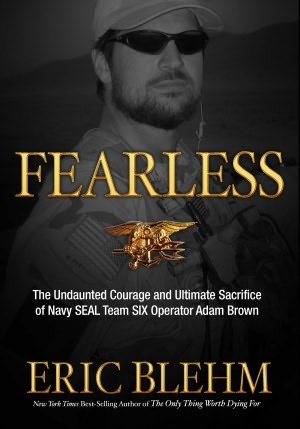
I just finished Fearless: The Undaunted Courage and Ultimate Sacrifice of Navy SEAL Team SIX Operator Adam Brown by Eric Blehm. And wow. I can’t tell you how happy I am to have read this book.

It tells the story of Adam Brown who was killed while on assignment in 2010. But this book isn’t about a special operations battle in Afghanistan, although the battle is detailed. It’s not a war book. Although it tells about many episodes in the life of a Navy SEAL operator. No, this book starts when Adam was a kid.

It like the story of Louis Zamperini that’s told in Unbroken by Laurel Hillenbrand (and, yes,the film adaptation missed so much of the story, including the most important part,that if you haven’t read that book, you are missing out on an absolute treat). In this one, Brown starts out as a boy with bright promise, but after he graduates from high school, he makes a number of bad choices and drives his life right off a cliff.

You’ll be flipping the pages to see what helps him turn it around and whether he can make the change permanent, or if he’ll lose everything, including the love of his wife and kids. You’ll also be amazed at his grit. It’s a tremendous read. If you can listen to it on audio, you’ll enjoy the narration by Paul Michael. Either way, if you like stories about redemption and triumph amidst struggle, if you like books about special operations forces and elite soldiers, then you’re going to love this book. Highly recommended.

*

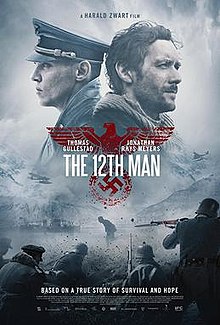
The 12th Man is a 2017 World War 2 historical drama based on the true story of Jan Baalsrud. He and eleven other Norwegian resistance fighters set off from the UK on board a fishing boat with six to seven tons of TNT to sabotage some German military facilities.

However, their mission falls apart soon after reaching Norway. A German warship attacks. The resistance fighters set fire to the TNT on their boat and jumped into the water just off shore. Eleven of the fighters are caught by the Germans. The twelfth, Jan Baalsrud, gets shot in the toe, but still runs across land and manages to elude immediate capture by swimming across the fjord, in the dark, in the freezing, winter water.

Yeah, and that’s just the beginning. The story is about his attempt to get to the safety of Sweden, a neutral country. I watched this with my teenage daughter, and we were riveted with the suspense and action. And we were amazed at what this guy endured.

You will have to read English subtitles during a large parts, but we found that after a few minutes, we really didn’t notice it. It was a great date night. If you like war movies and action, I think you’ll love this movie.

*

Tonight I ate a dish that instantly became one of my favorites. My oldest daughter and her husband found it. They love it and shared it with Nellie. And since it was her night to cook, she decided to give it a try. My first bite was wow.

It’s a baked casserole, a cross between lasagna and spaghetti, called “MillionDollar Spaghetti” from tastesbetterfromscratch.com. Just click on the link the get the recipe.

Now, here’s the thing: you can use spaghetti pasta, or you can make it totally low carb by replacing the pasta with cooked spaghetti squash like we did. The low carb version was awesome. I can’t wait to heat up the leftovers tomorrow.

By the way, here’s a quick way to cook spaghetti squash.

First, cut the squash in half lengthwise. The easiest and safest way I’ve found to do this is to place the uncooked squash on a cutting board. Next, get a big knife and set it along the line you want to cut. Finally, rap the spine of the blade smartly with a thick stick or long block of wood until the knife cuts through all the way. Using a knife this way is called batoning because you’re using a baton, a stick. It’s a slick and safe way to cut a hard squash.

Once you have cut the squash in half, scrape out the seeds with a large spoon.

Next, pour about a quarter cup of water into the hollow of the squash, and then turn the squash hollow-side down on a plate or microwave dish. Microwave the half on high for five to six minutes. It’s done when you can easily pierce the outside with a fork.

Remove the plate with hot pads and use a fork to scrape out the cooked squash. Voila! Cooked spaghetti squash in less than 10 minutes.

You can also just bake the halves in the oven for 40 minutes on 375 degrees. Baking gives the squash a slightly richer flavor. In this method, you brush the halves with olive oil and sprinkle with salt and pepper then put the sides face-down on a baking sheet. Again, it’s done when you can easily pierce the outside with a fork.

*

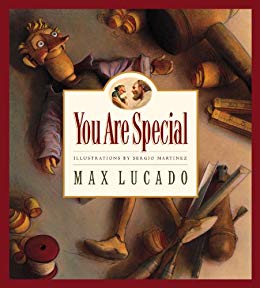
And here’s one more because it’s Christmas. I attended a young women’s meeting for my local congregation not too long ago. As part of the program, one of the leaders read a picture book called You Are Special by Max Lucado.

It’s about these small wooden people called Wemmicks who stick gold stars or gray dots on one another. The pretty or talented ones always get stars. The others, like Punchinello, get the ugly gray dots. And then one day Punchinello finds a happy Wemmick that has no dots at all. In fact, no dots stick to her. How does she manage it?

It’s a great little tale with an important insight. After hearing it, I knew I needed a copy of the book to read to all my grown up kids. 

Share

Similar Posts

  • |

    Indie Thoughts: Publishers know profit, but haven’t tapped best seller lists

    In The Business Rusch: Generational Divide Kris Rusch points out that the new on-demand and long-tail market for books has changed the duration of the opportunity a book has to be successful, but that it seems the industry still isn’t recognizing this in how they measure success.

    The problems come from the fact that those of us who run things—people in our forties, fifties, and sixties—use metrics that were developed by our parents for their world, that tightly controlled Mad Men world where everyone was expected to be the same, not just in what they wore or bought but in what they listened to or watched or read as well.

    The bestseller list?

    It measures velocity. (A good essay on this topic, “The Meaningless Metrics of Fame,”  came from Mike Briggs, husband of Patricia Briggs, earlier this week. I’ve also dealt with it.)

    Reviews?

    They only want new books, and then only at the time of release.

    Brick and mortar bookstores?

    They only have room for the latest releases, and then only the ones that are the most popular with their customers (whoever those folks might be).

    Books have come late to this fight. Books have been available on demand for only about four years now, in the U.S. In other countries, there’s been even less time.

    And we’re all still fighting over meaningless metrics, to use Mike Briggs’ term, because those metrics only measure things that were important around the water cooler, not things which are important now.

    What’s important now?

    She goes on to say:

    The publishing industry isn’t even talking about new metrics. That idea hasn’t occurred to traditional publishing, and indie (or self) published writers are constantly seeking validation from the old system—trying to figure out ways to game the bestseller lists or to get a fantastic review from somewhere that has old-world prestige . . . But at some point, traditional publishers are going to have to develop new ways to figure out which products sell well and which ones don’t. All of their systems—from sales figures (which measure books shipped not books sold) to bestseller lists to critical acclaim—are based on the old models.

    Kris is a very experienced with publishing, but her last point conflates internal accounting with marketing. Publishers DO know which products sell.

    The primary measure of success in a financial enterprise s not new. It’s been around for 100’s of years. And on demand and long-tail markets don’t change it.

    The measure is how much a product or service contributes in profit to the bottom line. You take revenues, minus expenses, and that’s the contribution that product (a book in this instance) makes to your total profit. Or to covering your fixed costs.

    Booksellers have measured the success of their books with actual or estimated profits for quite some time. Publishers already know which books sell well and which don’t. No accountant in the world is going to report books shipped as the measure of success. And they don’t. The very fact that publishers have a profit and loss statement and show returns on royalty statements demonstrate that. They look very closely at actual and estimated profits. And to they do this by channel, which is reflected in a small way when they break out ebooks on royalty reports. This is all basic accounting.

    Here’s an example. Until Ender’s Game the movie, Ender’s Game the book hadn’t appeared on any best seller list since it was first released. And its release was 30 years ago! Yet over the years Tom Doherty touted its sales numbers many times. Tom knew that book was gold. Of course, he did. Because he doesn’t use best seller lists to tell him what’s selling well. He knows those lists are marketing devices. He has the real data in house. Why would he need a list to tell him anything?

    And Tom isn’t going to use books shipped either. Tor may report those numbers to Publishers Weekly for marketing purposes, but he will always multiply that number by an expected return rate to estimate sales. He wants to do that. Because books shipped is meaningless to the bottom line and everyone knows it, including the auditors.

    Publishers are well aware of the long tail. They see it with books that have been rotated out of the brick and mortar channels but are still selling in the online ones. They report it in their annual statements. They know the online channels work differently from the brick & mortar ones.

    The measure of success is still the same as it ever was—how much profit is this property contributing to our bottom line?

    Marketing, however, is a whole other ball of wax.

    What the long tail and on-demand allow are marketing campaigns that are impossible in the brick & mortar channel. In brick & mortar you have a limited time to advertise (roughly 8-15 weeks). After that period, most books are rotated out of the store. This means that any marketing for those brick & mortar buyers MUST coincide with the period when the books are in the stores.

    But the online channels open up all sorts of other opportunities. You can market forever. And the contribution margin is always positive. The online and POD costs are easily recouped with each sale. (Publishers are well aware of this profit potential; this is why we have so many making grabs for backlists.)

    And I see publishers taking advantage of these new marketing methods. This last week I saw publisher books not currently stocked by brick & mortar retailers on BookBub, BargainBooksy, and Book Sends. And the industry isn’t totally focused on new books for reviews. I just had a large newspaper agree to look at my book that was published four months ago. Still, Rusch is right when she says that the publishers haven’t adapted one of their biggest marketing tools to take advantage of the new opportunities–they haven’t done anything with the best seller lists.

    Amazon has lead the way in creating new ways of marketing books to different types of readers with their best seller lists. These lists create the excitement of discovery.

    But every one else is still reporting weekly sales on the big lists.

    If I were a publisher, I’d be asking USA Today to provide more than just the weekly view of the top 150 books. And USA Today is THE list to watch because their numbers are not based on units shipped to a sample of stores, but actual sales. Here are some lists that readers would be interested in.

    1. Most anticipated this week: based on pre-order totals
    2. Most anticipated this month: based on pre-order totals
    3. Hot new releases: based on weekly numbers
    4. Hot new releases for the month: based on monthly numbers
    5. Books with legs: last 3 months; I know it needs a different name (grin)
    6. Best sellers of the last 12 months: annual total of units sold
    7. Best sellers of the last 18 months: total units
    8. Contenders: for each of the lists above show the next 150 books (I always want to see the next 100 books after the top 100 on Amazon’s lists; why not show readers the top 300?)
    9. Movers: for each of the lists above show those that have the biggest rise in percentage sales and meet some unit minimum (you don’t want to feature books with 2,000% increase because they went from selling 1 unit to 20), even if they don’t break the best seller lists
    10. Genre: allow all of this to be sliced by genre.

    Let the reader select the view they want to see!

    Avid readers will gravitate towards the shorter time periods. Those that read fewer books will gravitate towards the longer periods. Everyone who wants to discover something new will go to the contender and mover lists.

    This is about marketing. Not publishers measuring success.

    And then armed with those numbers guess what the publishers will do? They will go back to the brick & mortar venues and pitch to have some of these same books carried in the stores for the first time (some publisher books are printed digital first) or carried again.

    Share
  • Good Stuff! StoryBrand

    Folks running for office, especially our wonderful citizens running for local county offices, business owners, and any of the rest of us who what to persuade people to listen, I’ve got something for you.

    I will bet that most of you aren’t aware that you’re muddling your message and losing votes, sales, and converts to your causes.

    Of course, maybe you’re way ahead of me. I thought I knew what I was doing. I have a master’s degree in business, spent a few years in business consulting, have created a few small startups, and currently am a product manager for large software company. Despite all of that, I had somehow missed something vital. Something simple and powerful. Something that has a dramatic effect on sales, votes, and converts. On getting people to even listen to what I had to say.

    And I’m not alone. I saw another company struggling with it this weekend.

    On Saturday I went and watched the latest Marvel movie at a theater in Logan. One of the pre-movie video ads was for a local company called Conservice. I don’t know how many thousands of dollars they spent on the ad they played. Or how much they spent on the many other ads we’ve seen over the years. But when it finished, I turned to Nellie and said, “I still don’t know what that company does or why I should care.”

    “I know,” she said. “I know.”

    We were both baffled. After years of seeing their ads, we still have no idea what they do, how it would make our lives better, or what action we should take to use their service.

    They have wasted thousands and thousands of dollars on their marketing.

    There’s another local company that advertises during those pre-movie slots. It’s called ARS. I saw one of their ads this weekend as well. But it only reminded me of what I already know. I know exactly what they do, how it would make my life better, and what action to take.

    If you have a flood, fire, or plumbing backup—whatever—they clean it up. “Got a mess? Call ARS.” That’s their one-liner.

    If I ever have a mess, I will call ARS. I will never call Conservice. I have no idea what they do.

    What’s the difference here?

    Clarity.

    And what generates that clarity?

    A complete focus on the customer. The ARS ads are all about the customer and their problems and needs.

    The Conservice ads, on the other hand, are all about Conservice. We’ve been in business for x years. Here’s what our building looks like. Here’s a worker planting a bush. Blah, blah, blah.

    The ARS ads are all about me, the guy in the theater seat, the thing I want and the problem I have. ARS features me as the hero in my own story. They present themselves as the helper—the Yoda or Gandalf or Haymitch who helps the hero get what they want. You got a mess? We’ll help you.

    The difference in the power of the two ads is night and day.

    Of course this means it’s been verified that I’m a dolt. After all the years in business and education, I should have known this. But the surprising truth is that I’m not alone.

    I look at the marketing we do at the billion-dollar company I work for and see this same issue everywhere. Millions of dollars spent on muddles. I look at company websites on the internet and see more muddles. I recently listened to pitches by many of our local citizens running for office and saw the same thing. It seems this communication muddle afflicts a lot of us.

    About five years ago, when I began investigating an idea for a new company, I came across the Lean Startup method pioneered by a guy at Stanford and began to see the light. But a few months ago, the curtains were completely pulled aside to let in the sunshine. And wow! What a revelation.

    If you want to get people to listen, you have got to hear what Donald Miller has to say. He’s consulted with thousands of companies on how to clarify their message so people will listen. His framework and method make clarifying your message so easy.

    He calls it the StoryBrand framework, and it’s brilliant. What it does is help you clarify your message so that a customer or voter or whoever will know within three seconds:

    1. What you offer
    2. How it will make their life better
    3. And what action they should take if they are interested

    But it goes beyond that. It helps you actually define what you should be offering in the first place. It’s a powerful product development tool. I’ve started using this in all my business efforts. And in my training and presentations.

    For example, I just used it to develop a presentation I delivered at a huge writer’s conference last week. The results were that after the presentation, I had a line of people wanting to thank me. I had people telling me I made them cry. Others wanted to give me a hug. They were grateful. I had people tell me it was the best presentation of the conference.

    This was not because I’m brilliant. I’m a dolt, remember. It’s because I used the StoryBrand framework to focus on those people. Their needs. Their problems. Their aspirations.

    If you’re running for office, if you have a business, if you want to persuade anyone to do anything, then let me recommend you listen to this guy and learn about this framework.

    Get the revelation. Get out of the muddle. And get people to listen.

    And when you’ve finished the Miller stuff above, read How to Write Copy That Sells by Ray Edwards, the guy who has partnered with Miller. It’s all about clarifying your message as well.

    Share
  • Interview with John Goodwin of Writers of the Future

    During LTUE this year I sat down with John Goodwin, who manages the Writers and Illustrators of the Future contest, to chat about the contest, my win, and other writerly topics. I had a great time with John.

    If you’re a new writer or illustrator working in the science fiction or fantasy genres, I strongly recommend you submit each quarter. There is no fee and the prize is generous. Best of all, it comes with a week long workshop with pros.

    In the mean time, enjoy the interview.

    Here’s the teaser on YouTube.

    And here’s the full podcast.

    Share
  • Good Stuff! Two fun family and party games

    There’s nothing quite like the laughter and fun a good family or party game creates. And we discovered two games this summer that have brought hours of pleasure.

    The first is Just One. It’s for 3 to 7 players and takes about 20 minutes to finish.

    Now, I was skeptical of this game at first because it’s a cooperative party game.

    I mean, come on. Cooperation?

    No teams?

    No competition?

    What were we going to do—hold hands and sing Kumbaya?

    I was fully expecting to be bored out of my mind. Boy, was I wrong. There was suspense, laughter, and loads of fun.

    There are 13 rounds in each game. In each round, one player blindly selects the number of a word on one of the game cards. The other players each write a one word clue to help that player guess the word. However, if two or more players write down the same word, they have to remove that clue.

    So you’re trying to come up with one-word clues the others won’t that still help the guessing player. Some clues lead the guessing player off onto funny tangents. Others are just funny. And then there’s the suspense of whether someone else wrote your word and whether the player will be able to guess it from the clues that are left.

    Your goal is to guess all 13 words selected. And there’s a little score card that ranks what it means if you get 13, 12, 11, etc.

    As an aside, it’s crazy to me that the score card provided motivation. But it did. It was a delightful little brain hack.

    One Word is a quick, fun game. We’ve played it with a few as 3 and as many 8 players and had a ball each time. We are so happy to have it in the family game closet.

    The next is Fish Bowl. It’s for 4+ players. What this game does is take favorites like Taboo, One Word, and charades and mixes them together in a competitive game between two teams.

    Here’s how you play it. Each person writes up 5 to 7 different words or phrases on separate slips of paper, folds the papers, and puts them in a bowl. Then you do 3 rounds.

    Round 1 is like Taboo, where you can describe, but can’t say or act out the word or phrase on the paper. You select a team to go first. One person on the team selects the papers from the bowl and then tries to describe the word or phrase. The team has 30-45 seconds (you decide) to guess as many of the words as possible. When the time is up, it’s the other team’s turn. Back and forth you go, selecting a new team member each turn to give the clues, until there are no more slips of paper in the bowl. Then you count the number of slips each team got and move to round 2.

    In round two, you put all of the slips of paper back into the bowl. The team that went second in the first round starts this one. This time the person giving clues gets to share one word. That’s it. And the team has to guess it. Again, the team has 30-45 seconds to guess as many as they can.  Then it goes to the next team. And you switch back and forth just like you did in round 1, and when the slips of paper are gone, each team counts up their score.

    In round 3, you put all of the slips of paper back into the bowl. The time the person giving the clues has to act them out. No words allowed. You run this round just like you did the first two with  30-45  second turns, switching back and forth between the teams until all the papers are gone. At that point, the teams  total their scores for this round and then for all 3 rounds together to see which team won.

    If you don’t want to use paper, you can play a version online.

    Either way, it’s another fast, fun game. In fact, we played it last night. And laughed and laughed when one daughter was trying to get the other to guess “sling” and nailed her teammate in the head trying to act out a rock hitting Goliath.   Movies are great. But sometimes what you need is some delightful game fun. And I’m betting you’ll love these.

    Share
  • Good Stuff: Books Worth Multiple Readings Part 1

    Would you like to improve your relationship with your spouse or children?

    Would you like to improve your experience with teachers, coaches, and administrators this coming year at school as you try to influence them and work with them for the benefit of your children?

    Would you like to simply have a better time with the people in your community?

    There are some books so full of practical wisdom about relationships that they deserve to be read every year or three. I want to recommend two such books to you. The first is How to Win Friends and Influence People by Dale Carnegie.

    This book has been in print for eighty years. And not only that, it has been, year after year, one of the bestselling books out there for almost each of those eighty years. For example, Amazon right now ranks it the #9 most read book. You’ll see other books come and go on that list. But books like this and Stephen R. Covey’s The Seven Habits of Highly Successful People stay.

    There are thousands of how-to books published each year on relationships in business and personal settings. Most are never seen again. But this one has stayed because people find it so useful they recommend it over and over again.

    And I wish to heck I’d not waited ten years to pick my copy up again.

    As I re-read the book this last month, I saw that if I’d been thinking about the practical guidelines Carnegie shares, I could have avoided a number of public and private arguments I’ve had over the last few years.

    I could have avoided subjecting those relationships to attack, coming to my senses, and then trying to clean up the mess, large or small.

    But even more important, I could have added a little more sweetness to my life and the life of others I encounter on my way. There are only so many days we have here on earth, and how much better it is to add additional drops of honey to them instead of vinegar.

    One of the wonderful things about his book is that Carnegie shares the wisdom in a down-to-earth way with lots of examples and stories. He shares wisdom on building relationships, being liked, winning people to your way of thinking, and how to make your requests for change known without giving offense or rousing resentment. And he does it simply and in a way that you feel like you’re sitting down with a good-humored grandfather. There are no dry, abstract parts. Just look at a sampling of the chapter titles.

    • “If You Want to Gather Honey, Don’t Kick Over the Beehive”
    • “He Who Can Do This Has the Whole World with Him. He Who Cannot Walks a Lonely Way”
    • “An Easy Way to Become a Good Conversationalist”
    • “If You Must Find Fault, This Is the Way to Begin”
    • “Give a Dog a Good Name”

    I can tell you that every time I try to approach things the way he proposes, they almost always seem to go better.

    If you have an issue you want to discuss with a school teacher, coach, or administrator this year, let me suggest you first listen to what Carnegie has to say. I can promise you you’ll get much farther. And you will probably end up enjoying the interaction.

    If you want to improve your time with your wife and kids, open this book and look for insights.

    If you want to have a better time with your co-workers or boss, I suggest reviewing the wisdom you’ll find here.

    Carnegie doesn’t possess all the wisdom there is to be had about relationships. There are many people out there with great insights. But, gee whiz, he provides a great start. If you want to add some sweetness to your life, I think you’ll find this book a great help.

    Let me illustrate this Carnegie stuff with an experience I had with one of our high school coaches two years ago. I have a vast background in basketball that includes, well, nothing. I basically know how to dribble a ball. Oh, yeah, I also played church ball two or three years in a row back in the 1980s. So, as you can see, my knowledge is vast.

    And not to toot my own horn, but this wasn’t just any church ball team. This was a team that improved the sport.

    How? You ask.

    Well, during one of those church ball years, me and the guys from my ward (“congregation” for those not familiar with the Mormon faith) thought it would be capital to make jeans and concert tee-shirts our uniforms. Back in those days concert tee-shirts looked like this.

    This meant we ran up and down the church courts with drugs, sex, and rock and roll on our chests (I’m sure that’s precisely what the brethren had in mind for the program).

    As you can see, we were way up there on the basketball ladder.

    So back to this coach. My daughter was playing on the high school team, and the team was having a consistently hard time with one type of defense. And I thought, “Self, there’s got to be a way to break that defense.” These are the big thoughts that basketball gurus like myself have.

    And so I researched and watched and talked to folks who had actually played basketball competitively (unfortunately, without concert tee shirts) and identified an offensive counter that looked like it might work.

    And I sent an email to the coach sharing my idea.

    Now, the coach could have reacted in many ways. Especially given the fact that (1) he had already thought of the idea I was proposing, (2) had already tried it in games that, yes, I had attended, and (3) probably knew just a teensy bit more about basketball and his team than I did even though my church ball team had vastly superior uniforms.

    But this coach, whether he knew it or not, was following a number of the principles found in Carnegie’s book, including the chapter titled “Let the Other Person Save Face”. This meant that instead of rolling his eyes or ridiculing or saying something like, “Brown, are you blind?”, he explained what he was doing and then expressed his appreciation. He was happy I was so invested. He thanked me.

    And here’s the thing: he meant it.

    I replied that if he ever wanted someone to suggest an idea he was already trying, to just call. I’d be happy to help.

    We laughed, but the important thing is that what could have been a wedge became a good experience for all. And, more than ever, I wanted to work with him to help my daughter in the program.

    I will give you one more example. There’s a mother who had four of her children go through my wife’s seventh and eighth grade language arts classes. Now, Nellie is a worker. She expects her students to work. She wants to have a good time, loves having great interactions with the kids, but she also wants them to improve and learn, and knows that’s going to take some work. Sometimes the assignments, despite her best efforts, aren’t clearly understood. Sometimes they’re a bit challenging. And this sometimes creates frustration.

    There are a lot of ways that parents deal with this. But this one mother took an approach that, whether she knew it or not, followed many of the principles in the book including those shared in “You Can’t Win an Argument” and “A Formula That Will Work Wonders For You”. This resulted in a fabulous working relationship. It helped the mother have less stress. Helped her kids. And helped Nellie improve her program.

    The issues the mother encountered could have become wedges, but instead, because of how she handled them, they became stepping stones. And this didn’t happen with this one individual. There are many mothers and fathers who have taken a similar approach with similar results. The principles work every time.

    I could go on with many more examples in other situations, but why listen to mine? Carnegie has a book full of them. If you want to improve your relationships or persuade others to your way of thinking, you’ll want to start by reading this book.

    The second book I want to recommend is I Don’t Have to Make Everything All Better by Gary and Joy Lundberg. But this post is full, so stay tuned, and next time I’ll explain what awaits you in its fabulous pages.

    Share
  • Pew Study on American Reading Habits

    Pew Research Center just published the results of a national study surveying reader habits. It answers questions like:

    • Do folks read ebooks more often on cell phones, e-readers, or computers?
    • How many books does each age group read per year?
    • How do readers under 30 discover books to read? 

    Lots of great stuff. You can read the full survey here: http://libraries.pewinternet.org/2012/10/23/younger-americans-reading-and-library-habits/

    Share

2 Comments

  1. I love the “you are special” book. Been reading that to my kids for years. Kind of scary how we have turned ourselves into wemmicks with social media. China is doing it on a national level. Yikes. Thanks for all of you great books. Eagerly awaiting more! Especially the conclusion to the dark God series.

Comments are closed.