|

“How It All Came Crashing Down” by Peter B. Gardner

Everybody knows that we got into this recession because banks began lending money to people who had terrible credit ratings, right? People who didn’t have to prove they even had a job. I mean, how long are you going to stay in business when you keep handing out dough to people you never hear from again?

But is that all there is to it? And was it really just the fault of congress because they told Freddie Mac and Fannie May (the organizations that purchased loans) that they had to start purchasing these highly risky things? Or was it all those greedy Wall Streeters?

In this must-read article, “How it All Came Crashing Down,” BYU econ professors explain how we got into this mess—and what we can learn from it.

But that’s not the end of the story. Ira Glass and the folks at This American Life uncover deeper causes of the problem in their must-listen show “The Watchmen” (no, not the movie). I mean, come on, we were told these high-risk loans were as dangerous as milkshakes. Shouldn’t SOMEBODY have seen it?

President Obama keeps saying that the root of the problem was that there wasn’t enough government oversight. Sounds good, doesn’t it?  We’ll get disinterested Uncle Sam to protect us from all these investment bullies. But if we dig a bit deeper, it appears that Uncle Sam was one of the major players at the root of the mess.

Ouch.

Read. Listen. They are two fabulous pieces.

Share

Similar Posts

  • “Somewhere My Love” by Stephen Mark Rainey

    The latest issue of Intergalactic Medicine Show just hit the net. Of course, I don’t have time to read. But how can I help myself when Mark Rainey’s “Somewhere My Love”  starts with this line: “She lived in our town’s one and only haunted house.”

    What a hook!

    And soon I found myself reading a wonderful story about a boy and a teacher, who happens to be a witch.

    But the kind of witch Rainey writes about is not some gal with warts and a black hat. Nor is she some kind of Alice Hoffman Practical Magic type.

    She’s a Rainey witch.

    And this tale is about a boy caught in her class in school. I loved it. It evoked perfectly how some teachers affect us boys. I haven’t read any of the other stories in this issue yet. But I can still say the measley $2.50 subscription for issue 12 is worth it if only so you can read this one story. Besides, even if you don’t have time to read it, scroll down on the TOC and you’ll see you don’t have to–you can listen to Scott Card read the thing to you.

    Share
  • Mumma, Cat of Death

    PIC02680

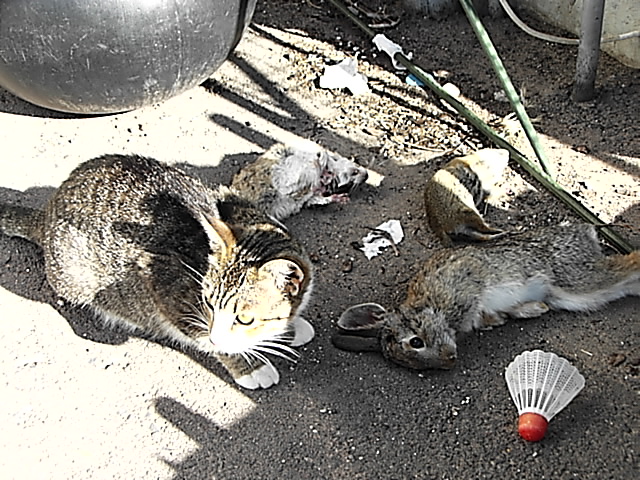
    I figured regular readers would want a break from all the book release news, as fascinating as it is. And so I present to you my photograph, “Mumma, Cat of Death.” (I need a new camera. The quality of this piece of junk is so stellar.)

    Mumma was a stray that showed up in our garage one day, freaked many of the long-timers, and then got pregnant. Up here in the ranch lands there are no such thing as spaying and neutering. There are a number of Toms, and, well, we were too slow with our communist population control program. So she had five cute kittens. Up until that time she was satisfied with catfood and an occasional bird or mouse. After that, she became Mumma, Cat of Death.

    What you see above is only PART of the catch of ONE day: a packrat, a ground squirrel, a bird (she ate it, what you see on that piece of white paper is what she left–one leg), and a rabbit. Notice, she’s looking away from her catches. I think she was eying a visitor’s toddler at that moment, deciding if she could take him down. Every day she hunted up a few meals. And these were not for show, not nice gifts left on the doorstep for the master. No, she’d bring them up from the fields, let them ripen a bit, and then start in at the head. But she wouldn’t always eat the whole thing. Sometimes she’d leave it for the kittens. Sometimes, she’d just leave it for the next day. She turned our garage into a scene of blood and carnage.

    So again: Mumma, Cat of Death.

    Share
  • Move over Internet, here comes the Grid

    This geeked me out today.

    THE internet could soon be made obsolete. The scientists who pioneered it have now built a lightning-fast replacement capable of downloading entire feature films within seconds.

    At speeds about 10,000 times faster than a typical broadband connection, “the grid” will be able to send the entire Rolling Stones back catalogue from Britain to Japan in less than two seconds.

    The latest spin-off from Cern, the particle physics centre that created the web, the grid could also provide the kind of power needed to transmit holographic images; allow instant online gaming with hundreds of thousands of players; and offer high-definition video telephony for the price of a local call.

    Can you imagine that game world? Can you imagine a world that’s an actual world? Where adventurers set out to find fortune and encounter all sorts of nasties being played by hundreds of thousands of other people around the globe?

    Dude.

    More here.

    Zing, Baby!

    Share
  • |

    Is Product Popularity Random?

    In Why Publishing is Making You Crazy—and What You Can Do About It: The Tao of Publishing, Steven Axelrod and Julie Anne Long write an interesting post that takes some findings made by Duncan Watts and attempts to explain why writers should only focus on the quality of their work because they cannot reliably affect popularity in any other way.

    I agree with them that social-influence seems like a good explanation for the sometimes unexplicable successes we see in publishing and the difficulty publishers have in both predicting and producing a steady stream of hits. However, I do not find support for their main conclusion that writers can do nothing but write.  In fact, I suggest that Watts’ findings show quite the opposite.

    Axelrod and Long base much of their argument on an experiment conducted by Duncan Watts that tested the power of social-influence on music selection in some controlled music websites. Watts summarizes his findings in the excellent Is Justin Timberlake a Product of Cumulative Advantage?.

    In his part of the post, Axelrod points out that the Watts findings indicate “50% of the factors affecting your career could be totally outside of your control—totally random” and that “unless we can separate out those random factors which contributed to an author’s past success [and we can’t, Axelrod suggests], anything we can say or predict about why she succeeded will invariably be way off-the-mark.” And therefore “what’s interesting—and chilling, as well—is that there’s evidence that the harder a person works to make sense of a random event, the farther they’ll end up from the truth.”

    In other words, the only thing an author can reliably do to improve the popularity of his stories is focus on their instrinsic quality. And get more stories out so he has more shots in the fickle social-influence game.

    I agree that having more product in the market increases your odds. I also agree that focusing on the intrinsic quality of the writing can do the same. I even agree that this is where authors should spend most of their time. However, Watts’ studies do not indicate other efforts are wasted. In fact, they suggest the opposite.

    Watts does not controvert anything we now know about marketing. What he does is clarify the power of social-influence in our decision making and the dynamics of ONE type of endorsement system. What Watts shows is:

    1. A perceived non-bias endorsement of your product can have a huge effect in the product’s popularity.
    2. The intrinsic quality of the product has an effect on popularity, but social-influence plays as large or larger role.
    3. Popularity in the system set up in the test websites depended on the decisions of a few early-arriving potential endorsers, i.e. good early reviews (downloads in this case) are amplified and lead to an effect he calls “the richer getting richer.”
    4. In this one endorsement system, neither a future endorsement nor the identity of the early endorser can be predicted.

    These findings, however, need to be put in context. From cars, to camcorders, to recipes, the popularity of a product depends on three main factors. These aren’t new ideas and publishing is no different than any other industry. The factors come from long-standing marketing practice:

    1. Visibility (people know about it)
    2. Endorsement (recommendation from an attractive person, trusted authority or friend, or trusted system like the perceived unbiased reviews on Amazon or “most downloads” stats)
    3. Attractiveness (intrinsic to the product, the perceived value offered the target market, and the social effect as pointed out by Watts)

    Each of these three affects the other two. Visibility makes endorsements and initial attractiveness possible. Endorsements make a product more attractive and more likely to be visible. Attractiveness makes something more visible and more likely to be endorsed. And round and round we go.

    It’s true that Watts shows 50% of the effect is due to endorsement. But nowhere does Watts suggest an author cannot increase the probability of visibility and endorsement.

    In the study, the endorsement method used was a counter showing the number of times the song had been downloaded. It was random, anonymous, and perceived as unbiased. That was a controlled environment. However, what if a singer had been able to ask all those he knew who loved his song to download it from the site? Or what if someone organized such a campaign independent of the singer? Both actions would immediately affect the probability of the song increasing in visiblity and endorsement and, hence, popularity.

    It’s too bad Watts didn’t test this in one of his sites to see if he could make a winner. As it was, all Watts was doing was seeing if he could predict a success by quality alone. He was passively observing, not actively taking measures to increase visibility and endorsement.

    Furthermore, the counter is just one type of endorsement system. There are a number of others. We’ve all seen how an Oprah endorsement can move the market. The identity of that endorser is NOT random and has great predictive value. Her decision to endorse is still random. But what if you have a way to make your book visible to her? Would it be a waste of time to do so?

    Robert Sawyer loves to tell of one action he took with someone with much less endorsement power than Oprah and the effect it had on his sales. Was Sawyer guaranteed visibility and endorsement from that action? No. However, he DID increase the probability, and it resulted in sales. Here’s his account.

    Watts confirms that endorsements have a mighty effect on popularity. Even something as simple as a “most downloads” counter can easily overwhelm a listener’s own reactions. But the logical conclusion is not to do nothing. The logical conclusion is that if authors want to increase their popularity, they must not rely only on the intrinsic value of their product, but they must also search for ways to increase visibility and endorsement.

    Axelrod is correct that it’s sometimes difficult to see the effect of any given marketing campaign or tactic. This is because marketing efforts are probabilistic, not deterministic. However, probabilistic does not mean random. Furthermore, it does not indicate you cannot increase the probability of success. While publishers may not be able to produce best sellers every time, I’m confident if they decided to stop marketing altogether, sales would drop.

    Will all efforts succeed? No. Any marketing progam needs to consider the effect of diminishing returns. The effectiveness of some actions may be difficult to test. Furthermore, authors may not have the budget to run a campaign large enough to increase their probabilities, although there are strategies to become a big fish in a small pond (see Geoffery Moore’s Crossing the Chasm).

    Despite all these issues, we know, in general, getting endorsements helps. In general, the right placement in book stores increases visibility. Author visits to schools, if done right for middle age readers, can also increase visibility. Radio interviews, if done right, do the same. There are many things that DO improve an author’s odds. We can increase the probability of visibility and endorsement by taking intelligence, consistent action.

    And that’s good news. We might not be able to guarantee a hit, but one thing IS certain—we’ll have no direct influence on visibility and endorsement if we do nothing.

    (BTW, for those interested, here’s a great presentation on a related idea:Six Degrees: The Science of the Connected Age a presentation by Duncan J. Watts.)

    Share
  • The Sing-Off, Sam’s Salmon, The Englishman Who Went Up A Hill

    One of the best TV programs this fall

    American Idol was good until the judges became irrelevant and annoying. Or maybe I was just tired of the format. I didn’t think I’d watch another singing show. But I tuned into the opener for The Sing-Off on NBC last week, and holy harmonies, Batman–it was wonderful.

    Ten of the best a’capella groups in the country compete for a $100,000 prize and a recording contract with Sony Music. Unlike American Idol, the groups represent a wide range of ages—from kids in high school to older adults—and backgrounds. They don’t use any instruments, just their voices, to sing incredible arrangements of modern songs with percussion, bass, and lovely vocals. This ain’t no choir music. And unlike American Idol, the judges actually have interesting and useful things to say. Also unlike American Idol, the judges eliminate the groups until three are left. Only then do the rest of get to call in and vote.

    We were glued to the TV watching each episode. The programs are all two hours long, but move like lightening. Our favorite groups at this point are Committed and The Backbeats.

    This whole show runs a total of three weeks, one episode each on Monday and Wednesday. It started last week, continues this, and finishes next week. Some of you might be depressed, feeling you’ve already missed it.

    Not so! You can watch all of the full episodes online at www.nbc.com/sing-off/ (with fewer commercials). Then tune in for the grand finale. I can’t wait. 

    Are you kidding? From a can?

    Canned tuna fish is one of those un-meats. It doesn’t taste like fish. It doesn’t taste like chicken. I guess the all-white albacore is okay. But tuna’s not one of those spectacular foods I crave.

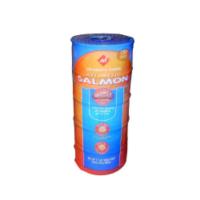
    So you’d think, as I strolled the isles of Sam’s Club, that I would have passed up the canned Member’s Mark Atlantic Salmon. But one of my wild culinary urges, the ones that rarely pan out, overtook me.

    I purchased a pack of five, seven-ounce cans for $11.88. I brought the pack home put it on the shelf and didn’t dare open it. What was I thinking?

    Canned salmon? Canned meat?! When was the last time you had a steak out of a can?

    It couldn’t be good.

    Of course, my sensible hesitations only last so long. I broke down one afternoon when the cupboards were bare. I saw the salmon and thought that it might go well with a salad and baked potato.

    I opened the can. It was pink, like the trout I used to catch and immediately fry when I went camping as a boy. I tasted it. And it tasted like .  .  . fish. Real fish. The light delicious taste of those trout I caught so many years ago.

    I enjoyed a wonderful meal that day and have had several repeats since. Boneless, skinless filets in water, packed with omega-3 fats, all grown on fish farms in Chile. 

    Great movie set in Wales

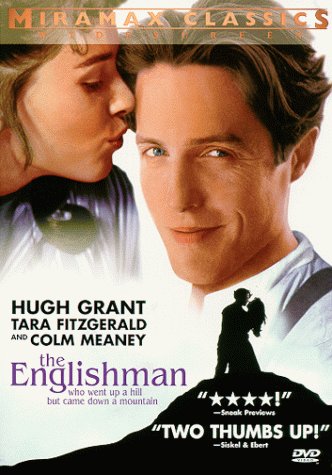
    I enjoy Hugh Grant as an actor. I loved him in Sense & Sensibility with Emma Thompson, one of my most favorite movies ever. And so I was curious about another movie with Grant that received two thumbs up from Siskel and Ebert. It’s called The Englishman Who Went Up A Hill And Came Down A Mountain.

    The setup is unusual. In 1917, with the war still raging in Europe, two English cartographers visit the small South Wales village to measure what is claimed to be the “first mountain inside of Wales.” The villagers are proud of their “mountain,” but become alarmed when the Englishmen measure it and find it’s not a mountain but a hill. The villagers are determined not to lose their status. Especially not to two Englishmen. What follows is good humor, drama, and a bit of romantic comedy. I think you’ll fall in love with the characters. It’s a wonderful tale. And it’s on DVD.

    As a little bonus, here are the opening lines, given to us by two narrators.

    “Narrator: For some odd reason, lost in the mists of time, there’s an extraordinary shortage of last names in Wales. Almost everyone seems to be a Williams, a Jones, or an Evans. To avoid widespread confusion, Welsh people often add an occupation to a name. For example, there was Williams the Petroleum, and Williams the Death. There was Jones the Bottle, and Jones the Prize Cabbage… which described his hobby and his personality. Evans the Bacon, and Evans the End of the World. But one man’s name was a puzzle, and it wasn’t until I was 10 years old that I asked my grandfather about the man with the longest and most enigmatic name of all.

    “Grandfather: The Englishman Who Went Up a Hill but Came Down a Mountain? Now there’s a long name for you. And a long story. You are not going to fidget, are you? For this is a story… an epic story. Yes, epic.”

    Share
  • Good Stuff! A great place to eat

    huhot-fb-defaultNellie and I recently celebrated our anniversary and enjoyed a delicious meal at HuHot Mongolian Grill in Logan, Utah.

    If you’ve never been to a Mongolian grill, here’s how it works. You take a plate, pile it with your desired selection of fresh meats and veggies, douse it with sauces, then hand the plate to the chef. He then spreads it on his gigantic, circular Mongolian grill and cooks it before your eyes, then hands your hot meal back to you. You take it to your table and enjoy a fine, fresh stir fry of your own making.

    If you want more, or want to try something different, when you’re finished, you go back because it’s an all-you-can-eat grill. I can happily report that Nellie and I did go back. We wanted to go back a third time but were stuffed.

    The food was excellent. The service was friendly. If you’re looking for something different, I think you’ll want to give HuHot a try.

    Share