“Somewhere My Love” by Stephen Mark Rainey

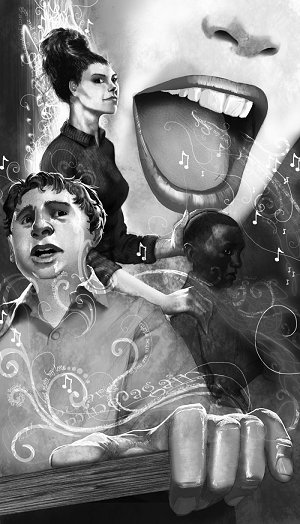
The latest issue of Intergalactic Medicine Show just hit the net. Of course, I don’t have time to read. But how can I help myself when Mark Rainey’s “Somewhere My Love”  starts with this line: “She lived in our town’s one and only haunted house.”
What a hook!

And soon I found myself reading a wonderful story about a boy and a teacher, who happens to be a witch.

But the kind of witch Rainey writes about is not some gal with warts and a black hat. Nor is she some kind of Alice Hoffman Practical Magic type.

She’s a Rainey witch.

And this tale is about a boy caught in her class in school. I loved it. It evoked perfectly how some teachers affect us boys. I haven’t read any of the other stories in this issue yet. But I can still say the measley $2.50 subscription for issue 12 is worth it if only so you can read this one story. Besides, even if you don’t have time to read it, scroll down on the TOC and you’ll see you don’t have to–you can listen to Scott Card read the thing to you.

Share

Similar Posts

  • Interview with Author Bradley Beaulieu

    Bradley P. Beaulieu just had his first novel released on April 1st. It’s called The Winds of Khalakovo and is the first of three planned books in The Lays of Anuskaya series publishehd by Night Shade Books. In addition to being an L. Ron Hubbard Writers of the Future Award winner, Brad’s stories have appeared in various other publications, including Realms of Fantasy Magazine, Orson Scott Card’s Intergalactic Medicine Show, Writers of the Future 20, and several anthologies from DAW Books. His story, “In the Eyes of the Empress’s Cat,” was voted a Notable Story of 2006 in the Million Writers Award. His agent is Russell Galen.

    Brad is a software engineer by day, wrangling code into something resembling usefulness. He is also an amateur cook. He loves to cook spicy dishes, particularly Mexican and southwestern. He lives in Racine, Wisconsin with his wife and two children. As time goes on, however, Brad finds that his hobbies are slowly being whittled down to these two things: family and writing. In that order . . .

    I recently had the opportunity to interview Bradley. Among other things, we talked about how he broke in and how he comes up with his ideas. He also convinced me to use his picture method, which I’m finding very handy on my current thriller project.

    ***

    JOHN: In your novel an elemental spirit attacks an incoming windship, murdering the heir to a kingdom. The person believed to be behind this is a child, an autistic savant. This sounds like Orson Card tale (grin). Did you come up with this character first, the magic, or something else. Tell us the genesis of the tale and this character in particular.

    BRADLEY: The genesis of the book is actually from a series of postcards of fine art that I picked up in Edinburgh, Scotland. (I posted about it on my website if you’re curious to learn more.) I used that artwork to first generate and then crystallize my thoughts about the book. Initially, I tried not to let any one thing rule the brainstorming I would do from time to time. I didn’t even know who the main characters were at first. I was quite taken by the picture of the three sisters, though, and I knew right away, the moment I laid eyes on the original in the National Gallery, that they would play a major part in the novel.

    But in the end it was the picture of the boy with the flaming brand that kept leaping out at me, calling for attention. The artist is Godfried Schalcken, and the piece is called A Boy Blowing on a Firebrand to Light a Candle. This character eventually became Nasim, the autistic savant. As I was studying the characters, I began to realize that this boy was not going to be a point-of-view character, but he was going to be a prime mover. In the end, he embodies much of what Winds is about. The story truly does revolve around him and his unique powers.

    The brand that he holds in the painting also came into play. I didn’t know what the magic was going to be about. I hardly had a single preconception about the book going in. I just wanted the artwork to speak to me, to advise me as to what the story was going to be–from the characters to the world to the magic. The boy blowing on the brand got me to thinking about elemental magic, and I realized that Nasim was one who could do this without even thinking. It came as naturally to him as did breathing. That’s a difficult place to put a character, however. As a writer, you have to be careful of all-powerful things, and so I needed something to balance Nasim’s abilities. And this, of course, is where his disconnection from the world came from. Nasim, as written in the book, is often lost. He has difficulty relating to others in even the smallest of ways. This both limited his power and made him in some ways more dangerous and more scary than a calculating villain, simply because of the unpredictability.

    I’d be remiss if I didn’t also mention Rehada, who started out as a somewhat minor character but grew into the most complex and perhaps the most compelling of my three main characters. Rehada came from Andrew Geddes’ Hagar. It’s another beautiful painting, filled with emotion. I was drawn to the fact that she was crying. I wondered why. I spent a lot of time answering that one question. After knowing that her people were essentially pacifists, I realized that Rehada was not. She felt she had betrayed her people and their ways because she had taken to the path of violence. It was from this, from that one single tear, that the entirety of the Maharraht–the fanatical splinter group that came to embrace violence as a means to an end–was born.

    By this point, I understood that I wanted there to be an aristocracy of some kind, and I fairly quickly landed on a culture that was modeled loosely after Muscovite Russia. I don’t remember why, exactly. It might have been that the other artwork reminded me of Russian Czars a bit, but I think the biggest driver here was that I definitely didn’t want something that was centered around western Europe, because frankly that’s been done to death. I wanted something more unique, and I’d always sort of like the mystique and darkness that seemed to hover around that time period in Russia. They’ve always seemed like a hard people, a people that would do whatever it took to survive, but in the same light, they took time to live life fully when they could.

    Given that I had the loose guidelines of the aristocracy, the peace-loving, indigenous Aramahn, and finally the will of the Maharraht to do whatever it took to regain the islands as their own, it created a crucible from which the story flowed fairly easily. I spend a lot of time building my worlds so that the conflicts within them come naturally, and that was definitely the case here.

    JOHN: The description of the world and your process for getting into the story is fascinating. From the article on your site it sounds like using images was a new technique for you. Is that correct? And if it is, was your process previously to have some other physical object of which you’d ask questions?

    BRADLEY: Yes, using artwork as a starting point was a new technique for me. I had no idea if it was going to work or not. An interesting thing came up when I was doing it, though. One of the things I learned at a few of the workshops I’ve been to (Writers of the Future and Orson Scott Card’s Literary Bootcamp) was to create stories in very little time using a few unrelated things as starting points. One unanticipated result of having restrictions in some areas (such as the elements involved in the story) is that it opens your mind in other areas. You’re forced to become more creative in some ways because certain avenues have been closed to you. I think it was the same with the portraits I used to represent the characters.

    Before that, in the previous three novels I’d written, I didn’t really have any specific brainstorming techniques. I would start with a premise and perhaps a loose idea of the characters and a mood, and I would go from there, trying to stay true to those things as the story evolved and grew. Although part of the problem with those early stories was that I was young in my craft, I also think my brainstorming wasn’t very efficient. I think, as I alluded to above, that there were too many possibilities. I had trouble narrowing the story down, and it led to stories that were ok, but nothing great. Too often they became a bit generic. Nothing really stood out.

    So while the artwork I used is one of a great many possible brainstorming techniques, I like the idea of challenging yourself with restrictions in order to force the story to stretch and bend in unpredictable ways.

    JOHN: Wow. That’s a striking insight. I think I’ve found the same thing occurs when I run workshops or do my own brainstorming, but I don’t know that I’ve ever crystallized it the way you have. (See folks, this is why I love these interviews.) So I see _The Winds of Khalakovo_ will be published by Night Shade books. You’ve had quite a few short stories published, but this is your first novel. How did you make the sale? Did you have an agent? Was the editor someone you knew? Gives us a bit of the story behind this.

    BRADLEY: As you said, I’d been making steady progress throughout the years in short story sales. I had attended a number of workshops, and I think my name had at least some recognition by editors, either from short stories I’d published or personal connections I’d made at conventions. As an aside, some people will say that you shouldn’t go and sell yourself at conventions. If an opportunity comes up, they say, and an editor or agent asks you what you’re working on, go ahead and take advantage of it. I don’t doubt that that’s good advice for some. Just not for me. I believe that editors and agents are at cons not just to meet with their authors and speak with agents, but to see who’s coming up in the field. They’ll get to know a certain percentage of the newcomers from their short sales, or even novel sales, but they can’t read everything. They can’t even read a small percentage of the fiction that comes out each year. So, frankly, it’s up to me to make them aware of who I am.

    Now, that doesn’t mean you should be pushy. You should be friendly and businesslike. Keep things short and sweet and as casual as you possibly can. And that’s exactly what I tried to do. I approached Jeremy at World Fantasy in San Jose (2009) and told him I had an epic fantasy that he might like. I pitched it as “The Song of Ice and Fire meets Earthsea.” He asked me if I had an agent. I said no. Night Shade doesn’t normally take unagented mss (and I should probably ask Jeremy some day if he gets annoyed that I tell this story), but he said he liked the cool pitch and said to send it his way. Roughly five months later, I got an email from Jeremy, offering to publish the book. 

    At that point, I moved quickly to find an agent, and believe me, agents will move quickly as well if you tell them you have an offer on the table. That doesn’t mean they’ll be clamoring to sign you up. It just means you have their attention. I was lucky enough to be picked up by Russell Galen of the Scovil Galen Ghosh Literary Agency. Russ and I are simpatico on a number of levels, and to be frank, as an agent he kicks serious ass, so I feel honored and blessed to be under his wing.

    JOHN: What a great breaking in story. And you’re right, Galen is tops. So to give my readers perspective, did you approach a lot of editors this way? Or was Jeremy at Night Shade one of a select few? And did you encounter any annoyance? I know my editor, David Hartwell at Tor, doesn’t much like to be approached at cons. But obviously, that’s not the case with all editors.

    BRADLEY: Well, I had not approached anyone else for Winds. However, I had previous novels, and I’d approached a variety of agents and editors over the years. Not scads of them, mind you, but a number of them, and there were more agents I spoke to than editors because the general rule of thumb is that you can approach and/or query multiple agents at the same time, whereas editors you typically ask for exclusives, even at the partial stage. I was also careful about who I approached, and when. I went to the Pikes Peak Writers Conference for several years. They had pitch sessions there, where you can sit down with an acquiring agent or editor and talk to them about your novel. I certainly took advantage of this, but I also wasn’t afraid to approach them outside of those sessions. At conferences in particular, I think the invited guests are open to being approached at the bar, at the dinners, and at the parties. Again, though, I tried to keep things as casual as I could, and I kept the pitch short and sweet so that they could determine quickly whether it was a project that interested them. Most often I got a “Sure, send me 50 pages” type of answer, but I got a few requests for fulls by doing this as well.

    Conventions are another beast. It’s a looser environment than a conference, so I was much more choosy about when I approached agents and editors. I’ve never encountered annoyance, but I’ve certainly felt stiffness from those who perhaps would rather not be approached. I learned from this early on and adjusted my approach. I would try to meet them first and strike up a conversation and see where it went. Often, if you can just be humans with one another, the subject of what you write and what projects you might have ready will come up. Try to take that approach, because there’s nothing to put off an editor that already keeps unknown writers at arm’s length than the smell of desperation. In the words of Monica Geller, keep it breezy.

    JOHN: Well, I’m excited for you. Night Shade is a great publisher. So I have one more question: what’s next?

    BRADLEY: I’m contracted for two more books, so that’ll occupying my time for a little while yet. But I’ve started brainstorming the next project. (I like to let things germinate for quite a while, so it’s important for me to get my hindbrain working on these as early as possible.) I have two possibilities that I’m mulling over. The first is a science-fantasy called The Days of Dust and Ash. Think Nausicaä of the Valley of the Wind meets The Coldfire Trilogy. I’m excited about this story, because it’s a departure from what I’ve written in the past, though it will still be fantastic and wide in scope. The story focuses on a young girl who is summoned from the dust, a global consciousness that was created as the last great age of technology fell under a nanite plague.

    The other is called From the Spices of Sanandira. I sold a novella with the same title to Beneath Ceaseless Skies last year, and it will be appearing sometime this spring. It’s a story that springs from Sanandira, a large desert oasis known for its caravan trade and spice bazaars. It’s got a strong Thousand and One Nights feel to it. The novel is not so much an expansion of the novella as it is a re-imagining of it. It will probably focus on a pair of twins: one boy, one girl. The sister is sold to one of Sanandira’s famed assassin rings at a young age. The boy (the protagonist) finds his sister by happenstance years later, and because of this chance meeting is drawn into the world of intrigue his sister walks every day.

    ***

     JOHN SEZ: I just love hearing how other authors work. As I said before, after this interview I decided to use the image technique myself on my current thriller project. Images of people and places and thing. I’m finding it helpful to help the story come to life. I also think Bradley’s breaking in story illustrates one key thing: work. And that’s exactly what I need to do right now 🙂

    Share
  • Good Stuff! Mr. Holmes and 13 Hours, the book

    Earlier this month I watched Mr. Holmes.

    Mr._Holmes_poster

    It left me with this fine peace. With this feeling of goodness and light, in spite of, or probably because of, a number of poignant moments. It also surprised me.

    To write a story like this, to give people this kind of gift…

    What a wonderful, powerful thing.

    Now, it was not a thriller. It’s not an episode of Sherlock or Elementary. It’s not a murder mystery. It reminds me of Saving Mr. Banks most, but also of Miss Potter, maybe even The King’s English. It has that kind of tempo.

    Basically, Sherlock Holmes is a much older man. He’s retired. And there’s a case he’s trying to solve. But, again, this isn’t a murder mystery. This story is about Sherlock himself and wisdom and the beauty of change whenever it occurs.

    The story lingered with me, and I avoided reading or watching anything else for a few days to savor it. Give yourselves a treat. Watch this wonderful story.

    *

    The book 13 Hours: The Inside Account of What Really Happened in Benghazi was the answer to so many questions.

    13_Hours_ZuckhoffWant really happened in Benghazi?

    What we’re we doing there?

    Who are the brave men who tried to save the ambassador?

    It was also a thrilling read in the tradition of Marcus Luttrell’s Lone Survivor. As such, it purposely avoids the political aspect of the incident. It’s not about what the officials of the United States government did, said, or knew, or the political firestorm that ensued.

    It’s not a hit piece on Clinton and Obama, nor is it any kind of defense. Instead it simply documents the events on the ground in those last 13 hours, relying most heavily on what the five American security contractors who rushed to give aid said happened. Those men–two former Marines, two former SEALs, and a former Army Ranger—teamed up with Mitchell Zuckoff, the writer, to simply set the record straight.

    I couldn’t put the book down. Not only because the book’s well-written and the characters and situation are compelling, but also because of the insight it shared into some key dynamics within Libya itself. For example, it helps you understand why the revolt against Muammar Gaddafi centered in Benghazi, not Tripoli. It also touches on some of the currents inside these Muslim-majority countries close to the epicenter of Sunni extremism—Egypt and Saudi Arabia–so volatile. And it shares details, large and small, as only those who experience such things first hand can.

    If you want a fascinating account of really happened on the ground in Benghazi, get this book.


    Share
  • The Last Apprentice, Path Finder

    The Last Apprentice

    Revenge of the Witch by Joseph DelaneyMy wife is always telling me I need to write a young adult or middle grade adventure series. One that’s directed at boys.

    Not because we have something against girls. We have four daughters, and my wife is adamantly pro-woman. But she finds very few books for her sixth-, seventh-, and eighth- grade male readers. I haven’t done a count, but I’m pretty sure that most YA is targeted at females. And this isn’t just me. I remember visiting a Barnes & Noble in Arizona with my voracious-reader nieces a few years ago and riding the escalator to the YA section. They told me that they called it the “girl-book section” because they figured that basically 90% of it was indeed for girls.

    Anyway, I think writing such an adventure would be a blast. I can already think of a number of near future or fantasy settings that would rock. But the time constraints I have right now just won’t allow me to start another series. Nevertheless, we sat down the other day and listed out all of the authors and books we knew that had a more male focus.

    For about the twentieth time she told me about Joseph Delaney’s The Last Apprentice series. It’s about a boy who apprenticed to the county Spook who is someone that takes care of witches, ghasts, ghosts, etc.  Her students love the stories. She loves them. She has bought the first ten volumes for her classroom. Why the heck wasn’t I reading them?

    Well, for starters, I just don’t like books about witches. And the first book in the series is called Revenge of the Witch. I don’t know what it is. Witches aren’t as bad a zombies–I am SO bored with zombies; I just don’t get the appeal. But even if they’re better than creatures that make no sense at all to me, I just don’t like spooky horror all that much. I loved to be scared, startled, and filled with dread. But not with witches.

    Witches? The gals with pointy hats?

    No.

    But this was, as I said, like the twentieth time she’d brought it up. We were driving over to Logan (that’s the big city for us), and stopped at the library, and we went over to the YA section. Unfortunately, they didn’t have volume one. But I did see many other volumes on the shelf and figured I needed to see what the competition was doing. So I perused. A few night later we went to her classroom, and there was volume one. The one about the witch.

    I sighed and opened it and began to read. And when I finished chapter one, I realized I kind of liked it. It was like the old Life cereal commercials—hey, Mikey!—and I wanted to read more. And so I took it home, read the whole book, and was delighted with the story. I liked it so much I promptly borrowed volume two, Curse of the Bane, from my wife’s classroom and read it as well. And I liked that one so much I checked out the third.

    The story is about Thomas Ward, the aforementioned apprentice. In book one, he is forced to face down some witches. But it’s Alice, the girl with pointy shoes, who made the story for me. Adding her as a character transformed it from a run-of-the-mill booger man story, into something special. No, I’m not going to give you a peek at the plot. Just know that this is the book where Thomas starts his apprentice, has to deal with that new life (and I thought Delaney captured that so well), and makes some apprentice mistakes that he then has to fix.

    In book two, we get to meet Alice and Thomas again, but this time they have to face down a different creature. And again, while the adventure is all cool, it’s the interactions with Alice that put it over the top.

    Having praised the books, I will say that I think Delaney has something against priests and religion in general because he paints it all with a negative broad brush. It’s too bad. Not only is such a view inaccurate, but showing the good and bad could add so many delicious dimensions to the tale. Maybe we’ll see that in later books. But even if we don’t, book two was still a great read.

    I’m looking forward to book three. If you’re in the mood to try something new, something about a young man and young girl that doesn’t revolve around romantic smoldering, something that a guy would like to read, let me recommend you join me in reading the volumes of The Last Apprentice.

    Pathfinder

    Pathfinder by Orson Scott CardI was once in a discussion about religion with a friend who happens to be an atheist and fellow science fiction and fantasy writer. He’s a great guy. The blog posts he wrote about the passing of the woman he loved who was lost to cancer were poignant and wonderful–full of beauty. I read them and wanted to be a better man. Still, he and I disagree about God.

    I remember telling him that science fiction is the one genre that makes God more plausible than any other. At least, it makes my view of God more plausible.  Now, I do not want to talk religion in this essay. But it’s just hard for science fiction to leave the idea of creation and Adam and Eve alone. Witness the many stories over the years about these very things.

    Heck, even the recent movie Oblivion has references—are not Jack and Victoria much like Adam and Eve? Just think about it. Their paradise together as a team, the knowledge, the fall. The echoes are simply marvelous.

    Well, I just read another science fiction tale that provided a wonderful opportunity to think about these things. It’s Orson Scott Card’s novel Pathfinder. Now, the story isn’t about God. It’s not a biblical allegory. It’s not dressed-up doctrine. It’s a tale about a boy named Rigg with special abilities on a quest to find his real family and who he is. Along the way we meet some interesting people, especially one character named Loaf who leavened the whole tale. So there’s an interesting adventure and speculations about faster-than-light travel. But one of the chief delights for me was the questions and ideas this story raised in my mind about the creation of our own world—“Garden,” the name of the world, just begged for it.

    For example, a long-time staple of science fiction is the idea of terraforming—changing face of the flora, fauna, atmosphere, and climate of the planet to be hospitable to your species. If you believe in a God that is more a being of advanced technology than one of unknowable fantasy, doesn’t that present a new and interesting way of viewing the creation story? It does for me, and Pathfinder sparked ideas about this.

    The book also led me to think about life. First, Card has these characters called “Expendables.” They’re robots, but not really. They’re artificial intelligence. But not really. The way Card presents the expendables, you don’t think of silicon and steel and gears. You think of biology.

    You think of mosquitoes.

    You think about the fact that if we humans use intelligent machines, surely God must use intelligent machinery. So what kind of intelligent machinery does God employ? (Dude, that idea is just pregnant with stories!)

    Are viruses and bacteria machines? Are mosquitoes and beetles (please, let there be no mosquitoes in heaven)?

    The book prompts me to wonder. It prompts me to look at the life about me on our wonderful world with new eyes. It prompts me to think differently about some of my core definitions. In fact, there are some exchanges between a character and an expendable where they talk about the difference between humans and expendables and the definition of what it means to be human, especially given evolution.

    This is a book about an adventure, but also a book about ideas, which is as it should be. Science fiction is the one genre, more than any other, that marries character and plot with exploration of ideas. If you’re looking for an interesting tale that will make you think about our world differently, give Pathfinder a try.

    Share
  • Good Stuff! The Addiction Recovery Program

    137-What-is-the-12-Step-Addiction-Program-L2-ldsPart of my research for Bad Penny led me to the Utah state prison. I was able to attend a session with five of the convicts. Let me tell you: walking through those high fences and electric doors and hearing them close behind you was something.

    The five men all had interesting and unfortunate tales to tell. But they were all hopeful. I was there with a couple of kids in a troubled youth program and their leader. And of course there were a couple of guards.

    We got to ask questions and chat. It was an upbeat session despite the topic. One thing I asked about was the food, and one fellow said that the worst thing was this “crack wheat” they served for breakfast.

    “Cracked wheat?” I asked with a smile. “That’s good old Mormon food.”

    He said, “It’s awful.”  We laughed.  There were many times we laughed.

    And there were a lot of things asked and shared. One of the key things that stood out to me was that all of them were there because of drug addictions. And as they shared their goals of staying clean, they revealed that this wasn’t their first time inside. For one it was his third, another his fifth, another his ninth.

    And it was with those comments I realized just what a hold addiction had on these guys.

    Fortunately, most folks with addictions don’t have to go to prison. But a lot fail to break out of them and miss many opportunities for joy, sometimes wrecking the ones they have. The 12-step program has one of the best success rates of any program.

    My church has meetings and programs all over the country. They’re free and open to anyone. If you or someone you know is struggling with an addiction to alcohol, drugs, tobacco, porn, or eating disorders, you might want to go here to see what to expect from a 12-step meeting and how to participate.

    Even with all the vicissitues, life is meant to be enjoyed.

    Share
  • Hey, I live in Washington and I’m an Idiot

    I’m sick of politicians who are more worried about votes, Republican or Democrat, than actually doing what needs to be done. Sick of these fools buying votes with Federal programs for everything from farm subsidies to gelatin wrestling.

    When someone runs for office, does an idiot switch get flipped? “Vote for me, I’ll spend like there’s no tomorrow. Cause look, honey, I got this magical piece of Uncle Sam plastic. It doesn’t cost anything. And when the bill comes, we’ll just tax all the rich folks to pay for it, and send government agents to put them in jail if they don’t. Or we’ll print money and make it all worth nothing. Or, better yet, we’ll just use the funds we set aside for social security.  It would be dumb to just save and invest that money we’re taking from people for their retirements. I mean, it’s just sitting there earning interest. Besides, we’ll set it all up like Amway with downlines and circles, and the rising generation will just be taxed out of their brains to pay for it.  And that will be someone else’s problem anyway. See the pretty money, honey. See it? Vote for me.”

    They’re like that candy man in Chitty Chitty Bang Bang with the nose that should have scared the soup out of those kids. Of course, American voters aren’t kids hiding in Benny Hill’s basement. Maybe the switch is getting flipped on some of us as well.

    Here’s what we need. It’s not rocket science.

    1. A balanced budget ammendment to prevent our super smart and caring representatives in Washington from continually spending what they don’t have.

    2. Real spending reductions. What does that mean? Dave Ramsey just shared some thoughts on what’s it’s going to take to get the nation out of debt. Go have a listen.

    Edit 6/7/11: Besides, Paul Ryan, here’s Tim Pawlenty with some ideas on how to accomplish it.  I’m looking forward to seeing the ideas Romney and the other presidential candidates put forth.

    Share
  • Gandhi & Waiting for Superman

    Enthralling History

    The miracle of Netflix means that no movie or television show becomes unavailable. And there are so many produced over the last fifty years that are so very good. I recently re-watched the 1982 Gandhi with my family and have to say it is one of those fabulous movies that’s amazing every time I watch it. Not once did the production feel dated. And even though I’d already seen it, I found myself enthralled with the events and the character played so well by Ben Kingsley. No wonder it won eight Academy Awards.

    The movie portrays the last 50 years of Mahatma Gandhi’s life. It starts in 1893, when Gandhi, educated in the UK, is thrown off a South African train for being an Indian and traveling in a first class compartment. Gandhi decides to start a non-violent protest campaign for the rights of all Indians in South Africa. Quite an undertaking in those years. He’s arrested and finds himself in a number of dicey moments, but ultimately brings change.

    Gandhi is then invited back to India, where he is considered a national hero. Leaders there urge him to take up the fight for India’s independence from the British Empire. Gandhi agrees and mounts a non-violent campaign of unprecedented scale. Nothing of this magnitude has ever happened in the recorded history of the world. Which is why it’s a rough road all the way to the end.

    There’s suspense and humor and heartbreak in this movie. But it goes far beyond entertainment. This movie will move you. It has power to change. This movie is what history should be. If you haven’t seen Gandhi, or haven’t seen it in a while, let me recommend you get it this week and sit down with friends or family to enjoy a wonderful experience.

    Education and Teachers Unions

    I find it interesting that teachers in Utah, one of the most conservative states in the union, send almost three million dollars each year to the National Education Association. That’s the $165 in NEA dues for each of the roughly 18,000 union members in Utah. This is interesting because the NEA, the largest labor union in the United States, is one of the biggest supporters of the Democratic party.

    For example, the NEA spends roughly 85-90% of its direct candidate donations on Democrats. The NEA is quick to point out that those direct candidate donations do not come out of the three million Utah teachers send to them, but from additional donations to one of their political action committees. It’s illegal, in fact, to contribute directly to candidates with money received from union dues. However, there are a lot of other ways to support candidates and causes in addition to direct donations. 

    Mike Antonucci, a teacher’s union observer, explains just how that works in his article “How Much Does the NEA Spend on Politics”. The upshot is that the NEA can spend as much as they want on politics with their dues. And the lion’s share of that spending goes toward liberal causes. ACORN, for example, has been a beneficiary of NEA grants.

    Now, I don’t see anything wrong with that. People should be able to donate to whatever cause they think is important. The NEA has just as much right to make their voice heard as anyone else. I just think it’s interesting that so many conservatives have been led to donate their cash to these causes. And it’s not just in Utah. About 60% of NEA members identify themselves as conservative or independent. And yet they donate to these liberal causes via the union. What’s even more ironic is that most of them probably do not personally donate anything close to that to conservative candidates and causes. It’s not like teachers have tons of extra cash.

    It’s a neat trick to get conservatives to donate so much money to liberals. And perhaps some teachers feel it’s the price they have to pay for the services they want from the union. I would think it would be better to start another union, but that’s me. However, this is not the only kink teachers unions have introduced into the education system.

    I’m not going to argue that teachers unions are evil. These unions arose in a time when female teachers were heavily discriminated against. They do some good things. But mixed in with the good is, well, you’ll have decide for yourself if it smells.

    A great place to begin is with the documentary Waiting for Superman. You should know this movie came out of the gate with a huge strike against it in my mind–it’s produced by Davis Guggenheim, the same guy who did An Inconvenient Truth. Good grief, that’s all I wanted was another two hours of Chicken Little running around saying “sky is falling, the sky is falling!”

    But I didn’t find any of that in the film. For example, the film doesn’t say all American schools are awful. It doesn’t say teachers are terrible. Contrary to what the movie’s critics claim, including the NEA and its many state and local affiliates, the film doesn’t suggest charter schools or standardized testing are the silver bullet answers to our issues. I simply didn’t encounter the sensational propaganda others claimed would be there.

    No. What the film does is examine some of the issues in our current system, which put so many children at a disadvantage, and the role the teacher unions play. It does not, as some critics claim, go on to suggest any solutions. It presents a problem, experienced by real parents and children right now, then poses a question: what can be done?

    I found it eye-opening and thought-provoking. I think it’s a must-see. If you have children or grandchildren in school, if you’re one of our many fine teachers or school administrators, you’ll want to watch this movie and then ask yourself that same question. What can be done? What works? What’s best for the children? And does the current way our unions operate work in any way against those interests? For those who elect not to go into immediate union-attack or union-defense mode, I think this film will introduce some valuable points to the discussion about education.

    Share