When the workshop works

From a workshop participant at MountainCon:

I’m going to give a shout out to all the goodness I experienced. So if you don’t really care what happened at the con, you can stop after this paragraph and take this message away with you: Brandon Sanderson (who does Writing Excuses, has published several novels, and is the chosen one to finish Jordan’s Wheel of Time series) and John Brown (with a must buy novel coming up next year) are incredible teachers. If you ever get a chance to attend a class or workshop by any of them, don’t let it pass.

We loves to hear these things, Precious.

But we loves it just as much when we can make the students shiver with excitement: more here: http://www.amichopine.com/blog/?p=318

To those who missed this run of the 3 Things You Must Learn to Write Killer Stories Workshop, know I’ll be holding it again. Check back to see when.

Share

Similar Posts

  • |

    Since when did young adult fiction become the cure for cancer?

    Meghan Cox Gurdon wrote an opinion piece for the Wall Stree Journal called “Darkness Too Visible” in which she complained that it was hard to find young adult fiction these days that isn’t filled with coarse, dark material–profanity, pederasty, mutilation, etc. She claims that “contemporary fiction for teens is rife with explicit abuse, violence and depravity” and wonders “why is this considered a good idea?” She concludes by saying:

    So it may be that the book industry’s ever-more-appalling offerings for adolescent readers spring from a desperate desire to keep books relevant for the young. Still, everyone does not share the same objectives. The book business exists to sell books; parents exist to rear children, and oughtn’t be daunted by cries of censorship. No family is obliged to acquiesce when publishers use the vehicle of fundamental free-expression principles to try to bulldoze coarseness or misery into their children’s lives.

    This, of course, sent hordes of folks into a frenzy of posts sneering at Gurdon’s so-called prissy sensibilities, decrying censorship, and extolling the virtues of young adult literature and dark material in particular. For example, Mary Elizabeth Williams in a Salon piece called “Has young adult fiction become too dark?” rolls her eyes, then deigns to wade into what’s she thinks is an obviously juvenile argument to apparently show Gourdon how “stupid” she really is. Williams concludes:

    One of the terrific side effects of an obviously click-baiting piece of editorial twaddle like Gurdon’s is that it reminds people how many fellow passionate readers there are in the world. That incendiary WSJ piece promptly sparked a tear-jerkingly beautiful twitter #YA saves trend full of heartfelt reactions and links to outstandingly reasoned, article responses from well-read adults and teens on the value within so much of YA literature and its downright lifesaving effects.

    Williams suggests fiction doesn’t have the power to lead people into bad behaviors. After all, she assures us, “an entire generation of women managed to devour the ‘Flowers in the Attic’ series without having sex with their brothers.” No, according to Williams (and all the #YAsaves folks), YA fiction only saves lives. And she provides a link to prove it.

    But Williams misses the mark. Completely. This isn’t about whether fiction has power to influence us in good and bad ways. There’s a huge body of research on media effects which clearly proves fiction’s power for both. Nor is it about the theraputic uses of dark material.

    The heart of the matter revolves around a rather mundane thing–customer service and marketing.

    Gurdon and those parents she describes in her article want a certain type of entertainment. For years, YA fiction has provided that type of entertainment. But things have changed, and the YA label isn’t reliable to them any more. It’s like someone who has purchased steel cut oatmeal for years is now suddenly bringing the bags home to find them filled with sardines or, horrors, Twinkies.

    We can argue the merits of sardines and Twinkies. And a hundred other foods. We can argue the merits of certain types of stories for certain types of readers. And my metaphor above–maybe you think using Twinkies is unfair; maybe you would have wanted me to use something like Triscuts or Wheat Thins. But that’s all beside the point.

    The real problem here is that the publishers have ignored a significant segment of the market who want to buy books but can’t find the types they’re interested in. Either the covers and blurb material don’t help them find what they’re looking for, sometimes misleading them, or the publishers have simply made the mistake of not thinking about this segment of the reading market.

    The fix is easy. (1) Produce more books for these folks. (2) Label your books in a way that makes it easy for the consumer to find what they want. They’re not asking for censorship. They’re asking for a nutrition label that lets them know what they’re getting. Publishers can do what the movie and gaming industries have done with rating systems that prominently display on the cover. Or use some other method. This isn’t a moral issue, it’s simply a matter of helping the right customers find your good or service. It’s a matter of good marketing and branding.

    And I would think, with the upheavals in the book industry today, that publishers and booksellers would want to do whatever they could to boost sales. Surely it doesn’t help to turn customers away because your package is confusing them.

    In the meantime, the battle will rage and this simple practical core of the issue will be lost in the fires and clouds of smoke produced by the arguments extolling and excoriating the virtues and vices of fiction.

    Share
  • |

    More info on the American Fork Arts Council Gig

    Fat head alert.     

    Not to be missed – the most useful speech on writing you will ever hear! Keynote speaker John D. Brown will present ‘Three things you MUST know to write killer stories.’ John Brown is a prize-winning short story writer and novelist. His epic fantasy novel, “Servant of a Dark God” will be released in North America in September 2009. 

    “Most useful” is nice. Let’s hope I can live up to that one.  🙂 I’m looking forward to this event. A lot of other great authors will be there as well as editors from Deseret Book, Covenant, and Cedar Fort. If you’re a regional writer, you won’t want to miss this. Full information here on the American Fork Arts Council council for writers.

    Share
  • |

    Science Fiction and Fantasy beat Thrillers?!

    “More than 50% of all traditionally-published book sales of any format in the US now happen on Amazon.com.”

    That’s just amazing. But I found something even more amazing this week.

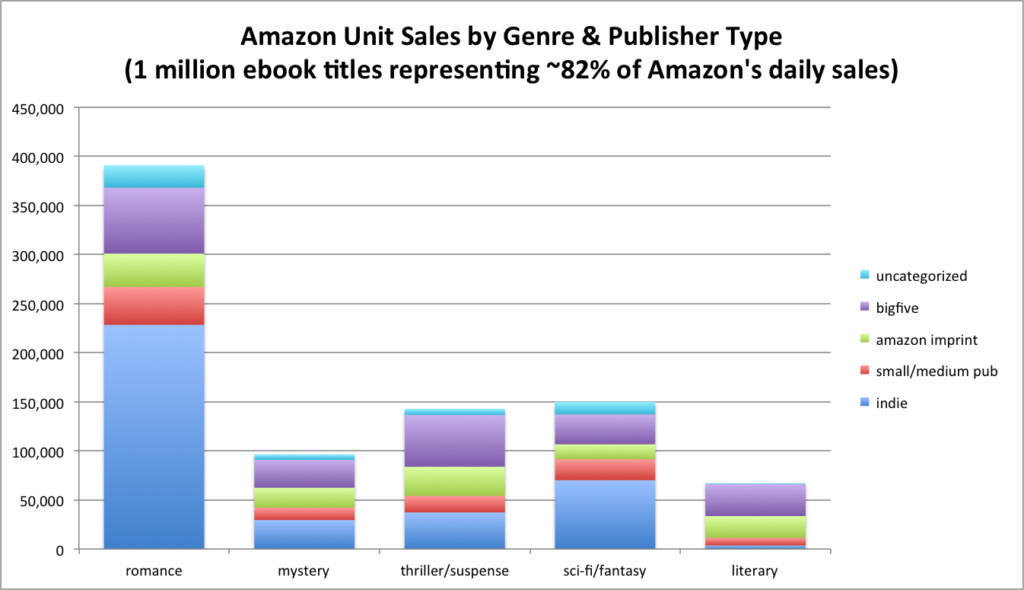
    Author Earnings released a report this week of their analysis of a million titles on Amazon. Data Guy, the tech guy behind the software gathering the information and crunching it, posted this graph in the comments.

    Do you see the amazing thing?

    AE-2016-06-genre-units

    Well of course you do, I gave it away in the title of the blog. Science fiction and fantasy sell MORE units than thrillers.

    More.

    What?!

    For, like, ever I thought SFF was a tiny portion of the market. Not so, my friends.


    Some may say, well, but this only represents Amazon. What about the channels traditional publishers sell through? Author Earnings explains a way to account for that in their report. Basically just double the size of the purple and red bars. If you do that I think thrillers might just edge SFF out. But it doesn’t dwarf it by any means.

    Furthermore, for an indie author, I don’t worry about those other channels because they’re not really a viable option for me. My world is selling online. And the online market for SFF is the SECOND BIGGEST MARKET after Queen Romance.

    Oh, BTW, next book in the queue is volume 1 of Lord of Bones. It’s going to start with something like this.

    The four men did not leave. Instead, they spread out just a bit in shallow semi-circle in front of Blaze.

    Four of them. One of him. There was definitely going to be blood.

    “You don’t want to do this,” Blaze said.

    The big one drew his sword and swung it a bit to loosen his shoulders.  “Oh, but we do. Because you’re not handing over the blackmeal. And we’re not leaving without it.”

    No, he was not going to hand that over. Couldn’t. Not if he valued the lives of his wife and boy.

    Two of the others drew their swords. The fourth brought his staff up and laid it on his shoulder in a two-handed grip.

    The big one would be the obvious target to take first. But Blaze knew that would be a mistake. The big one was there just to focus his attention. To fix Blaze in place. And then the silent one would slice him up the side.

    The man with the skinny face said, “Old man, the vultures will be picking your eyes out before lunch.”

    Blaze said, “Well, if you’re so determined, let’s not keep them waiting.” And then he rocked forward.

    I’ve not forgotten the Dark God series. I will finish it, but I need to get this smaller volume of Lord of Bones out.

    Share
  • |

    Handout to “How to Write a Story that Rocks”

    I had an absolute BLAST with Larry and the audience at LTUE. I think the workshop went very well for the first time. Of course, I’m going to make some tweaks. Paul Genesse had some interesting feedback and I’ll have to see if I can’t do more with character. Two hours is such a short period of time.

    The good news for those who couldn’t attend is that we have a recording and will be posting probably next week. Everyone should thank Stephen Nelson!

    We ran out of handouts. I printed 80. Then Mark Holt generously had 30 more printed. We still didn’t have enough. For those of you who didn’t get one or who want an electronic copy, here it is.

    How to Write a Story That Rocks – Handout

    Share
  • | |

    One of Orson Card’s best essays

    Scott Card recently wrote “Marriage needs lots of humor.” It’s an awful title for one of the best articles of his that I’ve ever read.

    I’m not going to spoil it for you. But I will say that I’ve found that it’s the small things that seem to make the biggest difference in relationships. And this is one of those small things that packs a HUGE punch. But not until this article did I realize it.

    And for you writers who are wanting insights on what makes characters interesting and sympathetic–there’s a little treasure trove here for you as well.

    Enjoy!

    Share