Four-letter words and fiction

Here’s Joseph Finder, a NY Times best-selling author, talking about how he studied his craft, why he uses outlines, and what he decided about four-letter words and why.

I had the same reaction when my daughter came to me wanting to read my stuff. I’ve never heard of Joseph Finder–there are soooo many authors these days. But I can tell you I’m going to pick up one of his books to see what he’s all about.

Share

Similar Posts

  • |

    Writing Update: 5/28/11 – Freewrites, Storylines, Proportion

    I finished the next chapter of my outline, which turned into three chapters. Hurray for making progress. However, I’m going to need to make more time on a weekly basis if I’m going to meet my goal.

    I’ve kept stats over the last four novels. My average is 500 words per hour during the drafting stage. That includes revising and doing quick researches etc. So sometimes I will write a smoking (for me) 800 or 900 words per hour. Sometimes I won’t finish a thing. When I’m all done it averages out to 500 words. I’m going to see if I can’t get 20 hours this next week and finish 10,000 words. 

    Addition to last week’s post

     Do you remember last week’s post about the process of making it come alive in my mind first? Orson Card illustrates this as he describes how he prepared to write a story in his essay “How One Story Can Give Birth to Another“.

    Spideysense, farmer’s faith, and freewrites

    Last week when writing chapter 7, I finished, but felt something was off.  Years ago I would have freaked about writer’s block.  I would have told myself I sucked because the chapter was glucky. But not now.  It’s a gift.  So I stopped and talked to myself in a freewrite.  I had farmers faith that if I just kept working on it, something good would result. 

    Here’s what I wrote in that freewrite. It’s an awful read for you, but it shows you just how sloppy and cryptic and freewheeling my freewrites are.

    Okay, so I’ve written the stuff below and I could tweak it, I guess. But I keep having this nagging feeling that it’s not good. It’s not a compelling villain. I think he’s creepy and evil. And, truth be told, I don’t want to make him into something other than what he is—a total thrall to the Glory and the mother. So as the “pet” of the mother, what else could he be called? I don’t know.

    I shall call you endless because you will be spared, you shall continue, whereas the rest will not. Blessing. Blessed. Grateful. What would you call a thing that did you bidding reliably? But enthralled. I am part of you, you are part of me, and so you may take my name.

    He WOULD think—I am not like them. I am GRACED by the Mother’s touch. I have taken her into myself. Or she has graced me and so I have become more than I would be otherwise. I am obedient.

    What else do you call pets or tools. Maybe that’s what she calls him. My skir master. The skir lord. My trowel. Harvester.

    He’s over the harvest. Reaper. Or he’s the one that supplies food. Supplier. Gatherer. Cook. Chef. Hunter. Provider. Butcher. Slaughter.

    So I like Endless with the whole part of him being part of her. But he could use that—”you’re just like us” “no, we are part of the XXX (what was the name I had for them?) endless. You are meat”

    Devourers, Mothers, Sublimes

    Okay, so do I go with Endless or Harvest Hope. Endless it odd, neat. What could I add to Harvest to do the same. Harvest Lord, King, Overseer, Meatman, Food provider, Feeder, Harvester, Harvest, Rancher, Collector, The Harvester. Harvest.

    I think when you’re raised, you get a new name.

    Rebellion.

    Soul collector.

    The Shepherd.

    Harvest Prime

    Bald Head

    Laughter

    Everlast

    DIVINES

    ID HIM AS THE MAIN HARVESTER

    RIGHTEOUS ANGER

    The issue was that his motive wasn’t working.  I had a feel for what I wanted him to be, and my Spideysense was telling me it wasn’t working, wasn’t interesting.  Thomas McCormack in his book calls this feeling for what you want in your story a “prelibation”.  What an odd term.  But it’s real. 

    “Prelibation.  The desire for a certain effect on the reader.  It may or may not be followed instantly by an intuition of what item of narrative will cause that effect, and it’s important to see that intuition and the prelibation it is trying to serve are not the same thing. The intuiting of the narrative that will produce the effect-wanted is the work of the imagination” (p153 The Fiction Editor, The Novel, and the Novelist)

    There’s more in his book. I recommend it highly. So, after that freewrite, I didn’t have a solution, but I’d pinpointed the issue, the prelibation. I took a break with kids into the big city. Came back and had my solution for a narrative that would do the trick.  Luckily, it was something I’d cut out of the outline. Back it went with some significant tweaks and was better than before.

    Storylines & the Size of this Presentation Phase

    For those who have read my series on suspense, at this point, the presentation of the problem for the main story and many of my sub-stories is complete.  Depending on how you categorize them, I have nine to eleven story lines (which makes it impossible to write this book in 100k words).  There’s one main story line that touches everyone—the Mokaddian threat.  Then there are other questions and issues I raise that set the reader up with the expectation for a resolution.

    1. Talen
      1. Mokad/Nashrud (external threat)
      2. Lusts (internal threat, mystery)
      3. Sugar (relationship)
    2. Legs: Vulnerability
    3. Sugar
      1. Talen (relationship)
      2. Urban (relationship)
      3. Ancestors (relationship, mystery)
      4. Mokad (external threat)
    4. Argoth
      1. Mokad (external threat)
      2. Nettle (relationship)
      3. Bone Faces (external threat)
    5. Eresh
      1. Flax (conflict relationship)
      2. The Creek Widow (relationship)

    So most of these story lines have been presented, although not all. It took about 30,000 words to finish the presentation phase. I’m estimating 170,000 words, so that a presentation phase of roughly 18%.

    There are a lot of story lines and characters to juggle. Sometimes I kick myself for having so many. Of course, I love them, despite the challenge they present. Nevertheless, I AM looking forward to writing that thriller with a limited cast.

    Share
  • |

    Get great writing tips, for cheap!

    The annual Life, The Universe, and Everything writer’s conference is being held this year February 11-13. It’s chock full of panels and presentations from working authors. And this year you don’t have to live within driving distance of Provo, Utah to go because they’re doing it all online (thank you, Covid).

    I will be delivering two hour-long presentations. The first is about plot, where you learn the John Brown Story Framework that makes plotting so much easier. Heck, it makes story much easier. The second is for folks new to self-publishing and is called Indie Publishing 101.

    If you’re a new writer or looking to hone your craft, you will want to check it out.

    Share
  • On writing lesson 5 is up

    In lesson 5, I share insights on creativity that elude many who start down the path of writing. Not knowing them can cause a lot of frustration and convince writers to quit. Don’t be frustrated. You’re going to learn:

    • What creativity really is
    • How it actually works
    • What it requires
    • And two of the main tools that will help you practice it–hunting zing and creative Q&A

    Here it is: Lesson 5: How do you get and develop ideas?

    Enjoy!

    Share
  • |

    “The Fringe Benefits of Failure, and the Importance of Imagination” by J.K. Rowling

    This is J. K. Rowling’s 2008 Harvard commencement speech, “The Fringe Benefits of Failure, and the Importance of Imagination.” It’s one of the best speeches I’ve ever heard. Watch and then watch again. Read the full text here.

    Two quotes that in no way can do justice to the whole thing.

    And so rock bottom became the solid foundation on which I rebuilt my life.

    You might never fail on the scale I did, but some failure in life is inevitable. It is impossible to live without failing at something, unless you live so cautiously that you might as well not have lived at all – in which case, you fail by default.

    . . . 

    Though I personally will defend the value of bedtime stories to my last gasp, I have learned to value imagination in a much broader sense. Imagination is not only the uniquely human capacity to envision that which is not, and therefore the fount of all invention and innovation. In its arguably most transformative and revelatory capacity, it is the power that enables us to empathise with humans whose experiences we have never shared.

    One of the greatest formative experiences of my life preceded Harry Potter, though it informed much of what I subsequently wrote in those books.

    Share
  • Can you write for love AND money?

    Many artists think you can’t. And not simply because they envy those who are selling hundreds of thousands of copies.

    The reason they think this is for the simple fact that the creative process is fueled by following the zing. It’s ruled by passion. You have to care about AND believe in what you’re writing. You have to because if you think it’s boring or unbelivable, then it’s likely everyone else will as well. 

    For example, let’s say you are deeply bored by vampires, but see that vampire love stories are making piles of cash and decide to write about one with smoldering eyes and a bad habit of chewing tobacco even though it leads to dental problems with the fangs (hey, why would her man-toy care?), then you’re substituting passion (that which springs up from within) for graphs and plots about marektability (stuff that’s imposed from without).

    And so many folks think that there’s a continuum. On one end is writing for passion. On the other is writing for money. And the two don’t cross. But this is a false dichotomy. The truth is that money and passion are independent factors.

    Lon Prater, a writer friend, recently expressed it this way.

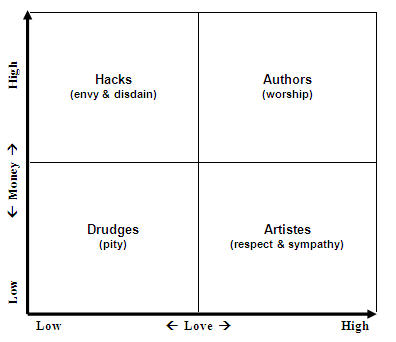
    Not a dichotomy, but rather an X and Y axis, the way I see it.

    There’s:

    low love, low money (SEO writing?)

    low love, high money (For me, this would be tech writing, or media tie-in to a universe I didn’t care about)

    high love, low money (unfortunately too much of my writing!)

    high love, high money. (Loftiest of goals) 🙂

    You can find datapoints for every quadrant, and of course “love” is highly subjective and individualized, as are what counts as low and high for each writer.

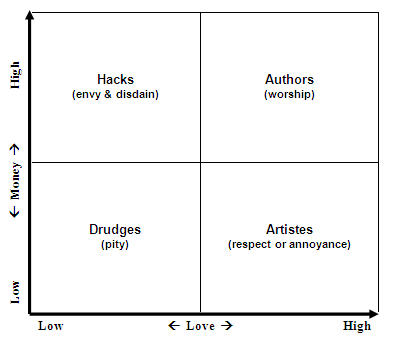
    If we put labels to the quadrants, we get something like this, along with common emotions they tend to evoke in other writers. (Although I will say that envy seems to want to run amok in the author quadrant as well.) 

    writer-love-and-money-quadrants2

    Share
  • More 10-to-20’s

    I just posted this in one of the comments sections and realized it would be useful to everyone.

    There’s another part to this that has to do with text. There will be more 10-to-20’s that go along with it. But I think I’ll be trying to create that presentation as a video for the site. We’ll see. Right now I’ve got to finish CODG. But when you finish the ones I assigned, I suggest you add these.

    1. BEGINNINGS. Go to the bookstore or library and pick up 10 to 20 random fiction books off the shelves and then sit down with them. Pick up each and read the first two pages. Note which ones pull you in and which resist you. Identify the cause. Then see what patterns you can find.

    2. 3 GRUNTS. Find 10 to 20 short stories or chapters from different books. Read them over three or four days. Do NOT read them looking for problems, but just as you would any book you’d picked up for enjoyment. While reading make a note of any section where your interest flags, the writing or story is unclear, or you just don’t believe it. These bumps are what Orson Card calls the three reader grunts. They occur when a story is unclear, unbelievable, or boring (i.e. you grunt huh? come on? or who cares?). When you’ve finished, look for the patterns that caused this response in you. ***This is one of the key things we did in Card’s boot camp that made me feel like the mists were being parted*** 

    3. ENDS. Look at the endings to 10 to 20 novels or short stories that you’ve read. Identify which you enjoyed the most and which you did not. Look for causes. See what patterns emerge.

    4. SMALL BEGINNINGS AND ENDS. Do the beginnings and ends analysis 10 to 20 chapters and then 10 to 20 scenes.

    Of course, you can look at anything this way–plot turns, magic systems, aliens, settings, dialogue exchanges. Get 10 to 20 of them. Identify which are interesting to you and which aren’t. And then try to see the patterns. But I’d recommend you start with those above.

    Share

4 Comments

  1. Will someone show the last few minutes of that to Scott Lynch? I would love to read more of his books, but really am not interested in 20 f-bombs every page.

  2. Tell me about it. He’s totally bumped me out of the audience.

    BTW, I’ve been listening to Finder. I think he was focusing on the f-word class of explitives. There are other milder obscentities in his stuff. Still, I think he’s right. The story is what matters. There are many ways to paint a person and make them believable that don’t require that. Although language is a fairly quick and powerful way to do it.

  3. I found his book Killer Instinct some tiem ago and never saw anything elseby him. I enjoyed the book very much even though it’s not exactly the genre I typically prefer. I appreciate the comments rearding the expletives. I’ve wrestled with the same issue and pretty much come to the same conclusion as John.

Comments are closed.