I just posted this in one of the comments sections and realized it would be useful to everyone.
There’s another part to this that has to do with text. There will be more 10-to-20’s that go along with it. But I think I’ll be trying to create that presentation as a video for the site. We’ll see. Right now I’ve got to finish CODG. But when you finish the ones I assigned, I suggest you add these.
1. BEGINNINGS. Go to the bookstore or library and pick up 10 to 20 random fiction books off the shelves and then sit down with them. Pick up each and read the first two pages. Note which ones pull you in and which resist you. Identify the cause. Then see what patterns you can find.
2. 3 GRUNTS. Find 10 to 20 short stories or chapters from different books. Read them over three or four days. Do NOT read them looking for problems, but just as you would any book you’d picked up for enjoyment. While reading make a note of any section where your interest flags, the writing or story is unclear, or you just don’t believe it. These bumps are what Orson Card calls the three reader grunts. They occur when a story is unclear, unbelievable, or boring (i.e. you grunt huh? come on? or who cares?). When you’ve finished, look for the patterns that caused this response in you. ***This is one of the key things we did in Card’s boot camp that made me feel like the mists were being parted***
3. ENDS. Look at the endings to 10 to 20 novels or short stories that you’ve read. Identify which you enjoyed the most and which you did not. Look for causes. See what patterns emerge.
4. SMALL BEGINNINGS AND ENDS. Do the beginnings and ends analysis 10 to 20 chapters and then 10 to 20 scenes.
Of course, you can look at anything this way–plot turns, magic systems, aliens, settings, dialogue exchanges. Get 10 to 20 of them. Identify which are interesting to you and which aren’t. And then try to see the patterns. But I’d recommend you start with those above.
Just got word from the programming organizer that my killer workshop is a go for MountainCon this year. The bonus is that Brandon Sanderson will be teaching it with me. You do NOT want to miss this one.
WHAT: Writing Killer Stories: This is a hands-on workshop conducted by two professional
authors (Brandon Sanderson, John Brown).
When you finish, you will know:
The 3 keys to writing killer fiction
4 parts of story & how they relate to the key
The creation process
7 principles of creativity
Critical guidelines on suspense, plotting, setting, and character building
WHEN: Saturday, September 20th, 7:30-10:00 PM, Panel Room 1
I found this a fascinating talk. It’s Ira Glass who is the executive producer of the This American Life radio program from Chicago Public Radio. It’s a show that merges true stories (and some short fiction) of everyday people, surprise, humor, and meaning. There’s a structure to the types of stories that they produce. It’s not a new thing. It’s used all the time in a venue many of us are familiar with. Maybe you’ll identify that venue immediately. If not, it doesn’t matter. Watch and listen. This is a fascinating talk and it highlights just how much humor, curiosity, and insight depend on surprise.
Almost everyone reading this knows what they like in a car. We know what we want a car to do. We can talk about acceleration, voom-voom styling, and handling. Some of us could talk about how engines and transmissions and tires all work together to create those things. We could get really technical.
But how many of us could then go manufacture a tire? Or the paint we’re going to put on the car? How about a windshield?
No?
Well, what about one little bolt? Just a little bolt. Can you do it?
There’s a difference between knowing what a thing is supposed to do, how it works, and actually building it. A lot of people can talk about the first two topics and have no idea at all about the third.
It’s the same with stories.
There are three things we have to learn to write killer stories.
What a story is supposed to do.
How the 5 parts of story—character, setting, problem, plot, and text–do that
How to come up with and develop a story idea in the first place
We authors talk a lot about the second thing. You have books and blogs galore on dialogue, plot, characters, structure, grammar, world-building, setting—you name it. Heck, the big series I wrote last year about the key conditions for reader suspense was all about how story works.
Some of us talk about the first thing. And really there’s no point in blathering on about the how-to’s if we don’t know the what-for’s, which is why I tried to highlight one of the core what-for’s in my series on suspense.
But as important as those two things are, none of it matters if we don’t know how to put it to use. We’re not reviewers or editors. We’re creators. We’re writers—the ones that invent the story in the first place. And let me tell you, knowing how a story works and how to invent one are two very different things.
I didn’t know the principles of invention when I was first starting out. And that gap in my knowledge was one of the things that held me back for years. In fact, I almost gave up my dream of writing stories because of it.
Very early in my attempts to start a career I wrote a story that won an award and $2,000. I was flown out to Cocoa Beach, Florida for a week-long workshop with amazing pros. Was published. And then I went home, finished another story (yea!), and proceeded not be able to finish another thing for five years.
Five years.
FIVE. YEARS!
And I tried.
After five years of failure you begin to wonder if maybe you didn’t get the wrong memo (what am I doing at this empty warehouse?). Your family begins to wonder that as well. You realize life is short and there are a lot of other things you could be spending your time on. You begin to think that only an idiot would spend more time on this. And you’d probably be right.
Unless, of course, you realize that what’s keeping you back isn’t a manifestation of cosmic will. Rather, it’s just a lack of understanding.
That’s what happened in my case. Just a few days before I gave up on all my dreams, the light was turned on for me. I learned some key, but simple, principles of invention that I hadn’t known. You can read the whole story here. After I learned these principles, my production took off like a rocket.
And so what I want to do in this series is share those principles with you. Hopefully, this will unleash your abilities. You might find a huge audience for your stories. You might find only the family dog will stick around to listen to them. The popularity of your stories is a separate matter. But you can’t even find out how big your audience will be if you don’t know how to finish.
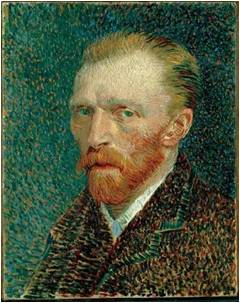
So let’s start. A lot of people think that creativity is about passion. When they think of creativity, they think of someone like this.
Look at him. Brushed velvet jacket. Beard. Rakish devil-may-care hair. And that gaze. Look at that gaze! It’s full of passion. It’s coming off him in waves. In fact, we all know his inner world is a vast tempestuous sea of passion that sends ideas crashing in great surges onto the rocky beaches of his soul. And those earthly forces cannot be contained. No, he must write them, write them, write them. That’s the face of a man who will channel fire onto the written page because if he didn’t, he would surely burn.
Or maybe not.
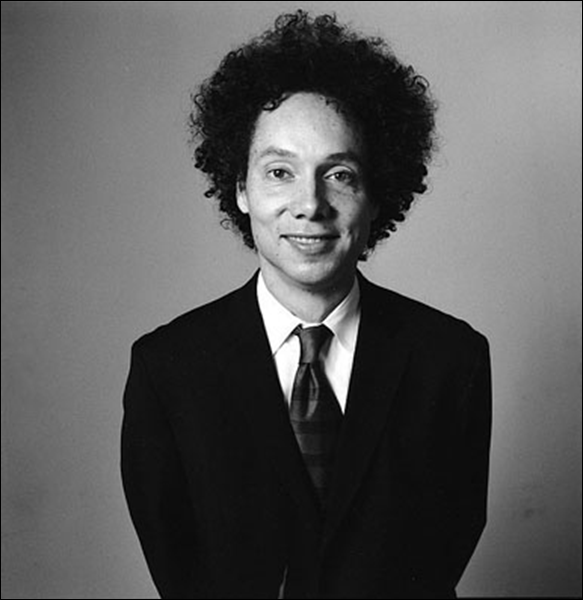
Maybe creativity is about being like this guy.
Hello, Malcolm Gladwell. Look at him. There are so many ideas in that great blaze of brains they trip over themselves trying to get out. There are so many they kinked his hair with their electric heat. Oh, fecund mind!
Or maybe not.
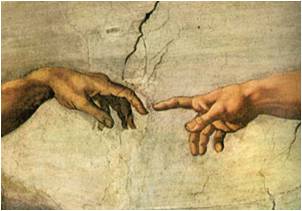
Maybe creativity is all a function of being blessed.
Or maybe it’s about alcohol (or some other chemical). After all, isn’t that how Ernest Hemmingway did it?
Booze Makes Ernie Reel Smart
Or it’s about being mentally unstable.
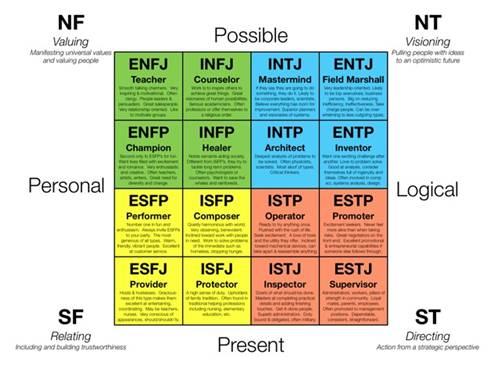
Or it’s about having the right personality type. I remember the day of woe when I learned that I was an ENFJ but that the “natural” writers were all ISFPs!
Alas, me being a blockhead was all scientific
Or it’s about being eccentric.
Patrick Rothfuss shows us the key is crazy beardage and an Alice in Wonderland chair
Or it’s none of that. It’s about being born to it.
I wrote my first novel when I was six
Right? All of those things are what creativity is about. And if, as so clearly demonstrated by those pictures, you don’t have passionate hair, well then, forget about it. Except here’s Larry Correia, a New York Times bestseller, who has no passionate hair whatsoever.
I keep guns in my basement
Huh?!
How could that be?
Here’s how. All those ideas above about creativity–they’re rubbish. Creativity has nothing to do with passion or hair or whether you wear Argyle socks.
Nothing.
Let me show you the face of creativity.
That is Warren Ellis. Warren is my brother-in-law, except when he’s not (do not ask me to explain this). One day our fridge started to drip. The freezer would cycle through its normal thawing, and all the water would drip down into the fridge and soak up our egg cartons and pool in the vegetable crispers. It was a mess.
We defrosted the freezer we weren’t supposed to ever have to defrost, but the problem persisted. So we called Warren because he fixes things.
Warren came to our house, looked the fridge over. He declared that the freezer’s drain tube was plugged. We thought up a few ideas for cleaning it out, none of which were any good, then Warren asked if we had an air compressor. We did and hauled it in.
Warren plugged it in, let it build up the pressure, and then held the compressor nozzle to the bottom end of the tube. The compressed air went in. The obstruction flew up and out and landed on the counter. The obstruction was a fat fly that had crawled in there, gotten stuck, and died.
We poured a quart of water into that freezer, and it all flowed down into the catch pan at the bottom. Warren fixed our freezer with an air compressor.
Folks, that is creativity.
What did Warren have? He didn’t have passionate hair; I can tell you that. No. He had an objective. He knew basically how fridges worked. And he came up with a couple of options to fix the issue.
Let’s look at another example. Here’s Ed Smylie.
Ed was like Warren. He ran into some problems. Actually, the astronauts in Apollo 13 ran into some problems. Ed was tasked to help solve them. One of those problems was the fact that the astronauts were running out of air.
Ed and the others designed the solution in two days. The ground crew relayed the instructions to the flight crew. The lunar module’s CO2 scrubbers started working again, saving the lives of the three astronauts on board. Of the experience, Ed said that he knew the problem was solvable when it was confirmed that duct tape was on the spacecraft. “I felt like we were home free”, he said. “One thing a Southern boy will never say is: I don’t think duct tape will fix it.”
Ed and his crew saved the day. The made a round peg fit into a square hole. How did he come up with such a creative solution?
Ed had an objective. He knew how the CO2 scrubbers and the shuttle worked. He knew about duct tape. He came up with options.
Let’s look at a few more examples of this. I know you’ve seen some of these.
That is creativity. So is this.
And this . . .
And this . . .
Or this, if you don’t need to go so fast . . .
Smaller size, for trolling
And this . . .
And this, which is officially called a Bumper Dumper . . .
Do you really want to dig?
These fine folks had a goal. They knew the basics of how things worked. They came up with some solutions.
That’s all there is to creativity. Three things. You need to have an idea of what you’re trying to do. You need to have a basic knowledge of how things work. And you have to know how to come up with some solutions to meet your objective.
Not so mystical, is it?
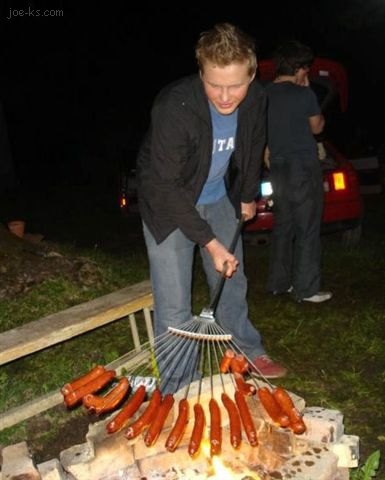
But I can hear some of you complaining. Writing is different. It’s a whole other world. It’s Fiction, which is so significant we must capitalize it. It’s passion. It IS mystical. This is a matter of the heart. It’s not a fridge or space ship or some dumb hotdog roast. You cannot compare these things.
Except I can because they’re the same. It doesn’t matter if you’re trying to invent a different recipe like the folks at Cook’s Illustrated, or decorate your house, or come up with a way to keep the squirrels out of your bird feeders, or make people weep in a movie theater.
What I’ve found is that when we have troubles coming up with ideas, we probably don’t know what our objectives are. Or we probably lack some understanding of how fiction works. Or we don’t know the principles of generating options.
And so we conclude it’s a mystery. It’s arcane lore.
But it just ain’t so. Can you create a redneck toilet? Then you can write a story.
Now, it’s true that a lot of people feel their way through this. They don’t know what they’re doing, but they do it. I did that. Remember: I won an award. But then I couldn’t repeat it. Couldn’t find that groove I’d stumbled into.
I don’t want to stumble around hoping to get lucky. I want to make a living at this. And if I’m going to make a living, I need to produce. Regularly. I can’t be bumbling around, hoping to create something by accident.
The good news is that we don’t have to create by accident. We can create on purpose. There are principles to invention. When we learn them, our productivity will shoot through the roof.
Finding a solution to Apollo 13’s issues might seem impossible to us. But they weren’t impossible to Ed Smylie because Ed had an objective; he knew how things worked up there; and knew how to come up with options.
My intent is that when you finish this series, you’ll know what Ed Smylie knew, except for stories.
I get a lot of emails from authors who are just starting out, or who are on the road but frustrated at the level of success they’ve seen thus far. I wish I had more time to correspond with everyone, but the truth is I’m usually slammed with writing/publishing related tasks, and don’t have a lot of opportunity to do more than offer a brief sentence or two.
But the last few missives I received got me thinking about what I wish someone had explained to me before I started self-publishing in June, 2011. So here’s my top 10 list, such as it is:
1) There are lots of talented writers out there. Lots. And it seems like everyone’s now got a book, or books, on Amazon. Being good isn’t enough to guarantee you anything but satisfaction for a job well done. It should, but it doesn’t. Don’t take it personally.
2) There are lots of crap writers out there. Lots. And while many sink to the bottom of the swamp with nary a whimper, some sell well, and some even become bestsellers. This is because the world’s unfair and, depending upon the genre, oftentimes readers don’t care much whether they suck or not, as long as the story entertains or reaffirms some conviction or bias the readers have. These authors succeed in spite of their abilities, rather than because of them. Don’t take it personally.
3) The internet is filled with gurus who know nothing. It’s hard to turn around without bumping into a writing or self-publishing expert. Most of them are completely full of shit, and don’t sell many books – but that doesn’t stop them from trying to get you to part with your money to hear them tell you what you need to do to sell well. Whenever you hear advice, consider the source. If it’s a million selling author, that means more than from someone whose work ranks slightly lower on Amazon than the collected love poems of Adolf Hitler in original German. Seems like everybody but me is selling seminars, courses, or how to books that promise much and deliver nothing. Must be a good business there, but I prefer labeling my fiction as such and putting in a car chase or gunfight rather than trying to trick the dim or desperate out of a few bucks.
4) You need to be able to put out books at a decent clip. Sure, you might hit huge off one, but probably not. You’ll be building your readership the hard way, which means one reader at a time, and the more quality books you have on your virtual bookshelf the more likely one will catch someone’s eye. This doesn’t appeal to a lot of authors’ wish that they could write a book every year or two and have a nice living. Sorry. I have yet to see that happen. But it’s a seductive siren song, so lots of newbies listen to it like it’s still a viable way to go. In self-publishing, not so much.
“Blurbers” is so much more fun than “endorsers.” Stacy has sent the manuscript of Servant of a Dark God out to the first round of people who said they would give the story a go. If they find they’re in the audience, they’ll write up a blurb for it. This is all in preparation for the launch meeting in December when my editors go to bat for me and sell the book to the salespeople inside Tor.
While I hope the potential blurbers will all find themselves in the story’s audience, I do not assume it’s a given. If they’re not, I’m still a happy man (although a bit disappointed). There are many wildly successful tales that I myself am not in the audience for.
I expect we’ll get reactions back in a month or two. I’ll post here the results.
I can’t remember the last time I was this anxious. Yesterday I read Scott Card’s review of K.J. Parker’s stuff. All his business about great writers. And I’m thinking, holy heck. I’m a nothing. Just a little dude with this nothing book. And then I thought, what if none of these readers find they’re in the audience for the book? It’s one thing to send out a manuscript. You can always change, improve. But this is it. This is the book. It either soars or plops in the mud.
But then I read Mette Ivie Harrison’s first article on writing for IGMS and thought—you know what, I tell the stories I tell. While others may aspire to “greatness,” that’s not something I care to strive for. I want to write stories that entertain and move. And while I can learn how to write and tell better stories, they’re always going to be John Brown stories. If they plop, they plop. And I just have to forget all the greatness-everybody-must-love-me nonsense and write John Brown
I met Mette at Card’s boot camp in 2002. We’ve read each other’s manuscripts every once in a while. I respect her ideas, loved MIra, Mirror, and am grateful for that article. If you’re a writer, I recommend it to you highly.
How would you like to listen to a master story teller for almost an hour? You can. Radio West recently interviewed Pete Docter who directed Pixar’s recent motion picture Up.
Docter has been with Pixar since the beginning and he shares a number of insights into story telling. He talks about the importance of emotional hooks, getting ideas and developing them via the creative Q&A process, and editing a story from schlock to greatness, and much more. What a wonderful interview.

















 How would you like to listen to a master story teller for almost an hour? You can. Radio West recently interviewed Pete Docter who directed Pixar’s recent motion picture Up.